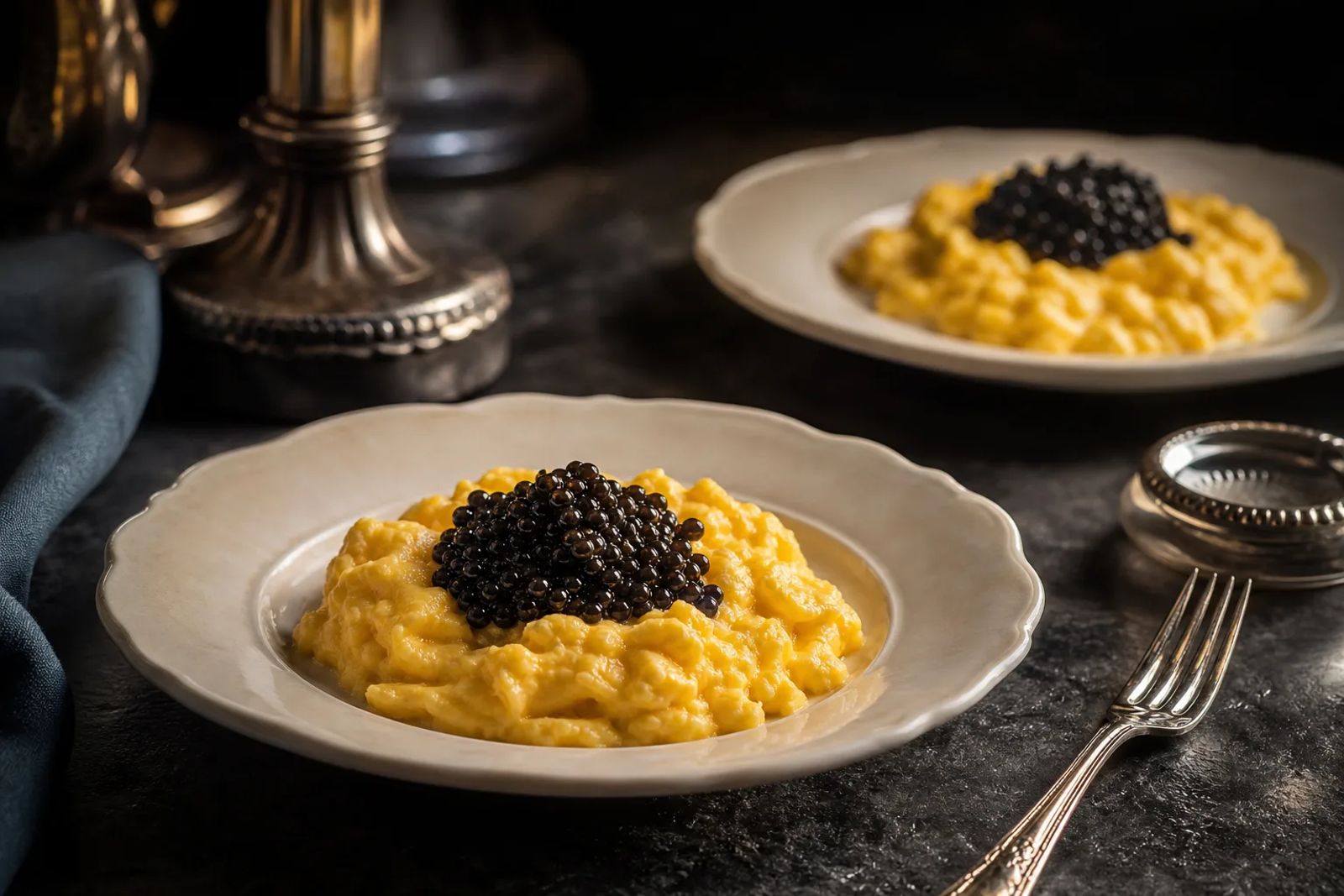
Soft, buttery curds beneath firm, separate beads of caviar: the pleasure is in the contrast. Keep the eggs moving over low heat, then add the caviar only after they have left the pan. This recipe serves two, with 25 g caviar, or 12.5 g per person, and a soft scramble finished with crème fraîche.
Why eggs and caviar work together
Butter brings richness; caviar brings salt. The pleasure lies in enjoying them together without losing the character of either. Season the scramble gently and keep the topping separate, so each spoonful holds both textures rather than blending them into one.
Belmond's published recipe takes this approach, combining butter and crème fraîche with the eggs before spooning caviar over them after plating. It is a useful way to build the dish, with room to adjust the balance to taste.
Choosing caviar for scrambled eggs
Choose lightly salted, unpressed caviar with a mild flavour and firm, separate beads. The firmness gives contrast; the milder flavour leaves room for the eggs.
Farmed Russian sturgeon (Acipenser gueldenstaedtii), commonly sold as Ossetra, is one option. Check the named species rather than relying on the trade name alone, and choose for the qualities of the particular caviar: the species alone does not guarantee a particular flavour or texture.
Salted salmon or trout roe makes a good alternative. Petrossian includes salmon roe in its scrambled egg recipe, while Gourmet's published Caviar Eggs offers rainbow trout roe. Keep either on top rather than stirring it through.
Recipe card
Adapted from Bre Graham's recipe for Belmond, halved from four servings to two. The low heat and finishing sequence follow that recipe. Petrossian's version gives a ten-minute cooking guide; for this adaptation, let texture and the safety guidance below determine when the eggs are ready.
- Serves: 2
- Caviar: 25 g total, 12.5 g per person (50 g divided by four in the source).
- Time: no fixed cooking time for this adaptation; follow the texture and safety guidance below.
- Equipment: bowl, whisk or fork, non-stick pan, flexible spatula, two plates and a small serving spoon.
- Allergens: egg, milk and fish.
Ingredients
- 6 large hen eggs
- 28 g unsalted butter, cubed
- 30 ml crème fraîche, made with pasteurised cream
- 25 g lightly salted, unpressed farmed Russian sturgeon caviar (Acipenser gueldenstaedtii)
- Salt and white pepper, only if needed
Use all six eggs: the source measures them by number, not weight, so do not substitute an assumed gram equivalent. The butter and crème fraîche quantities are converted from the source's tablespoon measures.
Method
- Get ready. Set out two warm, not hot, plates. Beat the eggs until the whites and yolks are combined. Leave the caviar refrigerated.
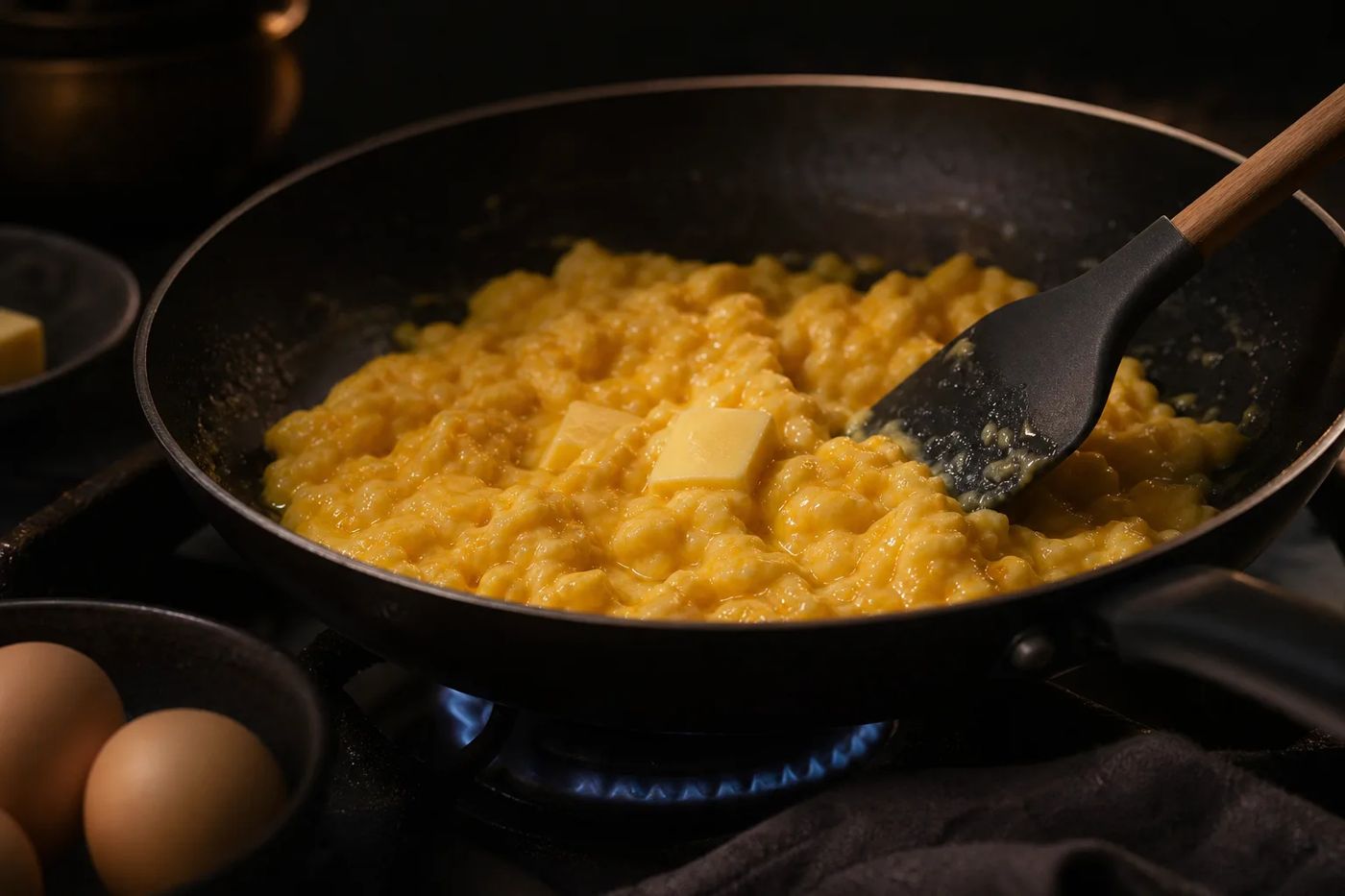
- Start gently. Melt half the butter over low heat and pour in the eggs. Stir continuously, sweeping the base and corners with a flexible spatula.
- Watch the curds. Add the remaining butter as the mixture thickens. If the eggs set rapidly, lift the pan off the hob and keep stirring. Jacques Pépin also uses this technique to control the heat.
- Finish off the heat. Once soft curds have formed, remove the pan and fold in the crème fraîche. Use the egg-safety advice below to decide how fully to set the eggs.
- Plate and top. Divide the scramble between the plates and spoon 12.5 g caviar onto each portion. Taste a mouthful of eggs and caviar together before adding salt. Serve immediately.
Why the caviar goes on last
Cook the hen eggs; leave the fish eggs alone. Gentle heat and close attention keep the scramble from turning rubbery, while the ready-to-eat roe belongs on the finished dish, away from direct cooking heat.
Codex guidance on pasteurising caviar notes that prolonged heating of its proteins might affect taste and texture. This supports keeping the topping away from direct cooking heat, without establishing a precise temperature at which a spoonful changes on warm eggs.
Place the beads gently with a small mother-of-pearl or glass spoon.html).
Variations and presentation
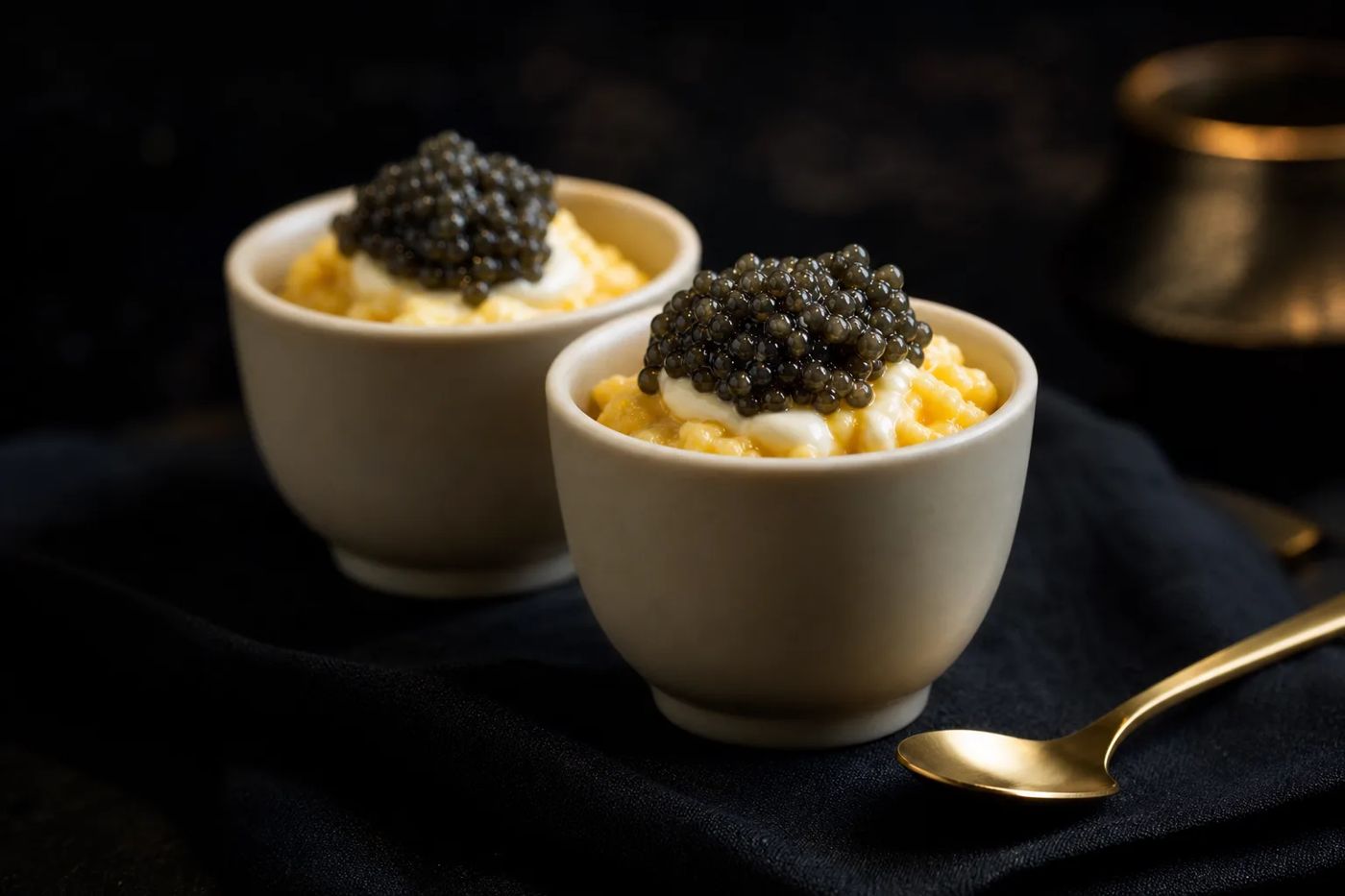
For a more elaborate presentation, look to Gourmet's 2008 Caviar Eggs: warm scrambled eggs, cold cream and caviar layered inside an eggshell. Created by Louis Outhier, the dish was, as of 2008, served at Jean-Georges. Bring those layers to the table at home in small porcelain egg cups or bowls, rather than reusing shells.
Crème fraîche is part of this recipe, not an essential ingredient in every scramble. For a dairy finish without it, Jacques Pépin's published method adds cream after transferring the cooked eggs to a bowl. Read about crème fraîche and butter before changing the balance.
Pépin also stirs chives into the finished eggs. Keep a scattering light rather than covering the surface densely, leaving most of it free for the caviar.
Egg and roe safety
Handle the caviar only after washing hands, utensils and work surfaces that have touched raw eggs. The topping is ready to eat, so keep it separate from raw-egg preparation.
In the US, FDA advice says scrambled eggs should not be runny and recommends pasteurised eggs or egg products for recipes served undercooked. Readers in EU countries and Australia can also use pasteurised eggs for a lightly cooked scramble and should check their local food authority's advice.
UK FSA advice allows lightly cooked hen eggs bearing the British Lion mark or produced under the Laid in Britain scheme, including for many vulnerable consumers. If the eggs do not meet these assurance conditions, cook them thoroughly or use pasteurised egg products for lightly cooked dishes. This advice excludes people requiring medically supervised diets because of severe immunosuppression; seek medical advice for them.
Keep the roe refrigerated until plating. Follow its labelled storage temperature, use-by date and instructions after opening. FSA household guidance for England, Wales and Northern Ireland recommends a fridge at 0 to 5°C (32 to 41°F). If the product specifies colder storage, follow that instruction.
Refrigeration alone does not make every chilled roe suitable for every diner. In May 2023, Hong Kong's Centre for Food Safety warned against a batch of salmon roe sold as Lachskaviar over possible Listeria. For pregnancy or reduced immunity, ask a doctor or midwife about both the roe and the eggs. Warm scrambled eggs do not make an uncooked topping safe.
Prepare only the portions you intend to serve immediately. For the remaining roe, see how to store caviar at home. Explore the complete caviar recipes guide or try eggs Benedict and eggs Royale with caviar.
Sources
- Belmond, Bre Graham. Recipe: Soft Scrambled Eggs and Caviar. Undated online edition, checked November 2026. Published recipe.
- Great British Chefs. How to make scrambled eggs. Online edition dated 14 February 2025. Technique guide.
- Petrossian. Scrambled Eggs with Caviar. Undated online edition, checked November 2026. Seller-authored recipe, used for its stated cooking allowance and salmon roe alternative;
- Jacques Pépin Foundation. Scrambled Eggs with Truffle Oil and Caviar. Undated online recipe and video, checked November 2026. Chef's recipe.
- Gourmet, reproduced by Epicurious. Caviar Eggs. 16 September 2008. Published recipe.
- FAO and WHO, Codex Committee on Fish and Fishery Products. Report of the Thirty-fourth Session, REP16/FFP, Appendix V, caviar processing guidance, 2016. Committee report.
- US Food and Drug Administration. What You Need to Know About Egg Safety. Current online edition, checked November 2026. Consumer guidance.
- Food Standards Agency. Advice on safe storage, handling and use of eggs for catering. Current online edition, checked November 2026. Egg-handling guidance.
- Food Standards Agency. How to chill, freeze and defrost food safely. Published 18 December 2017, current online edition checked November 2026. Household chilling guidance.
- Hong Kong Centre for Food Safety. CFS urges public not to consume batch of prepackaged caviar suspected to be contaminated with Listeria monocytogenes. 5 May 2023. Food safety notice.
This piece was researched by comparing published cookery methods with official egg-handling, refrigeration and caviar-processing guidance; the adaptation has not been tested by caviar.uk.
Last checked: November 2026