
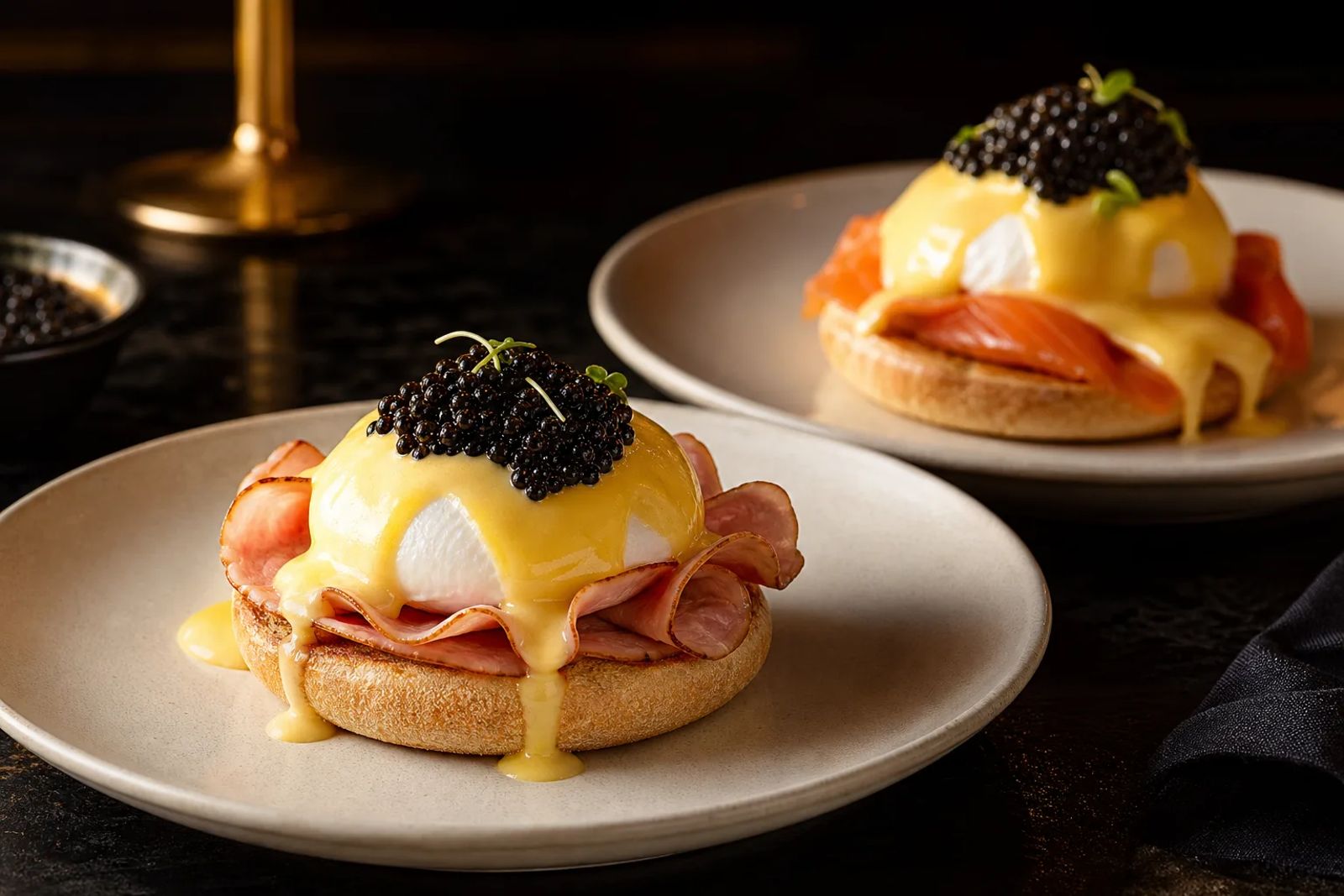
In 1894, Lemuel Benedict ordered toast, bacon, poached eggs and hollandaise at the Waldorf, according to his recollection recorded in The New Yorker in 1942. Caviar gives that rich breakfast another finishing touch: a spoonful of roe over the hollandaise, added just before serving, with the plate away from the heat.
Today, Benedict puts ham beneath the poached egg; Royale replaces it with smoked salmon. Both sit on a toasted muffin. The caviar goes on last.
Two names, several origin stories
The Waldorf account includes a transformation: the hotel subsequently replaced Benedict’s toast and bacon with an English muffin and ham. Delmonico’s tells a competing story, crediting its chef Charles Ranhofer with creating the dish. Benedict’s origins remain disputed.
In British cookery, eggs Royale is the familiar smoked salmon variation. Sally Abé uses that name in her Great British Chefs recipe notes. Naming varies elsewhere, so specify the topping when ordering or writing a menu rather than relying on “Royale” alone.
Choose the base and roe
A toasted English muffin should carry the egg, not collapse beneath it. Split it and toast the cut faces, then drain the poached egg well before assembly. Brioche or another toast also works: choose a piece wide enough to support the egg, without making the base thicker than the topping. Find more caviar recipes for other brunch ideas.
Fresh eggs make neater poached eggs because their whites hold together better. Great British Chefs recommends them for poaching. Crack each into its own cup, ready to lower gently into the water rather than dropping it from the shell. Choose them for safety as well as freshness, following the guidance below.
For the caviar version here, choose salted Siberian sturgeon roe labelled Acipenser baerii, while recognising that the label does not independently verify the species. Salmon roe is another established finish: Marc Matsumoto’s PBS recipe adds it to Royale after the sauce. Trout roe offers a more pronounced bead if you prefer that to a soft garnish.
The Caviar Co. describes its rainbow trout roe as firm and warns that heat harms caviar. That firmness may give a clearer textural contrast against the sauce, but it does not make the roe suitable for cooking. For differences in handling and flavour, see salmon roe.
Get to know your hollandaise
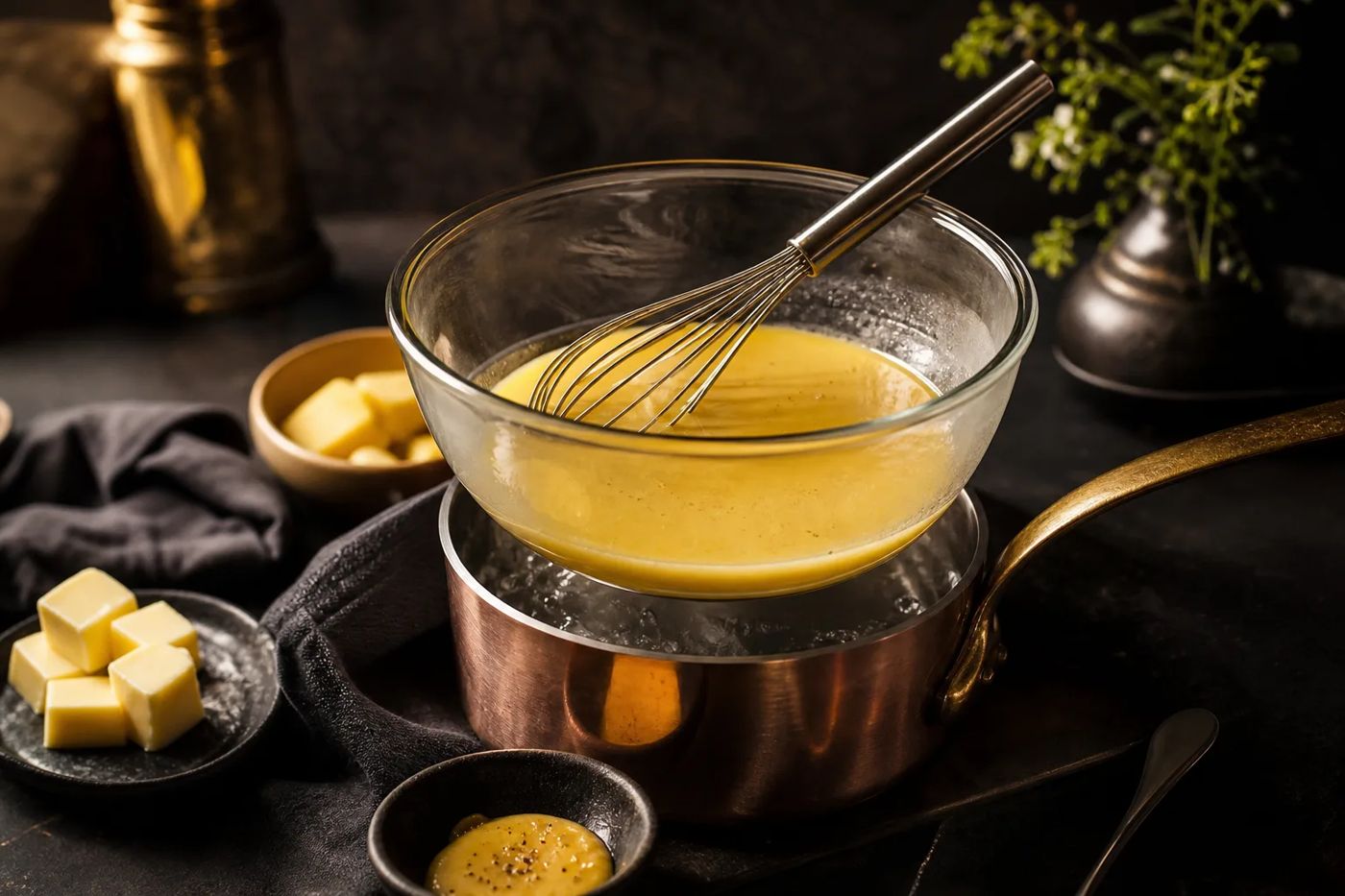
Smooth hollandaise depends on gentle heat and patient whisking. It is an emulsion: butter dispersed through a mixture containing water, egg yolk and acid, rather than floating separately. Warming thickens the yolks; whisking and adding the butter gradually hold the sauce together.
Great British Chefs advises barely simmering water and slow incorporation. Too much heat can curdle the eggs. A thick, greasy appearance is the warning to act before the sauce splits.
If it starts looking oily, take it off the heat and gently work in a little room-temperature water. For a fully split sauce, the same guide recommends warming and whisking a fresh yolk with vinegar in a clean bowl. Slowly incorporate the broken sauce as though it were the butter. Scrambled egg cannot be rescued this way.
Check egg safety for the people eating
Choose the egg treatment before starting: both the poached egg and homemade hollandaise may contain lightly cooked yolk. Thickening the sauce does not establish that it has received a validated safety treatment, and lemon juice cannot replace one.
- UK: The FSA allows raw or lightly cooked hen eggs bearing the British Lion mark or produced under the Laid in Britain scheme for vulnerable groups, including pregnant people, young children and older adults. This excludes severely immunocompromised people requiring medically supervised diets; seek their clinician’s advice.
- US: The FDA recommends pasteurised shell eggs or pasteurised egg products for dishes served raw or undercooked. USDA FSIS allows egg products to replace raw eggs in hollandaise, while advising that they are best used cooked, particularly for higher-risk people.
- EU example, Ireland: The HSE advises avoiding raw or undercooked eggs during pregnancy. It also advises avoiding raw or smoked fish, so changing the eggs alone does not make Royale suitable under that advice.
- Australia and New Zealand: FSANZ lists raw and lightly cooked eggs as higher-risk foods for vulnerable people. Its safer alternatives include pasteurised eggs and eggs cooked until both white and yolk are firm.
Follow local advice on chilled ready-to-eat fish and roe as well. In the UK, the FSA advises pregnant people and people with weakened immune systems to cook chilled ready-to-eat smoked fish thoroughly. Uncooked smoked salmon is therefore unsuitable for them. Anyone pregnant or immunocompromised should discuss uncertain food choices with their doctor or midwife.
Recipe: eggs Benedict or eggs Royale with caviar
Serves: 2, with two muffin halves each. Time: This adaptation has no fixed timing. Gordon Ramsay’s source recipe gives 5 minutes’ preparation and 15 minutes’ cooking.
Caviar: 30 g (about 1 oz) total, or 15 g per person. This portion follows Seelenschmeichelei’s published two-person caviar Benedict recipe. The egg and sauce methods below draw on Ramsay and Great British Chefs.
Equipment: Two saucepans, a heatproof bowl, whisk, four small cups, toaster, slotted spoon, kitchen paper and a clean serving spoon.
A toasted English muffin should carry the egg, not collapse beneath it.
Allergens: Egg, milk, wheat and fish. Check the muffin and ham labels for additional ingredients.
Ingredients
- 2 English muffins, split into four halves
- 4 fresh hen eggs, selected according to the safety advice above
- 4 thin slices of cooked ham for Benedict, or 100 g smoked salmon for Royale
- 30 g malossol, or lightly salted, Siberian sturgeon caviar
- 125 g unsalted butter
- 2 egg yolks, or the equivalent pasteurised yolk specified by its manufacturer
- 2.5 ml white wine vinegar for the sauce
- 45 ml white wine vinegar and at least 2,000 ml water for poaching
- Lemon juice and cold water, as needed
- Salt and cayenne pepper, to taste
Method
- Prepare the base. Split the muffins and arrange the ham or salmon ready for assembly. Keep the caviar refrigerated according to its label until needed. Wash your hands and utensils after handling raw eggs.
- Start the sauce. Melt the butter gently. In the bowl, whisk the yolks with the sauce vinegar and a splash of cold water. Set it over barely simmering water and whisk until pale and thick, about 3 to 5 minutes in Ramsay’s method.
- Finish off the heat. Remove the bowl and gradually whisk in the butter. Loosen with a little water if necessary, then add lemon juice and cayenne to taste. Taste before adding salt: the ham or salmon and roe bring seasoning of their own.
- Poach the eggs. Bring the poaching water and vinegar to a gentle simmer. Crack each egg into a cup, then slide it into the water, keeping the eggs apart. Waitrose’s Royale method gives 3 to 4 minutes for set whites and soft yolks. Check that the whites are set. For anyone advised to avoid soft eggs, cook until both whites and yolks are firm and follow their national food safety guidance.
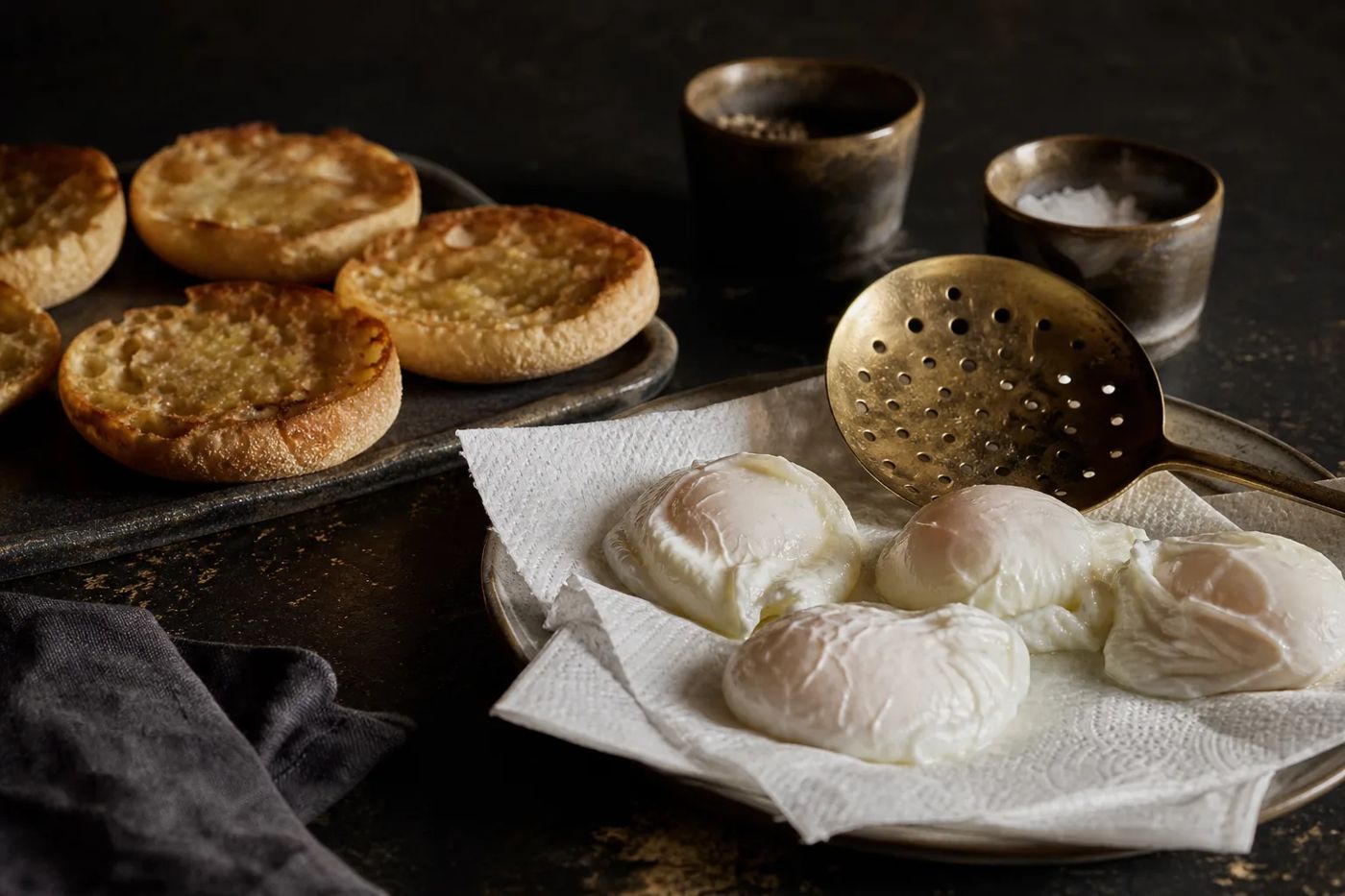
- Toast and drain. Toast the muffin halves while the eggs poach, then cover each with ham or salmon. Lift out the eggs with a slotted spoon. Drain on kitchen paper before placing them on the muffins.
- Sauce, then caviar. With the plate away from the hob, spoon hollandaise over each egg. Divide the caviar into four small spoonfuls, one on each sauced egg, and serve immediately. Keep the finished plates out of the grill and warming oven.
Bring everything together
Make the hollandaise first, then poach the eggs and toast the muffins. That leaves only assembly when the eggs are ready, rather than several unfamiliar techniques competing for attention.
Before starting the sauce, measure everything, set out the plates and get the poaching pan ready. A clear sequence is more useful here than a countdown.
Great British Chefs allows up to 30 minutes over warm water to keep hollandaise ready to serve. That is a culinary holding suggestion, not a validated safety control. Make this small batch for immediate service rather than leaving it lukewarm through a long brunch.
Warm sauce still transfers heat to roe after the pan leaves the stove. Add the caviar at service and keep that contact brief; there is no precise cooling delay or supported temperature target to follow here.
Where to go next
- Scrambled Eggs with Caviar: a simpler egg breakfast without a separate sauce.
Sources
- Good Food, Gordon Ramsay, Eggs benedict, September 2005 recipe, current web edition checked 2026.
- Great British Chefs, How to make Hollandaise sauce, updated February 2025.
- Great British Chefs, How to poach an egg, updated March 2025.
- PBS Food, Marc Matsumoto, Eggs Royale, June 2015.
- Waitrose & Partners, Festive eggs royale, undated web edition checked 2026.
- Seelenschmeichelei, Kaviar Benedict, 6 December 2020, a recipe post marked as sponsored by Imperial Caviar; used for quantities only.
- The Caviar Co., Trout Roe, producer description and care advice, undated, checked 2026;
- Great British Chefs, Sally Abé, Eggs Florentine, undated web edition checked 2026.
- The New Yorker, Thomas Doremus and Russell Maloney, Benedict, December 1942, digitised archive edition.
- Delmonico’s, Our History, restaurant’s account, undated web edition checked 2026.
- Food Standards Agency, Food Fact Check: Can you get salmonella from eggs? What you need to know, August 2026.
- US Food and Drug Administration, What You Need to Know About Egg Safety, current consumer guidance checked 2026.
- USDA Food Safety and Inspection Service, Can egg products be used as an ingredient in uncooked foods?, current public guidance checked 2026.
- Ireland Health Service Executive, Foods to avoid in pregnancy, current consumer guidance checked 2026.
- Food Standards Australia New Zealand, Food safety for vulnerable people, current consumer guidance checked 2026.
This editorial adaptation combines published cookery methods and portions with separately checked national food safety guidance; it has not been kitchen-tested by the site.
Last checked: November 2026