
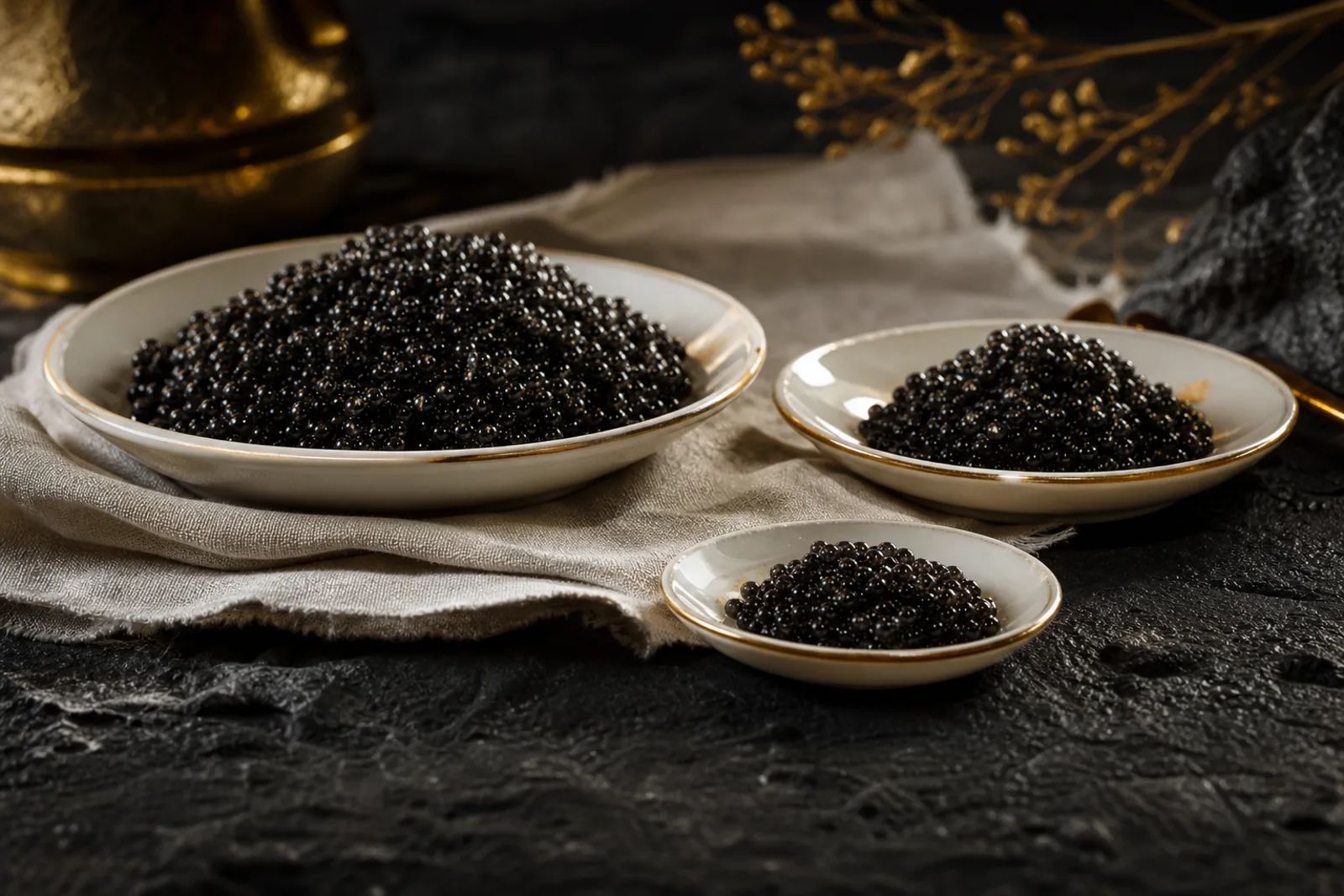
Two 50 g tins hold the same declared quantity as one 100 g tin. The difference comes when you break the seal: smaller tins let you leave half unopened. That is the useful way to think about caviar tin sizes. Choose what you will eat at one sitting, rather than a large tin to work through over several days.
The size tells you the net weight of the caviar inside. It says nothing about the weight of the metal container or the caviar’s quality grade.
Common caviar tin sizes
From a 10 g taste to a 500 g service, familiar tin sizes follow trade conventions rather than a legally prescribed series. Sterling Caviar’s published range includes 30 g, 50 g, 125 g, 250 g and 500 g; Rabel Caviar also lists 10 g, 100 g and 200 g retail tins.
The table brings those published sizes together. Uses are suggestions for planning, not fixed serving recommendations; ounce conversions are rounded to two decimal places.
| Size in grams | Approximate ounces | Typical use |
|---|---|---|
| 10 g | (0.35 oz) | A small taste or garnish |
| 30 g | (1.06 oz) | A focused tasting |
| 50 g | (1.76 oz) | A shared tasting or small dish |
| 100 g | (3.53 oz) | Shared service with caviar prominent |
| 125 g | (4.41 oz) | A larger shared service |
| 200 g | (7.05 oz) | A gathering with a planned menu |
| 250 g | (8.82 oz) | A gathering or kitchen service |
| 500 g | (17.64 oz) | An organised event or professional service |
A tin is not a set number of servings. Plan quantities with how much caviar per person, and use how to buy caviar for the wider buying checklist.
Why grams and ounces do not quite match
30 g is close to 1 oz, but the two are not interchangeable. An ounce of weight is about 28.35 g. More precisely, 30 g is about 1.06 oz; a tin labelled 1 oz declares a quantity equivalent to about 28.35 g.
Covered US retail foods must declare both metric and US customary quantities, which helps explain why ounce based sizes sit alongside gram based ranges. Compare the actual net quantity on the label, rather than a rounded description on a menu or in a product heading. These are ounces of weight, not fluid ounces.

What net weight and the e-mark mean
Net weight counts the food alone. The tin, lid and other packaging do not count towards it. For prepacked caviar sold at retail, the main rules checked in November 2026 are:
- EU: Regulation (EU) No 1169/2011 requires net quantity by mass in grams or kilograms for foods such as caviar. Directive 76/211/EEC sets the framework for qualifying prepackages and the e-mark.
- Great Britain: Metric net quantity labelling sits under assimilated Regulation (EU) No 1169/2011, with weights and measures enforcement. The Weights and Measures (Packaged Goods) Regulations 2006 govern average quantity control and the voluntary e-mark.
- Northern Ireland: EU Regulation (EU) No 1169/2011 continues to apply to food information. Its separate quantity-control instrument is the Weights and Measures (Packaged Goods) Regulations (Northern Ireland) 2011.
- United States: The Fair Packaging and Labeling Act requires metric and US customary net quantities on covered retail foods. The FDA's net quantity provision is 21 CFR 101.105.
The small ℮ symbol concerns quantity control, not the character of the caviar. Voluntary in the EU, it applies to qualifying prepackages from 5 g to 10 kg and represents the packer’s declaration of compliance with the average system. It is neither government approval nor evidence of species, quality or authenticity.
Under that system, batches must meet the declared quantity on average, with strict limits on individual shortfalls. Every tin need not contain precisely the same weight. Equally, a package without the mark is not unlawful simply because the symbol is absent.

The lid does not tell you the quantity
Read the quantity declaration, not the shape of the tin. Neither its diameter nor its lid tells you how much caviar it holds.
Traditional press lid tins have a close fitting lid with a rubber band around the join. Vacuum sealing describes the removal of air and can also be used with a press lid: the two descriptions are not alternatives.
From a 10 g taste to a 500 g service, familiar tin sizes follow trade conventions rather than a legally prescribed series.
A large container and a small retail tin therefore need not contain different qualities of caviar.
One larger tin or several smaller ones
Choose one larger tin for a definite occasion when you expect to finish it together. Choose several smaller tins for separate meals, or when you are unsure how much your guests will eat.
The two 50 g tins and one 100 g tin in the opening example have the same declared total. The smaller tins give you control over when each seal is broken. Open both at once and the advantage of leaving half unopened disappears.
Once opened, caviar is exposed to air and handling. Plan to finish it promptly. Sterling Caviar advises consuming its caviar within 24 hours and up to 48 hours after opening; those timings are specific to its guidance, rather than a shelf life for every product.
Follow the producer’s storage temperature, date and after-opening instructions. For handling details, see how to store caviar at home. The US FDA advises using refrigerated ready-to-eat foods promptly because longer storage gives bacteria such as Listeria more opportunity to grow. A pleasant appearance or smell cannot establish safety.
Sources
- Sterling Caviar. FAQs, sections on tin sizes and storage. Undated web edition, retrieved November 2026. Published guidance.
- Rabel Caviar. Packaging, retail and bulk packaging ranges. Undated web edition, retrieved November 2026. Packaging information.
- National Institute of Standards and Technology. David Sefcik, Package Testing Based on the Largest of Declared Quantities, Article F-033, 11 September 2013. Technical article.
- European Parliament and Council. Regulation (EU) No 1169/2011 on the provision of food information to consumers, 2011, particularly Articles 23 and 25. Official Journal text.
- Council of the European Communities. Directive 76/211/EEC relating to the making-up by weight or by volume of certain prepackaged products, consolidated 26 July 2019, Articles 1 to 4 and Annex I. Consolidated text held by The National Archives.
- European Union, Your Europe. The e-mark: quantity information for prepackaged products. Live guidance retrieved November 2026. Official guidance.
- Office for Product Safety and Standards. Packaged goods: weights and measures regulations, updated 20 September 2024. Great Britain guidance.
- UK Government. Food information: net quantity labelling, published 2014, live edition retrieved November 2026. Net quantity guidance.
- Northern Ireland. The Weights and Measures (Packaged Goods) Regulations (Northern Ireland) 2011, SR 2011 No 331, particularly regulations 4, 5 and 8. Legislation as made.
- Food Standards Agency. Packaging and labelling, updated 4 September 2026. Current jurisdiction guidance.
- Federal Trade Commission. Fair Packaging and Labeling Act: Regulations Under Section 5(c) of the Fair Packaging and Labeling Act. Live explanatory page retrieved November 2026. Official overview.
-
US Food and Drug Administration. 21 CFR 101.105: Declaration of net quantity of contents when exempt, checked November 2026. https://www.ecfr.gov/current/title-21/section-101.105
-
Bon Appétit. Molly Tries, Petrossian interview and tin-packing demonstration, 2019, video transcript. Episode title abbreviated here to omit monetary wording.
- Caspian Caviar. FAQs, sections on opening tins and storage after opening. Undated web edition, retrieved November 2026. Packaging guidance.
- US Food and Drug Administration. Are You Storing Food Safely?, live consumer guidance retrieved November 2026. Food storage guidance.
This article was researched by comparing published caviar packaging ranges with official quantity-labelling legislation and guidance, distinguishing producer handling advice from general food-safety advice.
Last checked: November 2026