
Start with the temperature printed on your tin or jar and find a reliably cold place that meets it. Those delicate beads need careful storage long before the lid comes off.
Leave unopened packs sealed until needed. Once opened, protect the surface, replace the lid and refrigerate promptly rather than leaving the whole tin beside the plates.
- Measure the temperature beside the caviar, not just at the fridge's display.
- Pasteurised caviar does not automatically belong in a cupboard.
- Record when you open the pack and follow its after-opening instructions.
What temperature should caviar be stored at?
The right temperature is the one specified on your pack. Caviar is salted roe, not a room-temperature preserve: it is perishable and often eaten without further cooking. Salt and processing help control deterioration; cold slows microbial growth. Temperature protects both safety and quality, and some producers require colder conditions than general fridge guidance provides.
Codex's Standard for Sturgeon Caviar specifies 2°C to 4°C (36°F to 39°F) during packaging, storage and retail, with a separate colder range for wholesale handling. This international reference standard is neither a universal domestic law nor an instruction to recreate commercial cold storage at home.
Prunier gives an ideal storage range of -2°C to 2°C (28°F to 36°F); Paramount Caviar publishes 0°C to 4°C (33°F to 40°F). Both concern storage, not serving. Follow your own pack rather than reaching for the coldest figure.
The household recommendations below show why checking matters. A fridge can meet its country's general guidance and still be too warm for a particular caviar.
| Where | Authority | General fridge guidance |
|---|---|---|
| England, Northern Ireland and Wales | FSA | 0°C to 5°C (32°F to 41°F) |
| Scotland | Food Standards Scotland | 0°C to 5°C (32°F to 41°F) |
| US | FDA; USDA FSIS | About 4°C (40°F) or below |
| EU | EFSA | Below 5°C (41°F) |
| France, EU | Agriculture ministry | Coldest zone no warmer than 4°C (39°F) |
| Australia | FSANZ | 5°C (41°F) or colder |
How to store caviar at home: the method
You need a fridge thermometer, the original pack and a clean spot protected from raw-food drips. A small bowl of crushed ice can help if the supplier recommends it, but does not replace measuring the temperature.
-
Read the pack before putting it away. Check the required temperature, date and any separate instructions for an opened container, and keep them with the caviar. If anything is missing or unclear, ask the supplier rather than borrowing another product's storage life.
-
Find the right cold spot. Move the thermometer between likely shelf positions, letting it settle as its instructions require before comparing readings. France's agriculture ministry notes that the coldest zone can be at the top or bottom, depending on the model, so do not assume where yours lies.
-
Protect the pack. Paramount recommends the back of the fridge because temperatures fluctuate less there. Choose a measured position that meets your label's requirements, with raw meat, poultry and fish sealed below ready-to-eat food, never above it.
-
Use ice carefully if needed. The Caviar Guy advises surrounding the tin with crushed ice inside the fridge. Place the closed pack in a clean bowl or drained ice holder, keep meltwater away from the opening and replenish the ice as it melts. Check that this arrangement delivers the temperature your pack requires.
-
Keep the seal intact. Lifting the lid for a preview offers no benefit. Preserve the original seal and label, and take the pack out only when ready to portion or serve.
-
Check the temperature, not the dial. A numbered fridge control is not necessarily a temperature reading. The FSA recommends checking with a fridge thermometer once a week; recheck your chosen spot after changing the setting or rearranging a crowded shelf.
Unopened fresh and pasteurised caviar
A tin or a glass jar cannot tell you whether caviar has been heat-treated. The label can. Keep fresh, unpasteurised caviar in its original sealed container under the producer's stated chilled conditions.
Pasteurisation is a controlled heat treatment intended to extend keeping life. It reduces the microbial load, allowing a longer unopened life under specified conditions, but it is not sterilisation. Aquatir, for example, describes a pasteurised caviar range and still instructs customers to keep it refrigerated.
Cupboard storage is appropriate only when the unopened product has validated shelf stability and its label explicitly permits it.
After opening: protect the remainder
Serve the portion you need and return the rest to the fridge promptly. A separate serving dish lets you enjoy the caviar without leaving the reserve tin on the table.
Open the pack with clean hands and use a clean utensil every time you remove roe. A spoon that has touched someone's mouth, raw food or another dish must not go back into the stored caviar. Keep the original container covered, and cover strongly scented foods separately so their odours do not reach the exposed eggs.
A fridge can meet its country's general guidance and still be too warm for a particular caviar.
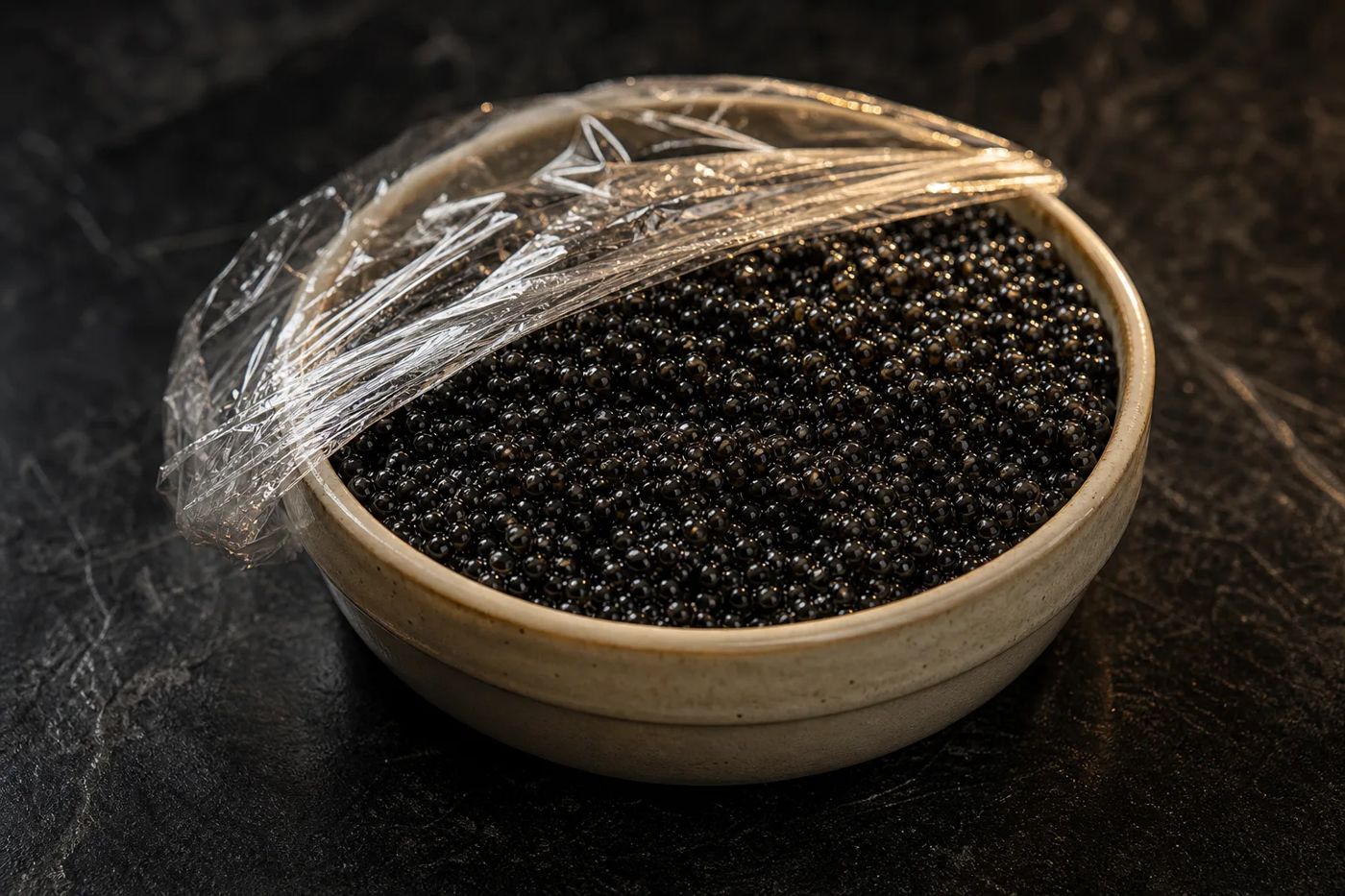
The Caviar Guy recommends gently smoothing the remaining eggs, laying food-safe cling film directly against their surface and replacing the lid tightly. Be gentle: protect the beads without crushing them. The film limits contact with air; it does not restore the shelf life of an unopened pack.
Record the opening date and time on a separate note if there is no space on the pack. Eat the remainder quickly, within the producer's after-opening limit and before any use-by deadline. Unopened and opened storage times explains why one duration cannot cover every tin.
Storage is not serving
Bring out only what you will serve. A temperature chosen for tasting does not become a new storage setting, and the reserve pack belongs in the fridge, not beside the plates. Keep the serving portion chilled as appropriate; serving temperature and keeping caviar cold covers table arrangements.
Time out of refrigeration matters too. For US households, the FDA says perishable seafood should not remain unrefrigerated for more than two hours, or one hour when the air is above 32°C (90°F). These are outer safety limits, not caviar serving targets. Follow a shorter limit if the producer specifies one.
Australia's FSANZ guidance addresses the total time potentially hazardous food spends between 5°C and 60°C. Under two hours, it may be refrigerated again; between two and four hours, it must be used straight away; at four hours or more, it must be discarded. FSANZ's food-business guidance counts exposure cumulatively, a useful precaution at home too. Follow stricter pack instructions and never eat food past its use-by date.
Other roe styles, freezing and travel
- Pressed caviar: its dense texture is no reason to assume it belongs in a cupboard. Follow its own pack instructions.
- Non-sturgeon roes: handling requirements can differ. Conradi recommends 0°C to 2°C (32°F to 36°F) for its salmon roe and gives separate frozen-storage instructions.
- Freezing: the freezer is not a colder fridge for fresh caviar. Read can you freeze caviar? before deciding what to do with a particular product.
- Storage away from home: arrange insulated cold transport and a checked fridge at your destination. The storing caviar hub brings together related guidance.
When storage has gone wrong
Ice cannot undo a broken cold chain. If a delivery arrives unexpectedly warm or the fridge fails, establish the temperature and time involved before deciding whether to keep the caviar. Contact the supplier when a delivery's cold chain is uncertain, rather than simply putting the warm pack onto ice.
Do not taste a suspect pack to check it. A pleasant smell, normal-looking eggs and an intact seal cannot establish that caviar is safe. The FSA advises people in England, Northern Ireland and Wales not to eat food past its use-by date. Caviar spoilage and when to throw it away explains the warning signs and why their absence offers no reassurance.
Sources
-
FAO and WHO, Codex Alimentarius. Standard for Sturgeon Caviar, CXS 291-2010, last modified 2026 per the Codex register. Sections 2.3 and 7.2 cover storage. Official PDF.
-
Prunier. FAQ, undated web edition retrieved November 2026. Producer's stated ideal storage temperature. Producer FAQ.
-
Paramount Caviar. Caviar General Information, undated web edition retrieved November 2026. Supplier's refrigeration and placement instructions. Storage information.
-
Food Standards Agency. How to chill, freeze and defrost food safely, published 2017, current GOV.UK web edition retrieved November 2026. Household refrigeration, thermometer checks and separation of raw foods. Official guidance.
-
US Food and Drug Administration. Are You Storing Food Safely?, current web edition retrieved November 2026. Refrigerator temperatures, prompt refrigeration and limitations of appearance and odour. Official guidance.
-
USDA Food Safety and Inspection Service. How do you know the temperature of your refrigerator?, updated 2 May 2024. Appliance thermometers and refrigeration guidance. Official guidance.
-
European Food Safety Authority. Proper food handling, Safe2Eat, current web edition retrieved November 2026. Prompt refrigeration below 5°C and prevention of cross-contamination. Official guidance.
-
French Ministry of Agriculture. Des conseils pour bien ranger votre frigo, current web edition retrieved November 2026. Identifying the coldest zone with a thermometer and differences between refrigerator models. Official guidance.
-
Food Standards Australia New Zealand. Food safety basics, updated 8 July 2025. Consumer refrigeration and room-temperature holding guidance. Official guidance.
-
Food Standards Australia New Zealand. 2-hour / 4-hour rule, current web edition retrieved November 2026. Cumulative time outside temperature control, presented as food-business guidance. Official guidance.
-
The Caviar Guy. How to Store Caviar Properly, undated web edition retrieved November 2026. Supplier advice on refrigerated ice storage, surface film and replacing the lid. Storage instructions.
-
Sturgeon Complex Aquatir. Caviar Cards, undated web edition retrieved November 2026. Producer descriptions of pasteurised products and their refrigeration requirements. Producer information.
-
Conradi Caviar. Caviar & Ikura FAQs: Storage, Shipping, Freshness, undated web edition retrieved November 2026. Supplier's distinct instructions for sturgeon caviar and salmon roe. Storage FAQ.
-
US Food and Drug Administration. Selecting and Serving Fresh and Frozen Seafood Safely, current web edition retrieved November 2026. Clean handling, cross-contamination and unrefrigerated holding limits. Official guidance.
-
Food Standards Agency. Home food fact checker, current GOV.UK web edition retrieved November 2026. Use-by dates and why the sniff test cannot establish safety. Official guidance.
-
Foods, peer-reviewed research article. Evolution of Food Safety Features and Volatile Profile in White Sturgeon Caviar Treated with Different Formulations of Salt and Preservatives during a Long-Term Storage Time, 2021. Product-specific research on microbiological and volatile changes during controlled storage. Open-access paper.
This piece was researched against official food-safety guidance and the retrieved Codex standard, with supplier instructions attributed individually and research used without extrapolating commercial shelf lives to home storage.
Last checked: November 2026