
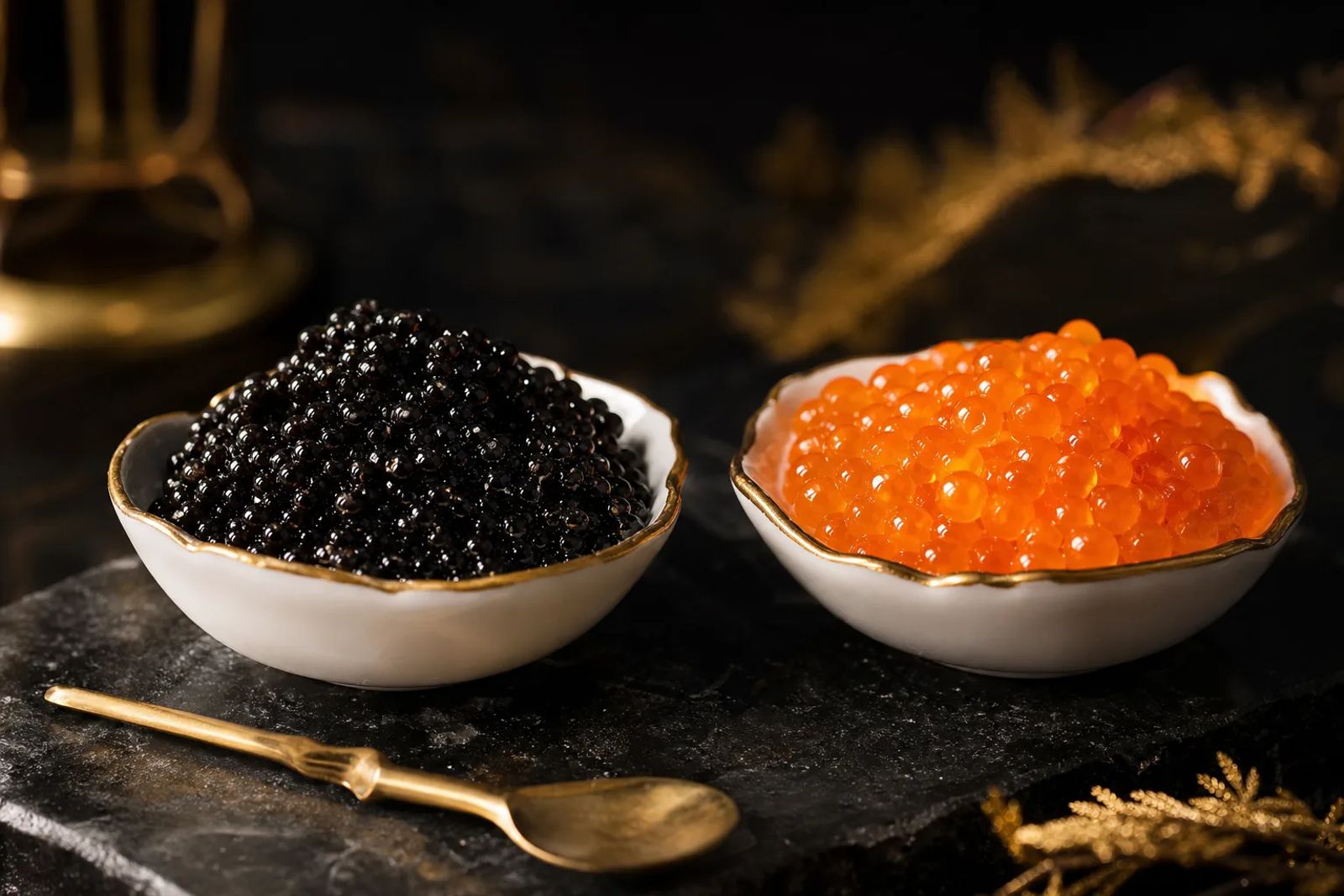
Caviar words do not map neatly from one language to another: some mean salted sturgeon roe, while others also cover eggs from other fish. Away from the table, caviar can stand for social privilege, political inconsistency or even censorship, but each expression needs its own definition and evidence.
In short
- Russian ikra covers fish roe broadly, while Japanese ikura has a narrower meaning.
- French gauche caviar is a disparaging political expression; its first use in Le Monde is documented in 1978.
- Some vegetable preparations use caviar in their names without containing roe.
Caviar words around the world
The table describes dictionary meanings, not a universal naming rule. Roe means fish eggs here; a word for roe does not necessarily imply that the eggs have been salted or prepared for eating. Roman spellings beside non-Latin scripts help readers recognise the words; they are not English pronunciation guides.
| Language | Word or words | What they cover | Expression or usage | Source |
|---|---|---|---|---|
| French | caviar; œufs de poisson | Caviar: brined sturgeon eggs. The second phrase means fish eggs. | Gauche caviar: a disparaging political expression. Caviar can also mean a censor’s black coating. Caviar d’aubergines names an aubergine preparation. | Larousse; Usito; Le Monde |
| German | Kaviar; Rogen | Kaviar: salted roe of various sturgeons. Rogen is the broader roe word. | Rogen is listed among Kaviar’s synonyms. | Duden |
| Italian | caviale; uova di pesce | Caviale: salted sturgeon eggs. The second phrase means fish eggs. | Treccani’s headword is narrower than its encyclopaedic discussion. | Treccani |
| Spanish | caviar; huevas | Caviar: prepared, salted sturgeon roe. Huevas: fish eggs collectively. | Hueva names the egg mass, not just individual beads. | RAE DLE |
| Russian | икра (ikra) | Roe broadly, including sturgeon and other fish. | Not restricted to the English culinary sense of caviar. | Russian Academy of Sciences |
| Persian | خاویار (xāvīār); تخم ماهی | The first is glossed as caviar; the second means fish eggs. | Sistani uses both expressions together. | Persian etymological lexicon; Sistani |
| Turkish | havyar; balık yumurtası | Usually brined sturgeon eggs; also fish eggs more broadly. | Havyar kesmek: to idle or waste time. | Turkish Language Association |
| Japanese | キャビア (kyabia); イクラ (ikura); 魚卵 (gyoran) | Kyabia: salted sturgeon eggs. Ikura: separated, salted salmon or trout eggs. Gyoran means fish eggs. | Ikura is narrower than Russian ikra. | Shogakukan |
| Mandarin Chinese | 魚子醬 (yú zǐ jiàng); 魚子 (yú zǐ) | The first names a food made from cured and processed fish eggs; the second means fish eggs. | The Taiwanese dictionary definition of 魚子醬 does not specify sturgeon. | Taiwan Ministry of Education |
| Swedish | kaviar; rom | Kaviar: salted fish roe, originally sturgeon roe. Rom: fish eggs. | Smörgåskaviar denotes a spreadable preparation. | Nationalencyklopedin; Språktidningen |
| Finnish | kaviaari; mäti | Kaviaari: salted sturgeon roe; also preparations from other roe. Mäti: roe. | Compound words can also name vegetable pastes. | Kielikello |
The same-looking word can name different foods
Swedish kaviar is a useful warning against translating by appearance alone. Nationalencyklopedin defines it as salted fish roe, originally only from sturgeons. Language writer Bo Bergman describes how Swedish usage expanded to other fish and later to spreadable sandwich preparations. Such a spread is not simply a different spelling of the loose beads an English reader may picture.
Japanese offers the reverse lesson in how a borrowed word can narrow its meaning. Russian икра, ikra, is broad, but Japanese イクラ, ikura, identifies separated salmon or trout eggs in the cited dictionaries. キャビア, kyabia, has its own entry for salted sturgeon eggs. Translating every occurrence of ikra as ikura would therefore change the meaning rather than preserve it.
The Chinese entry shows why scope matters just as much as spelling. Taiwan’s Ministry of Education defines 魚子醬, yú zǐ jiàng, through processed fish eggs without limiting the definition to sturgeon. That is evidence for the breadth of that dictionary entry, not a claim that every Chinese-language menu or speaker uses it identically.
Everyday meanings are not legal definitions
A dictionary tells you how a word is used; it does not by itself establish what a food business may put on a label or what customs classification applies. Those are separate questions with separate sources. Use the caviar versus roe guide for the distinctions rather than treating this vocabulary table as labelling advice.
For reading a menu, start with the fish named beside the roe, then look for preparation words such as salted or smoked. This is more informative than assuming that a familiar-looking word promises a particular species. Equally, a broad everyday meaning is not evidence that the writer has made a mistake.
Political expressions describe an accusation, not a fact
French gauche caviar, literally “caviar left”, is a disparaging expression. Usito, the University of Sherbrooke’s dictionary, defines it through an alleged contradiction between political opinions and a taste for an affluent way of life. The phrase questions consistency; it is not a neutral name for a political programme or a reliable description of everyone on the left.
Le Monde has traced its own first use to 23 January 1978, in reporting about singers and broadcasting. That gives a documented appearance in one newspaper, not a proven date of invention. Keeping those claims separate matters: a searchable archive can show when an editor used a phrase without showing who first said it.
When translating such language, retain the speaker’s distance from the accusation. Writing that someone “was described as gauche caviar” reports a judgement. Writing that they “are gauche caviar” adopts it. This distinction is especially useful when an expression crosses into another country’s political debate, where the local associations may not match those of the original phrase.
Caviar can mean censorship, too
In French, caviar also has a meaning far from food. Larousse records it as the black coating used by censors to conceal passages in a newspaper or book. In that setting, the relevant image is a dark covering over words, not an ingredient served with them.
In that setting, the relevant image is a dark covering over words, not an ingredient served with them.
Larousse associates this censorship practice with Russia under Nicholas I. It would be misleading to turn that historical association into an exact birthday for the expression. A date for a practice and a date for a word are different kinds of evidence.
A Turkish idiom about doing nothing
Turkish havyar kesmek means to idle or waste time, rather than to prepare a dish. The Turkish Language Association’s havyar entry lists the expression, and an official maritime terminology dictionary explains it as failing to work properly or being lazy. It belongs with expressions about behaviour, not culinary instructions.
The documented meaning is useful without an invented explanation.
When the caviar contains no roe
French caviar d’aubergines is an aubergine preparation. Larousse describes cooked aubergines worked into a purée with olive oil, garlic and chopped black olives. Here, caviar is part of an established dish name, not a statement that fish eggs have been added.
Finnish offers a particularly clear dictionary explanation. Kielikello reproduces the national dictionary’s separate sense for kaviaari as the second part of compound names for vegetable and other pastes. Its examples include aubergine and cucumber preparations, alongside a herring preparation. The extension is about the named food, not a rule that every small, round ingredient counts as caviar.
These names are worth translating as whole phrases rather than word by word. Before deciding that a dish contains roe, read the ingredient description. Our guide to things called caviar that are not roe follows these borrowed food names in more detail without confusing them with fish products.
How to read a dictionary date
Japanese historical entries illustrate a useful distinction. Shogakukan’s selected Nihon Kokugo Daijiten gives a 1903 example under kyabia, using an older spelling, and a 1928 example under ikura. These are the dictionary’s cited early examples, not dates when either food first reached Japan or when everyone began using the modern spelling.
The same discipline helps with sayings. Ask whether the source supplies a definition, a quotation, an early printed example or an origin story. Those answer different questions. For the longer route of the English word, follow where the word caviar comes from; for the Shakespeare expression, follow caviar in literature.
Where to go next
- Caviar Fun: explore other cultural questions about caviar.
- Caviar Quotes and Sayings: find attributed quotations rather than vocabulary definitions.
Sources
-
Larousse. “Caviar”, Dictionnaire de français, online edition, undated; retrieved November 2026. Food definition, censorship sense and caviar d’aubergines. Dictionary entry.
-
Duden. “Kaviar”, Duden online, online edition, undated; retrieved November 2026. Sturgeon-roe definition and listed synonyms. Dictionary entry.
-
Istituto della Enciclopedia Italiana. “Caviale”, Treccani, online encyclopaedia and embedded vocabulary entry, undated; retrieved November 2026. Entry.
-
Real Academia Española and Asociación de Academias de la Lengua Española. “Caviar” and “hueva”, Diccionario de la lengua española, online edition retrieved November 2026. Caviar; hueva.
-
V. V. Vinogradov Russian Language Institute, Russian Academy of Sciences. Активный словарь русского языка, volume 4, part 1, letters И and Й, Moscow, 2023. Entry for икра. Dictionary volume.
-
Parsianjoman, hosting organisation. فرهنگ اشتقاق واژگان فارسی [Persian etymological lexicon], online PDF, undated; retrieved November 2026. Entry presenting خاویار as xāvīār, “caviar”. Lexicon.
-
Office of Sayyid Ali al-Husayni al-Sistani. “خاویار و تخم ماهی”, توضیح المسائل جامع, volume 2, edition dated 1403 in the Iranian calendar. Persian usage of both expressions together. Text.
-
Türk Dil Kurumu, Turkish Language Association. “Havyar”, Güncel Türkçe Sözlük, online edition retrieved November 2026. Definition and cross-reference to havyar kesmek.
-
Shogakukan. “イクラ” and “キャビア”, Digital Daijisen and Seisenban Nihon Kokugo Daijiten, online editions reproduced by Kotobank, retrieved November 2026. Definitions, Japanese readings and historical examples. Ikura; kyabia.
-
Taiwan Ministry of Education. “魚子醬”, Revised Mandarin Chinese Dictionary, 2021 edition. Definition and Hanyu Pinyin reading. Dictionary entry.
-
Nationalencyklopedin. “Kaviar” and “rom (fiskägg)”, online edition, undated; retrieved November 2026. Kaviar; rom.
-
Bo Bergman, Språktidningen. “Rom med turkiskt ursprung”, 13 June 2016. Swedish usage and spreadable smörgåskaviar. Article.
-
Kielikello, Institute for the Languages of Finland. “Kielitoimiston sanakirjan kootut selitteet”, online article, 2021. Reproduces and explains the national dictionary’s kaviaari entry. Article.
-
Université de Sherbrooke. “Gauche”, including “la gauche caviar”, Usito, online edition, undated; retrieved November 2026. Definition and pejorative political register. Dictionary entry.
-
Agnès Gautheron, Le Monde. “« Gauche caviar » : la première fois que « Le Monde » l’a écrit”, 15 January 2021, updated 22 January 2021. Newspaper-specific first appearance on 23 January 1978. Article.
-
Turkish Ministry of Transport, Maritime Affairs and Communications. Ulaştırma Denizcilik ve Haberleşme Terimleri Sözlüğü, online PDF edition, undated. Maritime section, printed page 307, “havyar kesmek”. Terminology dictionary.
Last checked: November 2026