
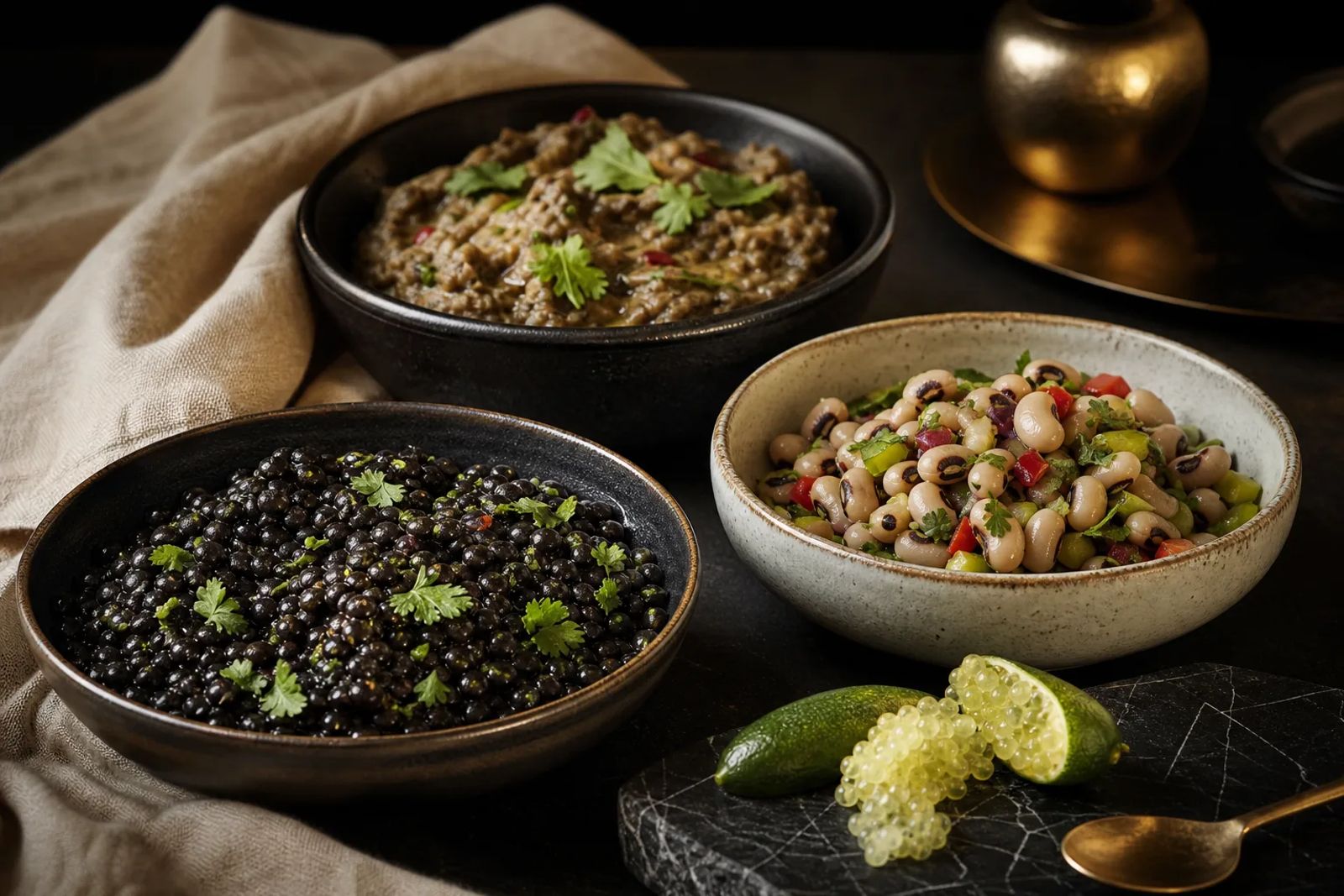
The dark sheen of cooked beluga lentils is enough to explain their name: the USDA Agricultural Research Service links them directly to beluga caviar. Yet every glossy little lentil is a plant seed. Elsewhere, the same borrowed word describes yielding aubergine flesh, rounded sacs of lime juice and even beads on a fingernail.
These names borrow caviar’s appearance, texture or prestige, not its ingredients. Roe usually means fish eggs, though it can also mean the egg-bearing ovarian tissue. Aubergine caviar is a vegetable preparation; Texas caviar is a black-eyed pea salad. The pleasure lies in understanding the comparison.
Why foods borrow the word caviar
Caviar lends foods an appearance and texture to evoke, and a reputation to borrow. The Académie française explicitly recognises its vegetable use by analogy with the grainy appearance and smooth richness of the fish product. Merriam-Webster records a separate figurative meaning: something considered the best of its kind.
One comparison can be seen or felt. The other claims special standing. Neither requires a food to imitate salted fish eggs. A bean salad can have an identity of its own, while a fruit earns the nickname because its pulp comes in little spheres. The useful question is what the name describes.
For the history of the original term, see where the word caviar comes from. This page follows the borrowed names; caviar words and idioms around the world explores the wider language.
A quick guide to the lookalikes
| Name | What it is | Why it is called caviar | Roe content |
|---|---|---|---|
| Aubergine caviar | Cooked aubergine spread | French dictionary records a texture and appearance analogy | None |
| Texas caviar | Dressed black-eyed peas | Associated with Helen Corbitt; naming reason remains uncertain | None |
| Beluga lentils | Small black lentils | USDA links their sheen to beluga caviar | None |
| Citrus caviar | Finger lime juice sacs | Rounded juice vesicles resemble roe | None |
| Juice caviar | Liquid in gel-coated spheres | Shape resembles roe | None |
| Caviar manicure | Tiny decorative nail beads | Clustered beads create a roe-like surface | None |
These entries describe the named preparations and materials. For a particular dish or cosmetic, check its ingredients: an added garnish or a different formulation can change what it contains.
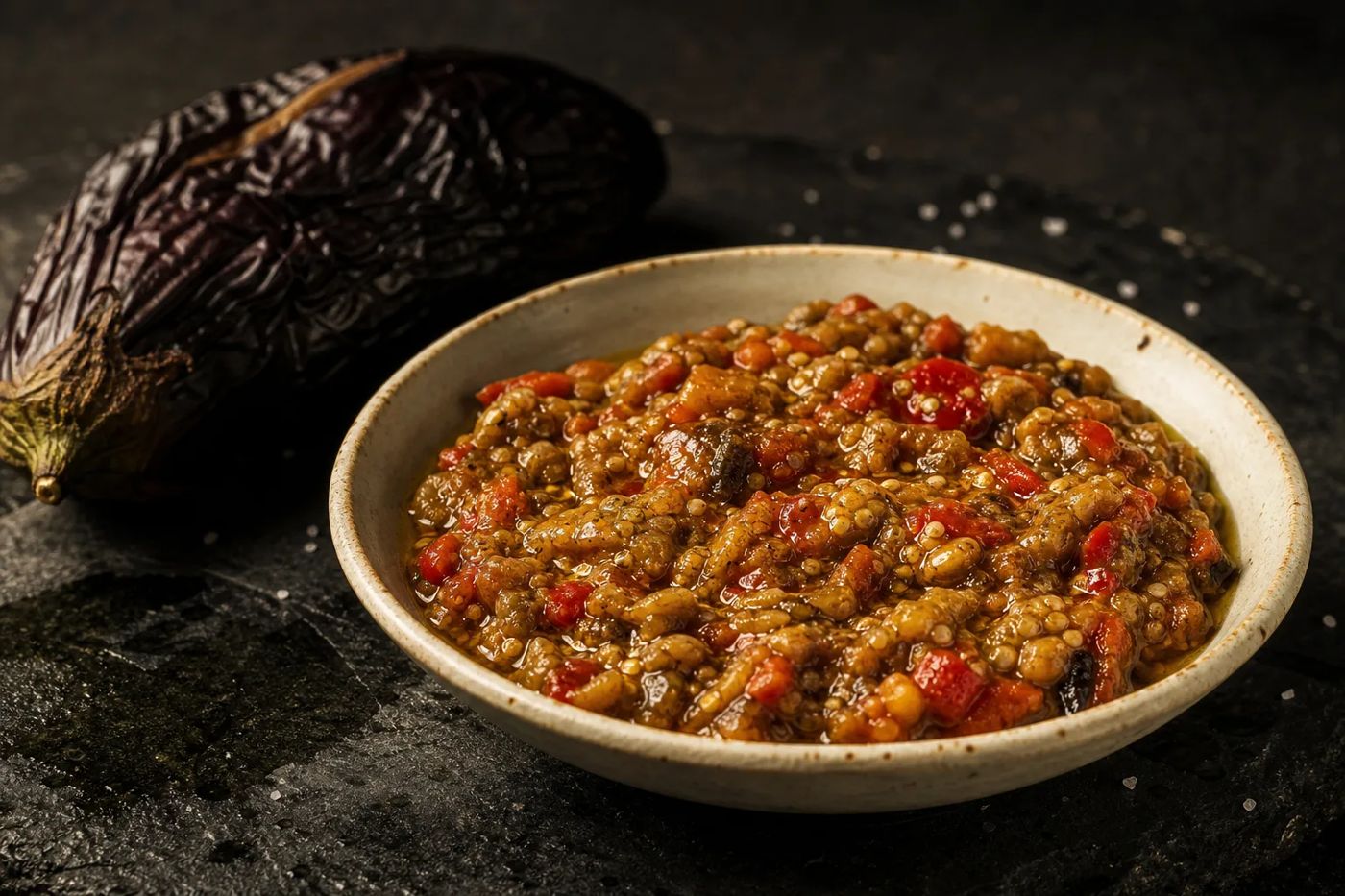
Aubergine caviar: richness without the beads
Aubergine caviar evokes texture and appearance without matching the shape of individual eggs. The French caviar d’aubergines is an established dictionary example of the name’s vegetable use: a finely divided, yielding preparation rather than a bowl of separate eggs. The name does not mean the spread contains fish.
One set of cookery notes gives a concrete example. Softened aubergine flesh is coarsely chopped, seasoned, then mixed with olive oil and tomato sauce. The notes call this mixture aubergine caviar before using it as a stuffing.
The result illustrates how a food name can rest on a resemblance without an exact visual match. Those notes document the culinary usage but do not establish who first coined the French name or where.
Texas caviar: black-eyed peas with a history
Texas caviar is a salad, not a manufactured roe substitute. The Texas State Historical Association describes Helen Corbitt’s version as black-eyed peas dressed with oil, vinegar, garlic and onion. Its connection to caviar is the name, not fish ingredients.
The association’s biography places the dish during Corbitt’s time at the University of Texas at Austin. It recounts a request for a convention dinner made with Texas products, giving the salad a place in her published history.
The naming story is less precise. This is a published historical account, not a surviving record of the moment someone chose “Texas caviar”, and it does not establish an exact first serving date. It gives the dish a historical setting without settling precisely when it was invented or why it received its name.
Beluga lentils: a dark sheen and a borrowed name
Beluga lentils really are named after beluga caviar. A 2005 report from the USDA Agricultural Research Service explicitly identifies the caviar as their namesake and describes the dark sheen of the cooked lentils. These small black pulses carry a visual comparison, not an unrelated word for colour or size.
The distinction is straightforward: beluga is the species CITES lists as Huso huso; the lentil remains a plant seed. Its culinary name describes a resemblance, not its species or ingredients. The USDA account records that comparison but does not identify the person who first named the lentils.
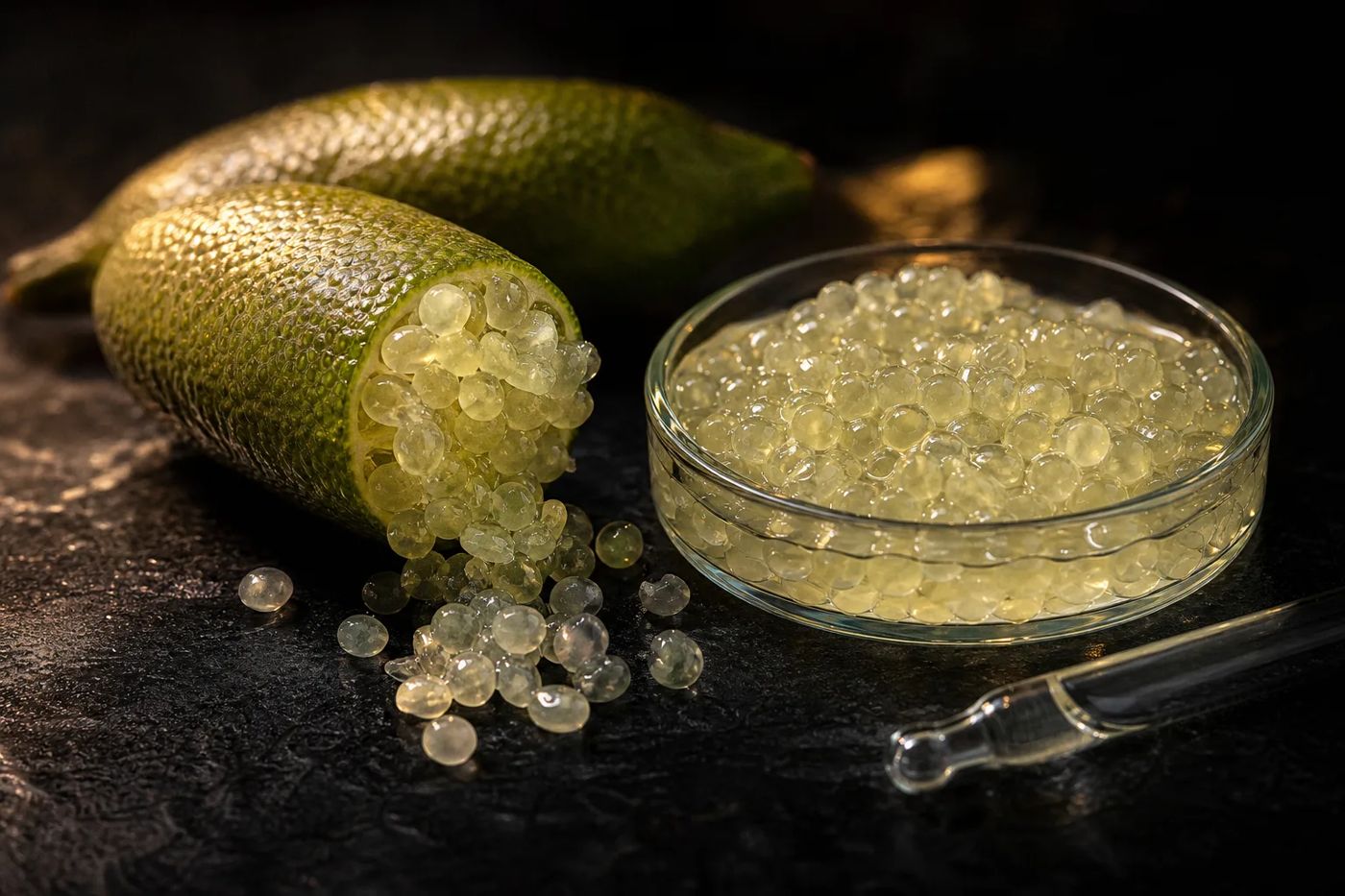
Citrus and juice caviar: grown sacs, made spheres
Finger lime grows its own little spheres. University of California extension explains that its nickname, citrus caviar, comes from the rounded juice sacs. They are fruit tissue, not roe.
Juice caviar takes a different route: liquid is shaped into small spheres. The Oxford Companion to Spirits & Cocktails describes the nickname as a reference to their resemblance to roe. Saint Louis Science Center explains the technique, spherification, as using calcium lactate and sodium alginate to form a gel. One resemblance grows inside a fruit; the other is engineered.
Neither name alone tells you whether the food is meant to replace caviar or simply garnish a dish. For products made specifically as alternatives, seaweed and vegan caviar explains that category. Caviar substitutes compared distinguishes it from substitutes that still contain fish eggs.
Beyond food: caviar at your fingertips
A caviar manicure turns the comparison into a surface effect. Tiny decorative beads cover the nail, creating the clustered, rounded appearance of roe. No fish eggs are involved.
SELF documented the expression in February 2011, alongside instructions using black seed beads. That establishes the name’s use by that date, although not its invention. Here, caviar describes decoration: neither food nor a skincare ingredient.
What food naming law actually requires
Food naming law asks whether a description misleads the consumer, not simply whether it uses the word caviar. These rules govern food marketing, not culinary metaphor in ordinary conversation. Customs classifications answer a different question and do not grant permission to use a particular retail name.
European Union
Regulation (EU) No 1169/2011, Article 7, prohibits misleading food information, including statements about a food’s nature, identity or composition. Article 17 sets the naming order: use the legal name; failing that, the customary name; and if there is none, or it is not used, a descriptive name. A fancy name cannot replace the required food name.
For these examples, the practical lesson is to identify the underlying food: aubergine spread or black-eyed pea salad. That applies the general rules; it does not make every “vegetable caviar” label lawful. The whole presentation and the consumer’s understanding still matter.
Great Britain and Northern Ireland
Great Britain applies the assimilated and amended version of Regulation 1169/2011. Articles 7 and 17 retain the requirements for non-misleading information and an appropriate food name. The Food Standards Agency distinguishes this framework from Northern Ireland, where EU food information law continues to apply under the Windsor Framework.
For packaged spreads and business product descriptions alike, a familiar culinary expression does not replace the actual food description or a check of the applicable naming requirements.
United States
The FDA’s CPG Sec. 540.150 is nonbinding guidance about fish roe, not a specific authorisation for bean salads or vegetable spreads. Its policy says unqualified caviar should apply only to salted sturgeon roe. Other roe may be labelled with the fish name before caviar, with all words in substantially the same type size and prominence. Any added colour must be prominently declared.
The broader binding rule is section 403(a)(1) of the Federal Food, Drug, and Cosmetic Act, codified at 21 USC 343(a)(1): food is misbranded if its labelling is false or misleading. A plant-based product’s actual description must be considered under those general rules; the fish roe guidance cannot settle every metaphorical use.
How to read a borrowed caviar name
On a menu, ask for the main ingredient. Does caviar describe a spread, whole seeds or little spheres?
On a packaged food, read the descriptive name and ingredient list. A nickname is not a recipe.
If avoiding fish is essential, ask about the whole dish, including sauces and garnishes. One borrowed word cannot tell you everything on the plate.
Where to go next
- Caviar Alternatives and Lookalikes: explore the wider guide to roe substitutes and foods that resemble them.
- Where the Word Caviar Comes From: follow the original word’s history rather than its borrowed uses.
Sources
-
Académie française. Dictionnaire de l’Académie française, ninth edition, 2024, entry “caviar”, sense 1. Records vegetable preparations as an analogous use based on appearance and texture. Dictionary entry.
-
Merriam-Webster. Merriam-Webster.com Dictionary, online edition retrieved November 2026, entry “caviar”, sense 3. Dictionary entry.
-
BBC Maestro. Course notes 2.0, undated, aubergine recipe section. Documents softened, coarsely chopped aubergine with seasoning, olive oil and tomato sauce described as aubergine caviar. Course notes.
-
Texas State Historical Association. Handbook of Texas, “Corbitt, Helen Lucy”, online edition retrieved November 2026. A secondary historical account identifying the dish and its association with Corbitt. Biographical entry.
-
US Department of Agriculture, Agricultural Research Service. Marcia Wood, New, Healthful Compound Discovered in Exotic Lentils, 16 September 2005, archived edition. Research report.
-
University of California Agriculture and Natural Resources. Finger Limes?, 28 May 2021. Explains the citrus caviar nickname through rounded juice vesicles. Extension article.
-
Oxford University Press. Chloe Frechette, “Spherification”, in The Oxford Companion to Spirits & Cocktails, edited by David Wondrich and Noah Rothbaum, 2021; Oxford Reference online edition, checked November 2026. Reference entry.
-
Saint Louis Science Center. NewScience, autumn 2024, “Understanding Molecular Gastronomy: Cooking from Within”, pages 8 and 9. Magazine issue.
-
SELF. A “Caviar” Manicure at Fashion Week, 14 February 2011. Contemporary documentation of the name and bead-based decoration. Article.
-
European Parliament and Council. Regulation (EU) No 1169/2011 on the provision of food information to consumers, consolidated text dated 12 December 2011, Articles 7 and 17. EUR-Lex text.
-
The National Archives. Regulation (EU) No 1169/2011, Great Britain assimilated legislation, Articles 7 and 17, online text retrieved November 2026. Article 7 and Article 17.
-
Food Standards Agency. Packaging and labelling, updated 4 September 2026; General food law, online edition retrieved November 2026. Distinguish Great Britain’s assimilated legislation from EU law applying in Northern Ireland. Packaging guidance and general food law guidance.
-
US Food and Drug Administration. CPG Sec. 540.150: Caviar, Use of Term, Labeling, October 1989. Compliance policy guide. US Department of Health and Human Services. Corresponding guidance repository entry and disclaimer on legal effect. Guidance repository.
-
United States Code. 21 USC 343: Misbranded food, subsection (a)(1), online text reproduced by Cornell Law School’s Legal Information Institute, retrieved November 2026. Statutory text.
-
CITES. Resolution Conf. 12.7 (Rev. CoP17), Annex 2, the edition in effect after CoP20. Lists the CITES scientific name and code. CITES resolutions.
-
FAO. Chebanov, M. S. and Galich, E. V., Sturgeon Hatchery Manual, Fisheries and Aquaculture Technical Paper 558, 2013, section 1.2.1. Identifies beluga as Huso huso.
This piece was researched through dictionaries, documented culinary examples, historical reference material, university and government publications, and food-labelling legislation and guidance.
Last checked: November 2026