
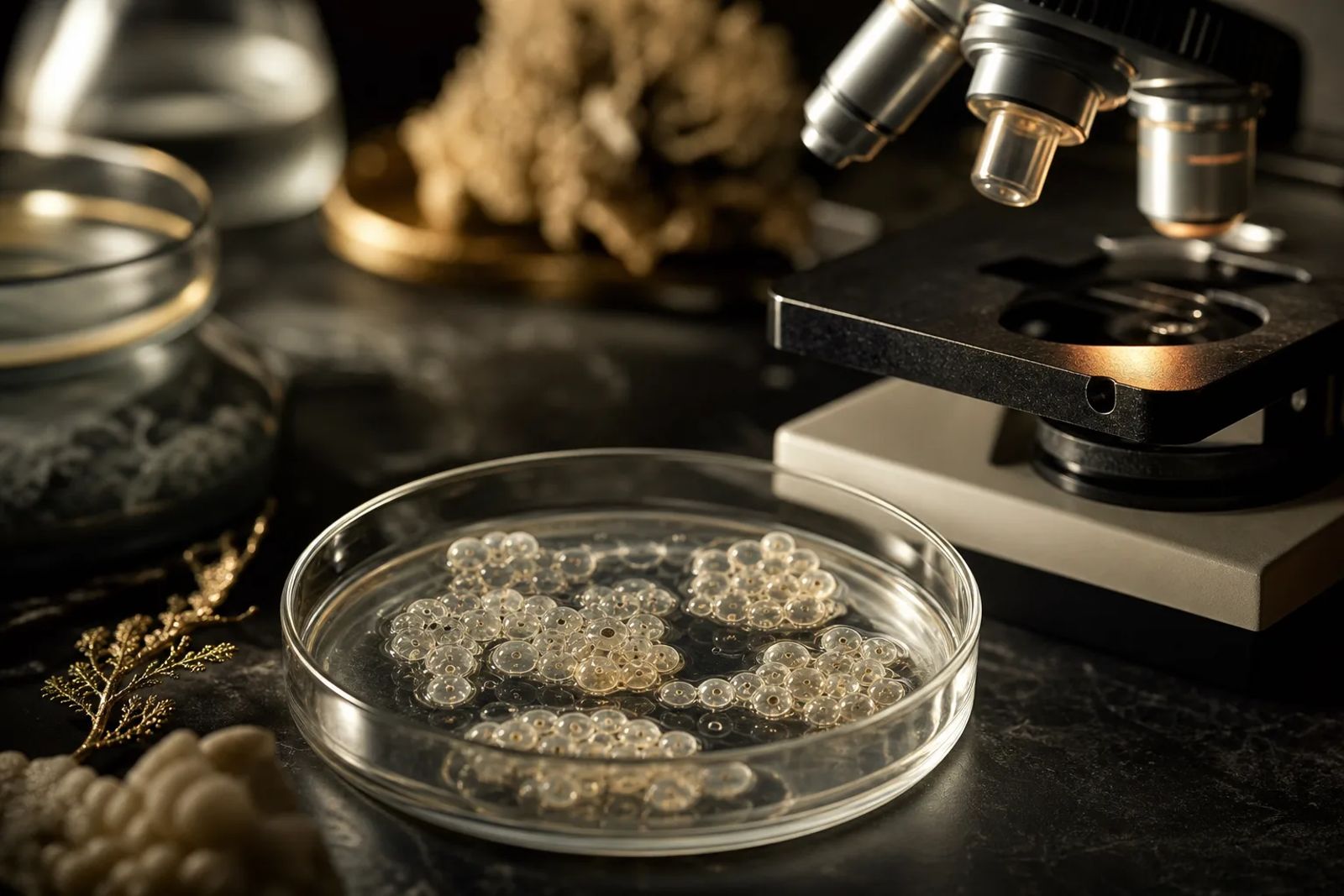
On 20 April 2026, researchers reported growing developing sterlet egg cells in the laboratory. It was a striking step towards a difficult goal: cultivating eggs, rather than simply shaping fish cells into beads. It was not a demonstration of edible, mature caviar.
That distinction defines this emerging field. Cell-cultured caviar alternatives use fish cells grown outside the animal, but need not contain complete fish eggs. As of 5 November 2026, no authorisation specifically for cultivated roe or caviar was verified in the sources reviewed. Cultivated salmon has completed the US FDA consultation process, a different milestone for a different food.
What is inside a cell-cultured caviar alternative?
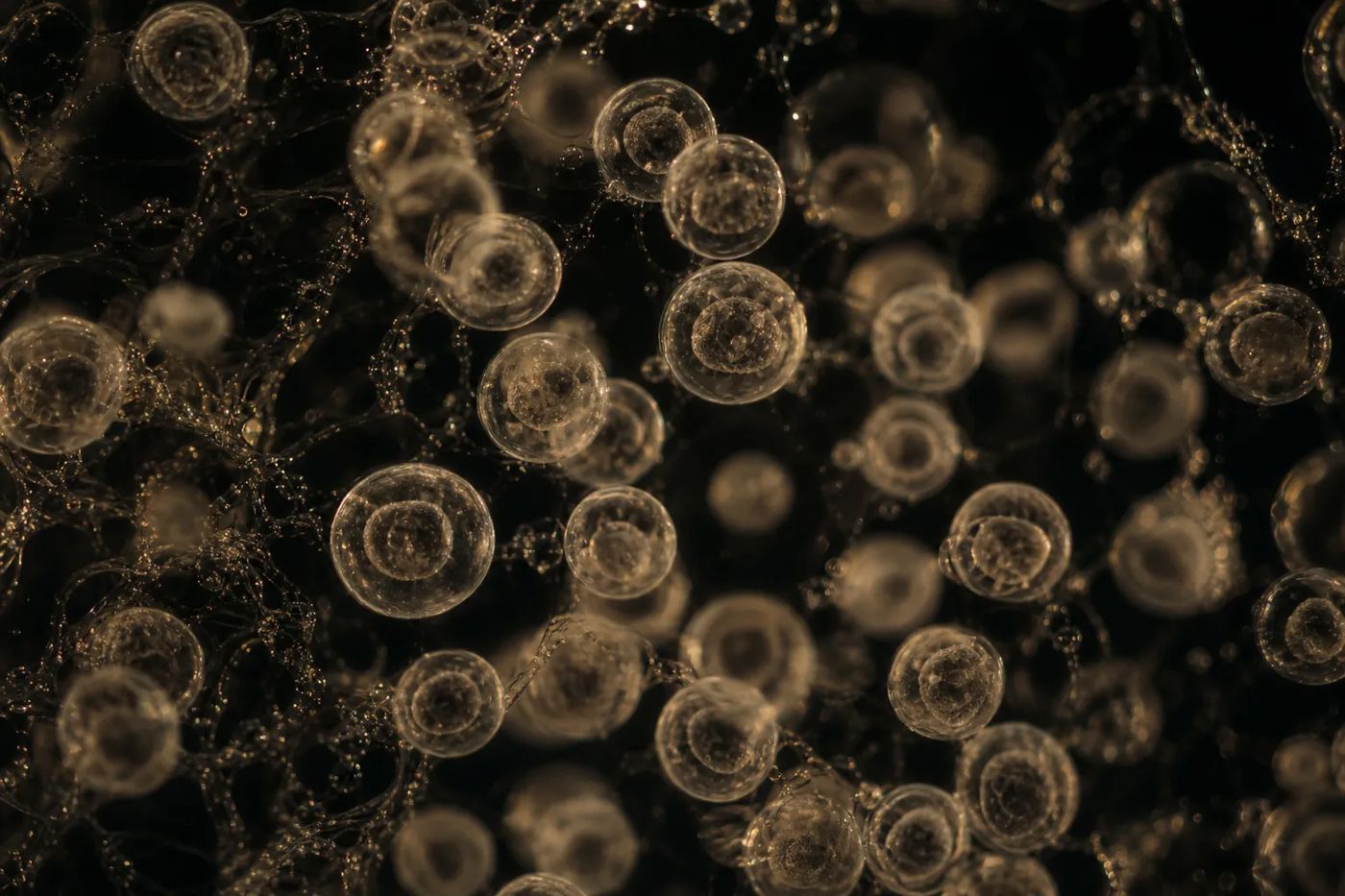
A cultivated bead may contain fish cells without being a fish egg. Cell culture maintains and multiplies isolated cells in a controlled, nutrient-supplied environment. The harvested material can then be formed into beads, rather than grown into oocytes, the developing egg cells that become roe.
Some formulations combine animal cells with plant ingredients. These are hybrid foods: neither crosses between two fish species nor wholly plant-based products.
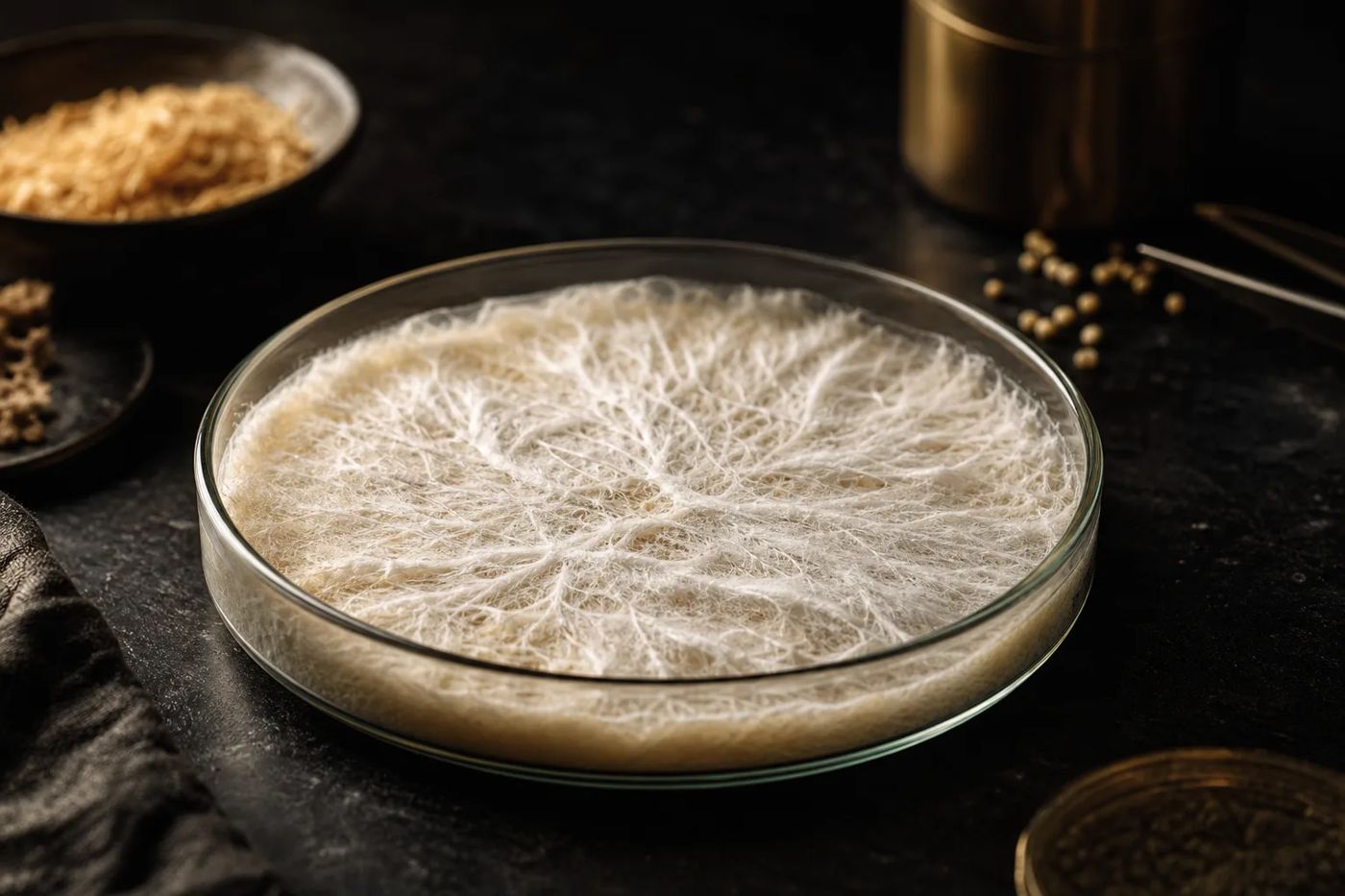
Plant-based beads get their structure and flavour from non-animal ingredients. Fungal fermentation offers another route. Optimized Foods currently describes its VEA alternative as spherical mycelium, the growing network of a fungus, combined with marine-inspired botanicals. That is a fungal formulation, distinct from cultivated fish roe. The wider family is explained in caviar alternatives and lookalikes.
Why growing an egg is harder than making a bead
The central challenge is getting cells to become eggs. An ovarian cell line does not automatically do that: ovaries contain supporting cells as well as germline cells, which give rise to eggs or sperm. Researchers must identify what is growing and establish whether it can differentiate, or develop into specialised cells.
Shape alone tells little. A scaffold, a supporting material for cell attachment or organisation, can help create a round structure without producing a biological egg.
The sterlet advance came from Ai Sun and colleagues, including researchers at the Beijing Academy of Agriculture and Forestry Sciences. They reported the ARO ovarian cell line, derived from sterlet tissue, and identified germline cells through gene markers, alkaline phosphatase activity and immunofluorescence staining. Their evidence went beyond appearance.
Under three-dimensional culture conditions, the authors reported oocytes at germinal-vesicle, germinal-vesicle-breakdown and meiosis I stages: steps in egg development. This is evidence of laboratory oocyte generation, not a demonstration of edible, mature caviar or commercial production. The accessible abstract does not establish the number of donor fish, a food-grade process or a finished product's composition.
Scaling up brings another set of demands. Developers need repeatable growth, stable composition between batches, suitable culture inputs and a convincing roe texture, while keeping the contents clear. An edible scaffold or binder may help assemble a bead. Its contribution belongs in the ingredient specification, and cannot be assumed to recreate an egg's membrane, internal structure or maturation.
Who is developing it, and what has been demonstrated?
UMAMI Bioworks describes a food programme; Caviar Biotec's website and related research concern skincare ingredients and potential sources for extracts. They represent different applications of cell technology.
UMAMI Bioworks announced a cultivated caviar alternative in January 2025 through its own public communications. The company describes a proprietary blend of sturgeon cells and plant-based ingredients, with sensory, nutritional and environmental claims. The announcement establishes its stated formulation and development programme, not independent confirmation of nutritional equivalence, market authorisation or routine sales.
Caviar Biotec's current website focuses chiefly on sturgeon stem-cell technology for skincare ingredients. A related peer-reviewed paper by Bianka Grunow and colleagues, published on 28 April 2026, analysed 14 commercial caviar samples in two laboratories using proteomics, the identification of proteins. It also introduced a cell-based system derived from spontaneously immortalised sturgeon larval stem cells, which can continue dividing.
The study concerns biochemical characterisation and a potential alternative source for extracts, rather than manufactured edible eggs. One author disclosed commercial affiliations with Caviar Biotec and CellRoe, relevant context when assessing the proposed applications. These records and the ARO research mark distinct areas of work: cosmetic biotechnology, ovarian-cell research and cultivated food.
Where regulation stands
Authorisation belongs to a specific product. A decision about chicken, quail, beef or salmon does not authorise cultivated roe. A verified regulatory pathway is not a roe authorisation. This table distinguishes verified pathways from questions the sources reviewed in November 2026 could not reliably settle.
| Jurisdiction and regulator | Pathway | Seafood or roe status | Legal or official source | Checked |
|---|---|---|---|---|
| EU, European Commission/EFSA | Novel food authorisation following safety assessment. | EFSA reports no animal-cell food approved; no roe authorisation found. | Regulation (EU) 2015/2283; EFSA novel food guidance. | November 2026 |
| GB, FSA/FSS | Regulated-product application, usually novel food assessment under assimilated law. | No cultivated roe authorisation found. | FSA/FSS cell-cultivated products guidance. | November 2026 |
| Northern Ireland, European Commission/EFSA | EU route; qualifying GB-authorised goods may enter through NIRMS. | No cultivated roe authorisation found. | FSA cell-cultivated products guidance, Windsor Framework provisions. | November 2026 |
| US, FDA | Voluntary pre-market consultation for cultivated seafood; general food law applies. | Wildtype salmon consultation completed on 28 May 2025; not roe. | FDA CCC 000005 response and inventory. | November 2026 |
| Singapore, SFA | Pre-market approval under the Food Safety and Security Act framework. | No roe authorisation found. | SFA framework; approved-food list dated 14 August 2026. | November 2026 |
| Israel, Ministry of Health | New-food safety review. | Ministry announced cultivated beef approval on 17 January 2024; no roe authorisation found. | Ministry of Health announcement. | November 2026 |
| Switzerland, FSVO | Novel-food status determination and safety assessment. | FSVO identifies cultured salmon cells as novel; no roe authorisation found. | FSVO guidance; Foodstuffs and Utility Articles Ordinance, Article 15. | November 2026 |
| Australia and New Zealand, FSANZ | Product approval under Standard 1.5.4 and Schedule 25A. | Cultured quail permitted from June 2025; no roe permission established. | FSANZ A1269 decision and Code framework. | November 2026 |
| Japan, Consumer Affairs Agency | Safety framework under discussion in official committee records. | No cultivated roe authorisation found. | New-food committee materials, December 2025. | November 2026 |
| China | Pathway not yet published. | No cultivated roe authorisation found. | No official record found. | November 2026 |
Wildtype reported serving cultivated coho salmon in Portland from May 2025, with a launch at Kann, Portland, in late May 2025. This was salmon, not roe. The FDA's letter said the agency had no questions about the company's safety conclusion at that time. It was neither a product approval nor blanket approval of cultivated seafood.
State restrictions create a separate barrier. Texas bans sales from 1 September 2025 until 1 September 2027; Louisiana's ban applies from 1 August 2026. Florida and other states also ban sales. Before distribution, suppliers must check current state law and relevant court orders.
Names, ingredients and safety
The name should tell the reader what the food is. Calling cultured sturgeon cells “caviar” does not make them eggs; a clear description identifies the ingredients and their origin.
In the EU and Northern Ireland, Article 7 of Regulation (EU) No 1169/2011 prohibits misleading food information. Great Britain has its own assimilated version of that regulation. In the United States, FDA Compliance Policy Guide 540.150 provides nonbinding guidance on caviar made from fish eggs. For roe other than sturgeon, it calls for the fish name alongside caviar in the same type size. Its application to cultivated cell material remains unsettled here. Customs classification does not itself determine the consumer name.
Australia and New Zealand require the descriptor “cell-cultured” or “cell-cultivated” under their new framework. FDA explicitly warns that terminology in its consultation inventory is not a recommendation for a food's common or usual name. These positions leave future caviar naming questions open.
Calling cultured sturgeon cells “caviar” does not make them eggs; a clear description identifies the ingredients and their origin.
Safety assessment reaches beyond the finished bead to the process: cell identity, growth-medium ingredients, microbiological control, residues, composition and allergenicity. Cultivation alone establishes neither freedom from fish allergens nor nutritional equivalence to roe. Request the authorised specification and analytical evidence. Claims about conventional caviar cannot simply be transferred to a different material.
Environmental and welfare claims: compare the whole process
The environmental case depends on how the food is made and what it replaces. UMAMI presents its alternative as environmentally and ethically preferable; Caviar Biotec also makes animal-welfare claims for its technology. These developer claims need a defined comparison covering cell sourcing, any animal-derived culture inputs, energy, growth media, waste and the conventional production system displaced. Cultivated products need not share one footprint.
Published life-cycle studies of cultivated meat reach different environmental conclusions because they use different assumptions. Sinke and colleagues modelled future commercial production, including scenarios with different energy supplies. Risner and colleagues examined systems in which growth-medium purification can impose substantial burdens. Neither establishes the footprint of an edible cultivated caviar product.
A stable cell bank could reduce repeated fish rearing and harvesting, a plausible welfare benefit. Its scale depends on the sourcing of donor material and culture ingredients, and on whether production actually displaces conventional roe.The word “cultivated” alone settles neither question.
Before a prototype becomes a product
Request and check:
- The regulator's decision.
- The exact cell line and ingredient specification it covers.
- Permitted uses.
- Required wording.
- Evidence of lawful supply in the destination market.
A tasting, partnership announcement or application submission does not answer those questions on its own. For composition comparisons with established alternatives, see caviar substitutes compared.
Sources
-
Food Standards Agency. Cell-cultivated products: guidance for businesses, published 2023, current guidance retrieved November 2026. Official publication. The accompanying guidance covers definitions, GB authorisation and Northern Ireland arrangements.
-
Optimized Foods. Enabling the Power of Biology, undated company website, retrieved November 2026. Company description of spherical mycelium fermentation and VEA.
-
Sun, A., and colleagues. Establishment of a germline cell-containing ovarian cell line capable of oocyte generation in vitro from sterlet Acipenser ruthenus. Biology of Reproduction, volume 115, issue 2, 2026, pages 565 to 581; first published 20 April 2026. Publisher record and abstract.
-
UMAMI Bioworks. Announcement introducing cultivated caviar, company social-media announcement, 2025. Original company announcement.
-
Caviar Biotec. Caviar Biotec, undated company website, retrieved November 2026. Company descriptions of cell-culture and skincare technology.
-
Grunow, B., Dietrich, M. A., Di Leonardo, V., Pšenička, M., and Benning, K. Biological Composition of Commercial Caviar Extracts: Proteomic Insights and a Cell Culture Alternative. Cosmetics, volume 13, issue 3, article 105, 28 April 2026. Research paper.
-
European Parliament and Council. Regulation (EU) 2015/2283 on novel foods, 2015. Official legal identifier.
-
European Food Safety Authority. Novel food and Novel food application procedure, current web guidance retrieved November 2026; administrative application guidance updated 27 November 2025. Novel food overview; application procedure.
-
Food Standards Scotland. Cell-cultivated products, current business guidance retrieved November 2026. Authorisation and technical guidance.
-
Food Standards Agency. Cell-cultivated products: toxicology and growth media assessment, 2026. Official technical guidance.
-
US Food and Drug Administration. CCC 005: Agency Response Letter, 28 May 2025. Response letter.
-
Singapore Food Agency. Overview of Pre-Market Approval Framework for Novel Food, current guidance, and SFA List of Approved Novel Foods, 14 August 2026. Regulatory framework; approved-food list.
-
Israel Ministry of Health. Ministry of Health approves cultivated meat based on beef, official announcement, 17 January 2024, Arabic edition. Ministry announcement.
-
Swiss Federal Food Safety and Veterinary Office. Authorisation of novel foods, current guidance retrieved November 2026, including a cultured salmon-cell classification dated 23 July 2026. Official authorisation guidance.
-
Food Standards Australia New Zealand. A1269: Cultured Quail as a Novel Food, 18 June 2025, and Cell-cultured foods, current explanatory guidance. Approval and Code changes; current regulatory framework.
-
Japan Consumer Affairs Agency. Fourth meeting of the Newly Developed Foods Investigation Committee, financial year 2025, 25 December 2025; supporting material partly replaced 13 January 2026. Official committee record, Japanese.
-
Texas Legislature. Senate Bill 261: enrolled bill summary, 89th Regular Session, 2025. Official legislative summary.
-
Louisiana Legislature. Senate Bill 152, Act 742, Regular Session 2026. Official bill record.
-
Sinke, P., Swartz, E., Sanctorum, H., van der Giesen, C., and Odegard, I. Ex-ante life cycle assessment of commercial-scale cultivated meat production in 2030. The International Journal of Life Cycle Assessment, volume 28, 2023, pages 234 to 254. Research paper.
-
Risner, D., and colleagues. Environmental Impacts of Cultured Meat: A Cradle-to-Gate Life Cycle Assessment, 2025. Full research paper in PubMed Central.
Last checked: November 2026