
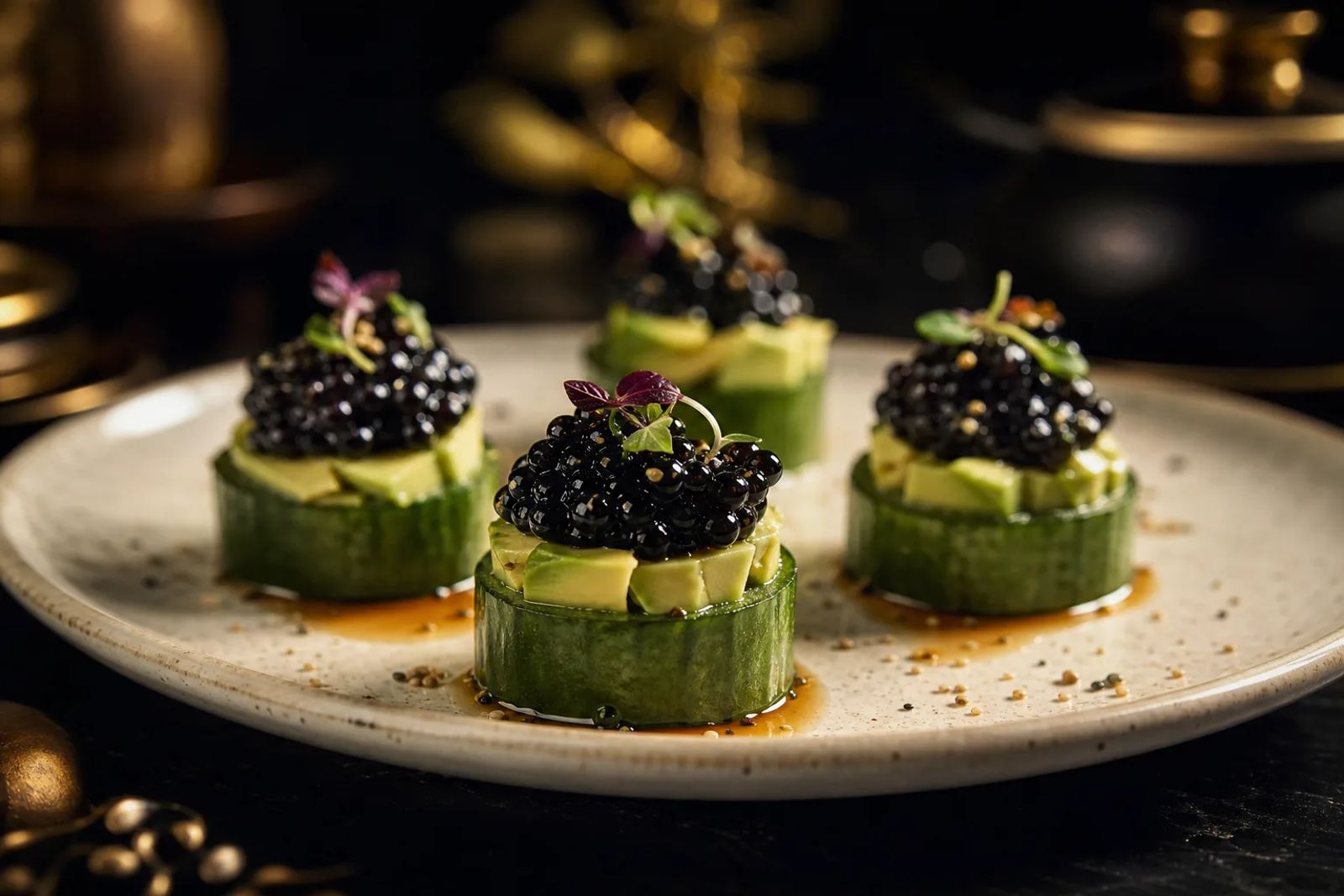
A black pearl can owe its colour to carbon and its shape to algae. One commercial seaweed caviar combines both, using seaweed extracts in beads that resemble fish roe. Seaweed and vegan caviar are plant-based pearls, not eggs taken from fish; some products use seaweed-derived gels. Flavour, storage, iodine content and labelling requirements depend on the formulation and market.
What goes into the pearls
One commercial ingredient list names water, salt, sunflower oil, sodium alginate from brown algae, agar from red algae, another thickener, spices, carbon colouring and lactic acid. This is a formulated food using seaweed extracts, not necessarily whole or chopped seaweed shaped into beads.
Alginate and agar build the structure. Oil, salt, spices and colourings help determine the finished result. That ingredient list describes one manufacturer's formulation; another black pearl may use different seaweed, colouring, flavouring or other ingredients. Read the actual declaration rather than letting a familiar appearance stand in for an ingredient check.
The same declaration gives 5.5 g of salt per 100 g, equivalent to 0.825 g in a 15 g serving. The figure is for salt, not sodium, and belongs to that formulation. For a broader view of the garnishes available, start with our guide to caviar alternatives and lookalikes.
How the pearls take shape
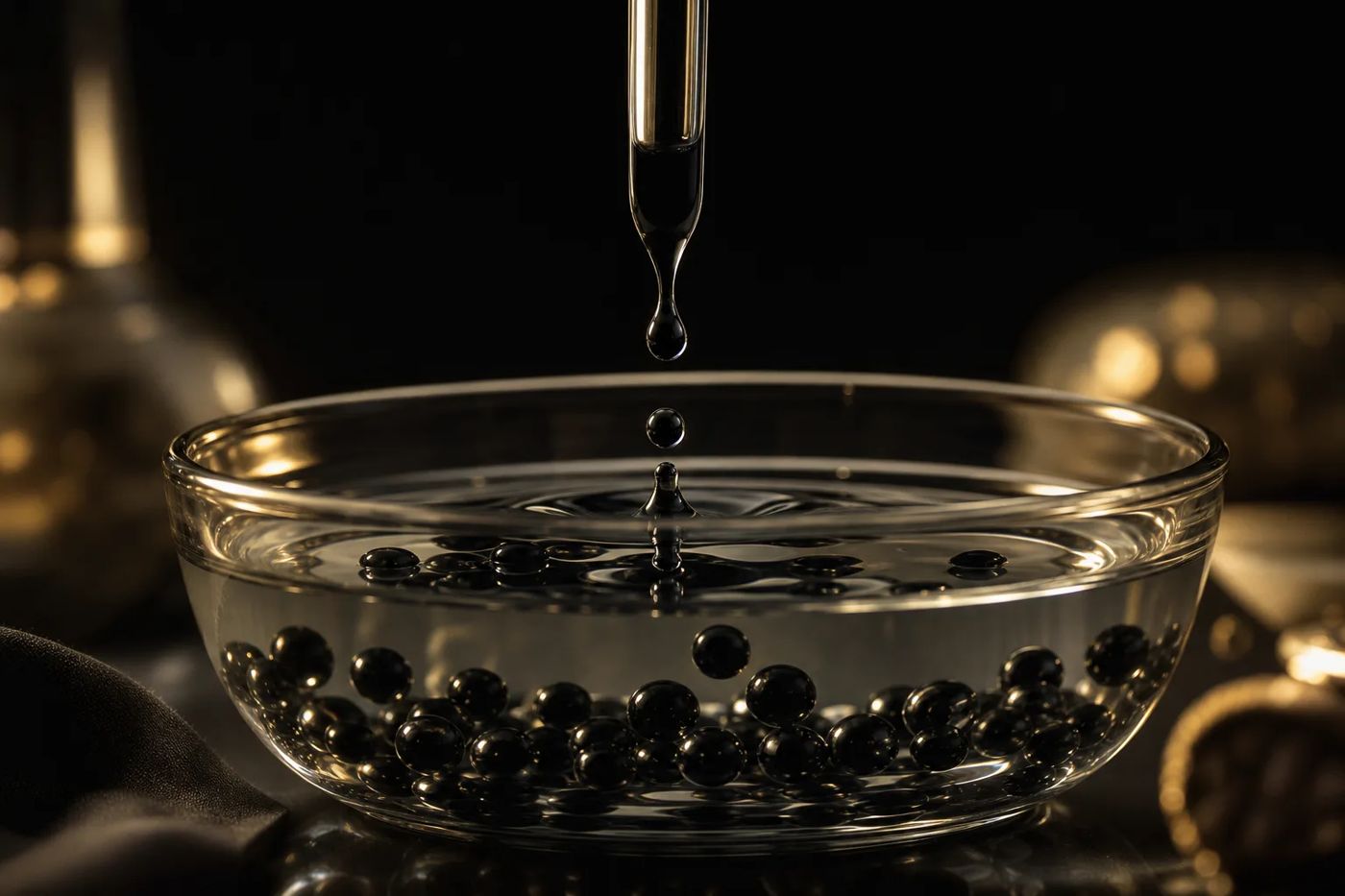
In the systems described here, gel chemistry provides the structure. In an alginate system, droplets meet calcium ions, which link alginate chains into a gel, creating a rounded bead rather than a biological egg. Agar works differently: it forms a gel as a heated solution cools.
A yielding centre and a bead gelled all the way through are different designs. Processing helps determine which texture emerges, so a commercial pearl need not be a liquid-filled sphere. The guide to spherified caviar and molecular gastronomy explains the technique in more detail; the essential distinction here is manufactured gel versus natural roe.
One producer describes its seaweed pearls as bringing colour, texture and versatility to dishes. The listed oil, salt and spices help explain the formulation's contribution. How closely it tastes like sturgeon caviar remains a separate question: the cited sources contain no independent comparative tasting.
Heat and storage are different questions
A pearl can keep its shape in heat while changing its texture. A laboratory study of model calcium alginate beads heated between 40°C (104°F) and 100°C (212°F) found changes in physical properties. The study examined experimental gels, rather than the full range of commercial seaweed caviar formulations.
For a hot dish, check the chosen product's cooking instructions. The word seaweed promises no particular heat tolerance, and a bead that remains visibly intact may still have a different flavour or mouthfeel afterwards. Shape retention also says nothing about microbiological safety. Cooking behaviour and safe handling need their own answers.
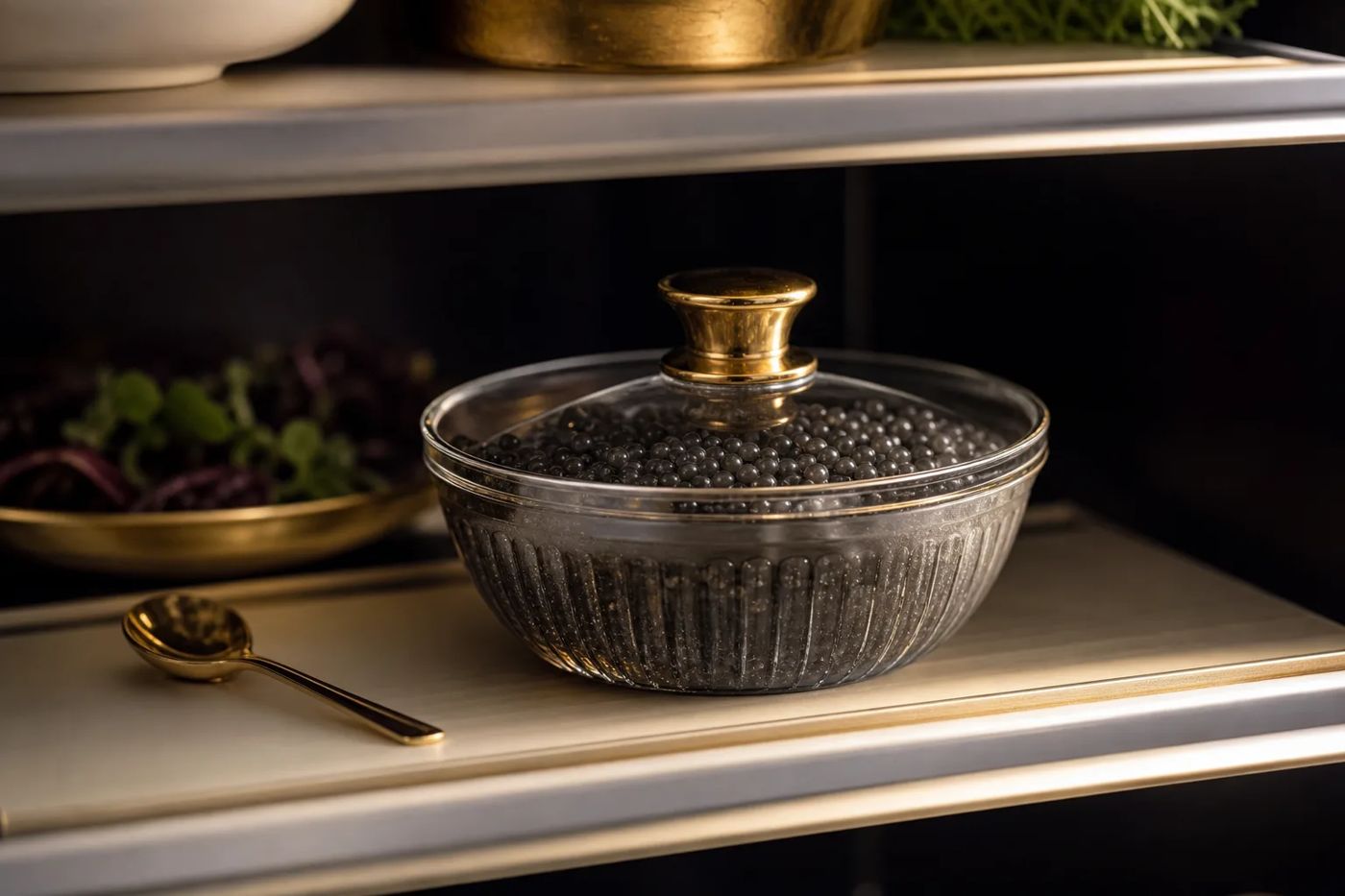
Storage is equally product-specific. The commercial declaration permits room-temperature storage unopened and requires refrigeration after opening, without establishing an opened shelf life for the category. Follow the pack's temperature, date and opening instructions. Fish caviar storage rules should not be transferred to a different food with its own validated preservation.
Iodine: use pearl data, not kelp data
Dried kelp figures cannot tell you the iodine content of seaweed pearls. Aakre and colleagues' 2021 study analysed 96 commercial seaweed products using inductively coupled plasma mass spectrometry. The three caviar alternatives contained 0.6 to 1 microgram of iodine per gram of original product, reported on a wet-weight basis.
Calculated from those figures, a 15 g serving would contain 9 to 15 micrograms. That is a useful reading of the study, rather than a specification for today's products. If iodine matters to your diet, ask the manufacturer for current product data. The name seaweed alone indicates neither a useful iodine dose nor an excessive intake.
UK NHS guidance gives adults a daily iodine requirement of 140 micrograms. The European upper intake level is 600 micrograms daily for adults, including pregnancy; the US NIH lists 1,100 micrograms for adults aged 19 and over. These upper limits concern total habitual intake. They are neither recommended targets nor thresholds for poisoning.
Vegan diets, fish allergy and pregnancy
A genuinely vegan formulation contains no intentionally used animal ingredients and is suitable for vegetarians on that basis. Seaweed in the name, however, describes only part of the recipe. Check flavourings and every other ingredient against your requirements, rather than checking the principal gelling ingredient alone.
For fish allergy, distinguish the recipe from cross-contact. Vegan foods exclude intentionally added fish ingredients, but the UK Food Standards Agency warns that fish allergens may still be present through cross-contact. Read ingredients and precautionary warnings, and ask the manufacturer about fish handling where necessary. The guide to fish allergy and caviar explains this distinction.
During pregnancy, look at the ingredients, iodine information and handling instructions together. A vegan claim cannot answer all three questions. UK NHS guidance recognises Listeria risks in chilled ready-to-eat foods but does not specifically approve seaweed pearls. Discuss personal questions with your doctor or midwife, particularly with thyroid disease or alongside iodine-containing prenatal supplements.
Can it legally be called caviar?
The food's name must tell the truth about what is in the pack. In the EU, Regulation 1169/2011, Articles 7 and 17, requires non-misleading information and an appropriate legal, customary or descriptive food name. A description such as seaweed-based caviar alternative clearly identifies the food, though the full label and national market still matter.
In an alginate system, droplets meet calcium ions, which link alginate chains into a gel, creating a rounded bead rather than a biological egg.
Great Britain applies Regulation (EU) No 1169/2011 as assimilated and amended in domestic law; Northern Ireland generally follows EU food labelling rules. Both require attention to the actual food name and presentation. Customs categories for caviar and substitutes concern tariff classification, a separate matter that does not itself authorise wording on a consumer label.
The EU Court's 4 October 2024 judgment in C-438/23 concerned vegetable-protein foods and animal-associated names. It limits blanket national prohibitions where no legal name exists, while misleading presentations remain actionable. The judgment informs this naming debate, but it concerned neither seaweed caviar specifically nor the legality of a particular seaweed pearl label.
In the US, FDA CPG 540.150 recommends unqualified caviar only for salted sturgeon roe. Its guidance for other fish eggs addresses the type size of the fish name and the declaration of added colour; it does not establish a naming policy for plant pearls.
The FDA's January 2025 guidance on plant alternatives is draft and nonbinding.
Federal misbranding law requires truthful naming, and neither guidance automatically authorises vegan caviar on every product.
What environmental claims actually establish
A sustainability claim needs evidence about the finished food. The manufacturer cited in source 2 markets its seaweed alternative as sustainable. The cited sources, however, contain no comparative life-cycle assessment covering the finished pearls, their ingredients, processing, packaging and transport together. The supplier's claim therefore cannot establish that every seaweed pearl has a lower environmental impact than all roe.
Choose a garnish whose composition suits you, whose behaviour suits the dish and whose environmental claims are substantiated. Read [caviar substitutes compared](a-caviar-substitutes-compared.
Sources
Commercial sources are listed for reference only; their product names are not used in the text.
- Finlandia Caviar. Vegan Cavi’ar, undated ingredient, nutrition and storage declaration, checked November 2026;
- Cavi-art. Manufacturer homepage and Sustainability, undated commercial statements, checked November 2026. Homepage; sustainability statement.
- Foods, MDPI. Changes in the Physical Properties of Calcium Alginate Gel Beads under a Wide Range of Gelation Temperature Conditions, research article, 2020. Full text.
- arXiv. Normal force controlled rheology applied to agar gelation, research preprint, arXiv:1508.01689, 2015. Research record.
- Foods, MDPI. Effects of Thermal Treatment on the Physical Properties of Edible Calcium Alginate Gel Beads: Response Surface Methodological Approach, volume 8, article 578, 2019. Full text.
- Aakre et al., Food & Nutrition Research. Commercially available kelp and seaweed products: valuable iodine source or risk of excess intake?, original research, 2021. Full text.
- NHS. Vitamins and minerals: Iodine, current online guidance checked November 2026. Guidance.
- European Food Safety Authority. Summary of Tolerable Upper Intake Levels, Overview on Tolerable Upper Intake Levels, 2024 summary report, iodine row citing SCF 2002. Summary tables.
- US National Institutes of Health, Office of Dietary Supplements. Iodine: Fact Sheet for Health Professionals, current online edition checked November 2026. Fact sheet.
- Food Standards Agency. Vegan food and allergens, current online guidance checked November 2026. Official PDF.
- NHS. Listeriosis, current online guidance checked November 2026. Guidance.
- European Parliament and Council. Regulation (EU) No 1169/2011 on the provision of food information to consumers, 2011, Articles 2, 7 and 17 and Annex VI. EUR-Lex record.
- UK Government. Food labelling: giving food information to consumers, updated 20 September 2022, checked November 2026; Food Standards Agency, Allergen guidance for food businesses, current online edition. Food information guidance; FSA guidance.
- Court of Justice of the European Union. Protéines France and Others, Case C-438/23, judgment of 4 October 2024, operative ruling published in the Official Journal on 3 March 2025; European Commission, answer E-002312/2024, 27 March 2025. Official ruling; Commission explanation.
- US Food and Drug Administration. CPG Sec 540.150 Caviar, Use of Term: Labeling, October 1989, current published guidance checked November 2026. Guidance.
- US Food and Drug Administration. Draft Guidance for Industry: Labeling of Plant-Based Alternatives to Animal-Derived Foods, January 2025, marked draft and not for implementation when checked. Guidance record.
- US Government Publishing Office. United States Code, Title 21, section 343: Misbranded food, 2024 edition, particularly subsections (a), (b), (c) and (i). Statutory text.
This piece was researched from a commercial ingredient declaration, original gel and iodine research, official health guidance, food information legislation and published regulatory guidance; no product tasting or recipe testing was undertaken.
Last checked: November 2026