
Desietra is a German sturgeon farmer and caviar producer based in Fulda, operating as DESIETRA GmbH. Its published range covers six named sturgeon species, but its farming network extends beyond Germany, so the brand’s address alone cannot establish the origin of an individual batch.
Desietra at a glance
| Legal entity and country | DESIETRA GmbH, Germany, according to its company imprint. 1 |
| Founded | 2002, according to the company. 2 |
| Headquarters | Kruppstraße 5, 36041 Fulda, Germany, according to the company. 1 |
| Operating base | Fulda: fish farming is documented by the regional authority; the company describes production and an indoor recirculating system there. 3,4 |
| Role | Breeder, farmer, processor and supplier of caviar and sturgeon meat, according to company descriptions. 2,5 |
| Own roe or sourced | According to Desietra, all sturgeon in its stocks come from its own breeding. 2 |
| Species and origins | Six species plus albino sterlet are listed by the company; individual product origins require batch documentation. 7 |
The business behind Desietra
The company’s imprint identifies DESIETRA GmbH, a German limited liability company, with its seat in Fulda and registration at the local court under HRB 2100. It names William F. Holst III and Frank Brömmelhaus as managing directors; management appointments are not evidence of share ownership.
Desietra dates its founding and the start of caviar, live fish and sturgeon meat production to 2002.
There is independent official evidence that this is a working fish farming business, not merely a brand using a German address. The Regierungspräsidium Kassel records a visit to Desietra in Fulda in its account of regional agricultural businesses.
Where the fish are raised
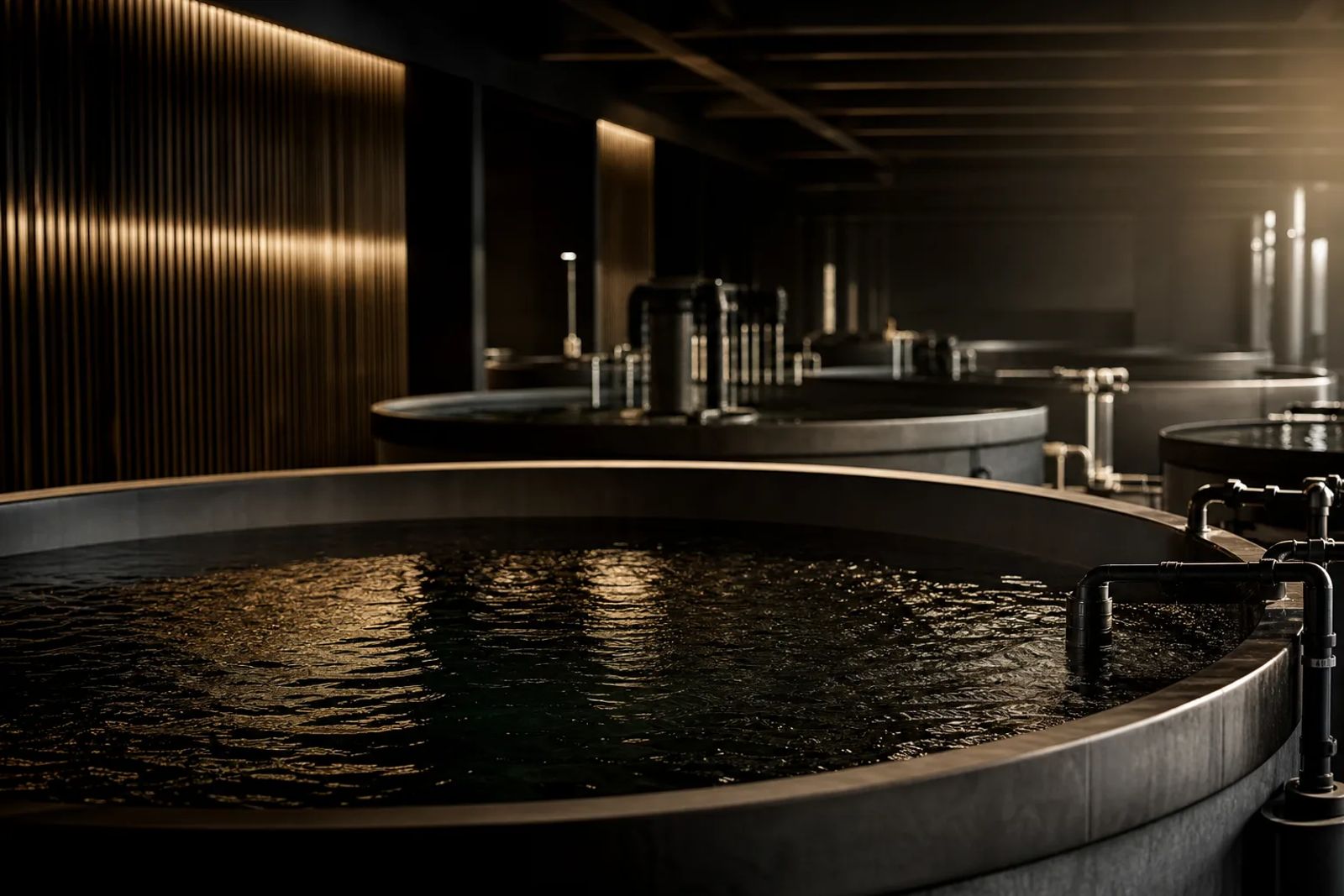
Fulda is the clearest documented operating location. Desietra’s recruitment page explicitly describes its production department and indoor recirculating aquaculture system there, meaning a tank system in which water is treated and reused rather than simply passing through once.
According to its production account, young fish start in its breeding tanks before moving to company farms in France, Italy and Hungary, or external farms in Bavaria. Females considered ready for caviar return to Fulda, where they are held separately by species before production.
This describes a multi-site production chain, not an exclusively indoor German lifetime for every fish. The company’s country list does not itself identify each farm’s address, operating entity or the origin assigned to each finished batch.
French government sanitary records also name a Pisciculture DESIETRA facility at 95b Barville bas, 57790 Nitting, with reference FR57509021CE. That independently supports a French operating connection, but a sanitary listing is not a corporate ownership record or evidence that a particular Desietra tin contains roe of French origin.
Desietra’s assertion of self-produced stock concerns the fish it breeds. Moving those fish to an outside grow-out farm is not, by itself, evidence that the company buys finished caviar from unrelated producers; equally, it cannot prove that every product ever supplied by the business came through the same route.
For a connoisseur comparing provenance, those are separate questions worth asking. The wider German caviar picture provides context, but a national industry profile cannot replace the records for a particular producer’s fish.
Which caviar Desietra lists
Desietra’s species page supplies the following name mappings. These describe the producer’s published range, not a verified inventory of fish at every farm or a promise that every variety is currently being produced.
| Desietra name | Species identified by the company |
|---|---|
| Beluga | Huso huso |
| Osietra | Acipenser gueldenstaedtii |
| Baerii | Acipenser baerii |
| Transmontanus | Acipenser transmontanus, white sturgeon |
| Sevruga | Acipenser stellatus |
| Sterlet or Sterletkaya | Acipenser ruthenus |
| Albino | Acipenser ruthenus, albino sterlet |
The distinction between Sterlet and Sevruga matters: the company maps them to different species, despite comparing their eating qualities. Likewise, its Albino entry is explicitly albino sterlet, not an unidentified pale roe or a separate species.
According to Desietra, its Osietra comes from Acipenser gueldenstaedtii.
What it is known for
Desietra’s documented identity is that of an integrated producer: breeding and rearing fish, producing roe and sturgeon meat, and supplying other food businesses. Its packaging information describes original bulk containers intended for subsequent repacking and also lists a white-label service for business customers.
That helps explain why a producer and the name on a retail tin need not be the same business. When evaluating a house, distinguish the company that raised the fish, the plant that processed the roe and any business that later divided it into smaller containers. The caviar houses and producers hub separates these different roles across the trade.
Desietra describes its Osietra as firm-skinned and its albino sterlet roe as cream-coloured to almost white. These are producer descriptions, not site tasting results.
Claims about husbandry and sustainability
Desietra says that its stocks come from its own reproduction. It also says it uses no hormones or antibiotics during rearing and fattening; this is a company statement with that stated scope, not an independently audited claim covering every procedure.
According to Desietra, its hormone statement concerns rearing and fattening.
The company also characterises its farming as sustainable and ecological. To assess those terms independently, useful evidence would include water and energy use, feed sourcing, effluent management, mortality and welfare records, together with the scope and date of any external audit.
A concrete caution concerns certification. The ISO 9001:2015 certificate linked from Desietra’s website records aquaculture and caviar production within its scope, but its stated validity ended on 23 July 2024; it cannot establish current certification in November 2026.
Reading origin and processing on the label
For Desietra, the practical starting point is the actual container’s CITES label, not a German flag, a seller’s address or the house name. Germany’s Federal Agency for Nature Conservation, the BfN, explains that commercial sturgeon caviar containers require non-reusable labels, including for sale within Germany and the EU.
According to EU rules, check species, source code, country, year, plant code and lot or permit reference; repacking labels identify the repacking country and year. For repacked caviar, ask the supplier to distinguish the original production records from the later repacking records.
The BfN identifies Regulation (EC) No 865/2006 as the legal basis for German caviar packaging registration and labelling. It also distinguishes processors and repackers, which require registration, from businesses simply reselling properly labelled original containers without opening them.
A company registration number, a food establishment approval and a CITES plant registration answer different questions and should not be substituted for one another.
For checking the operation rather than the branding, use how to check a producer’s registration. A CITES label is a traceability mechanism, not analytical proof of the contents of the container.
Destination labelling and import requirements must be checked separately.
For Desietra, the practical starting point is the actual container’s CITES label, not a German flag, a seller’s address or the house name.
The immediate provenance question remains narrower: which fish, which origin and which processing history belong to this batch? Country of origin versus repacking explains why those details must be kept separate when caviar passes through more than one business.
Sources
- DESIETRA GmbH, Impressum, undated web edition, retrieved November 2026. Legal identity, registered seat, address, register reference and named management.
- DESIETRA GmbH, Über uns, undated web edition, retrieved November 2026. Company account of founding, reproduction, husbandry and production.
- Regierungspräsidium Kassel, Von Biogas bis Baumschule: Regierungspräsident Mark Weinmeister schließt Sommerreise durch NOH ab, web edition, retrieved November 2026. Official account identifying Desietra’s Fulda fish farming operation.
- DESIETRA GmbH, Jobs & Karriere, undated web edition, retrieved November 2026. Description of production and the indoor recirculating facility in Fulda.
- DESIETRA GmbH, Produktion, undated web edition, retrieved November 2026. Company account of growing locations, fish movements and husbandry.
- French Ministry of Agriculture, Statuts sanitaires des zones et compartiments piscicoles, revision dated 6 February 2026. Entry for Pisciculture DESIETRA, Nitting.
- DESIETRA GmbH, Störarten & Kaviarsorten, company species descriptions, November 2026. Published product names, scientific names and producer descriptions.
- DESIETRA GmbH, Verpackungsarten, company packaging information, November 2026. Bulk packaging, subsequent repacking and white-label category.
- TÜV Rheinland Cert GmbH, Certificate: DESIETRA GmbH, ISO 9001:2015, issued 4 November 2021, registration 01 100 090207; stated validity ending 23 July 2024.
- Bundesamt für Naturschutz, Kaviar, undated official guidance, retrieved November 2026. German packaging registration, labelling and the distinction between repacking and unchanged resale.
Last checked: November 2026