
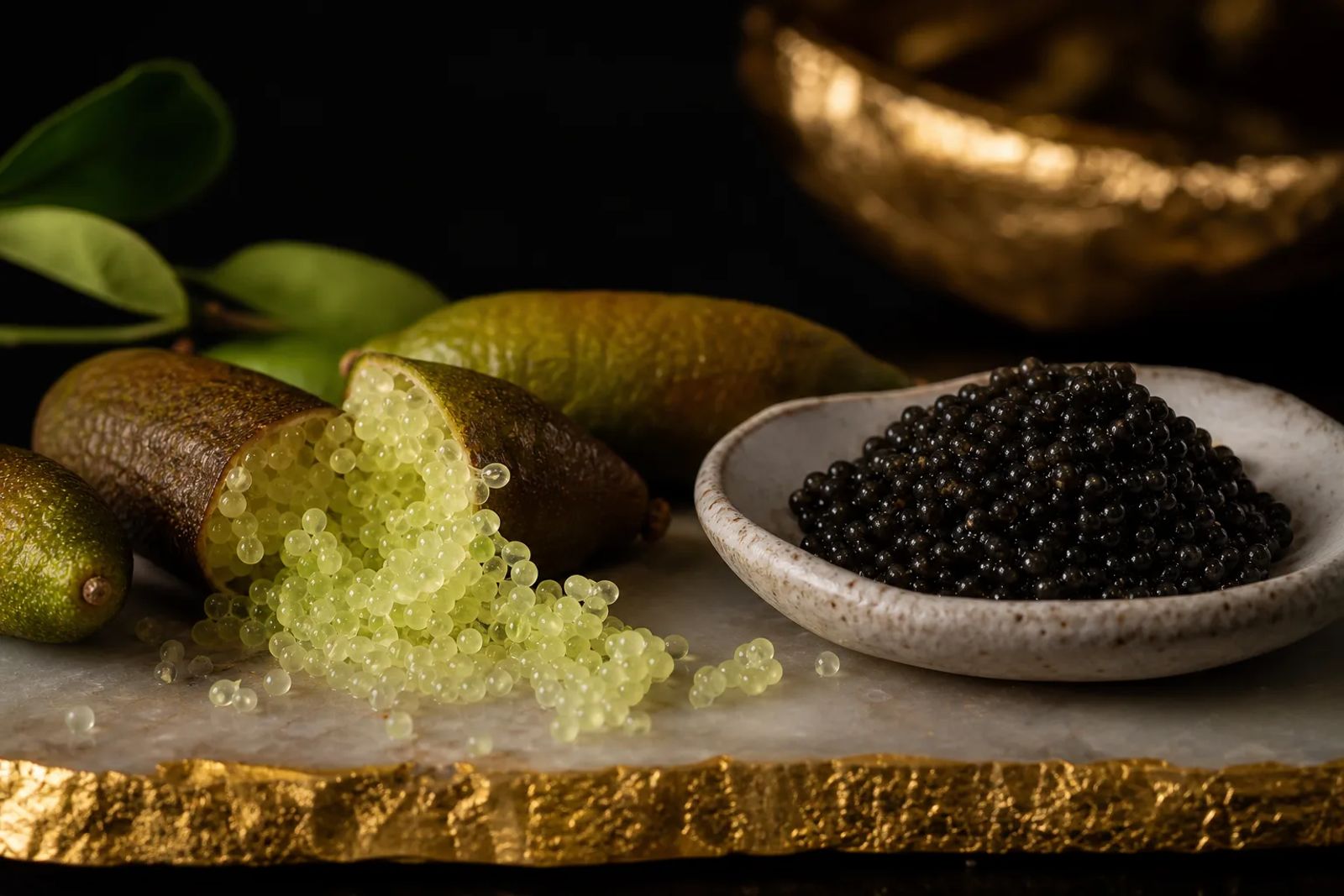
Finger lime makes its own pearls: the beads of “citrus caviar” are the fruit’s natural juice sacs, not a cook’s invention.
Truffle pearls take a different route to the plate. They are manufactured spheres containing truffle juice, flavouring or both. Neither is fish roe. Their resemblance to caviar is chiefly visual; their appeal lies in the very different flavours they bring to a dish.
What is finger lime “citrus caviar”?
Finger lime comes from the subtropical rainforests of Australia, with a native range running from south-eastern Queensland to north-eastern New South Wales. Kew’s Plants of the World Online accepts the scientific name Citrus australasica; Microcitrus australasica is a synonym still found in horticultural literature.
The pearls are juice vesicles: small sacs holding the fruit’s juice, not seeds or gel beads made by a cook. The University of Florida’s finger lime recipe book describes colours including pink, green and yellow, while its extension service describes lemon, lime and grapefruit flavours. These descriptions do not guarantee that every cultivar tastes alike.
Australian origin describes the species, not necessarily the fruit in your kitchen. University of Florida extension publications document commercial cultivation in California, and its researchers are developing finger lime cultivation in Florida. For the separate story of fish roe, see caviar in Australia and New Zealand.
Season and storage
Finger lime must be picked ripe: it does not ripen afterwards. In northern New South Wales, the state agriculture guide records fruit maturing between December and May, with the main harvest from March to May. Cultivar and climate affect that window, so it is not a worldwide availability calendar.
For whole fresh fruit, the same guide gives commercial cool-room storage of 5 to 10°C (41 to 50°F), with a reported shelf life of four to five weeks under those conditions. Temperatures below 4°C (39°F) risk chilling injury. These figures concern the quality of intact fruit, not the safe storage of oysters or caviar served alongside it.
At home, follow the supplier’s instructions rather than counting on the full commercial shelf life. The guide also permits frozen whole fruit or pulp to be held at −18°C (0°F) for three to six months. Thaw it in the refrigerator.
How cooks use the two kinds of pearl
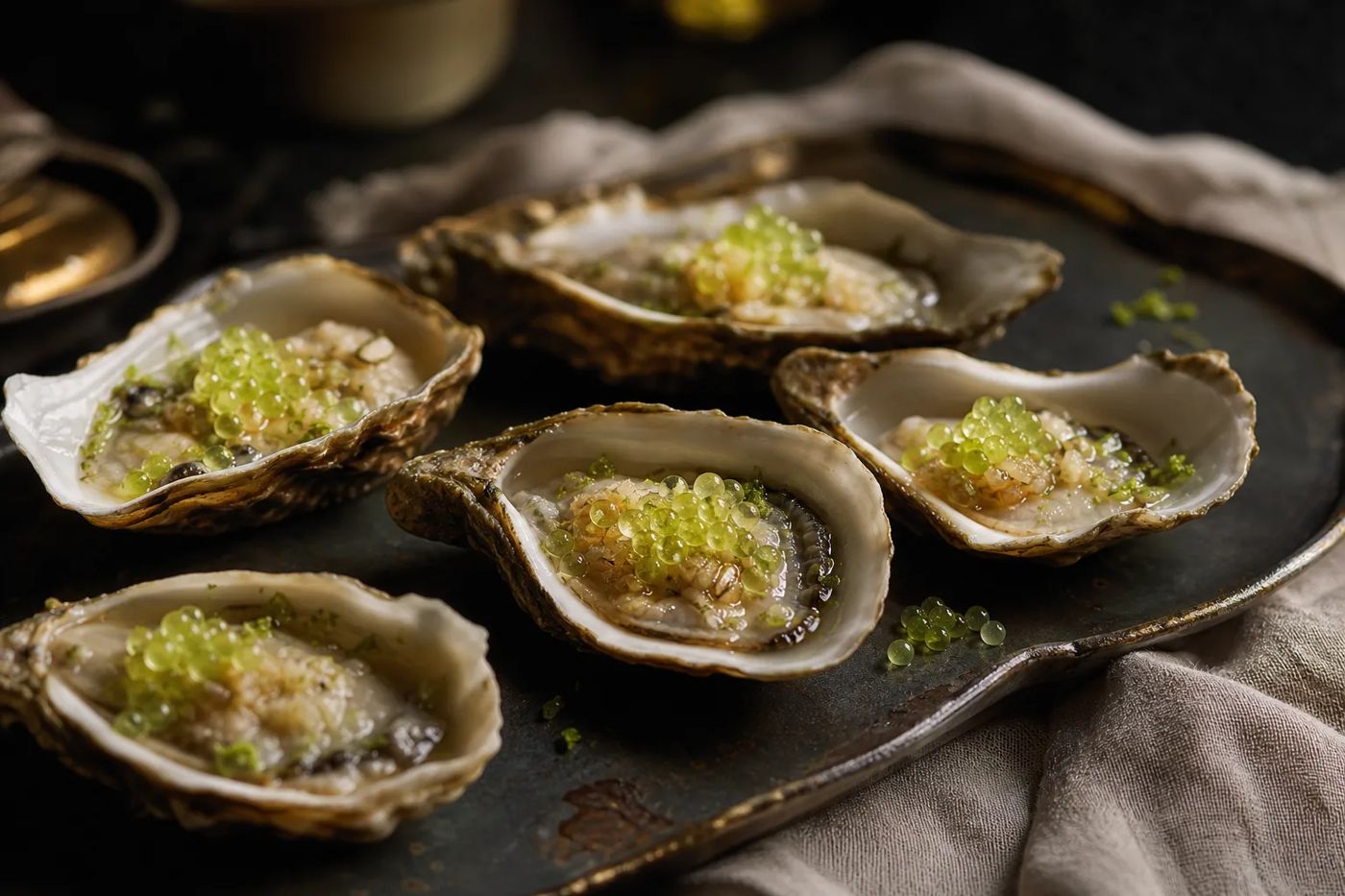
Put finger lime where a dish needs citrus. RICARDO’s oyster recipe scatters the pulp over a lime-and-ginger mignonette; David Bazirgan’s recipe published by Saveur folds it into beurre blanc for seared scallops. The fruit supplies acidity, not caviar’s fish-roe character.
It can also sit beside caviar. In Russell Bateman’s scallop recipe published by The Staff Canteen, finger lime pearls sit on the scallop, with dehydrated caviar grated over them. To try the combination in another dish, taste a small mouthful together before dressing the whole plate: the balance needs to work for that particular caviar service.
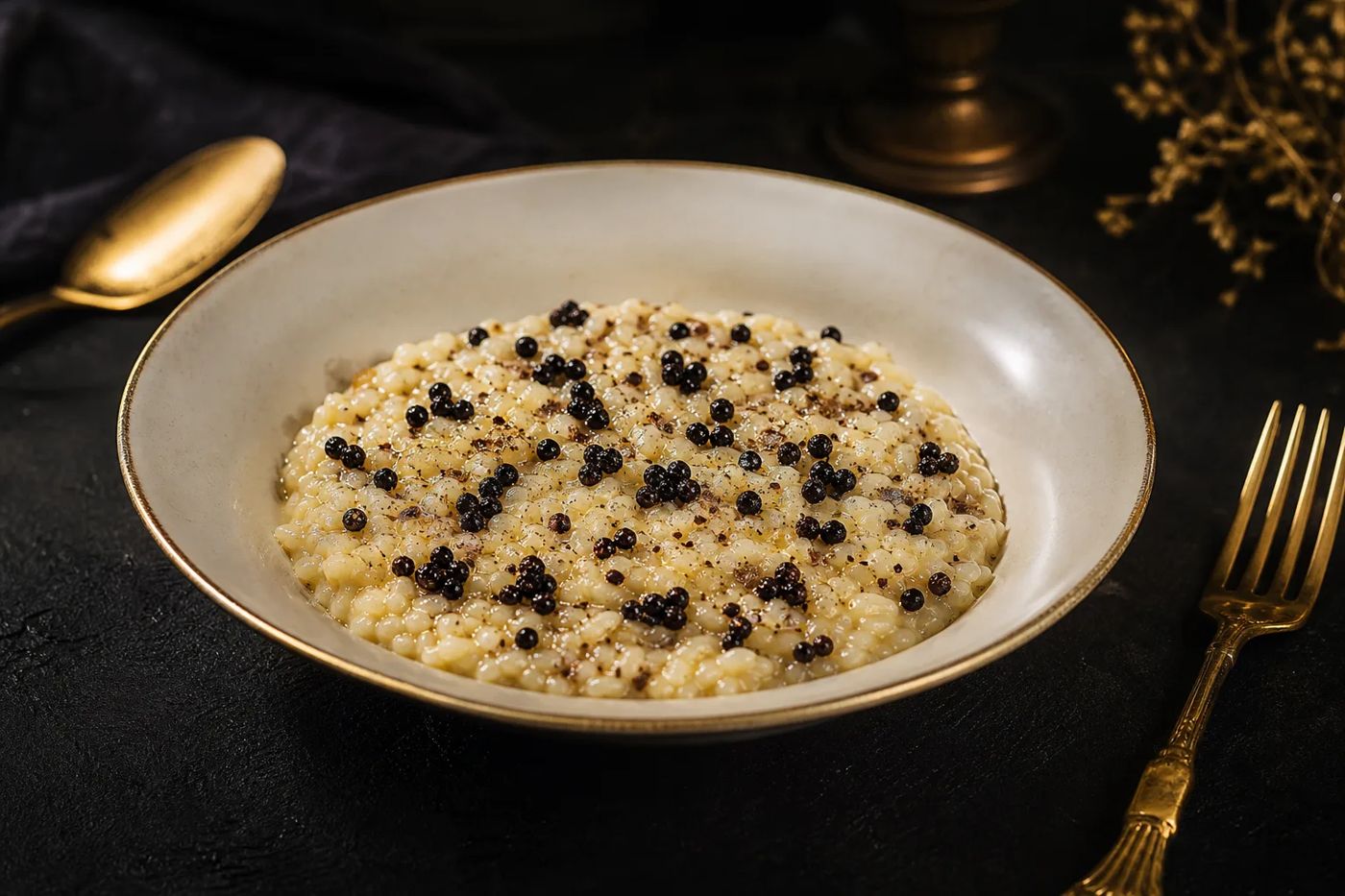
Truffle pearl producers suggest pasta, risotto, eggs and crostini. Those are serving suggestions rather than tested recipes, but they point towards a different role. Choose finger lime for citrus and truffle pearls for a truffle-flavoured garnish. Neither needs to impersonate fish roe to earn its place on the plate.
What is inside truffle pearls?
The ingredient list tells you more than the dark sphere. Truffle pearls are formulated foods, and their compositions differ substantially.
One manufacturer lists black truffle juice, water, potato starch, salt, flavouring, sodium alginate, squid ink and other stabilisers. Another declares summer truffle juice alongside a small amount of summer truffle, cuttlefish ink and flavourings. A retailer’s aroma-based version lists water, alginate, calcium chloride, sunflower oil, vegetable charcoal and truffle aroma, with no truffle juice or pieces.
Alginate is a gelling ingredient used to form pearls; the detailed method belongs in spherification and molecular gastronomy. A dark pearl is not necessarily a piece of truffle, and truffle juice can appear alongside added flavouring. Read the full list, including the ingredients within any declared juice or extract, to understand what supplies the flavour and colour.
Names and truffle flavour labelling
“Finger lime” or “finger lime juice vesicles” tells readers what the fruit is. For manufactured spheres, “truffle pearls” or “truffle-flavoured pearls” should reflect their composition. These are useful naming recommendations, not blanket legal approvals. The wider family of borrowed names is covered in caviar alternatives and lookalikes.
In the EU, Regulation (EC) No 1334/2008, Article 16, distinguishes “natural truffle flavouring” from generic “natural flavouring”. For the named-source description, at least 95% by weight of the flavouring component must come from that source.
The distinction matters: it does not mean that 95% of the pearls are truffle. Generic flavouring wording does not establish that truffle itself is present. EU food information must not mislead under Regulation (EU) No 1169/2011, Article 7.
Neither needs to impersonate fish roe to earn its place on the plate.
Great Britain has its own assimilated version of that regulation. EU flavourings law generally applies in Northern Ireland, with specific arrangements for eligible goods moved from Great Britain. Across the UK, food information must not mislead.
The same principle of clear description matters in Australia, where FSANZ sets label rules: “citrus caviar” should explain the food, not suggest fish eggs.
In the US, 21 CFR 101.22 governs flavour declarations and descriptions of a food’s characteristic flavour. “Natural flavor” alone does not establish that the flavour comes from truffle; the required description depends on the food and its flavouring.
The FDA’s separate, nonbinding caviar guidance concerns fish eggs. It does not automatically authorise calling fruit or gel pearls “caviar”.
Diet and allergen checks
Plain finger lime is fruit and suitable for vegan cooking. Serving it on an oyster or with caviar changes the dish, not the fruit.
Truffle pearls need a closer check. They are not automatically vegetarian, vegan or suitable for someone avoiding seafood: the squid and cuttlefish inks in the ingredient lists examined are animal ingredients from molluscs. When an allergy is involved, confirm the complete formulation and any cross-contact information with the supplier.
Check salt too. One manufacturer’s truffle pearls declare 1.7 g salt per 100 g, a figure for that product rather than a category average. For storage and use after opening, follow each product’s own instructions. The whole-fruit guidance above belongs to finger lime, not a jar of truffle pearls.
Sources
- Royal Botanic Gardens, Kew. Plants of the World Online: Citrus australasica F.Muell. Live taxonomic record, undated. Taxon record.
- Industry & Investment NSW. Growing Australian native finger limes. Primefact 979, 2010. Agricultural guide.
- University of Florida, IFAS Extension. Growing Finger lime in Florida. 10 June 2021. Extension article.
- University of Florida, Horticultural Sciences Department. Finger Limes: An HLB-Tolerant Prospect for Florida Growers. 19 March 2025. Research programme report.
- University of Florida, IFAS. Recipe Sublime: Exploring the Flavor & Texture of Finger Limes. Undated edition. Recipe book.
- South Australian Native Foods Association. Finger Lime. Undated growing and culinary profile. Fruit profile.
- RICARDO. Lime and Ginger Oysters. Holiday 2015 edition; the page identifies the recipe as sponsored content. Published recipe.
- Saveur. Seared Scallops With Finger Lime Beurre Blanc. David Bazirgan’s recipe, November 2011. Published recipe.
- The Staff Canteen. Russell Bateman’s Diver Caught Scallops with Green Peppercorn, Finger Lime & Oyster Emulsion. 16 November 2017. Published recipe.
- Selektia Tartufi; Italia Tartufi; BienManger. Truffle Pearls ingredient declarations, consulted November 2026;
- European Parliament and Council. Regulation (EC) No 1334/2008 on flavourings. Consolidated text dated 25 May 2016, Article 16. Legal text.
- Food Standards Agency. Labelling guidance for prepacked for direct sale food products; Guidance on using the Register of Flavouring Authorisations. Live guidance, undated editions. Flavouring labelling guidance; Great Britain register guidance.
- UK Government. Food labelling and packaging; Labelling requirements for certain products moving from Great Britain to retail premises in Northern Ireland under the Northern Ireland Retail Movement Scheme. Live guidance. General labelling guidance; Northern Ireland movement guidance.
- European Commission. Action plan on online offers and advertising of food related to COVID-19. Undated guidance citing Regulation (EU) No 1169/2011, Article 7. Consumer-information rule.
- US Food and Drug Administration. 21 CFR 101.22: Foods; labeling of spices, flavorings, colorings and chemical preservatives. Live eCFR edition; CPG Sec. 540.150: Caviar, Use of Term, Labeling, October 1989. Flavour labelling regulation; Caviar guidance.
This piece was researched using botanical records, agricultural guidance, published chef recipes, declared product ingredients and official flavour labelling sources.
Last checked: November 2026