“Fresh” caviar is already a preserved food. Salt is part of its making, even when the roe has never received a pasteurising heat treatment. The word promises less than it seems: it does not reliably tell you whether preservatives were used.
The useful distinction is straightforward. Unpasteurised caviar has not received that heat treatment and is usually sold salted and chilled. Pasteurised caviar is heated after packing to improve keeping life. Choose by the stated treatment, ingredients, storage instructions and date, rather than “fresh” alone.
What fresh, unpasteurised and pasteurised caviar mean
In ordinary caviar trade language, “fresh” often means unpasteurised caviar kept chilled. Salting preserves the roe; it does not mean the caviar has been cooked. For the basic definition of salted sturgeon roe, start with what is caviar.
Unpasteurised tells you about heat, not the whole recipe. An unpasteurised product can contain an authorised preservative. Equally, “roe and salt only” describes the ingredients, not whether the sealed container was heated.
Pasteurised caviar receives a controlled heat treatment in its sealed container, followed by cooling. The process must suit both the product and its package. It is different from the sterilisation that produces a food stable at room temperature.
| Criterion | Unpasteurised, often sold as fresh | Pasteurised |
|---|---|---|
| Process | Salted roe, without pasteurising heat | Salted roe, heated after sealing |
| Typical storage | Chilled, as labelled | Usually chilled, as labelled |
| Sensory effects | No changes from pasteurising heat | Heat can alter grain firmness and flavour |
| Keeping life | Depends on product, date and storage | Treatment can extend unopened life under stated conditions |
| Useful wording | Unpasteurised; check ingredients too | Pasteurised; check refrigeration instructions |
What heat does to the bead
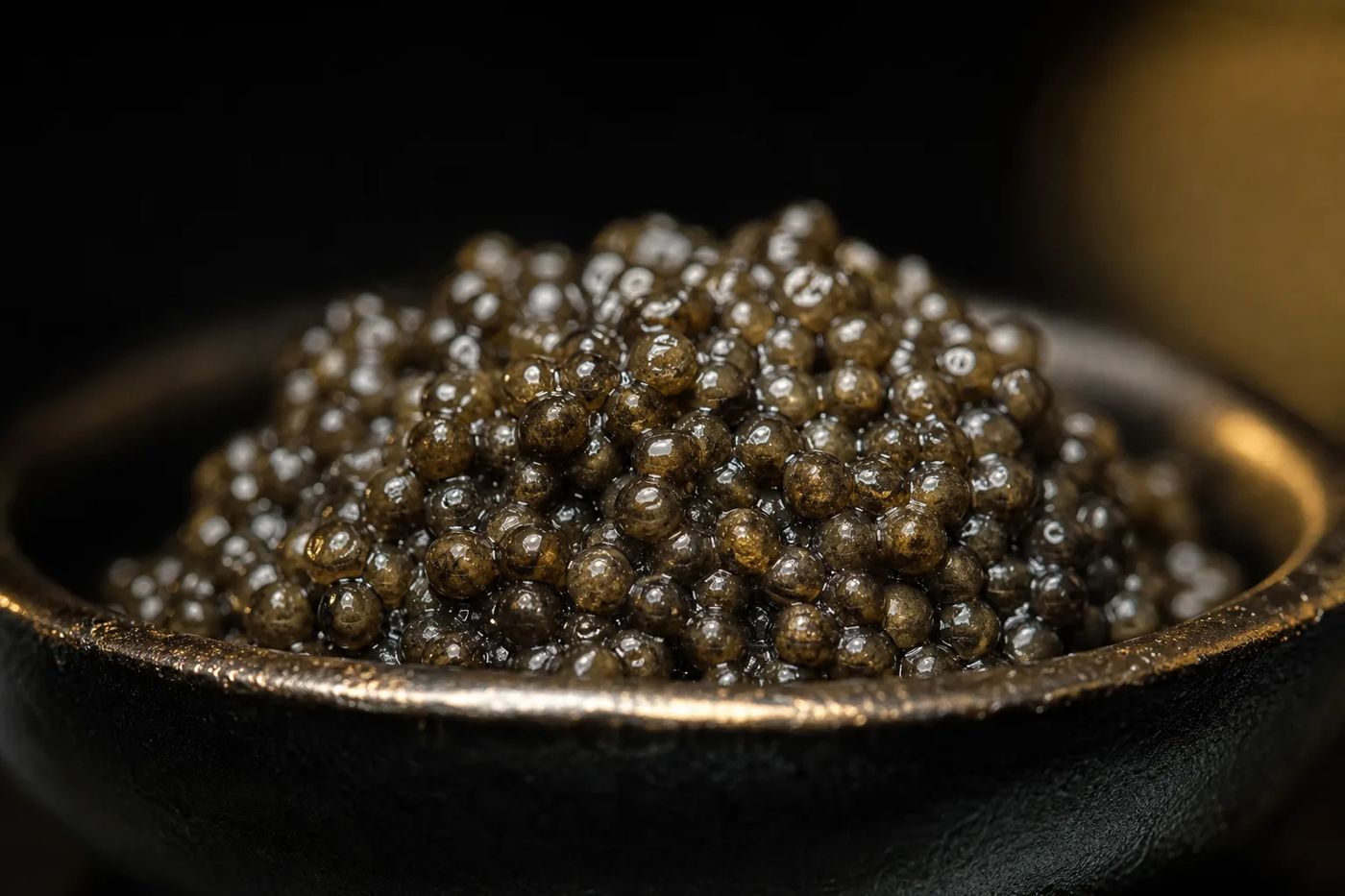
Heat can change how a caviar grain feels: the resistance of its membrane, the texture of its contents. It acts on the proteins that give the egg its structure. Codex committee guidance identifies hardened grains and changes in taste and flavour as potential processing defects.
Firmer beads are therefore possible, not inevitable. Nor does pasteurisation always dull flavour. The result depends on the caviar and the treatment it receives.
A 2025 study by Rocchetti and colleagues examined eight caviars from six sturgeon species through sensory assessment, texture evaluation and untargeted metabolomics, a broad survey of small chemical compounds. Crunchiness, colour uniformity and darkness helped distinguish the products. But species and preservative treatments also differed, so the study cannot isolate heat as the cause of those differences across all caviar.
Choose the treatment that suits your priorities, rather than treating it as an automatic quality ranking.There is no single preferred temperature for every caviar.
What these words mean legally
“Fresh caviar” has no single worldwide labelling rule. What matters is what the wording leads a buyer to believe under the food information law of the market where it is sold.
EU: Regulation (EU) No 1169/2011 does not define “fresh” specifically for caviar. Article 7 prohibits misleading information about characteristics and production methods. Annex VI requires treatment information alongside the food name when omitting it could mislead.
UK: Great Britain uses its assimilated version of that food information framework, with domestic enforcement legislation. Northern Ireland generally follows the applicable EU framework, with special arrangements for qualifying goods moved under the Northern Ireland Retail Movement Scheme. In both cases, look for clear treatment and ingredient information rather than relying on “fresh”.
US: The general rule is more specific: 21 CFR 101.95. Where “fresh” implies an unprocessed food, it means raw, not frozen and not thermally processed or otherwise preserved, apart from listed exceptions. Other uses remain subject to the prohibition on misleading labelling. Salted caviar needs to be assessed in context; the word does not automatically certify its processing history. A claim that caviar is pasteurised must likewise be accurate and not misleading.
Storage and shelf life: keep it cold
Pasteurisation can give an unopened container more time by reducing the microorganisms targeted by the validated process. It does not remove every hazard. Treat ordinary pasteurised caviar as chilled food unless the manufacturer explicitly documents otherwise.
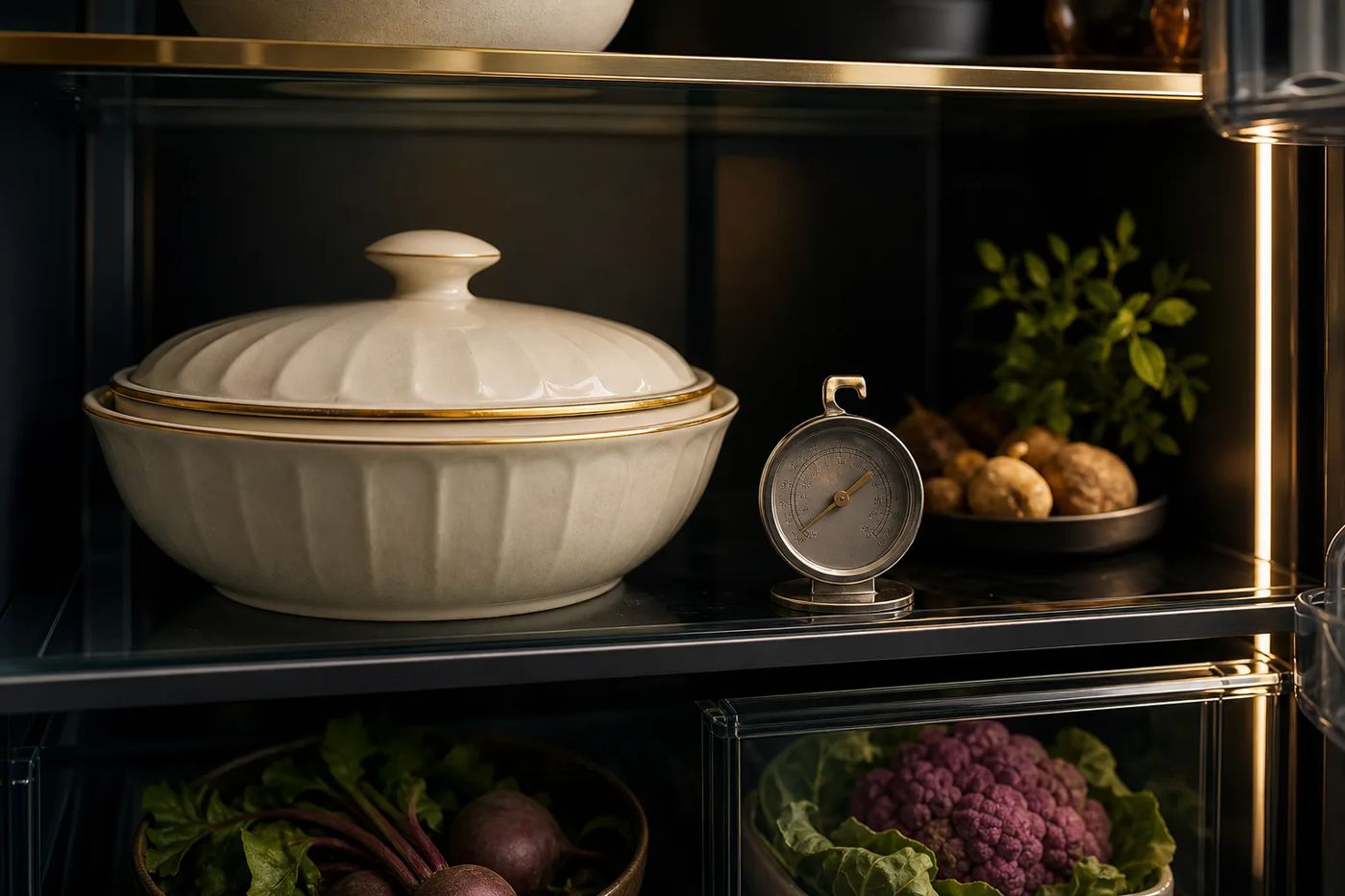
Codex CXS 291-2010 specifies 2 to 4°C (36 to 39°F) for packaging, storage and retail, with colder conditions for wholesale handling. This international reference standard is not a universal law for home storage. Follow the producer's validated temperature instructions for the container in front of you.
For household refrigeration in England, Northern Ireland and Wales, the Food Standards Agency advises 0 to 5°C (32 to 41°F). In the US, the FDA advises 4°C (40°F) or below. A colder limit on a caviar label takes precedence over these general fridge recommendations. Check with a thermometer, not just the appliance dial.
No single number of months describes the keeping life of all pasteurised caviar, or all unpasteurised caviar. Read the unopened date alongside the storage conditions, then follow the separate instructions for after opening. Extra unopened life does not give you extra time once the seal is broken.
Keep the main supply refrigerated and bring out only what you need for service. A storage temperature is not an invitation to let the whole container warm on the table. See how to store caviar at home for handling and unopened and opened shelf life for dating.
A pleasant smell and an intact seal cannot establish safety. FDA guidance explains that food can cause illness without looking, smelling or tasting spoiled. Never taste a questionable delivery to decide whether its temperature history was acceptable.
Preservatives: read the ingredients
Pasteurisation is a process. A preservative is an ingredient. Neither “fresh” nor “pasteurised” tells you whether boric acid or borax has been added; the ingredient list answers that question.
Heat can change how a caviar grain feels: the resistance of its membrane, the texture of its contents.
In the EU, Regulation (EC) No 1333/2008, Annex II, category 09.3, permits boric acid (E284) and sodium tetraborate, borax (E285), only for sturgeon eggs. Their combined contribution has a maximum of 4,000 mg/kg expressed as boric acid. That is one combined limit, not a separate allowance for each compound.
In Great Britain, the FSA's food additives register lists the authorisation, with conditions drawn from the assimilated Annex II. Northern Ireland's applicable EU regime permits the same caviar use.
In the US, check the FDA's current position on both compounds. Its listings for certain indirect food-contact uses do not amount to permission to add them to roe.
In Australia, the NSW Food Authority says the Australia New Zealand Food Standards Code does not permit borax in food. Its legal status in caviar in Switzerland and Japan is not documented.Permission in one market does not establish permission elsewhere.
Which should you choose?
For a tasting where avoiding changes caused by heat matters most, choose explicitly unpasteurised caviar. Look for clear ingredients and a delivery date that suits the occasion. This chooses a process, not a guaranteed winner in the glass or on the spoon: unpasteurised caviar will not invariably taste better than pasteurised caviar.
For a gift that may remain unopened, pasteurised caviar can make sense when its stated date gives the recipient more time. Confirm that they can refrigerate it on arrival. Check that the supplier's transport arrangements cover the whole journey, including any delay before handover.
For travel or an event, settle refrigeration and timing first, then choose the treatment. Longer unopened life can help with planning. It cannot compensate for an uncooled journey or a buffet without temperature control.
Before committing, ask four questions:
- Was it pasteurised?
- What ingredients were added?
- What temperature must it stay at?
- What date and opening instructions apply?
If the pack says only “fresh”, ask for the missing treatment information. The guide to reading a caviar label separates these practical details from traceability information.
If you want roe and salt only, say so explicitly. That is a different requirement from unpasteurised. Let the ingredient list, rather than a broad freshness claim, decide whether the product meets it.
FAQ
Can I pasteurise caviar at home?
Do not use a household water bath to turn unpasteurised caviar into a product with a longer keeping life. A safe commercial process depends on the formulation, container, heat penetration and controlled cooling. Simply reaching a warm water temperature is not enough.
Buy caviar with a validated treatment instead. Reheating a questionable tin cannot establish that it is safe.
Sources
-
FAO and WHO, Codex Alimentarius Commission. Standard for Sturgeon Caviar, CXS 291-2010, adopted 2010, last modified 2026. Amended 2011 and 2013; the Codex register records a 2026 modification. Standard.
-
FAO and WHO, Codex Committee on Fish and Fishery Products. Report of the Thirty-fourth Session, REP16/FFP, 2016, Appendix V, proposed caviar processing guidance, particularly cooling, maturation and optional pasteurisation. This is a committee report, not cited here as independently binding law. Report.
-
Rocchetti, G., Vezzulli, F., Senizza, B., Betti, A., Dordoni, R., Lambri, M. and Lucini, L. The contribution of sturgeon species and processing conditions on caviar texture, metabolomic profile and sensory traits. Food Chemistry, volume 463, article 141516, 2025. University repository abstract retrieved; full study not retrieved. Repository record.
-
European Parliament and Council. Regulation (EU) No 1169/2011 on the provision of food information to consumers, 2011, Article 7 and Annex VI, Part A. Official text.
-
UK Government and Food Standards Agency. Food labelling: giving food information to consumers, live guidance retrieved November 2026; Packaging and labelling, updated September 2026; Managing food safety, updated August 2026. Food information guidance, packaging guidance, food safety framework.
-
US Food and Drug Administration. 21 CFR 101.95: “Fresh,” “freshly frozen,” “fresh frozen,” “frozen fresh.” Electronic Code of Federal Regulations, live text retrieved November 2026. Regulation.
-
Food Standards Agency. How to chill, freeze and defrost food safely, live guidance retrieved November 2026, applying to England, Northern Ireland and Wales. Guidance.
-
US Food and Drug Administration. Are You Storing Food Safely? Live consumer guidance retrieved November 2026. Guidance.
-
European Parliament and Council. Regulation (EC) No 1333/2008 on food additives, consolidated text dated 2 July 2025, Annex II, category 09.3. EFSA ANS Panel. Scientific Opinion on the re-evaluation of boric acid (E284) and sodium tetraborate (borax) (E285) as food additives, EFSA Journal 11(10):3407, 2013. Regulation, EFSA opinion.
-
Food Standards Agency. Authorised Regulated Food and Feed Products for Great Britain: Boric acid, E284, register entry updated April 2025; Approved additives and E numbers, live list retrieved November 2026; Food additives authorisation guidance, live guidance retrieved November 2026. Register entry, additives list, authorisation guidance.
-
US Food and Drug Administration. Substances Added to Food: Boric acid, live inventory entry retrieved November 2026. Michigan State University, Institute for Integrative Toxicology. News from CRIS: Trending, Borax, August 2023.
-
NSW Food Authority. Borax and boric acid, live consumer guidance retrieved November 2026. Guidance.
This piece was researched through official standards, legislation, food authority guidance and a peer reviewed study abstract.
Last checked: November 2026