
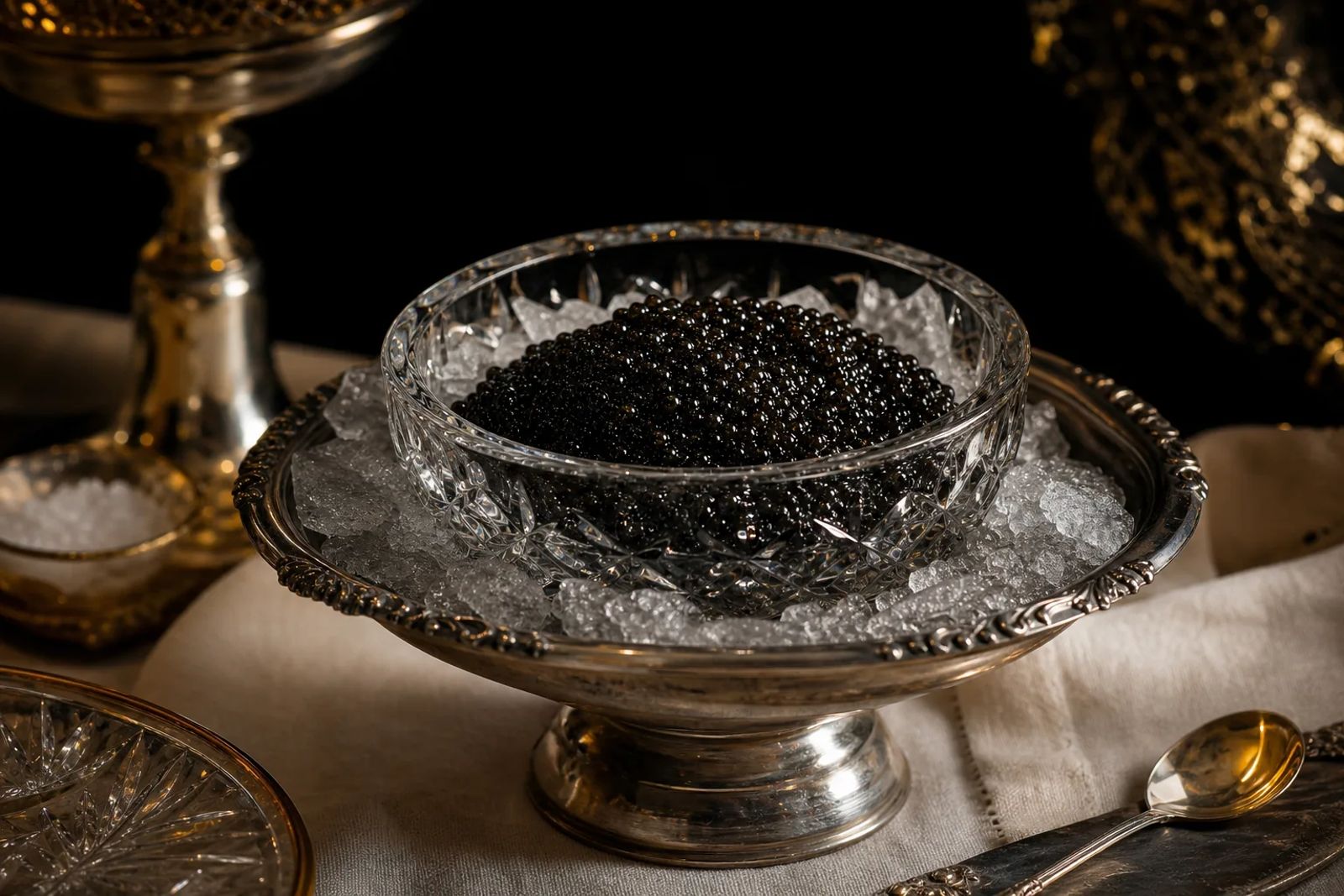
Caviar is fish roe, meaning eggs, prepared with salt; the Codex food standard uses the name specifically for roe from true sturgeons. Most caviar you encounter today comes from farming, and choosing it well means understanding the fish, the processing and the cold chain, not simply recognising a familiar name.
What counts as caviar?
Codex CXS 291-2010 covers salted eggs from the family Acipenseridae, including hybrids within that family. It is an international reference standard, not automatically binding national law. Salmon, trout and lumpfish roe are other fish eggs, not sturgeon caviar under that definition.
In the United States, FDA guidance says unqualified “caviar” should mean salted sturgeon roe. Other roe may be called, for example, “salmon caviar”, with the fish name in substantially the same size and prominence; artificial colour must also be prominently declared.
CITES, the wildlife trade convention, covers the wider order Acipenseriformes, which includes paddlefish as well as sturgeons. That trade scope does not change the Codex food definition; the plain-English definition explains the distinction without the legal shorthand.
In EU and UK customs classifications, caviar and substitutes occupy separate lines under heading 1604, respectively 1604 31 00 and 1604 32 00. These are customs categories, not a complete retail naming rule: consumer information must not mislead, under EU food information law and the applicable UK regimes, which distinguish Great Britain from Northern Ireland.
The fish behind the names
Start with the species name, not the grade on the lid. Under CITES nomenclature, beluga is Huso huso and Kaluga is Huso dauricus; “Kaluga Beluga” is a trade term, not true beluga.
Ossetra, also written Oscietra or Osetra, is the Codex usual name for Acipenser gueldenstaedtii and Acipenser persicus; check the actual species. Sevruga refers to Acipenser stellatus, while Siberian sturgeon is Acipenser baerii. Royal, Imperial, Golden and Reserve are commercial descriptions, not species or universal legal grades.
Colour alone will not tell you which fish produced the roe. Codex allows grey, black, yellow, brownish and greenish shades; use the species declaration rather than colour as an identification test.
A hybrid has parents of different species. One documented cross has a female Kaluga, Huso dauricus, and a male Amur sturgeon, Acipenser schrenckii; both parents matter more than a shortened marketing name.
This guide retains CITES names. Genus changes were proposed in 2025, but the IUCN Sturgeon Specialist Group and WSCS declined to support that revision at their October 2025 meeting. They proposed dissolving Huso; Eschmeyer's Catalog and WoRMS now list beluga as Acipenser huso. The species guide covers names and identification.
Where caviar comes from today
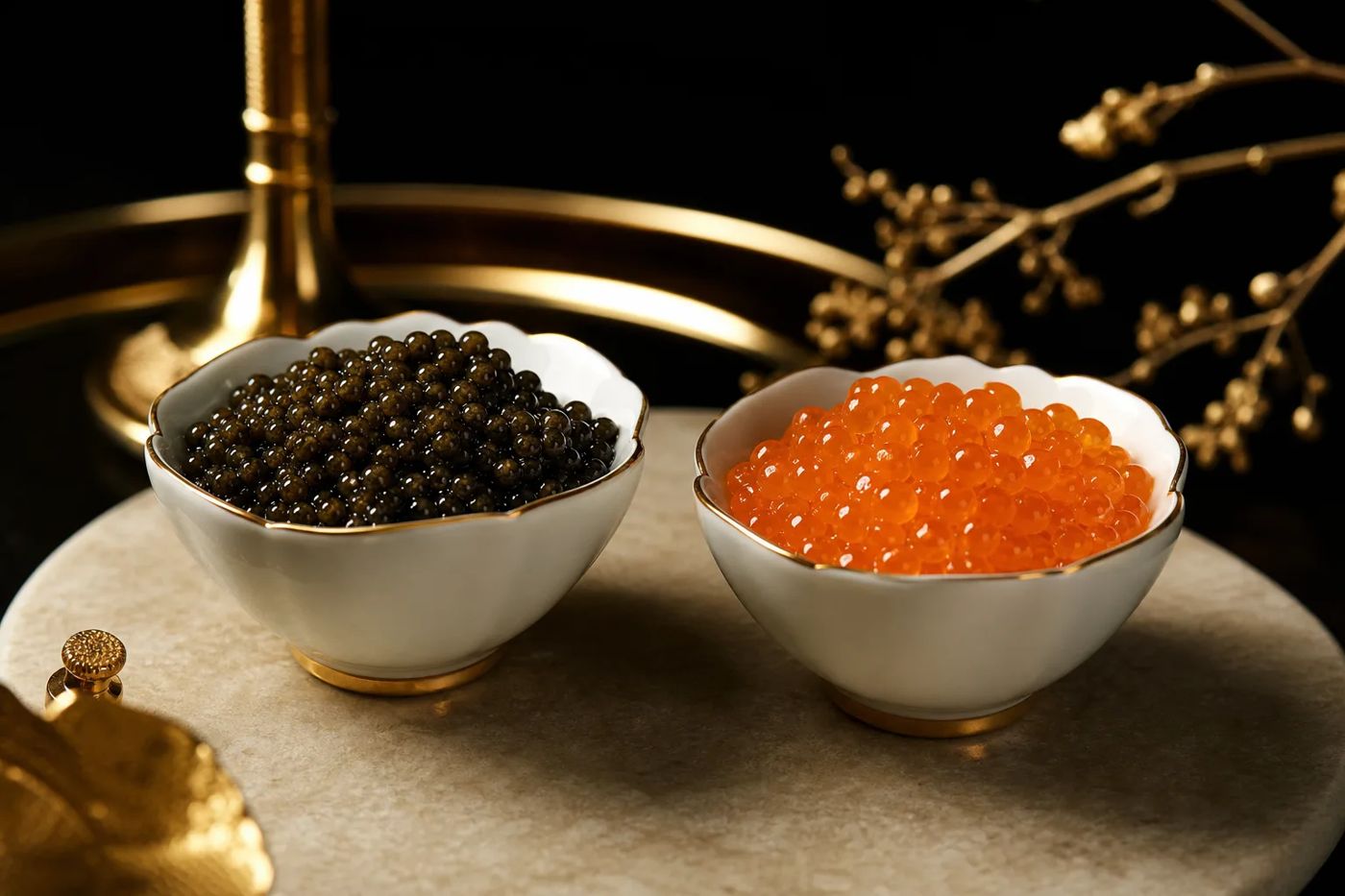
Farming has shifted caviar production beyond its historic Caspian and Black Sea associations. Documented farming countries include China, Italy, Poland, Bulgaria and Belgium; these are examples, not a current production ranking.
Wild caviar is not subject to one worldwide rule. Checked in November 2026, USFWS still provides a permit route for exports of lawfully harvested wild sturgeon or paddlefish products, while the EU requires established export quotas before permits for caviar from shared wild stocks can be issued.
Farming is not proof that a product has no environmental impact. Ask for a named species, documented origin and a traceable supplier rather than accepting an unsupported “sustainable” claim.
Buying legally within one country does not automatically authorise carrying the same caviar across a border. Import and export documents, wildlife restrictions and food-entry rules are separate checks; CITES suggests Parties cap personal exemptions at 125 g per person; national food entry rules still apply.
From living fish to packed caviar
Conventional caviar production normally involves killing the fish to collect the ovaries. Methods using eggs released at ovulation also exist, but collecting eggs without immediate death does not, by itself, establish good long-term welfare.
- Harvest: collect roe under hygienic conditions from fish selected for suitable egg development.
- Screen: separate eggs from ovarian tissue, taking care not to crush them.
- Rinse and drain: remove unwanted material and excess water.
- Salt: mix with measured food-grade salt under controlled conditions.
- Pack: fill suitable food containers, close them and apply traceability information.
- Mature: hold under controlled refrigeration so salt distributes through the product.
Codex permits ovulated eggs from farmed sturgeon, with specified treatment and controls on any hormones used. The processing guide explains these routes, optional pasteurisation, meaning heat treatment, and why treatments can change egg firmness.
These stages describe a process, not a fixed recipe for every farm. The processor must control hygiene, temperature and salt distribution together; adding salt at home does not turn loose fish eggs into an equivalent product with a validated shelf life.
What drives quality and value
Species and the age and maturity of the fish shape the starting material; older does not automatically mean better. Water quality, feed and any purging, a period of holding fish to reduce unwanted flavours before harvest, also matter, alongside careful handling that protects the eggs.
Conventional caviar production normally involves killing the fish to collect the ovaries.
Salting and maturation determine how the roe develops after collection. Freshness means appropriate handling and storage throughout that process, not simply the shortest time since packing; traceability lets you ask meaningful questions about what happened.
When comparing two options, ask for a description you can actually assess: intact grains, the degree of firmness, saltiness and any stated maturation. A named species offers context, but it cannot promise the same flavour in every batch; the producer's handling and your own preferences still count.
For a first purchase, choose a supplier who identifies the species and origin and gives clear storage and opening instructions. Ask what its grade describes: bead size, colour, selection or something else, then use the buying guide to compare like with like.
Read the label before the lid
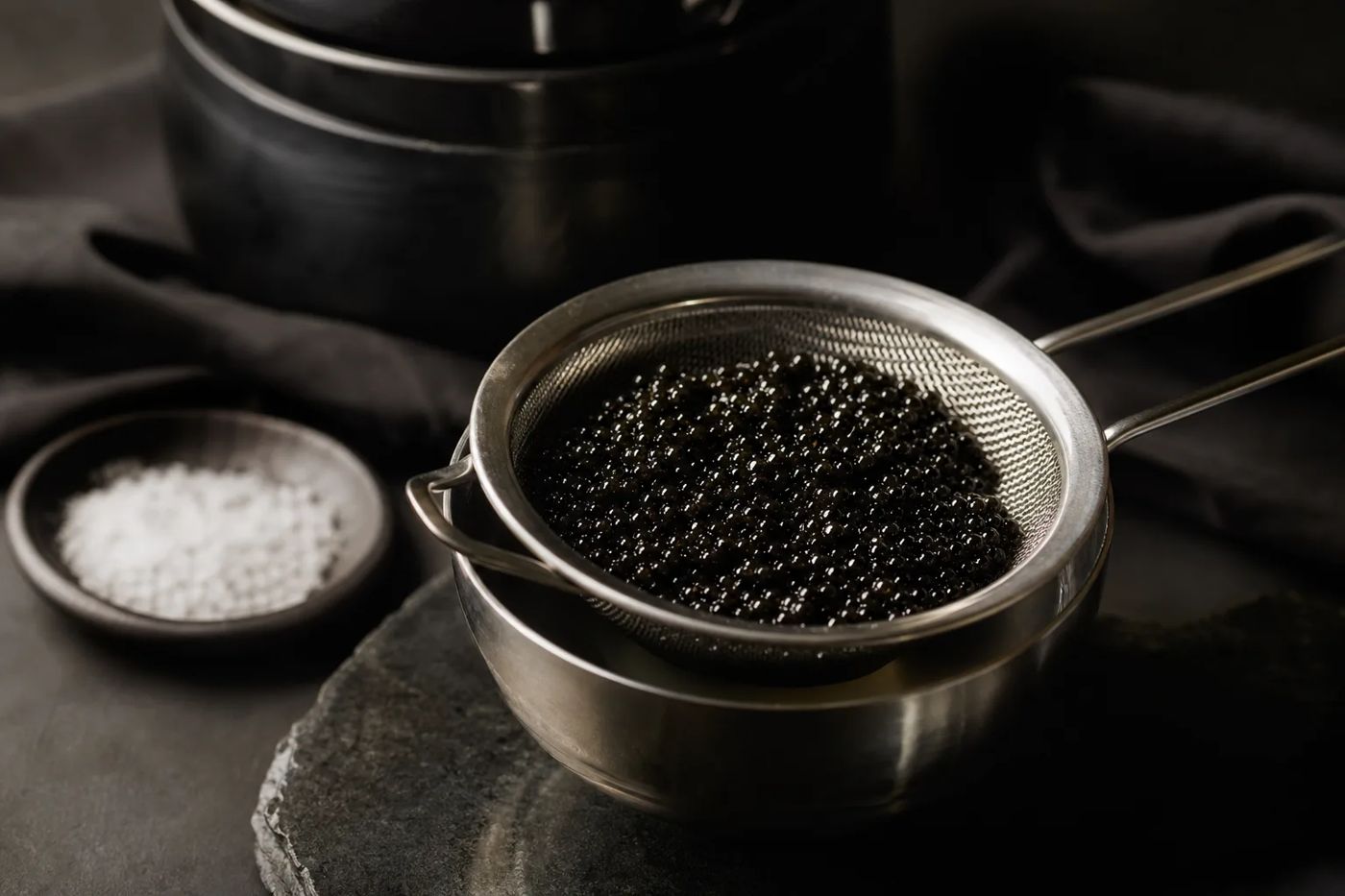
The food label and the CITES marking do different jobs. Check the ingredients, dates and handling instructions, then the CITES code, which gives species, source, country of origin, harvest year, plant registration code and lot number.
A repacker transfers caviar into new containers; its country is not necessarily where the roe originated. A CITES label provides traceability, not proof of the contents: checking that claim requires more than reading a code, as reading a caviar label explains.
Keep storage and serving separate
Keep caviar refrigerated according to its producer's validated instructions, including after opening. Codex sets +2 to +4°C for packaging, storage and retail and 0 to -4°C for wholesale; Prunier, a producer, suggests -2 to +2°C. A home freezer is no substitute.
Do not assume every unopened container keeps for the same length of time: packaging, processing and the producer's shelf-life validation differ. Codex does not impose an absolute freezing ban, but allows freezing only where deterioration in quality is avoided; that conditional provision is not a recommendation to freeze an ordinary purchase.
Serving is a brief interval, not another storage condition. Chef's Pencil suggests about 8°C (46°F) for tasting, warmer than that storage example; present a small amount over ice, use a clean mother-of-pearl or glass spoon, and return the remainder promptly to the fridge.
Taste it plain first, then try a little on a blini or plain toast with crème fraîche. Keep accompaniments restrained while learning what you like, and follow the serving guide for a fuller setup rather than leaving the whole supply on the table.
For planning, the site's standard tasting serving is 15 g per person, about half an ounce, so 30 g (about 1 oz) gives two such servings. This is a useful starting quantity, not a regulatory serving size or a rule about how much anyone should eat.
Health and safety in brief
Caviar contains salt: the Codex standard specifies 3 to 5 g per 100 g, not sodium. Fish allergy matters, and chilled ready-to-eat fish can carry Listeria, with greater consequences during pregnancy, in older people and for those with weakened immunity. NHS guidance advises avoiding uncooked cold smoked or cured fish during pregnancy; advice about caviar should consider the particular product and its processing. Ask a midwife or doctor about a particular caviar product. An intact seal or pleasant smell does not prove safety, so follow use-by dates and validated handling instructions.
A short, documented history
Stories of ancient caviar often blur eating fish eggs with making the salted product recognised today. A firm documentary point is the US labelling discussion recorded in 1914, reproduced in FDA's guidance; by 1998, all sturgeons and paddlefish were covered by CITES listings. These records establish naming and trade milestones, not a single inventor, so treat colourful origin legends separately from dated evidence.
Start here
If you are new, follow these routes in order rather than trying to learn every species at once. The what is caviar hub keeps the basic explanations together.
- What Is Caviar? A Plain-English Definition: settle the terminology.
- How to Buy Caviar: The Complete Guide: choose with clearer questions.
- The Complete History of Caviar: explore the documented past.
Sources
-
FAO and WHO, Codex Alimentarius. Standard for Sturgeon Caviar, CXS 291-2010, last modified in 2026 according to the Codex register. Retrieved through the FAO document proxy; the canonical publisher address is CXS 291-2010. See the edition-verification flag below.
-
US Food and Drug Administration. CPG Sec. 540.150: Caviar, Use of Term, Labeling, October 1989, live guidance retrieved November 2026. FDA guidance.
-
European Commission and TRAFFIC. EU Wildlife Trade Reference Guide, Annex XIV, updated October 2026. Caviar labelling and trade provisions.
-
United States, Code of Federal Regulations. 50 CFR 23.71: How can I trade internationally in sturgeon caviar?, live text retrieved November 2026, reproduced by Cornell Legal Information Institute. Regulatory text.
-
European Commission. Commission Implementing Regulation (EU) 2025/1926, 22 September 2025, Combined Nomenclature applicable from 2026. Official legal identifier.
-
UK Department for Business and Trade. Request for Input: Indicative Long List of US Products, 2025. Used only as a retrieved official record of the two UK commodity descriptions, not as a definitive November 2026 tariff consolidation. Official document.
-
UK Government. Packaging and labelling, live guidance retrieved November 2026. Food information requirements.
-
UK Government. General food law, live guidance retrieved November 2026. Great Britain and Northern Ireland regimes.
-
European Commission, EUMOFA. Sturgeon meat and other by-products of caviar: production, trade and consumption in and outside the EU, February 2023. Report.
-
FAO GLOBEFISH. Chinese sturgeon and caviar industry, 30 September 2019. Industry account.
-
US Fish and Wildlife Service. 3-200-76: Export of Caviar or Meat of Paddlefish or Sturgeon Removed from the Wild under CITES, live permit guidance retrieved November 2026. Wild-source export route.
-
FAO. Sturgeons (Acipenseriformes), undated report chapter, approximately 2004. Technical chapter.
-
FAO, Chebanov, M. S. and Galich, E. V. Sturgeon Hatchery Manual, Fisheries and Aquaculture Technical Paper 558, reprinted 2013. Manual.
-
World Sturgeon Conservation Society, Bronzi, P. IUCN SSG summary report, 13 November 2025, reporting the joint meeting of 22 October 2025. Taxonomy statement.
-
Codex Alimentarius. Code of practice for fish and fishery products, CXC 52-2003, section 19, “Processing of sturgeon caviar”, undated government-hosted extract. Processing guidance.
-
FAO and WHO, Codex Alimentarius. Report of the Thirty-fourth Session of the Codex Committee on Fish and Fishery Products, REP16/FFP, 2016, Appendix V. Cooling, maturation and pasteurisation guidance.
-
Prunier. How should you eat caviar?, 13 March 2024. Producer guidance, attributed as such. Storage and service advice.
-
Chef's Pencil. How to Serve Caviar, 2011, live search-retrieved version consulted November 2026. Serving guidance.
-
Culinary Institute of America. Caviar, teaching presentation, publisher-hosted file dated June 2025. Used for serving utensils and accompaniments only. Teaching presentation.
-
NHS. Foods to avoid in pregnancy and Listeriosis, live guidance retrieved November 2026. Pregnancy guidance and Listeriosis guidance.
-
US Food and Drug Administration. Fish and Fishery Products Hazards and Controls Guidance, June 2022 edition. Seafood hazards guidance.
This overview draws on retrieved food standards, official wildlife and food guidance, technical references and the supplied verified fact sheets.
Last checked: November 2026