
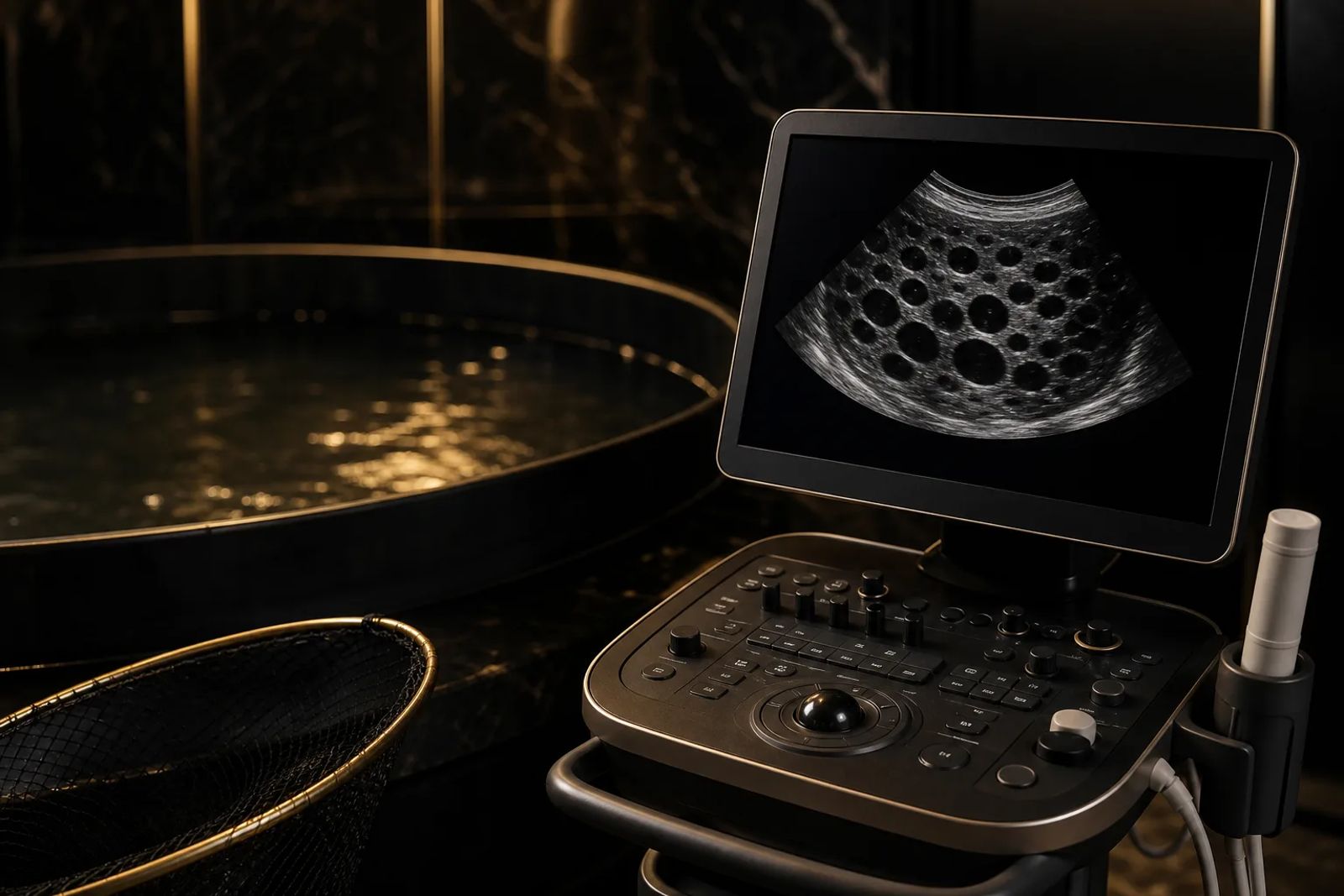
A fully grown sturgeon egg can be ready for traditional caviar before it is ready to leave its follicle. That is the harvest window farms seek: firm eggs, still attached, with no sign of degeneration. Finding it takes more than knowing a female's age. Farms combine images of the ovary with close examination of sampled eggs.
What ripe means for caviar
Ripe for caviar does not mean ready to spawn. An oocyte, an egg cell developing within its follicle, can reach the size and structure wanted for traditional caviar before completing the changes needed for ovulation. Its follicle is a surrounding layer of cells, not simply unwanted ovarian tissue.
The distinction matters at the sampling bench: farms must assess both the egg itself and its developmental state. Size alone cannot answer both questions. For the stages, see how sturgeon eggs develop. The decision here belongs to harvesting caviar, rather than selecting broodstock for fertilisation.
Checking ripeness: what each method reveals
Ultrasound shows the ovary; a sample brings individual eggs into view. Other measurements reveal nuclear position, physical condition or circulating hormones. Together, these methods address three questions: is the ovary developing, are its eggs approaching final maturation, and has degeneration begun? Agreement on a broad maturity stage still leaves the precise harvest date to resolve.
| Method | What it measures | Invasiveness | Reliability as reported | Source |
|---|---|---|---|---|
| Catheter or biopsy sample | Ovarian eggs examined directly | Invasive; access varies by technique | Visual inspection can miss microscopic early atresia | Chapman and Van Eenennaam; Talbott et al. |
| Polarisation index (PI) | Nuclear position in sampled eggs | Requires egg sampling | Correct sectioning essential; cannot predict yield alone | Chapman and Van Eenennaam; Van Eenennaam et al. |
| Diameter, colour and firmness | Growth, pigmentation and condition | Requires egg sampling | Useful selection criteria; no universal readiness threshold established | UF/IFAS FA194; Black River Caviar |
| Ultrasound | Ovarian appearance and visible egg masses | Non-invasive scan | Biopsy confirmed mature masses in a white sturgeon study; diameter comparisons mixed | Donahower et al. |
| Plasma hormones | Circulating testosterone and oestradiol | Requires blood sampling | Studied against biopsy findings; no universal harvest test | Talbott et al. |
Catheter sampling is not simply drawing loose eggs through the genital opening. The UF/IFAS biopsy protocol obtains ovarian eggs through an abdominal incision, using flexible tubing or an alternative instrument. Before sampling, check the applicable veterinary and animal welfare requirements. The cited sources do not set out the legal requirements for invasive sampling in the EU, Great Britain, Northern Ireland and the US. See sexing and sampling methods for the techniques.
Reading the polarisation index
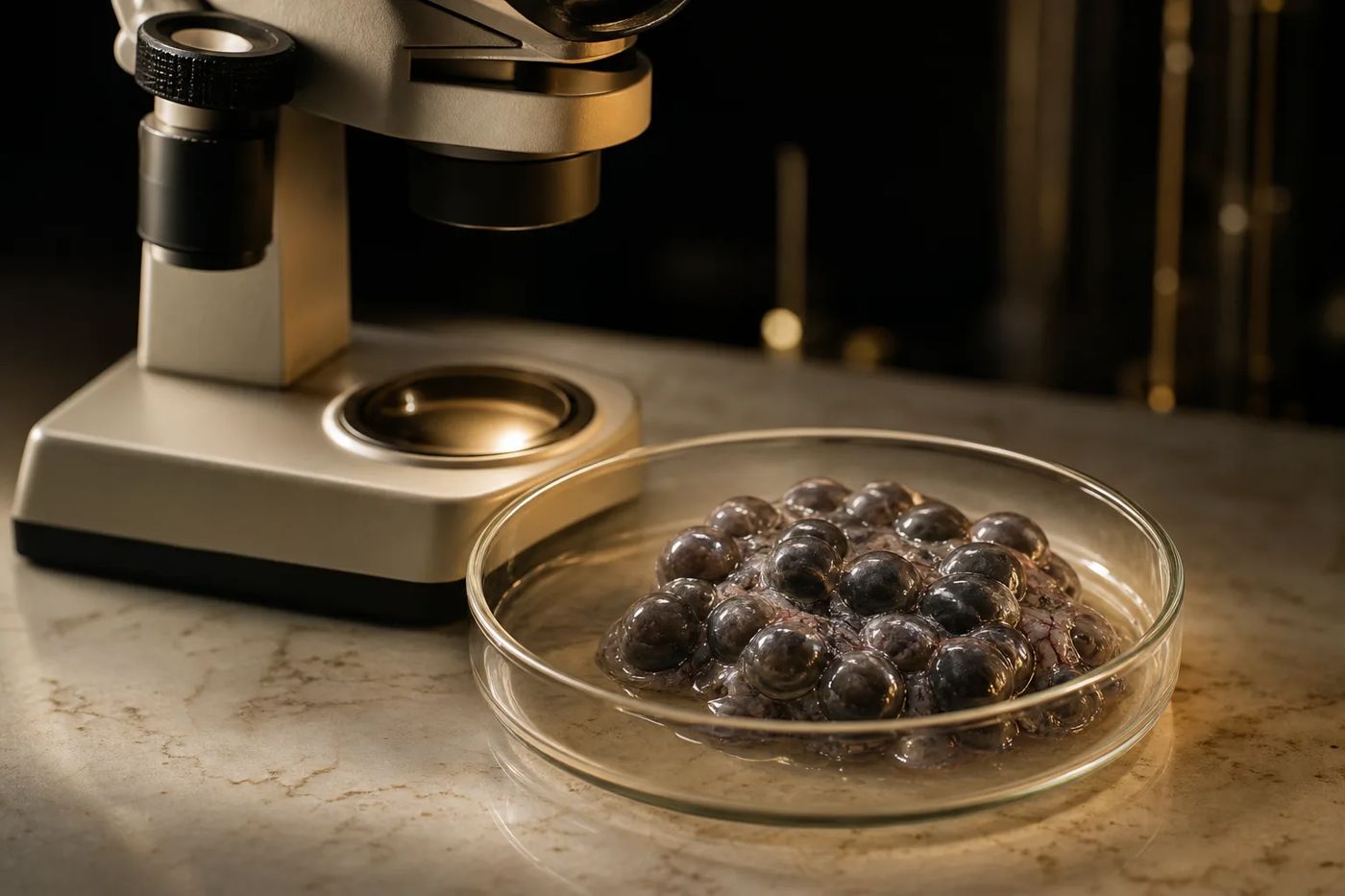
A lower polarisation index generally means the egg's nucleus has moved closer to its edge. It does not automatically mean better caviar. The PI tracks the germinal vesicle, the egg's nucleus, as it moves towards the animal pole during final maturation. Measuring it requires the egg sampling described above.
A 2010 technical report by Donahower and colleagues gives PI 0.10 to 0.12 as the range associated with optimal caviar yield and quality in adult white sturgeon. Treat that as a reported production target. The same report warns that initial PI measurements vary between females and do not always predict subsequent maturity accurately, so the range cannot serve as a universal cut-off.
A separate conference abstract followed 100 white sturgeon from one year class, processing 20 fish monthly from February to June 2008. Mean PI fell as egg size increased. Yet neither measurement correlated with caviar yield as a percentage of body weight. The study measured yield, not flavour through sensory testing: PI offers information about maturation, rather than a complete quality score.
Who checks the fish, and when?
The useful schedule is the one fitted to the fish and the farm. Published accounts describe particular farms and research programmes, rather than a standard interval for every female.
Donahower and colleagues reported an autumn biopsy used to predict harvest during the following winter and spring. That approach reflected the labour and disturbance involved in assessment. They identified the long gap between checks as a limitation, not an ideal monitoring schedule.
Black River Caviar describes its aquaculture team combining ultrasound, biopsy and measurements of sampled eggs to stage Russian sturgeon females for harvest. It publishes no fixed repeat interval. Caviar Mallorca also describes ultrasound followed by biopsy. It selects eggs against its own size, texture and colour specifications, with production within three days of acceptance.
For an auditable farm protocol, record who performs each examination and who interprets it, alongside the fish identifier, sampling date, findings and next decision. Set the checking interval and responsibilities locally. This record structure is a practical recommendation, not a description of a staffing model used by every farm.
When harvest timing goes wrong
Harvest too early and the eggs may be smaller, with incomplete pigmentation. Chapman and Van Eenennaam describe those physical shortcomings. Their account does not establish that all immature eggs are soft, or include a controlled tasting study identifying a flavour defect caused solely by early harvest.
At the other end of the harvest window, three processes need separating. Final maturation prepares the egg for ovulation. Ovulation releases it from its follicle. Atresia is the degeneration and resorption of ovarian follicles. It is not simply the next normal stage after ovulation: an ovary can become atretic while its eggs remain unovulated.
White sturgeon research links atresia to disrupted reproductive conditions, including unsuitable temperature exposure. It does not place its onset at a universal number of days beyond a harvest date. Nor can an apparently normal sample exclude the earliest microscopic changes. Checking for degeneration is therefore a separate job from measuring whether eggs have grown large enough.
The physical deterioration can be clear. UF/IFAS describes resorbing eggs losing firmness and becoming irregular in shape. The cited sources do not establish how harvest timing affects flavour.

What hormones and laboratory methods add
Blood tests and laboratory analysis offer ways to investigate degeneration beyond the visible egg. Their value here comes from specific research studies, rather than a ready-made test for every farm.
A lower polarisation index generally means the egg's nucleus has moved closer to its edge.
Talbott and colleagues repeatedly collected blood and ovarian biopsies from ten female white sturgeon, before and after the onset of atresia. They investigated circulating testosterone and oestradiol as indicators of ovarian degeneration. The work documents hormone monitoring as a research approach; it does not supply a hormone concentration that can safely be applied across farms or species.
Lu and colleagues studied plasma and ovarian follicles from 11 white sturgeon using Fourier transform infrared spectroscopy. The method detects biochemical differences through infrared absorption. Their statistical classification distinguished late yolk accumulation from early atresia about 70% of the time. That result belongs to a small study addressing a specific classification task, rather than a routine test guaranteeing harvest quality.
Why species and farm conditions matter
An egg's diameter needs context: the species, the female's history and the conditions in which she has been held. UF/IFAS gives a general range of 2.8 to 4.2 mm for fully grown eggs, rather than separate species ranges. Size varies with the fish and its conditions, so those measurements are not harvest readiness thresholds.
Much of the evidence discussed here concerns white sturgeon, especially the work on PI, yield and atresia detection. Applying it to Siberian or Russian sturgeon requires care, rather than simply adopting it as a protocol. A producer's preferred texture and colour also serve a different purpose: they are acceptance specifications, not biological definitions of maturity. See bead size, colour and firmness for those separate quality attributes.
Temperature changes the pace of maturation. A calendar date therefore means little without the holding conditions that accompany it. The mechanisms are covered in water temperature, light and maturation. Keep that environmental history beside the egg measurements in the harvest record. Females assessed together should not be assumed to remain developmentally synchronised.
A different endpoint for ovulated eggs
For stripping, the eggs must have ovulated and become available for collection. Traditional ovarian harvest seeks eggs still attached within the ovary. These are different endpoints, and they call for different readiness decisions.
FAO describes ultrasound distinctions between mature ovaries and ovulated eggs, including the appearance of fluid and rows of eggs. Those observations help separate readiness for traditional ovarian harvest from readiness for stripping.
Do not transfer the white sturgeon caviar PI range above into an ovulation-induction schedule. Induction, confirmation of egg release and subsequent collection require a protocol suited to the species and production method. For the collection routes, continue to how caviar is harvested. Hormone dosing and stripping intervals fall outside this article's scope.
Sources
-
University of Florida, UF/IFAS Extension. Chapman, F. A. and Van Eenennaam, J. P., Technically Speaking, What Is Sturgeon Caviar? FA194, originally published 2016, reviewed February 2025. Publication PDF.
-
University of Florida, UF/IFAS Extension. Chapman, F. A. and Van Eenennaam, J. P., Sturgeon Aquaculture: Specialized Techniques: Determining the Stage of Sexual Maturity in Female Sturgeon for Artificial Spawning: The Egg Polarization Index or PI. FA153, originally published 2007, reviewed August 2025. Publication PDF.
-
Global Aquaculture Advocate. Donahower, B. C. et al., Ultrasound helps stage sturgeons for caviar production. Author-written technical report, 1 May 2010, now hosted by Global Seafood Alliance. Technical report.
-
World Aquaculture Society. Van Eenennaam, J. et al., The relationship between white sturgeon caviar yield and stage of maturity. Conference abstract reporting the 2008 harvest experiment; publication year not displayed on the page. Conference abstract.
-
Elsevier, Aquaculture. Talbott, M. J. et al., Investigating the use of plasma testosterone and estradiol-17β to detect ovarian follicular atresia in farmed white sturgeon, Acipenser transmontanus. Volume 315, issues 3 to 4, pages 283 to 289, 2011. Abstract and indexed introductory passages. Publisher record.
-
Washington State University Research Exchange. Lu, X. et al., A study of biochemical parameters associated with ovarian atresia and quality of caviar in farmed white sturgeon (Acipenser transmontanus) by Fourier Transform Infrared (FT-IR) Spectroscopy. Aquaculture, volume 315, pages 298 to 305, 2011. Institutional abstract and bibliographic record. Institutional record.
-
Food and Agriculture Organization of the United Nations. Chebanov, M. S. and Galich, E. V., Sturgeon Hatchery Manual. FAO Fisheries and Aquaculture Technical Paper 558, 2011, reprinted 2013. Manual PDF.
-
Black River Caviar. Mayo, S., It's Harvest Time. Company account, 22 May 2023. Production account.
-
Caviar Mallorca. Production. Undated company account, checked November 2026. Production account.
Research combined technical manuals, original research reports and study abstracts, with producer descriptions identified separately as company accounts.
Last checked: November 2026