
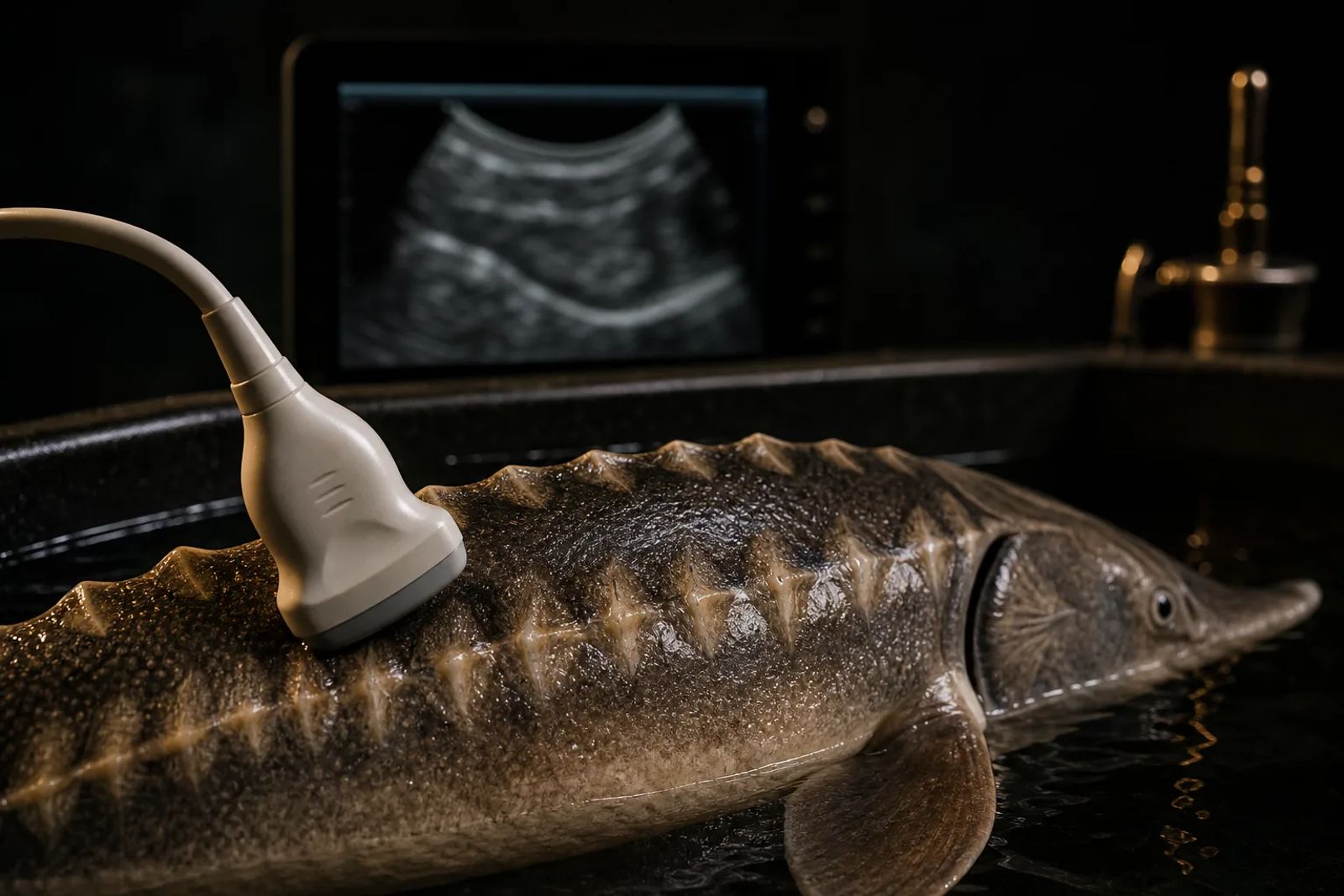
Only female sturgeon produce the eggs used for caviar. Finding them is less straightforward: in a study of Siberian sturgeon, ultrasound agreed with histology in 113 of 128 fish; endoscopy recorded agreement in 124 of 128.
Each method reveals something different. Ultrasound images tissues without a surgical wound; endoscopy gives a direct view of the reproductive organs; biopsy supplies tissue for the microscope. How early and how accurately they work depends on species, development, operator and method.
Why sexing matters
Within sturgeon farming, sexing means identifying females to retain for future egg production and separating them from males whose management follows a different route. Male sturgeon may instead be managed for meat or breeding, depending on the farm.
There is no dependable external shortcut for sorting juvenile sturgeon by sex. Body shape and the appearance of the urogenital opening cannot replace examination of the reproductive organs or a validated laboratory test. Sturgeon anatomy explains where those organs sit.
Sexing sturgeon: methods compared
A high accuracy figure can hide how many fish received no answer. Accuracy among classifiable fish measures correct assignments; diagnostic yield is the proportion of all examined fish given a result. Leaving unknowns out can make performance look stronger. These figures show what particular studies achieved, not guaranteed farm performance. Nor does “reliable from” mean a single birthday or weight across sturgeons. Unless a study established a threshold, its published age tells us when the fish were tested.
| Method | Age or size studied | Reported result | Invasiveness | Study |
|---|---|---|---|---|
| Ultrasound | Siberian sturgeon aged 3 or 4 years | 88.3% agreement with histology (113/128) | No surgical wound | Munhofen et al. 2014 |
| Endoscopy | Same Siberian cohort | 96.9% agreement (124/128) | Surgical access for internal viewing | Munhofen et al. 2014 |
| Gonad biopsy | Same cohort | Histological sex determination in 91.4% (128/140); yield, not accuracy | Tissue sampling | Munhofen et al. 2014 |
| Blood steroids | Prepubertal hatchery origin and wild white sturgeon | 69% and 74% sexing accuracy, respectively | Needle sampling | Maskill et al. 2022 |
| Steroids and vitellogenin | Lake sturgeon; age or size not stated | 56% assigned a sex; only 12 fish had independently verified sex | Needle sampling | Craig et al. 2009 |
| Genetic marker | Russian sturgeon: compared with endoscopy at 4.5 years; also applied at seven months | 39 of 43 agreed with endoscopy; four endoscopically identified females lacked the marker | Fin tissue sampling | Curzon et al. 2022 |
Blood assays and genetic tests have no universal minimum size.
Ultrasound: imaging without a wound
Ultrasound leaves no surgical wound, but the image still needs an expert eye. Reflected sound displays internal tissues; a trained operator must distinguish ovarian tissue, testes and surrounding fat. A suitable scanner and probe, together with consistent image acquisition, are essential. Interpretation is part of the test, not an automatic output.
The same method can perform very differently in two populations of one species. Maskill and colleagues examined 332 hatchery-origin and 75 wild white sturgeon during 2017 and 2018. Ultrasound sexing accuracy was 57% in the hatchery-origin fish, compared with 70% in the wild fish. Endoscopy achieved 98% and 100%, respectively, after exclusions for unsuitable reference biopsies and intersex fish.
Endoscopy and biopsy: seeing versus sampling
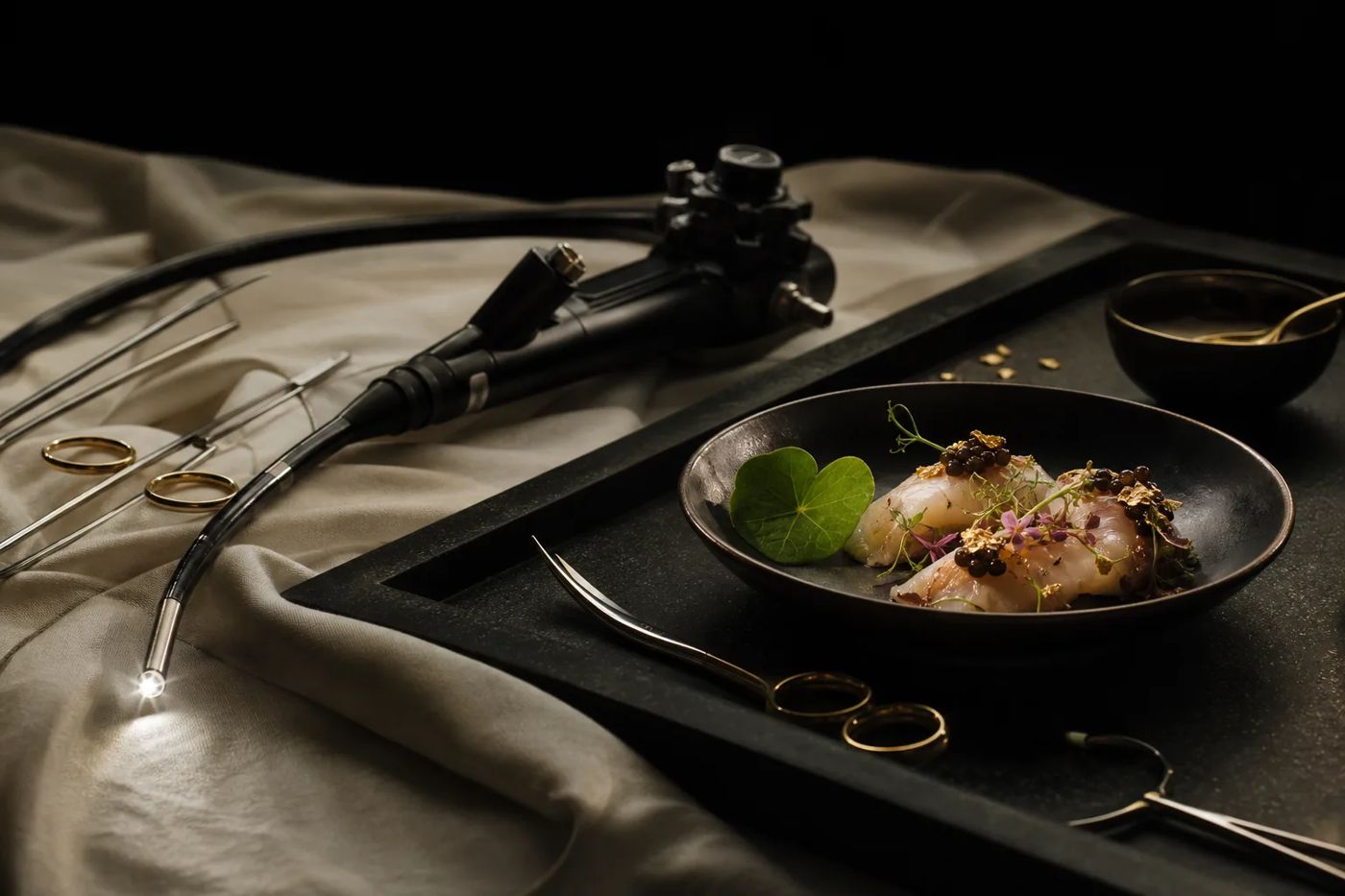
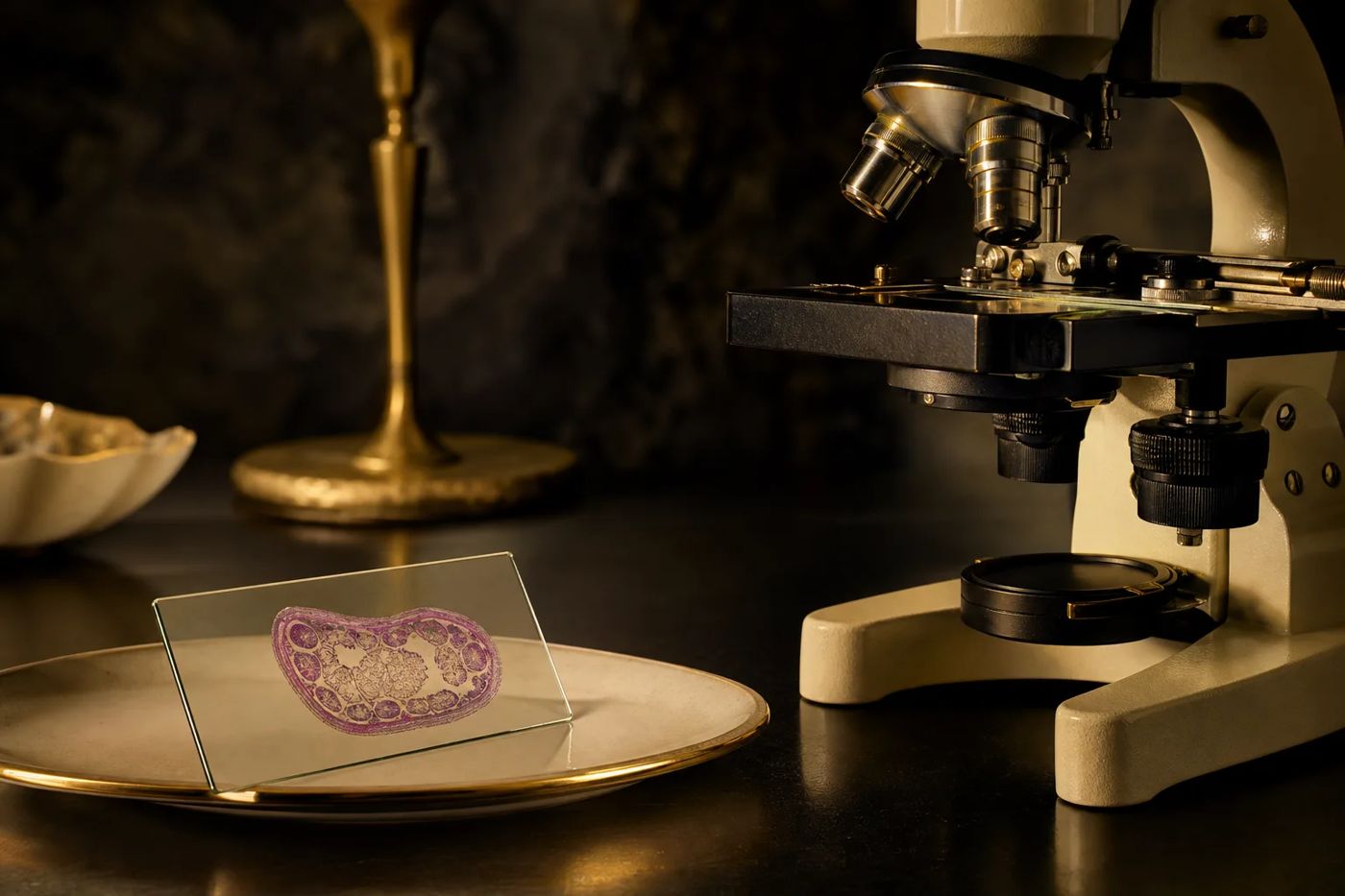
Endoscopy lets the operator look directly at the gonads, the ovaries or testes. An illuminated viewing instrument reaches them through surgical access. Biopsy collects a small tissue sample for histology: prepared sections examined under a microscope, rather than judged by appearance alone.
The methods can be combined, but their results are not interchangeable. Endoscopy requires suitable optics, lighting and surgical competence. Biopsy also demands sampling skill, careful specimen handling and a competent histology laboratory. Fat can obscure the gonads; a sample without diagnostic cells must remain unclassified.
UF/IFAS guidance describes direct gonadal examination and biopsy as useful at 16 to 36 months. It also warns that ultrasound is less accurate in early differentiated tissue at 12 to 24 months. These broad extension ranges help frame an assessment, but do not establish a species-specific age at which every young fish can be sexed.
Blood tests and genetic markers
Blood tests read physiological signals rather than inspect a gonad. Those signals include the sex steroids testosterone and oestradiol, and vitellogenin, a yolk precursor protein. Collection requires competent blood sampling, appropriate sample processing and laboratory assays. Interpretation must be calibrated against independently established sex in the relevant population.
Maturation changes the signals. A hormone threshold therefore cannot simply move from one species or age group to another. In Craig and colleagues’ lake sturgeon study, 115 fish were sampled, but only 12 had independently verified sex. A biomarker-based assignment was made for 56%: a measure of classification coverage, not validated accuracy.
Where blood assays measure physiology, genetic tests look for a sex-associated marker in DNA. That brings a different set of laboratory and validation requirements. Curzon and colleagues tested Russian sturgeon using a fin sample and duplex PCR, which amplifies two DNA targets. Their assay paired AllWSEX2 with an internal control, and was also applied to seven-month-old fish.
A missing female-associated band needs investigation before a fish is called male: failed amplification must first be excluded. The assay requires molecular laboratory equipment, controlled interpretation and validation for the species or cross being tested. It identifies a DNA signal, not ovarian development or readiness for harvest.
Welfare is more than invasiveness
A wound-free scan is still a handling event. Fish must be captured and restrained, sometimes with anaesthesia. Assess crowding, handling, time away from normal water conditions, gill ventilation and recovery alongside the procedure itself. Surgical methods also require appropriate aseptic technique and postoperative monitoring.
Fat can obscure the gonads; a sample without diagnostic cells must remain unclassified.
Munhofen and colleagues reported normal recovery, with no postprocedural morbidity or mortality, in their Siberian sturgeon study. Longer-term welfare effects of repeated invasive sexing remain a separate question. Farms should record complications and review repeat procedures, rather than treating immediate survival as the only measure of welfare.
Anaesthesia and pain management need a fish veterinarian’s plan. Check local drug permissions, prescribing rules and withdrawal requirements for food fish. An anaesthetic protocol published in a research paper does not authorise use of that drug on a commercial farm.
Who may perform invasive sexing?
Skill and legal permission are separate requirements. Before a procedure, establish both whether it is permitted and who may perform it. Veterinary supervision alone creates no exemption. The rules below concern farm procedures, not authorisation for research involving protected animals.
| Jurisdiction | Rule and operator implications | Legal source | Checked |
|---|---|---|---|
| EU | The general welfare duty covers farmed fish, but Article 4 excludes fish from the Annex’s detailed conditions. Directive 98/58/EC does not itself authorise technicians to biopsy fish; national veterinary law determines that. | Directive 98/58/EC, Articles 2 to 4 | November 2026 |
| UK | Check permission for routine sturgeon gonad biopsy and operator eligibility separately in England, Wales, Scotland and Northern Ireland. | Veterinary Surgeons Act 1966; RCVS guidance, section 19; applicable animal welfare legislation | November 2026 |
| US | Veterinary licensing and exemptions vary by state. Ask the relevant state veterinary board whether a non-veterinarian may perform sturgeon gonad biopsy. | North Carolina Veterinary Practice Act and Administrative Rules; check the current state law | November 2026 |
| Switzerland | The ordinance regulates fish handling and competence. Confirm the current text and procedure-specific requirements with the cantonal veterinary authority. | Animal Welfare Ordinance, SR 455.1, Articles 97 to 100, status 1 February 2026 | November 2026 |
In England and Wales, the Animal Welfare Act 2006 also prohibits unnecessary suffering and restricts non-therapeutic interference with sensitive tissues. A veterinary surgeon’s involvement does not automatically make a production biopsy lawful. Confirm a procedure-specific legal basis for routine sturgeon sexing with the relevant authorities, together with equivalent welfare permissions in Scotland and Northern Ireland.
Recording results and planning the next assessment
Record what the examination found, how certain the result is and how mature the fish is. These are separate pieces of information. A farm protocol should capture individual identification, species or documented cross, date, size, method, operator, result and uncertainty, supported by saved images or laboratory identifiers and recovery observations.
“Unknown” is a useful result. Keep it available rather than forcing every fish into a male or female category, and review uncertain cases before an irreversible management decision. Individual fish tracking provides the record structure; the sexing result should remain open to correction.
The next assessment asks how a female’s ovaries are developing and whether her eggs have reached the required stage. See egg development and atresia for the biology, and checking egg ripeness for the separate decision about harvest timing. Sexing identifies the female. It does not set the harvest date.
Sources
-
University of Florida, IFAS Extension, Chapman and Van Eenennaam. Sturgeon Aquaculture: Specialized Techniques: Determining the Sex of Sturgeon by Direct Examination of the Gonad Using a Minimally Invasive Surgical Procedure. FA183, originally published 2012, retrieved web edition. Extension publication.
-
Munhofen, Jiménez, Peterson, Camus and Divers. Comparing Ultrasonography and Endoscopy for Early Gender Identification of Juvenile Siberian Sturgeon. North American Journal of Aquaculture, volume 76, issue 1, 2014, pages 14 to 23. Publisher record and abstract.
-
Maskill, Crossman, Webb, Marrello and Guy; US Geological Survey publication record. Accuracy of histology, endoscopy, ultrasonography, and plasma sex steroids in describing the population reproductive structure of hatchery-origin and wild white sturgeon. Journal of Applied Ichthyology, 2022; online record dated 27 October 2021. USGS publication record.
-
Craig, Papoulias, Thomas, Annis and Boase; US Geological Survey publication record. Sex assignment of lake sturgeon (Acipenser fluvescens) based on plasma sex hormone and vitellogenin levels. Journal of Applied Ichthyology, volume 25, supplement 2, 2009, pages 60 to 67. The spelling in the document title is reproduced as published. USGS publication record.
-
Curzon et al. Cross-species conservation of a transposase-linked element enables genetic sexing of commercial populations of Russian sturgeon (Acipenser gueldenstaedtii). Animal Genetics, 2022, open-access full text. Research paper.
-
Journal of Great Lakes Research. Multi-year evidence of unbiased sex ratios in hatchery and wild-reared age-0 lake sturgeon (Acipenser fulvescens). 2022, author-hosted research paper. Full-text PDF.
-
FAO. Sturgeon hatchery practices and management for release: Guidelines. FAO Fisheries and Aquaculture Technical Paper 570, 2011. FAO technical paper.
-
Council of the European Union. Council Directive 98/58/EC concerning the protection of animals kept for farming purposes. Consolidated version of 14 December 2019. EUR-Lex consolidated PDF.
-
Royal College of Veterinary Surgeons. Code of Professional Conduct: Supporting guidance, 19. Treatment of animals by unqualified persons. Updated 7 February 2025. RCVS guidance.
-
UK Parliament. Animal Welfare Act 2006. Chapter 45, 2006, sections 1 to 5. Official Act PDF.
-
North Carolina Veterinary Medical Board. North Carolina Veterinary Practice Act and Administrative Rules. Online compilation, retrieved November 2026. Board legislation.
-
Swiss Federal Council; Federal Food Safety and Veterinary Office. Ordonnance sur la protection des animaux, SR 455.1, dated 23 April 2008, Fedlex text, status 1 February 2026. Official ordinance PDF.
This piece was researched from comparative studies, an extension publication, FAO guidance and official legal sources, keeping study performance separate from farm guarantees and legal permission.
Last checked: November 2026