
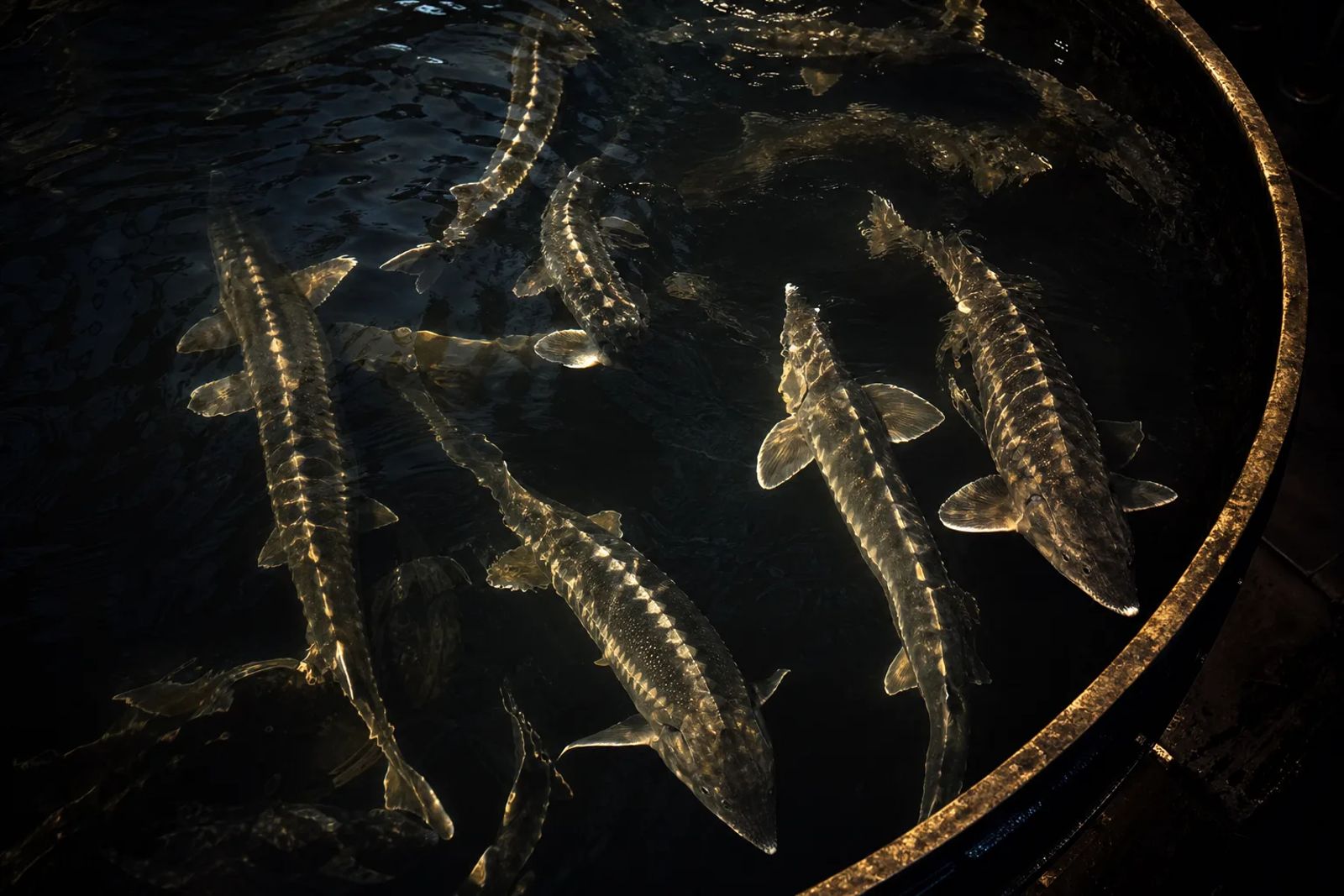
White sturgeon eggs can differ sharply in their lipid chemistry. In a study by Czesny and colleagues, linoleic acid made up about 12% of the fatty acids in egg neutral lipids from university-held fish, compared with 2.5% in farm fish and 0.3% in wild Sacramento River fish. Even the two captive groups were markedly different.
Farmed and wild sturgeon can differ in growth, body fat, maturation, behaviour and egg chemistry without being different species. The important distinction is between changes shaped by a fish's surroundings during its lifetime and inherited changes shaped by which parents reproduce over generations.
- Faster growth alone does not demonstrate genetic domestication.
- Egg fatty acids can reflect feed, but cannot universally identify origin.
- Hatchery experiments on young fish cannot establish how adult caviar fish behave.
Begin with the species and the population
'Farmed' tells you how a fish was raised, not what it is. A meaningful comparison names the species, the wild river or stock, the captive population, the fish's age and sex, and its rearing conditions. Without those details, a difference between species or life stages can easily be mistaken for an effect of farming.
Two processes explain much of the picture. Phenotypic plasticity is the environment changing observable traits, such as growth or fat deposition, without requiring inherited genetic change. Domestication selection occurs when inherited variants become more common because fish carrying them reproduce more successfully in captivity, through deliberate breeding or unintentionally.
The sturgeon biology hub explains the underlying life cycle. Commercial farms and conservation hatcheries also need to be distinguished. Both rear captive fish, but a conservation hatchery producing juveniles for release is not a direct model of an adult caviar farm.
How farmed sturgeon differ from wild sturgeon in growth
Young white sturgeon can grow remarkably quickly when food and temperature suit them. The California Department of Fish and Wildlife, citing laboratory studies, reports that Acipenser transmontanus at 16 °C (61 °F) can double their body weight every 2 to 3 weeks during their first four months.
For wild young of the year in the San Francisco Estuary, CDFW reports total lengths of 18 to 30 cm after one year. The laboratory and estuary figures do not come from a controlled comparison: they measure weight and length over different periods. They cannot yield a fixed multiplier for how much faster farmed fish grow.
Reliable food and suitable temperatures can extend opportunities for growth in captivity. Comparing maturity is harder: published ranges for named Siberian sturgeon populations rarely specify the rearing and environmental conditions behind the figures, making farmed and wild figures hard to compare.
Sexual maturity and first caviar harvest are different milestones, too. Eggs are collected at a chosen ovarian stage, rather than necessarily at natural spawning.html).
What the comparisons reveal
The clearest findings belong to named populations and measured traits. Together, these studies show how captivity can matter, without defining a single farmed body type or egg composition.
| Trait | Captive finding | Wild finding | Study and sample |
|---|---|---|---|
| Muscle fat | Higher crude fat in cultured juvenile Chinese sturgeon muscle | Lower crude fat in Yangtze estuary juvenile muscle | Song et al., 2007: five muscle samples per group |
| Egg lipids | Neutral lipid linoleic acid about 2.5% in farm fish and 12% in university fish | About 0.3% in Sacramento River white sturgeon | Czesny et al., 2000: three farm, two university and three wild females |
| Stress response | Hatchery lake sturgeon larvae lost a detectable cortisol response after nine days | Upper Black River larvae also lost the response | Wassink et al., 2022: three hatchery families and three wild collection nights |
| Inherited diversity | Two original maternal lineages lost in a captive Adriatic sturgeon programme | No contemporary wild comparison reported here | Boscari et al., 2014: pedigree analysis of 445 potential breeders |
Body fat and the chemistry of eggs
Captive juveniles had fattier muscle in Song and colleagues' Chinese sturgeon study. Chemical analysis of fresh muscle from Acipenser sinensis found more crude fat in the captive samples than in the wild ones. The finding concerns muscle, rather than whole-body fat or caviar composition.
Egg chemistry offers a more detailed picture. Czesny and colleagues separated egg lipids into neutral lipids, principally energy reserves, and phospholipids, important components of cell membranes. They then analysed the fatty acids in each.
The white sturgeon comparison reveals differences in egg chemistry between the sampled groups, without establishing their cause. Its percentages describe fatty acids within the neutral lipid fraction, not grams of fat per 100 g of eggs.
Phospholipid profiles varied less. The researchers' statistical attempt to distinguish all the studied origins was inconclusive, while the substantial difference between the two captive groups shows how much the label 'farmed' leaves unsaid.
Egg size and protein content require their own measurements. These comparisons establish no general pattern of larger, smaller or more protein-rich eggs in farmed sturgeon. A useful test would match species and ovarian stage, measure individual females, and account for their size, age and diet.
Nine days can change behaviour and stress responses
A short spell in a hatchery can alter the physiology and behaviour of young sturgeon without requiring genetic change. In Michigan's Black Lake system, Wassink and colleagues compared hatchery-produced lake sturgeon, Acipenser fulvescens, with wild larvae collected from the Upper Black River.
Over nine days in the hatchery, they measured whole-body cortisol, a hormone involved in the stress response, alongside swimming activity and vulnerability to predators.
The revealing result was shared by both groups: after nine days, neither retained a detectable cortisol response to an acute stressor. Swimming activity followed different trajectories, and predation increased in both groups. The authors warned against using cortisol alone to judge readiness for release.
These are findings about larvae during a short rearing period. They do not describe the stress state of adult farmed females or establish a response common to every farm system.
Captive breeding can narrow inherited diversity
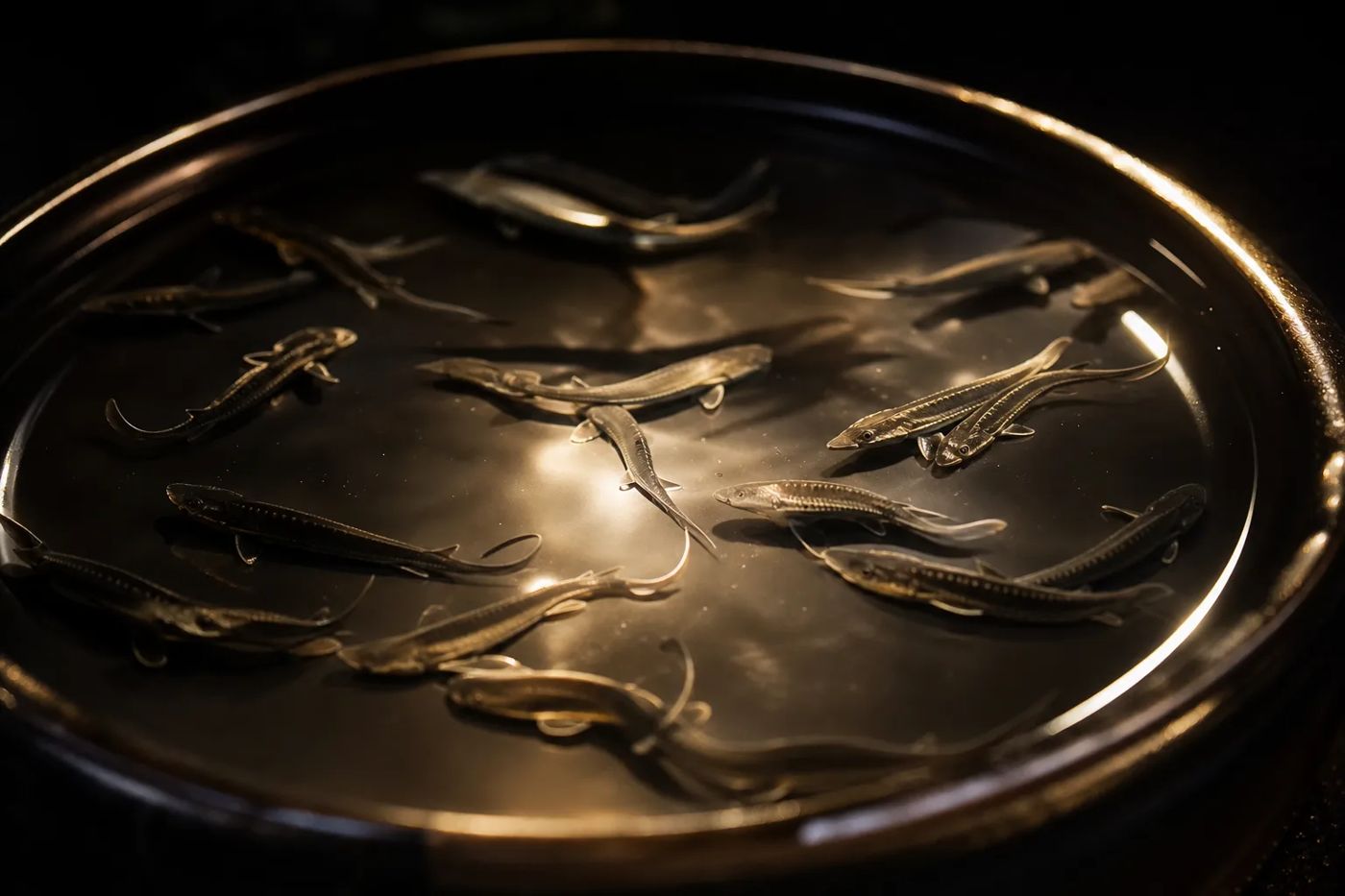
A captive population can descend from only a small part of the original wild stock. When some families contribute far more offspring than others, inherited diversity can disappear even without deliberate selection for faster growth. This is a different process from a well-fed individual simply becoming heavier.
In a captive Adriatic sturgeon, Acipenser naccarii, breeding programme, Boscari and colleagues reconstructed family relationships and compared mitochondrial lineages across generations. Two of seven original maternal haplotypes, inherited DNA variants, had disappeared through the random choice of breeding pairs. That is a documented loss in this programme, rather than a percentage loss applicable to farmed sturgeon generally.
A short spell in a hatchery can alter the physiology and behaviour of young sturgeon without requiring genetic change.
How breeders are chosen matters. Using microsatellite DNA markers in Snake River white sturgeon, Thorstensen and colleagues found that collecting naturally produced young for captive rearing retained diversity more closely resembling a wild cohort than breeding from selected adult broodstock. Broodstock are the fish kept as parents for the next generation.
FAO hatchery guidance recognises the risk of domestication selection. An inherited selection response in commercial sturgeon, however, has not been documented in the studies cited here. Faster growth alone cannot establish inherited adaptation.
Health depends on exposure and husbandry
Neither origin guarantees freedom from disease or parasites. Canada's white sturgeon recovery strategy records pathogens and parasites in wild Columbia River fish, alongside an occurrence of the egg parasite Polypodium hydriforme at a hatchery. The records demonstrate infection in both settings, without establishing which has the higher prevalence.
The strategy also identifies stressful conditions, including increased temperature and pollutant exposure, as factors that can raise outbreak risk. To assess a particular population, examine its water supply, pathogen exposure and fish movements.
A separate Wabash River study found Polypodium in the eggs of two of eleven wild female shovelnose sturgeon, Scaphirhynchus platorynchus, examined by necropsy. It is a clear example of natural parasite exposure, but the small survey's rate cannot be transferred to other rivers, species or caviar.
Can appearance or laboratory tests reveal origin?
Body shape cannot reliably tell a farmed sturgeon from a wild one. A CITES technical summary notes that malformations sometimes associated with aquaculture are not obligatory features of farmed fish. Appearance offers clues, not a dependable identification.
Laboratory methods ask more precise questions. Fatty acid profiling investigates dietary chemistry. Stable isotope analysis measures the relative abundance of forms of elements such as carbon, nitrogen and sulphur. With suitable reference samples, both can help distinguish production histories. As the CITES summary stresses, these approaches largely identify feeding signatures, which means a change of feed can complicate interpretation.
DNA addresses population relationships instead. Research in Georgia used microsatellite markers to find genetic differentiation between sampled wild and commercial Russian sturgeon populations. Such assignments depend on which populations are represented: there is no general 'farmed gene' identifying every captive sturgeon.
For how the methods work together, read caviar origin testing. Whether biological differences translate into eating quality is a separate question. That belongs in farmed and wild caviar quality, rather than being settled by growth rate or a single fatty acid. The distinction matters: a clue to a fish's history is not, by itself, proof of its origin.
Sources
-
California Department of Fish and Wildlife. White sturgeon: the species, Marine Species Portal, sections on individual growth and maturity. Online account, retrieved November 2026; revision date not reliably established. Official species account.
-
Technical University of Denmark repository. 7. Sturgeon (order Acipenseriformes), aquaculture chapter extract. Publication year and complete parent-document bibliographic details not reliably established. Repository PDF.
-
Song et al., Chinese Academy of Fishery Sciences and collaborating institutions. Comparison of nutritive components in muscles between wild and farmed juveniles of Chinese sturgeon Acipenser sinensis. Acta Zoologica Sinica, 53(3), 502 to 510, 2007. Article PDF hosted by Shanghai's agricultural authority.
-
Czesny et al., Ohio State University and University of California, Davis. Discrimination of wild and domestic origin of sturgeon ova based on lipids and fatty acid analysis. Aquaculture, 189, 145 to 153, 2000. Article PDF.
-
Wassink et al. Hatchery and wild larval lake sturgeon experience effects of captivity on stress reactivity, behavior and predation risk. Conservation Physiology, 10(1), coac062, 2022. Published article PDF.
-
Boscari et al. Captive Breeding Programs Based on Family Groups in Polyploid Sturgeons. PLOS ONE, 2014. Open-access article.
-
Thorstensen et al., University of California, Davis and Idaho Power Company. To breed or not to breed? Maintaining genetic diversity in white sturgeon supplementation programs. Conservation Genetics, 20, 997 to 1007, 2019. Author-hosted article PDF.
-
FAO, Chebanov and Galich. Sturgeon Hatchery Manual. FAO Fisheries and Aquaculture Technical Paper 558, 2013 edition. FAO manual.
-
Fisheries and Oceans Canada. Recovery Strategy for White Sturgeon (Acipenser transmontanus) in Canada, amended strategy, 2014 web edition, disease discussion in sections 3 to 6.4. Official recovery strategy.
-
Sepúlveda et al. First record of a Polypodium sp. parasitizing eggs of shovelnose sturgeon from the Wabash River, Indiana. Journal of Aquatic Animal Health, 22(1), 36 to 38, 2010. Published abstract.
-
CITES Secretariat. Sturgeon identification study, accompanying Table 2, summary of forensic methods. Undated public PDF; publication year not reliably established. Technical methods table.
-
Beridze et al.; US Geological Survey publication record. Genetic evidence for the presence of wild-caught sturgeons in commercial markets in Georgia. Diversity, 16(5), 274, 2024. USGS research record and abstract.
This piece was researched through retrieved comparative studies, official biological accounts and technical guidance, keeping experimental findings separate from general species reference figures.
Last checked: November 2026