
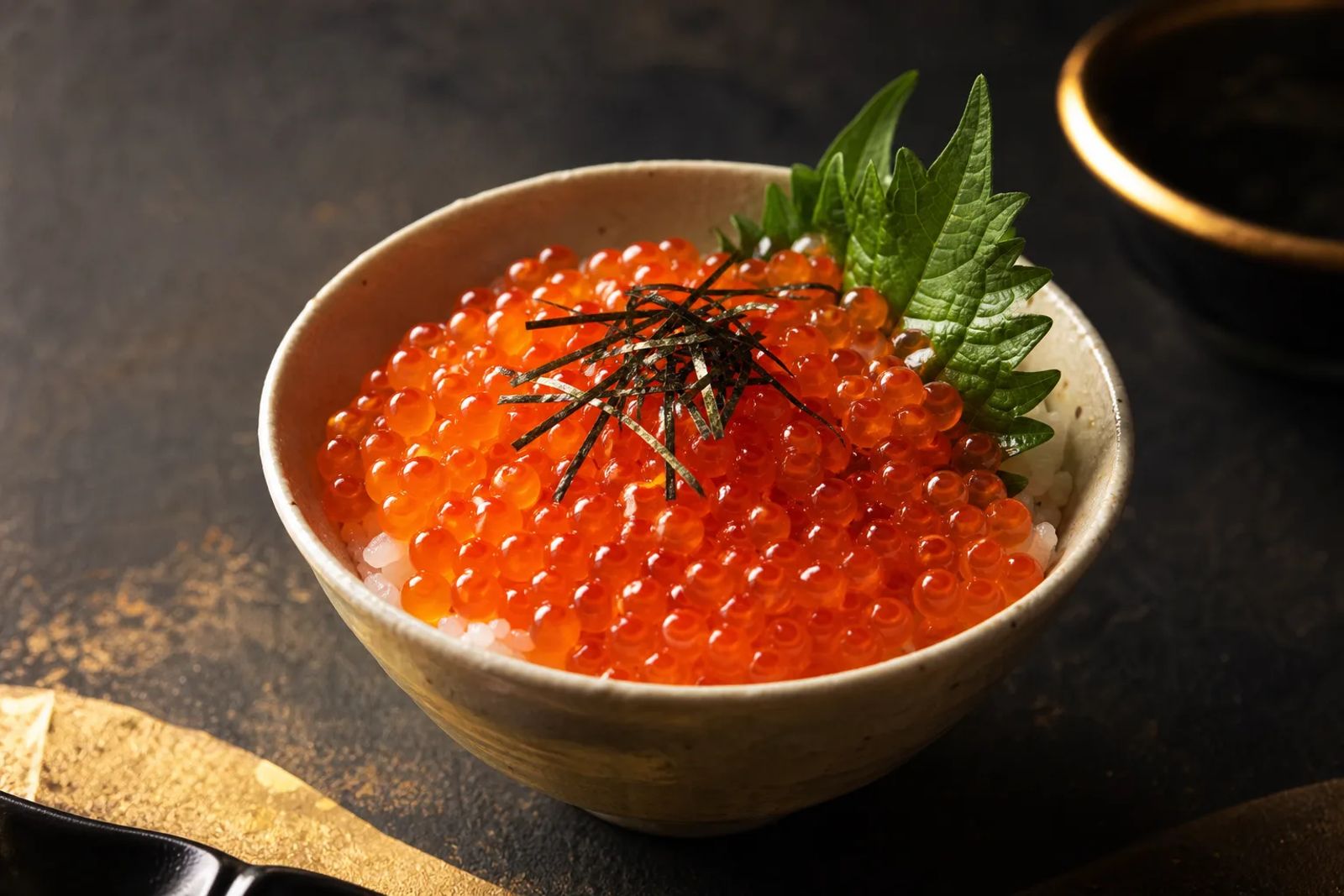
Ikura is salmon roe separated from its skein, the membrane holding the eggs together, and usually salted or marinated; our salmon roe guide explains the ingredient. Ikura don is a rice bowl topped with these seasoned eggs. To make shoyu ikura at home, separate and rinse the roe, marinate it in cooled soy seasoning, then spoon it cold over warm rice.
Before you buy a skein
Ask for fresh, uncured salmon roe in its skein, intended for preparation as a raw food, rather than salted sujiko or fishing bait. Chef Marc Matsumoto recommends skeins with large, plump, shiny eggs; he finds immature or previously frozen roe more prone to bursting during separation. Treat those as quality pointers, not proof of safety: appearance and smell cannot establish that roe is safe to eat uncooked.
Before ordering, ask the supplier what parasite controls apply to this particular roe and whether it has already been frozen. A description such as “fresh” does not answer either question, and a home freezer should not be assumed to achieve a commercial freezing schedule. If the supplier cannot explain its suitability for raw preparation, choose ready-to-eat ikura instead.
Shop-bought shoyu ikura is the simpler route: skip the cleaning and marinade, and go straight to the rice bowl instructions. Check its ingredients and handling directions, because salted roe and soy-marinated roe are not interchangeable seasonings. For the distinction between loose eggs and roe sacs, see ikura versus sujiko.
Homemade shoyu ikura and ikura don
This adaptation uses Japanese cookery author Misa Enomoto’s soy, sake and mirin marinade and her minimum two-hour refrigeration time. The one per cent cleaning brine follows Eat Act Tokyo’s published method; the bowl quantities follow Hokkaido Gyoren’s serving guide. These are combined here as an attributed adaptation, not a recipe tested by this site.
- Makes: one batch of marinated roe; assemble two bowls using 100 g of the finished ikura.
- Roe per bowl: 50 g, not an assumed yield from the skein.
- Time: Enomoto gives 15 minutes’ preparation, plus at least 2 hours’ marinating; allow rice cooking time separately.
- Equipment: saucepan, thermometer, large bowls, sieve, clean covered container, scales and rice cooker or saucepan.
Ingredients
For the marinade and roe
- 250 to 300 g fresh uncured salmon roe in its skein
- 45 ml Japanese soy sauce
- 30 ml sake
- 15 ml mirin (sweet rice wine)
For cleaning
- 2000 ml water at 40 °C (104 °F)
- 20 g salt for this water, making a 1 per cent brine; prepare more in the same proportion if needed
For two bowls
- 100 g prepared shoyu ikura, chilled
- 300 g freshly cooked Japanese short-grain rice
- Thinly cut nori and shiso leaves, optional, to finish
Allergens: fish and soya; ordinary soy sauce also contains wheat. Check the actual sauce and mirin labels for other ingredients.
Method
-
Make the seasoning. Bring the sake and mirin to the boil in a small saucepan. Add the soy sauce, let it return briefly to the boil, then remove from the heat and cool completely.
-
Separate gently. Dissolve the salt in the measured warm water. Open the skein in a bowl of the brine and use the pads of your thumbs to ease the eggs away from the membrane, following Enomoto’s gentle handling technique.
-
Rinse and drain. Pour away loose membrane fragments and repeat with fresh cleaning water until the eggs are clean. Pick out remaining membrane and broken eggs, then drain thoroughly in a sieve.
-
Marinate cold. Put the drained eggs and cooled seasoning in the clean container, cover and refrigerate at 4 °C (40 °F) or below for at least 2 hours, following US FDA consumer guidance on refrigeration. Do not add the roe to warm marinade.
-
Build the bowls. Cook the rice according to its packet or cooker instructions. Divide the warm rice between two bowls, add 50 g cold ikura to each, and finish with nori and shiso if using. Serve immediately rather than holding assembled bowls.
What the cleaning and marinade do
The warm bath is a preparation step, not a validated parasite treatment. Keep the temperature to the cited 40 °C (104 °F), rather than assuming hotter water makes this method safer or substituting a brief rinse for the controls below.
Shoyu means soy sauce; shoyu-zuke means marinating in it. This mixture seasons the eggs but does not sterilise them: Japan’s Ministry of Health, Labour and Welfare says ordinary salting, vinegar, soy sauce and wasabi do not kill Anisakis larvae.
This mixture seasons the eggs but does not sterilise them: Japan’s Ministry of Health, Labour and Welfare says ordinary salting, vinegar, soy sauce and wasabi do not kill Anisakis larvae.
Thorough draining before marinating follows the cookery sources and avoids carrying the cleaning water into the measured seasoning. For the wider processing background, read how salmon roe is harvested and cured; the task here is simply clean separation followed by refrigerated seasoning.
Parasite controls depend on the jurisdiction
An intact skein, separated and rinsed eggs, and raw salmon flesh are not automatically treated alike. The US FDA Food Code expressly exempts fish eggs removed from the skein and rinsed from its parasite-freezing requirement; that exemption is not permission to ignore bacterial contamination or another country’s rules.
The table distinguishes business rules from consumer advice, checked in November 2026. Do not transfer the American roe exemption elsewhere: obtain the supplier’s product-specific advice, including any documented exemption, rather than treating this recipe as a legal clearance.
| Jurisdiction | Scope | Freezing position | Official source |
|---|---|---|---|
| EU | Food businesses | For applicable fishery products, controls for parasites other than trematodes include freezing all parts at -20 °C (-4 °F) for at least 24 hours, or -35 °C (-31 °F) for at least 15 hours; specified exemptions apply. | Regulation 853/2004, Annex III, Section VIII, Chapter III, D |
| Great Britain | Food businesses | FSA gives the same two schedules as the EU row, with conditional exemptions. | FSA freezing guidance |
| Northern Ireland | Food businesses | EU hygiene requirements apply; consult FSA guidance for implementation and exemptions. | Regulation 853/2004; FSA |
| US | Model retail code, enforceable when adopted locally | Unless exempt: -20 °C (-4 °F) for 7 days; or -35 °C (-31 °F) until solid, then 15 hours there; or until solid at -35 °C, then 24 hours at -20 °C. Separated, rinsed fish eggs are exempt. | FDA Food Code 2026, 3-402.11 |
| Japan | Consumer and business advice | MHLW recommends -20 °C (-4 °F) for at least 24 hours against Anisakis. This is general fish guidance, not a roe-specific exemption. | MHLW Anisakis Q&A |
| Australia and New Zealand | Consumer advice | FSANZ advises freezing raw fish for at least 7 days. Ask the supplier which freezing temperature and parasite controls apply to the roe. | FSANZ, Raw fish dishes |
| Canada | Guidance; check provincial requirements | Ontario guidance lists freezing at minus 20 °C for seven days or below minus 35 °C for 15 hours, but exempts eggs removed from the skein and rinsed. Health Canada’s cited training guidance is archived. | Health Canada; Ontario F.B.14.17 |
Who should choose a cooked topping
For UK pregnancy advice, consult the NHS guidance on foods to avoid. US FDA and Health Canada guidance likewise advises against raw seafood during pregnancy; FSANZ says pregnant, elderly or ill people should not eat raw fish because of risks including Listeria.
Applying that advice to this uncooked roe recipe, use a thoroughly cooked topping instead for these diners. The FDA also includes children and people with weakened immune systems among groups who should avoid raw seafood; ask a doctor or midwife about individual circumstances, and see caviar during pregnancy for fuller context.
Refrigerating and freezing homemade ikura
Keep the finished roe covered at 4 °C (40 °F) or below, using clean utensils to take out each serving. Follow the supplier’s earlier deadline or FDA advice to use refrigerated seafood within two days of purchase, or freeze it promptly.
Yes, marinated ikura can be frozen: Matsumoto recommends individual portions in sealed containers, then defrosting in the fridge. Freeze promptly rather than keeping a batch until its last usable day, and label it with the preparation date so the remaining portions do not become anonymous.
FSANZ advises using thawed fish within two days. That is general handling advice, not a validated shelf life for every homemade marinade; freezing for storage also does not retrospectively establish that an undocumented parasite-control process was adequate.
Where to go next
- Roe Recipes: find other practical dishes built around fish eggs.
- Japanese Roe Culture: understand where rice bowls sit alongside other Japanese ways of serving roe.
Sources
-
Misa Enomoto, Futari Gohan. シンプルで簡単につくる、いくらのしょうゆ漬けのレシピ [Simple soy-marinated ikura]. Published 2019, updated January 2026. Marinade, preparation time and gentle separation technique. Japanese recipe.
-
Eat Act Tokyo. 自家製最高~!失敗しない「いくらの醤油漬け」作り方 [How to make soy-marinated ikura]. Cleaning water at 40 °C and salt at one per cent of the water quantity. Japanese method.
-
Marc Matsumoto, No Recipes. How to Make Ikura. Updated October 2025. Skein selection, definitions, refrigerated storage and freezing. Recipe and guidance.
-
Hokkaido Gyoren. 「いくら丼」の美味しいレシピを極める! [Making ikura don]. Undated. Serving guide of 50 g ikura to 150 g rice, with nori and shiso suggestions. Written by Kenta Yamada of Gyoren Hanbai. Serving guide.
-
European Parliament and Council, EUR-Lex. Regulation (EC) No 853/2004 laying down specific hygiene rules for food of animal origin. Consolidated version of 7 May 2026, Annex III, Section VIII, Chapter III, D. Consolidated regulation.
-
Food Standards Agency. Freezing fish, fishery products and treatment for parasites. Food business guidance. FSA guidance.
-
US Food and Drug Administration. Food Code 2026, sections 3-402.11 and 3-501.16; and FDA Food Code, current explanatory page, 2026. Parasite schedules, rinsed-egg exemption, cold holding and model-code status. 2026 code; code status.
-
Japan Ministry of Health, Labour and Welfare. アニサキス食中毒に関するQ&A [Questions and answers about Anisakis food poisoning]. Current web edition, retrieved 2026, questions 8 and 9. MHLW guidance.
-
Food Standards Australia New Zealand. Raw fish dishes. Updated 29 July 2025. Freezing, thawing, hygiene and vulnerable groups. FSANZ guidance.
-
Health Canada. National Guidelines for Food Safety Training Programs in the Food Retail and Food Service Sectors. 2006, archived web edition. Historical federal training recommendation, not presented here as current national law. Archived guidance.
-
Ontario Ministry of Agriculture, Food and Agribusiness. Fish plant guidelines: F.B.14.17 Parasite control. Current web edition, retrieved 2026. Ontario guidance.
-
NHS. Foods to avoid in pregnancy. Current web edition, retrieved 2026. UK pregnancy guidance.
-
US Food and Drug Administration. Selecting and Serving Fresh and Frozen Seafood Safely. Current web edition, retrieved 2026. Refrigeration, limitations of freezing and groups advised to avoid raw seafood. FDA consumer guidance.
-
Health Canada. Safe food handling for pregnant people. Current web edition, retrieved 2026. Canadian pregnancy guidance.
This recipe adapts Japanese cookery methods and has not been tested by this site.
Last checked: November 2026