
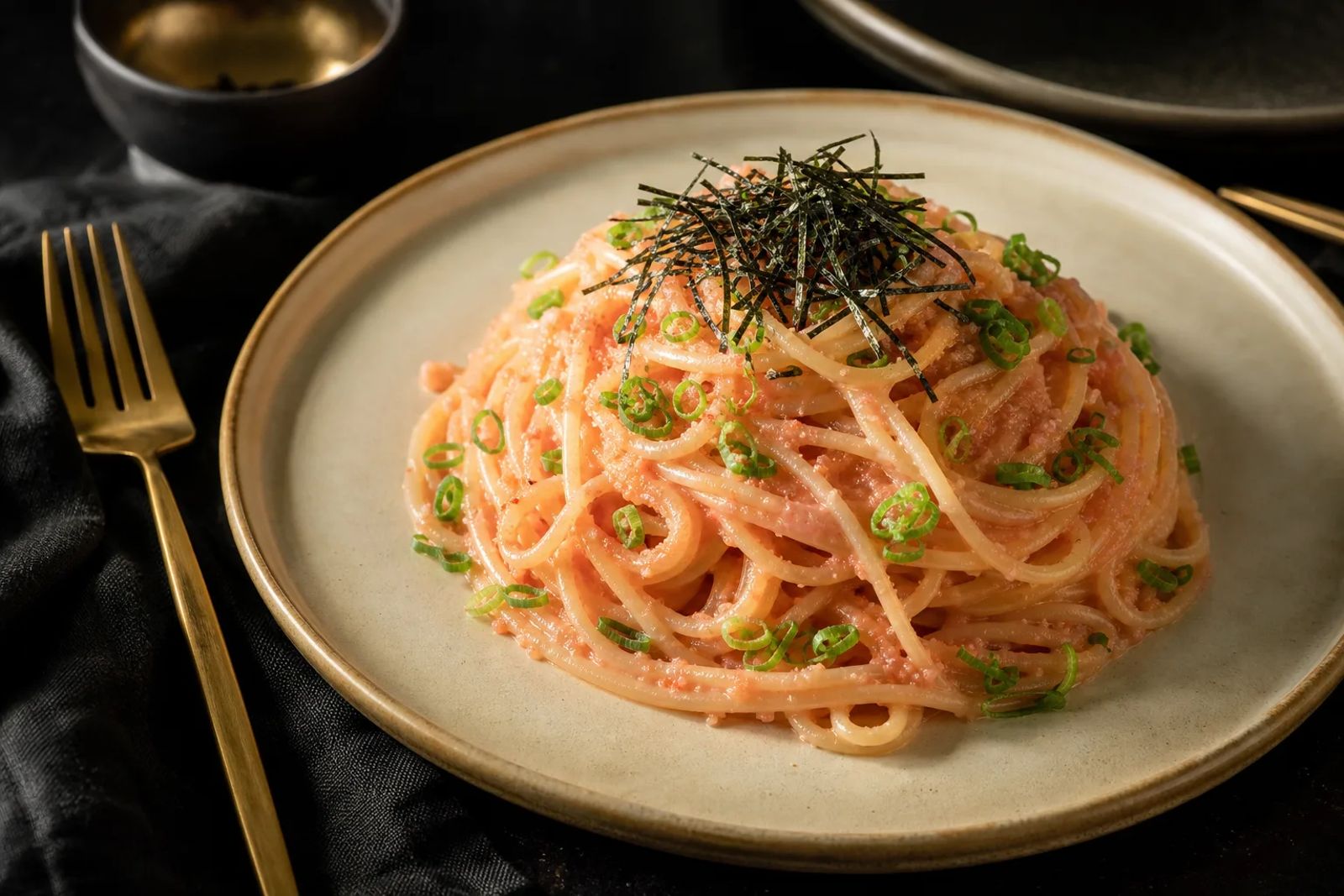
Mentaiko pasta is spaghetti tossed with chilli-seasoned pollock roe, butter and Japanese seasonings. This version uses a bowl rather than a frying pan for the final mixing, following the approach published by Japanese cookery site Shirogohan.com.
What is mentaiko?
Mentaiko here means karashi mentaiko, pollock roe cured with salt and chilli seasonings, whereas tarako is salted pollock roe without that chilli heat. The fuller distinction, including Korean preparations, is covered in pollock roe, tarako and mentaiko.
A Japanese pasta with Korean roots
Japan's Centre for Asian Historical Records traces mentaiko's origins to the Korean peninsula. In a January 2019 interview published by Japan's agriculture ministry, Fukuya's Takehiro Kawahara described his grandparents adapting the Korean roe preparation they remembered into the Japanese product in Fukuoka.
The pasta belongs to wafu, or Japanese-style, spaghetti. Restaurant company Kabe no Ana credits its own development of dishes using tarako, sea urchin and fermented soybeans with helping establish that style; its 2013 anniversary statement dates the restaurant's founding to 1953, not the invention of mentaiko pasta.
Mentaiko pasta recipe
Adapted from Shirogohan.com's bowl-mixed tarako pasta, which explicitly allows mentaiko. The source gives 50 to 60 g roe for two people, or 25 to 30 g per person; this card uses 30 g per person.
Serves: 2
Time: 20 minutes, as given by the source
Equipment: saucepan, colander, mixing bowl, knife, spoon and tongs
Ingredients
- 160 to 200 g dried spaghetti
- 60 g ready-to-eat karashi mentaiko
- 12 g butter, softened
- 3.3 ml soy sauce
- 15 to 30 ml olive oil
- Shiso leaves or finely sliced spring onion, to taste
- Black pepper, to taste
- Nori strips, optional, to finish
- Salt for the pasta water
Butter and soy are approximate metric conversions of the source's Japanese spoon measures. Nori is an optional addition drawn from the bowl-mixed mentaiko recipe published by Kurashiru.
Allergens: fish, milk, wheat and soya in the ingredients listed; check the roe's seasoning label for any others. Use mentaiko labelled for eating without further cooking, because this method does not provide a validated cooking step.
Method
- Boil the spaghetti according to its packet instructions in salted water. Prepare the sauce while it cooks.
- Slit each roe sac lengthways and open it flat. Scrape out the eggs with a spoon or the back of a knife, leaving the membrane behind.
- Warm the mixing bowl with hot water, then empty and dry it. Away from the hob, combine the roe, softened butter and soy sauce.
- Drain the pasta and immediately toss it through the bowl mixture. Add the olive oil and pepper, taste, then finish with shiso or spring onion and, if using, nori.
Why mix it off the heat?
For this recipe, the aim is a fine, speckled coating rather than firm pieces of cooked roe. Mix the sauce away from direct heat.
Using the pasta's residual warmth melts the butter without deliberately frying the eggs; direct heat would instead cook and firm their proteins, changing the texture.
Both Shirogohan.com and Kurashiru mix the roe sauce with freshly boiled pasta in a bowl. Using the pasta's residual warmth melts the butter without deliberately frying the eggs; direct heat would instead cook and firm their proteins, changing the texture. Other methods may use more heat.
Adjusting chilli and salt
For a milder plate, replace the mentaiko with the same weight of tarako, an alternative expressly allowed by Shirogohan.com. Do not add chilli automatically: let the roe you have chosen set the starting point.
Taste before adding more soy or salt, since the roe and soy already contribute seasoning. Shirogohan.com allows either salted or unsalted butter and adjusts the finished pasta afterwards; unsalted butter is a convenient choice when you want more control.
Storing and freezing the remaining roe
Keep unused mentaiko refrigerated according to its pack instructions and use-by date. Freezing advice is product-specific: Japanese producer Hakata Fukuichi recommends wrapping its whole sacs closely, or dividing broken roe into meal-sized portions before freezing.
For its own mentaiko, the company gives about 60 days as a frozen quality guide and recommends thawing slowly in the refrigerator from the previous day. It advises against refreezing because flavour deteriorates; use your own producer's instructions rather than treating that period as a universal shelf life.
Where to go next
- Roe Recipes: more ways to cook and serve fish roe.
- Caviar Pasta: a separate method for a different style of roe.
- Japanese Roe Culture: the wider context beyond this plate of pasta.
Sources
-
Shirogohan.com, 和えるだけ!和風たらこパスタのレシピ(明太子でも) [Bowl-mixed Japanese-style tarako pasta, also with mentaiko], recipe text revised May 2025. Main recipe, quantities, preparation and seasoning.
Read at sirogohan.com -
Kurashiru, 明太子パスタ [Mentaiko pasta], recipe by 食事処さくら [Shokujidokoro Sakura], Undated recipe with bowl mixing, roe sac preparation and nori.
Read at kurashiru.com -
NHK Educational, たらこ・明太子 のレシピ一覧 [Tarako and mentaiko recipes], Undated recipe collection explaining salted tarako and chilli seasoned mentaiko.
Read at kyounoryouri.jp -
Japan Centre for Asian Historical Records, Yasuaki Maruyama, Mentaiko and the Japanese People, Newsletter No. 19, 4 February 2016. Historical account drawing on archival records.
Read at jacar.go.jp -
Ministry of Agriculture, Forestry and Fisheries, Japan, aff, January 2019, text edition, interview with Takehiro Kawahara. Attributed family account of developing Japanese mentaiko from a remembered Korean preparation.
Read at maff.go.jp -
Kabe no Ana Co., Ltd, たらこスパゲティの元祖、「壁の穴」は創業60周年を迎えました。 [Kabe no Ana celebrates its 60th anniversary], company press release distributed by Dream News, 21 October 2013. Company account of its founding and Japanese-style spaghetti development.
Read at dreamnews.jp -
Hakata Fukuichi, よくあるご質問 [Frequently asked questions], Undated producer guidance on freezing, portioning and thawing mentaiko in the refrigerator.
Read at hakata-fukuichi.jp
The recipe was adapted from Japanese-language cookery instructions, with history checked against archival and attributed accounts and storage advice taken from a named producer; it has not been tested by caviar.uk.
Last checked: November 2026