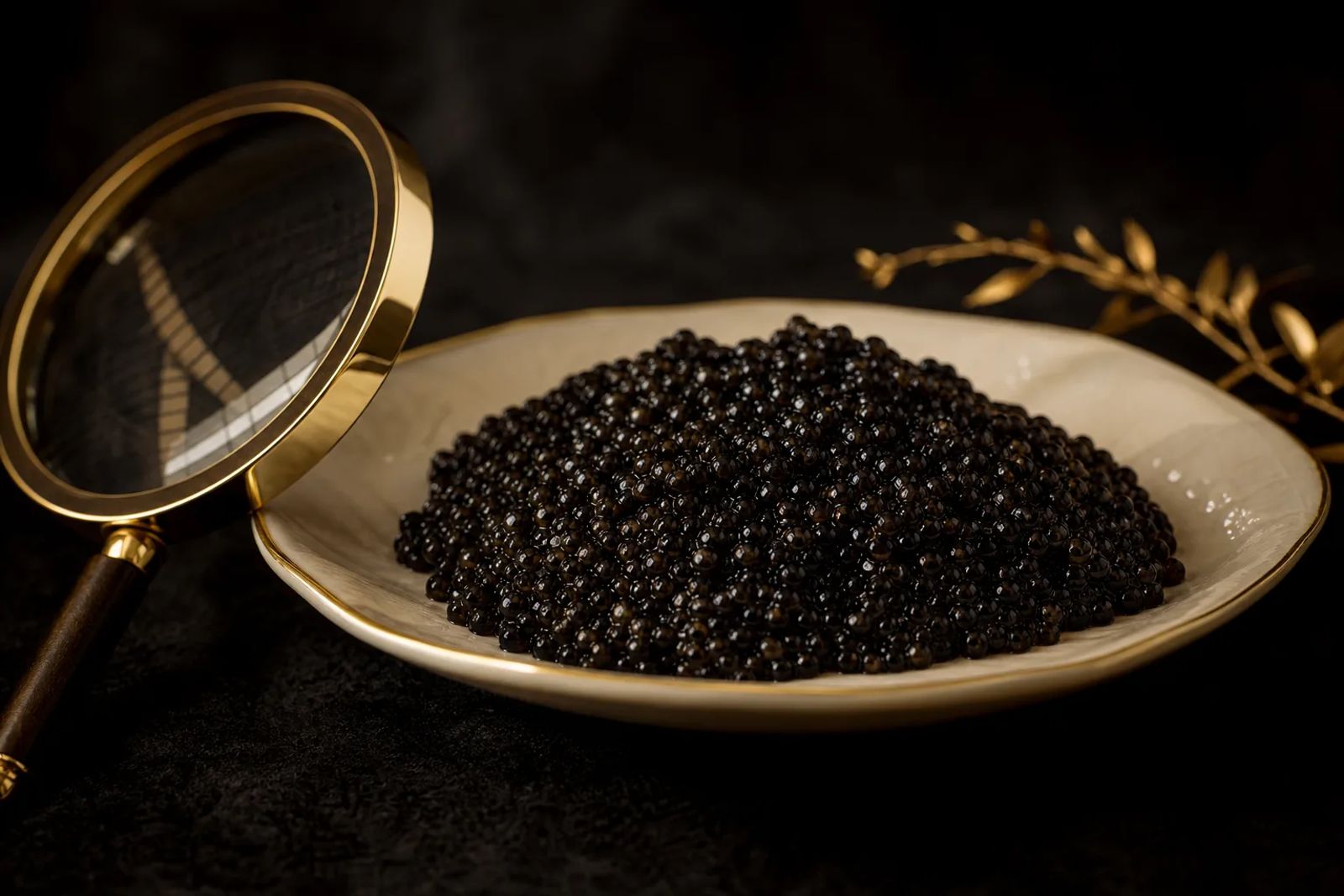
Black, grey, yellow, brownish, even greenish: sturgeon caviar comes in a striking range of natural shades. Codex, the international food standards body, recognises them all. Gold is one possibility, not the top of a quality ladder.
Neither black nor golden caviar is inherently better. Colour reflects the fish and its pigmentation. Golden roe, meaning fish eggs, can be naturally pale, and the word “golden” alone establishes neither albinism nor rarity.
Is black caviar better than golden?
Choose the caviar, not the colour. Look for flavour, texture and condition you enjoy, with documented species and origin, rather than treating pale eggs as an automatic upgrade.
Codex expects colour characteristic of the species and an evenly coloured product. It does not rank golden eggs above black ones. Colour still matters in some grading systems: GOST 7442, an interstate standard for granular sturgeon caviar, includes colour and uniformity among its specifications for different grades where the standard is adopted.
For a closer look at appearance and quality, see bead size, colour and firmness.
What makes caviar golden or pale?
Pigment is the starting point. In a 2022 study, researchers isolated pigment from black sturgeon roe supplied by one company. Chemical degradation and electron paramagnetic resonance, a technique for examining molecular structure, identified it as eumelanin: a dark melanin pigment.
Genetics can change that pigment system. A 2019 study compared gene activity in skin from albino and normally pigmented Russian sturgeon. Using transcriptome analysis and checking selected findings with quantitative PCR, researchers found several genes involved in melanin production were less active in the albino fish. The work examined skin, rather than golden eggs directly.
Albinism is an inherited reduction in melanin production and one explanation for unusually pale caviar. A golden appearance alone does not establish albinism: producer descriptions also document golden brown Russian sturgeon caviar without identifying the fish as albino.
Diet can influence appearance, too. A 2014 sensory study of caviar from sturgeon fed different diets found differences in several attributes, including mustard colour. That finding applies to those samples; it does not establish a particular feed as a reliable recipe for golden caviar.
Age cannot be read from the colour of an individual tin. If the female’s age matters to your choice, ask for a documented harvest history.
Which fish can produce pale roe?
Golden brown Russian sturgeon roe and golden albino sterlet roe offer two documented examples. Caviar Giaveri describes the former in its producer literature, identifying the fish as Russian sturgeon (Acipenser gueldenstaedtii) but not identifying them as albino. Adamas identifies its golden caviar as roe from albino sterlet (Acipenser ruthenus).
Giaveri’s description leaves the fish’s pigmentation status unspecified; Adamas explicitly identifies albino production. Neither description serves as a colour chart for identifying a species: neither a photograph nor “golden” on a container tells you which fish produced the eggs.
For more on Russian sturgeon, see the Ossetra guide. For the differences between pale roe, albino fish and the name Almas, read the white caviar explanation.
Golden caviar is not one measurable production category. The term may describe a selected colour within ordinary production or roe from an albino breeding line.
What “golden” means in the trade
“Golden” describes an appearance or a producer’s selection, not a species. Nor does it carry a quality promise shared by all producers. Ask two direct questions: what colour criteria define this selection, and is the producer claiming albinism?
As for stories that golden roe was reserved exclusively for tsars or shahs, ask for a contemporary record.
“Imperial”, “Royal” and “Reserve” also need explanation. Two companies may use different selection rules under the same name. The guide to caviar trade names separates these descriptions from the fish’s identity and the information needed for traceability.
As for stories that golden roe was reserved exclusively for tsars or shahs, ask for a contemporary record. Without one, the story belongs to legend.
Does golden caviar taste different?
It can, but colour alone does not establish the reason. Adamas describes its albino sterlet caviar as sweet and delicate. That is a description of the producer’s own caviar, rather than a flavour profile guaranteed by pale pigmentation.
The dietary study also found differences in texture and flavour attributes, showing how two samples can differ in much more than their appearance.
When comparing caviars, assess saltiness, aroma, firmness and finish separately from colour. Which tastes better to you? That is a useful answer when choosing caviar, without turning a preference between two samples into a ranking of every golden and black egg.
Natural colour, dyes and the label
Golden roe can be entirely natural. No dye is needed to explain its appearance.
Codex CXS 291-2010 describes characteristic natural colours and does not authorise colours in its additives section. It is a reference standard, however, not automatically binding national law, and rules for other fish roe can differ.
Rules by jurisdiction
- EU and Northern Ireland: Regulation (EC) No 1333/2008, category 09.3, permits colours in other fish roe but expressly excludes sturgeon eggs.
- Great Britain: Check permissions separately in the Food Standards Agency register under assimilated Regulation 1333/2008.
- US: The FDA’s nonbinding CPG 540.150 says unqualified “caviar” should refer to salted sturgeon roe. Names for other roe should give the fish name and “caviar” comparable size and prominence. FDA guidance also says added colour must meet applicable colour additive regulations and its presence must be prominently declared.
What to check on the label
Start with the consumer label: check the species name and ingredients. For internationally traded sturgeon caviar, also check the species code and country of origin on the CITES label.
Keep origin and repacker details separate. A brand’s address does not establish where the caviar came from. The CITES label supports traceability, rather than independently proving the contents, while domestic labelling requirements depend on the jurisdiction. For more on claims about appearance and quality, see caviar myths and facts.
Sources
- FAO and WHO, Codex Alimentarius Commission. Standard for Sturgeon Caviar, CXS 291-2010, incorporating the 2024 amendments. Sections 2.2 and 4 cover natural colour and additives. Standard PDF.
- Interstate Council for Standardization, Metrology and Certification. Granular sturgeon caviar. Specifications, GOST 7442-2017, November 2018 reissue. Section 4.2.4, Table 1, includes colour criteria by grade. Original standard reproduced by Meganorm. Standard PDF.
- Panzella, L. and colleagues. Identification of black sturgeon caviar pigment as eumelanin. Food Chemistry, volume 373, article 131474, 2022. Chemical and spectroscopic identification of the dark pigment. Research article.
- Gong, Y. and colleagues. Comparative transcriptome analysis reveals expression signatures of albino Russian sturgeon, Acipenseriformes gueldenstaedtii. Marine Genomics, volume 46, pages 1 to 7, 2019. Comparison of skin gene expression in albino and normally pigmented fish. PubMed record.
- Baker, A. K. and colleagues, Washington State University. Development of a Lexicon for Caviar and Its Usefulness for Determining Consumer Preference. Journal of Food Science, volume 79, issue 12, pages S2533 to S2541, 2014. University research record and abstract describing dietary groups and sensory assessment. University record.
- Caviar Giaveri. Cartella stampa, 2022, hosted by Pitti Immagine. Producer descriptions of Russian sturgeon caviar and Golden Sterlet. Producer press document.
- Adamas Caviar. Golden Selection: Albino, undated product description, retrieved November 2026. Producer description of albino sterlet, pale colour and flavour.
- European Parliament and Council. Regulation (EC) No 1333/2008 on food additives, consolidated text dated 5 October 2023, Annex II, Part E, category 09.3. Category 09.3 excludes sturgeon eggs from its listed colour permissions. EUR-Lex text.
- Food Standards Agency. Guidance on using the Register of Food Additive Authorisations, undated current guidance, retrieved November 2026. Explains the GB register’s legal role from 1 April 2025. Register guidance.
- Food Standards Agency. Approved additives and E numbers, 2026. Explains the separate GB and Northern Ireland legislative frameworks. Official guidance.
- US Food and Drug Administration. CPG Sec. 540.150: Caviar, Use of Term, Labeling, October 1989. Nonbinding guidance on naming, ingredients and added colour. FDA guidance.
- United States, Code of Federal Regulations. 50 CFR 23.71: How can I trade internationally in sturgeon caviar?, text retrieved November 2026, reproduced by Cornell Legal Information Institute. Paragraphs (b)(2) and (b)(3) distinguish origin from repackaging information. Regulatory text.
Last checked: November 2026