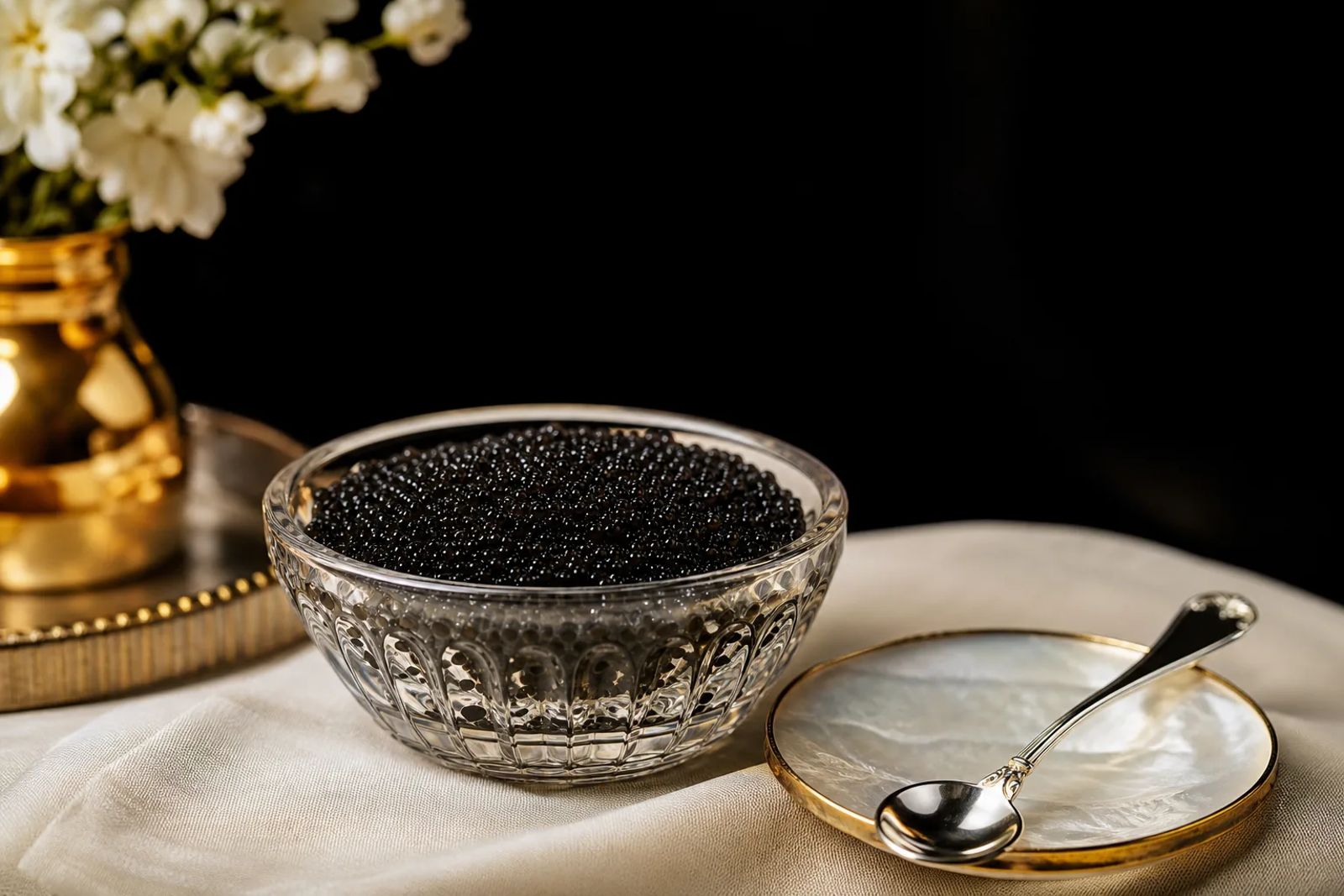
At the Corning Museum of Glass, a caviar set pairs glass bowls and a silver support with a mother-of-pearl spoon. Silver dresses the table; another material carries the roe to the mouth.
For serving, choose a suitable non-metallic spoon or sound stainless steel. But a brief touch of silver has not been shown to spoil caviar. Silver can tarnish, and spoon materials can influence taste. The science is more interesting than the familiar prohibition.
Why not use a silver spoon with caviar?
The familiar explanation is that silver reacts with sulphur compounds or salt in the roe, creating a metallic taste. Yet three different things are being bundled together: a reaction on the spoon, the taste of the spoon itself and a change in the caviar. Each needs its own evidence.
Calling the caviar rule simply “oxidation” leaves the crucial question unanswered: what, if anything, changes in the mouth?
The Canadian Conservation Institute explains that silver reacts with sulphur-containing gases, notably hydrogen sulphide, to form silver sulphide tarnish. It also documents silver chloride forming from salt in fingerprints. The chemistry is real. What it does not establish is how quickly chilled caviar would affect silver, or whether a diner would taste the result.
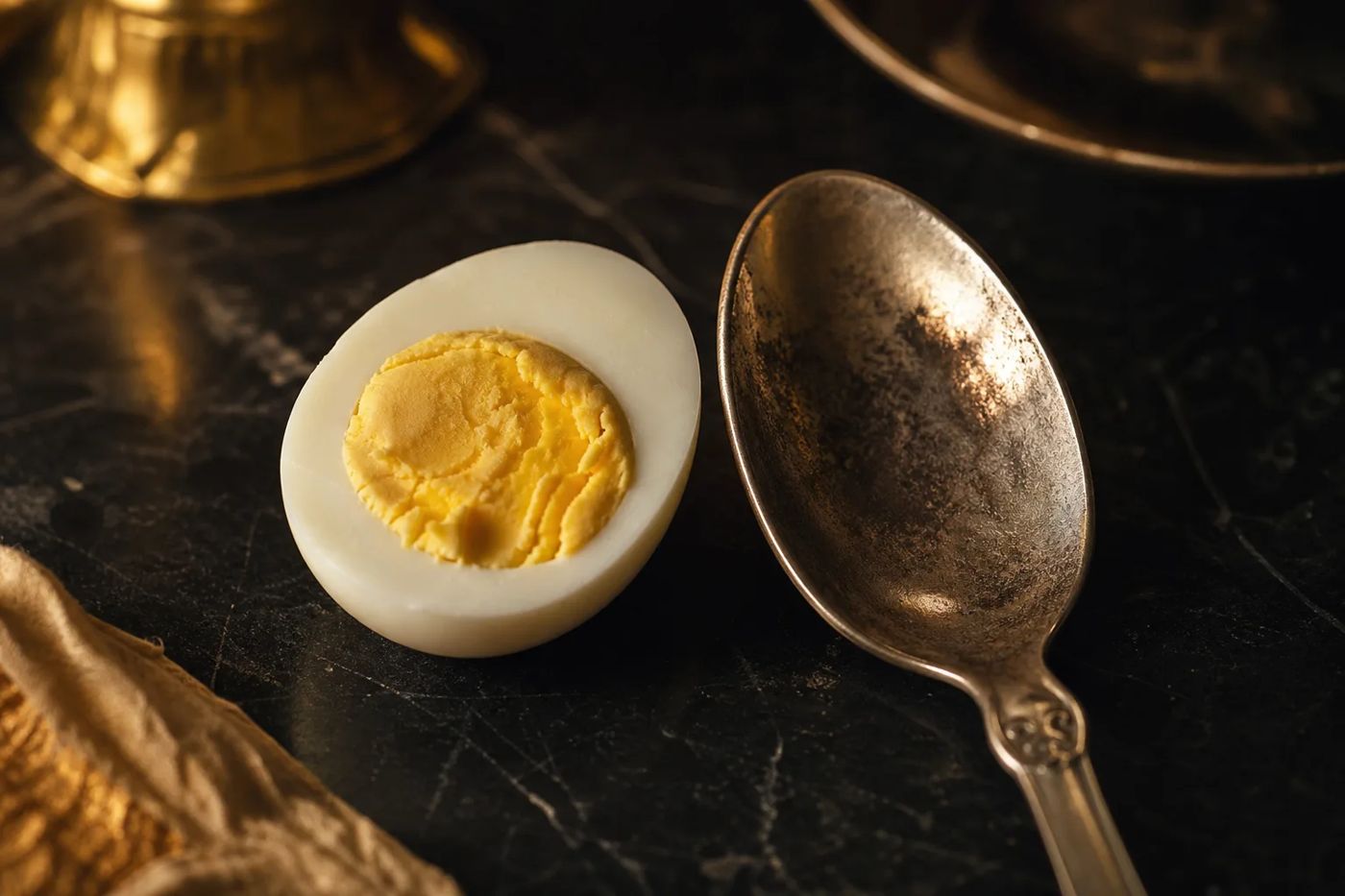
The familiar hard-boiled egg demonstration belongs here too. Hydrogen sulphide released by the cooked egg tarnishes the silver; the demonstration does not test caviar. Calling the caviar rule simply “oxidation” leaves the crucial question unanswered: what, if anything, changes in the mouth?
What the tasting studies actually tested
A spoon can have a taste of its own. In a 2011 study, Zoe Laughlin and colleagues asked 32 blindfolded participants to taste identically shaped spoons with seven different metal surfaces, including silver, gold and stainless steel. They rated sensations including bitterness, metallic taste and unpleasantness. The spoons carried no food.
Copper and zinc made the strongest metallic impression. Silver's taste was described as subtle in the discussion, and silver, gold, tin, chrome and stainless steel did not differ significantly in unpleasantness. The results give no reason to treat every metal spoon as equally intrusive.
A 2012 follow-up by Betina Piqueras-Fiszman and colleagues brought food into the experiment. Its 30 participants tasted plain, sweet, sour, bitter and salty creams with their eyes closed, using gold, stainless steel, copper and zinc surfaces. Copper and zinc imparted metallic and bitter sensations and changed some taste ratings. Silver was not tested.
Together, these controlled studies show that utensil material can influence perception. They examine the spoon in the mouth and, in the follow-up, its influence on cream. Neither compares caviar eaten with silver against caviar eaten with other spoons.
Silver, silver plate and stainless steel
Silver plate still puts silver against the food, provided the plating is intact. It therefore raises the same surface question as a silver spoon. Repeated polishing can wear through that layer, according to the conservation evidence, so a worn plated spoon is a different proposition from an intact one.
Stainless steel is another material altogether. As the British Stainless Steel Association explains, its corrosion resistance comes from a thin, chromium-rich protective surface film. Silver-coloured cutlery does not all share the same chemistry: sound stainless steel should be considered separately from silver.
Does contact time matter?
A quick scoop and a spoon left sitting in the roe are different exposures. No caviar-specific contact time after which silver changes flavour has been established in the studies reviewed here. Neither “safe for ten seconds” nor “ruined instantly” follows from the available evidence.
Keep serving contact brief and rest the spoon on a separate dish rather than leaving it in the caviar. That is a straightforward precaution, not a measured threshold. If a silver spoon has already touched a few beads, there is no basis in the research reviewed here for declaring the whole tin spoiled.
Why traditional spoons are still used
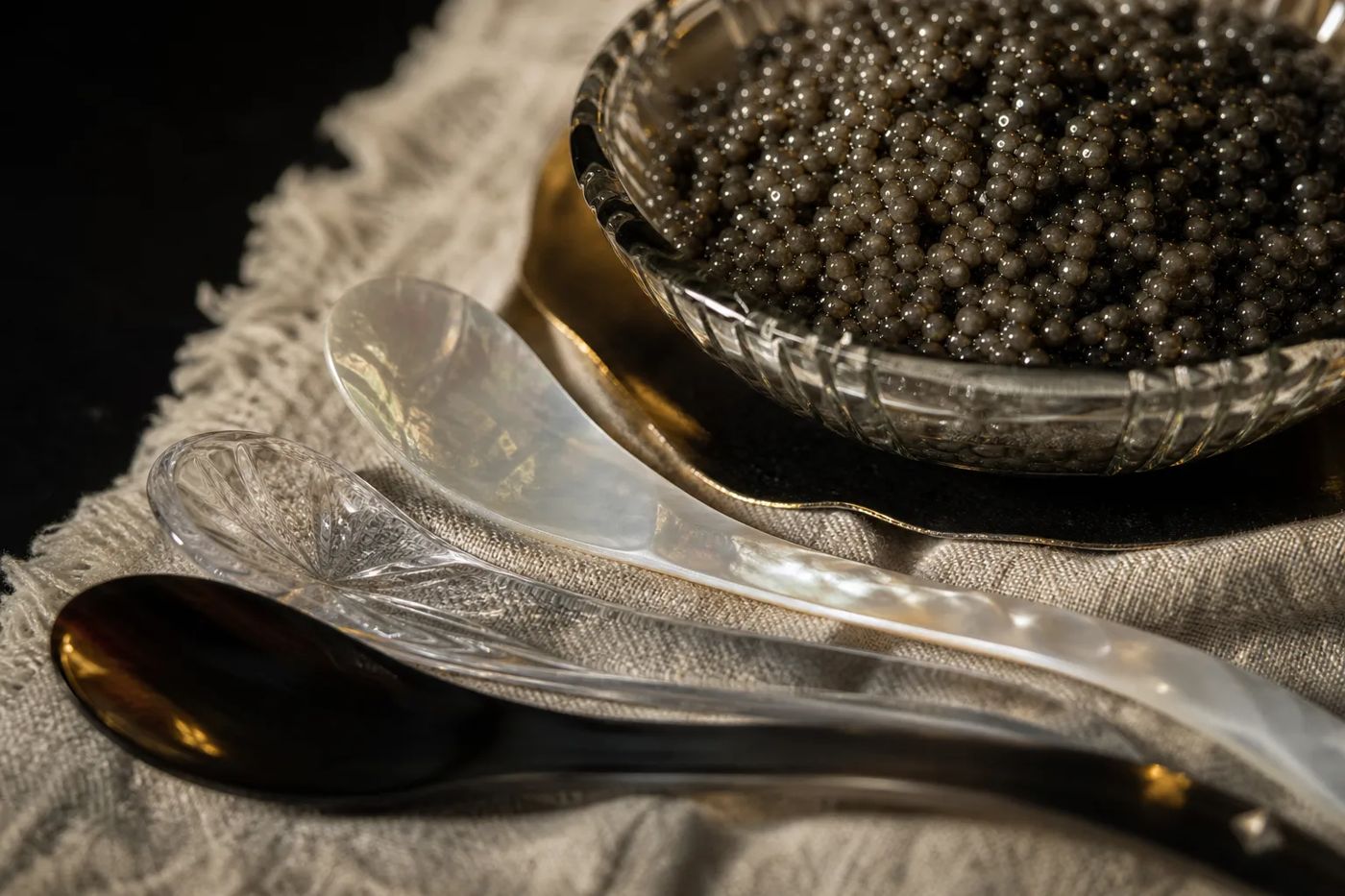
Mother-of-pearl, horn, bone, wood and glass keep a bare metal eating surface out of the mouth. Sid Cross's advice for the International Wine & Food Society lists these among the customary alternatives. Part of their appeal is the aim of avoiding an intrusive utensil taste, alongside the appearance and ritual of caviar service. Their superiority has not been demonstrated in a caviar tasting trial.
Gold makes the limits of “never use metal” especially clear. It is a metal, yet gold surfaces were among the mild-tasting options in the spoon research. Nor are all non-metallic materials interchangeable.
The surviving museum set records the practice, not its inventor. It is evidence of how caviar was served, rather than a test of which spoon makes it taste best.
But isn't caviar packed in metal tins?
Yes. The important detail is the inside surface, which can be a lining rather than bare metal. India's food standards explicitly describe caviar tins coated internally with stable food lacquer or enamel. Paramount Caviar likewise states that its metal tins have an internal food-grade varnish.
A metal tin therefore does not settle the spoon question. Packaging is designed for prolonged contact with its contents. A spoon meets both the food and the mouth, bringing the utensil's own sensory qualities into the experience. Those are different situations, even when both objects look metallic from the outside.
If you have only metal spoons
Use a clean, undamaged stainless steel teaspoon if that is what you have. Its corrosion-resistant surface and the broader sensory research make it a practical choice, although that does not promise identical results with every caviar. A missing mother-of-pearl spoon is no reason to abandon serving.
If the choice is between silver and stainless steel, choose stainless steel. If a suitable non-metallic spoon is already to hand, use it without ceremony.
The customs explored in caviar etiquette make more sense alongside the evidence in the myths and facts guide. For the occasion itself, turn to tasting caviar, then let the roe, rather than the spoon, hold your attention.
Sources
-
Canadian Conservation Institute. Understanding how silver objects tarnish. Technical guidance by Lyndsie Selwyn, published in 2017. Official guidance.
-
Canadian Conservation Institute. Caring for metal objects: Preventive conservation guidelines for collections. Guidance on metal corrosion, including silver and fingerprints. Official guidance.
-
Laughlin, Z., Conreen, M., Witchel, H. J. and Miodownik, M. The use of standard electrode potentials to predict the taste of solid metals. Food Quality and Preference, volume 22, issue 7, 2011, pages 628 to 637. Research paper.
-
Piqueras-Fiszman, B., Laughlin, Z., Miodownik, M. and Spence, C. Tasting spoons: Assessing how the material of a spoon affects the taste of the food. Food Quality and Preference, volume 24, issue 1, 2012, pages 24 to 29. Research paper.
-
Laughlin, Z. Research papers. Author's research summaries and publication record. Author's research page.
-
British Stainless Steel Association. When is stainless steel passive or active: Formation of the passive layer. Technical article on stainless steel passivation. Technical guidance.
-
International Wine & Food Society. Ask Sid: What's the best serving utensil for caviar? Advice by Sid Cross, posted by Joseph Temple, 12 November 2014. Published advice.
-
Corning Museum of Glass. Caviar set. Collection record 2009.4.346, object dated 2005. Museum record.
-
Food Safety and Standards Authority of India. Food Safety and Standards (Food Products Standards and Food Additives) Regulations, 2011: Chapter 2.6, Fish and fish products. Version 3, 7 May 2025, sturgeon caviar provision, paragraph 11. Official compilation.
-
Paramount Caviar. Caviar general information. Company information, “Packaging” section. Company packaging statement.
This article compares primary sensory studies with conservation chemistry, technical materials guidance, a museum collection record and attributed serving and packaging statements.
Last checked: November 2026