
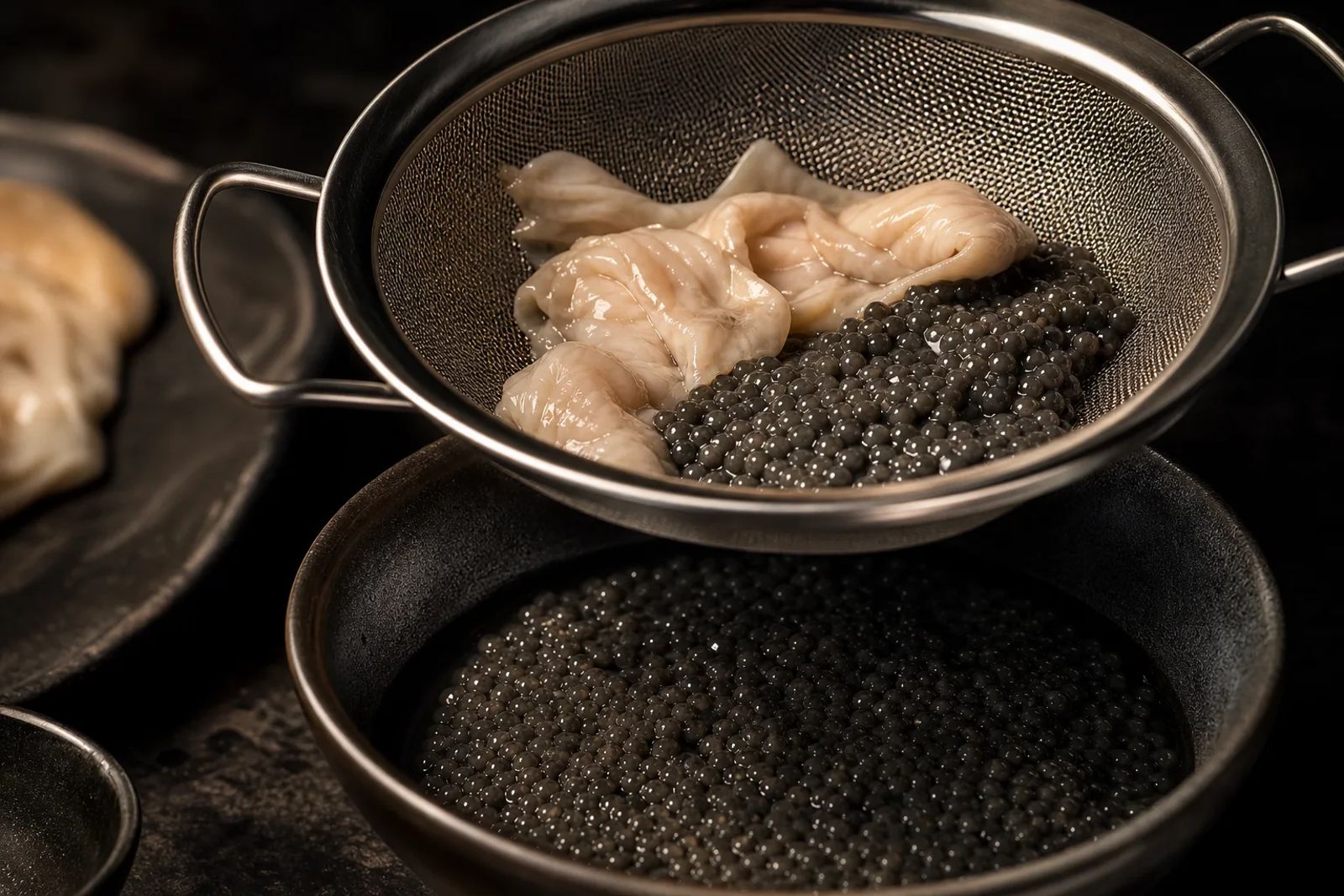
Before caviar becomes a spoonful of loose beads, it is a cohesive mass of eggs bound in ovarian tissue. The University of Florida's aquaculture guidance describes the transformation: handfuls of ovary are gently rubbed over stainless steel screens, releasing individual eggs into a container below.
The task is to remove tissue and loose contamination without breaking the beads destined for salting. Gentle handling, water suitable for direct food contact, thorough drainage and a documented cold processing sequence make that possible.
Screening, separating and rinsing the eggs: what reaches the screen
An extracted ovary brings more than eggs to the processing table. The surrounding ovarian membrane and connective tissue must come away, along with fat tissue, blood clots and fragments of ovarian follicles, the structures that enclose developing eggs.
This is the conventional preparation route for eggs collected within the ovary. Ovulated eggs have already been released from their follicles and need a different route, a distinction recognised by Codex. For the surrounding production sequence, see from fish to tin.
Screening and separating the eggs
The eggs should pass through the screen; the supporting tissue should stay above it. Florida's guidance describes cutting the ovary into manageable pieces, then gently rubbing handfuls over stainless steel screens into a receiving container. The aim is separation, not forcing every last egg through the openings.
Screen aperture is the size of those openings, not the wire thickness or an unspecified mesh number. Codex says the mesh should match egg size but provides no species-by-species aperture schedule. The primary sources reviewed did not establish reliable numerical screening apertures for individual sturgeon species, so no such figures are prescribed here.
Choose and verify the screen against the actual batch. It must release eggs without damaging pressure while retaining the tissue being removed. Published egg diameters cannot replace validated screen specifications. For the biological distinction between supporting tissue and the egg's own envelope, see the egg membrane.
What machines can and cannot replace
Size grading and tissue separation are different jobs. Mechanical screening for size grading is documented; reliable mechanical separation of eggs from ovarian tissue has not been documented.
Chinese utility model CN210386551U, published in 2020, describes a motor-driven reciprocating screening box with one or more mesh layers. Its stated purpose is to grade eggs by size, rather than detach ovarian tissue with acceptable egg damage.
A patent records a design and its applicant's claims, rather than independent commercial validation. Before replacing hand separation, a processor needs evidence that the equipment performs the intended task: intact-egg recovery, residual tissue and cleanability all matter. Faster size grading alone answers none of those questions.
Rinsing: water quality before water temperature
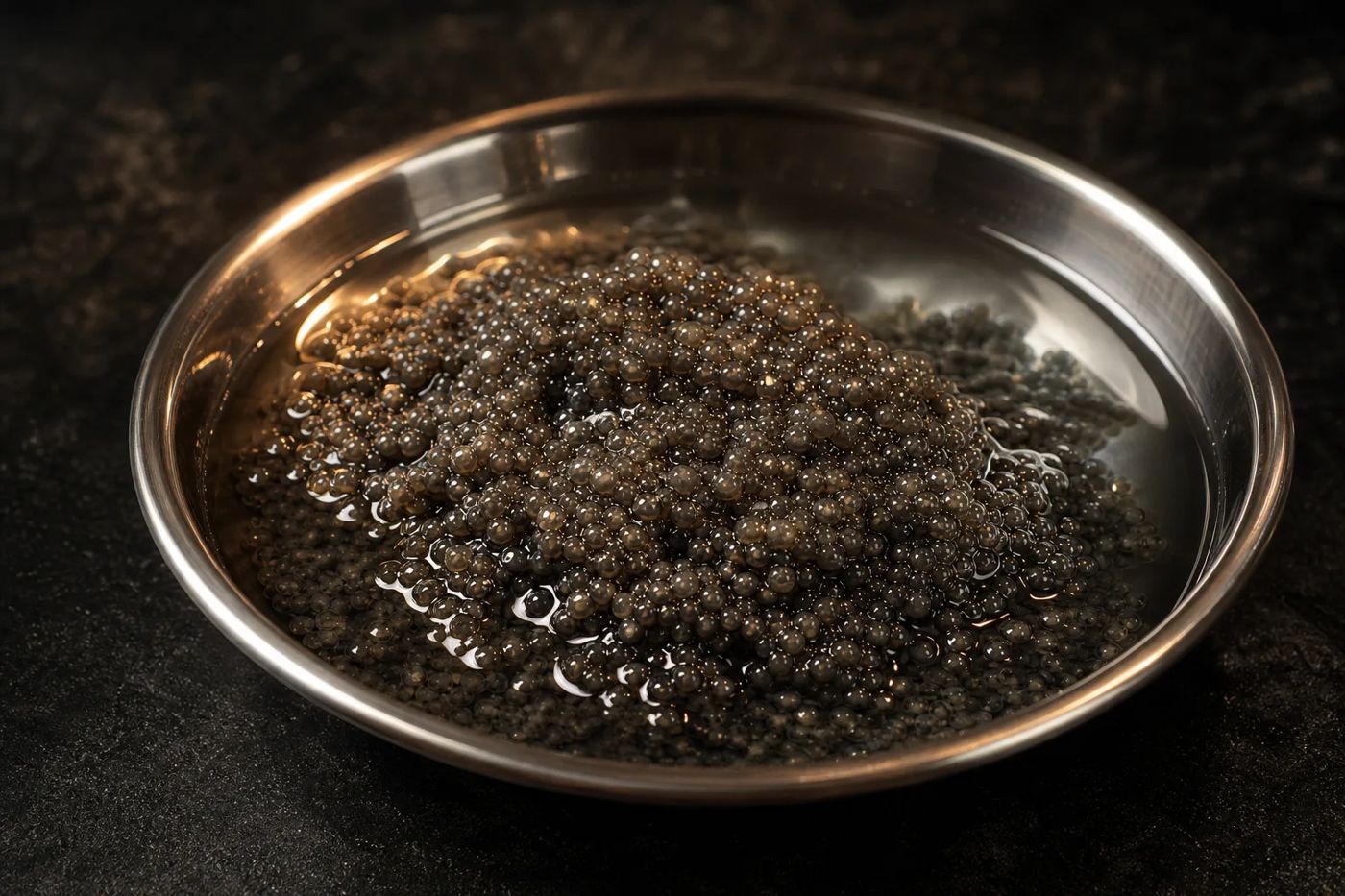
Rinsing carries away blood, broken eggs and loose tissue left after screening. Florida's guidance describes several rinses in chilled clean water. The water may run clear, but rinsing is a cleaning step, not a validated microbial kill step or confirmation that the eggs are safe.
Use chilled potable water, meaning water of drinking quality, and verify the supply at its point of use. Neither the Codex caviar standard reviewed nor the Florida processing account establishes a universal numerical rinse-water temperature. A finished-product storage temperature is not a rinsing instruction.
Set the rinse-water limit and monitoring requirements in the plant's documented process. “Cold” alone is too vague. Record product exposure too: chilled water cannot account for time spent waiting between the screen, rinse vessel and drain.
Which water rules apply
In the EU, Regulation (EC) No 852/2004, Annex II, Chapter VII, requires an adequate potable water supply where needed to prevent food contamination. Its allowance for clean water with whole fishery products does not give blanket permission to wash separated roe. Directive (EU) 2020/2184 provides the drinking-water framework, implemented through national law.
In Great Britain, Regulation (EC) No 852/2004 applies as assimilated and amended law, alongside the drinking water requirements applicable in England, Wales or Scotland. The FSA's official controls manual explains potable water requirements for England and Wales. Northern Ireland applies the relevant EU hygiene framework alongside its local drinking water requirements.
The water may run clear, but rinsing is a cleaning step, not a validated microbial kill step or confirmation that the eggs are safe.
In the US, 21 CFR 123.11 requires sanitation monitoring covering water that contacts food or food-contact surfaces. Section 117.37 requires an adequate supply and safe water of adequate sanitary quality for food contact. Seafood HACCP compliance does not remove the applicable current good manufacturing practice requirements.
Drain before weighing and salting
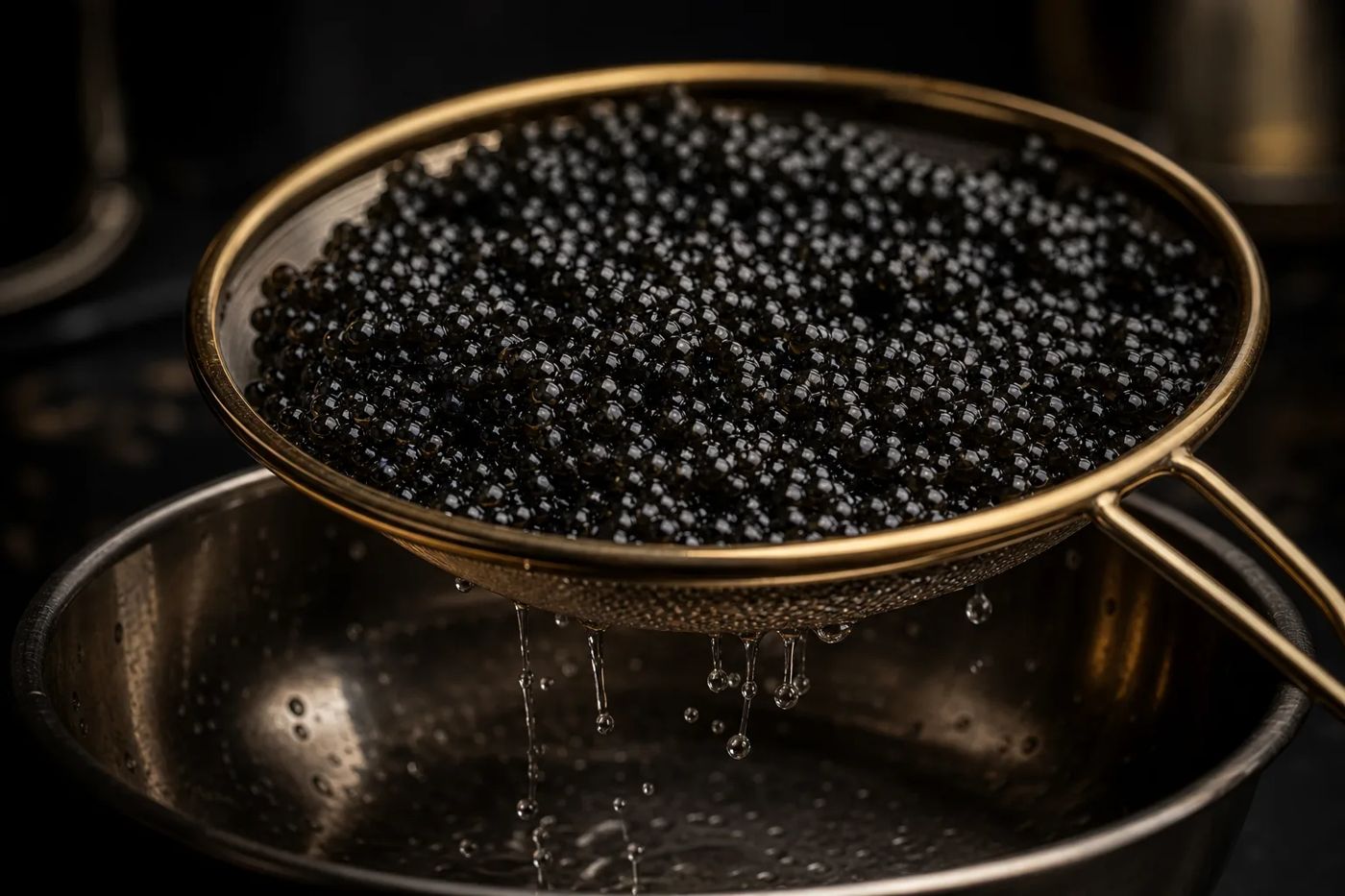
Let rinse water escape through a suitable draining sieve. Do not squeeze the eggs. This drainage before salting is a separate operation from removing excess brine after salting; the Codex processing flow distinguishes the two.
Surplus rinse water changes both the weight on the scales and the water available to dissolve salt. Material weighed with that surplus is not simply drained roe. A fixed salt addition calculated from its wet weight therefore cannot be assumed to deliver the intended final salt concentration.
That relationship explains why drainage matters; checking the finished product remains essential. The subsequent controls belong in salting caviar.
Faults to catch at this stage
Broken eggs cannot be repaired. Catching excess pressure, lingering tissue or poor drainage now allows the process to be corrected, but does not guarantee recovery of affected material. Hold it for assessment under the plant's procedures.
The responses below follow from the handling guidance in sources 1 and 2.
| Problem | Likely cause | Response |
|---|---|---|
| Broken eggs | Excessive separation pressure | Reduce force and review screen suitability. Broken eggs cannot be repaired. |
| Membrane residue | Incomplete tissue separation | Review screening and removal of loose tissue during rinsing. |
| Excess water | Incomplete drainage before weighing | Restore documented drainage before weighing and calculating salt. |
Soft texture does not identify a single processing error. Codex lists objectionable odour, flavour and consistency as defects, and rinsing cannot be relied on to correct them. See off-flavours and texture problems.
Time, temperature and hygiene
Keep the sequence cold and as short as practicable. That is the Codex recommendation, rather than a single stopwatch limit for every plant. FDA seafood guidance likewise treats cumulative time and temperature exposure as a hazard-control question.
Establish limits through the site's hazard analysis and validation, then monitor the whole sequence. The clock does not reset when eggs move from one vessel to another.
Keep egg processing separate from belly cutting and gutting. Use trained staff, washable food-contact screens and cleaned, disinfected utensils. Prevent contamination from hands, water and surfaces, and choose cleaning agents that do not taint the eggs.
These prerequisite hygiene controls protect the process; visible cleanliness alone cannot establish microbiological safety. The caviar processing hub places them within the wider production system.
Sources
-
University of Florida, IFAS Extension. Technically Speaking, What Is Sturgeon Caviar? Publication FA194, retrieved online edition; publication and revision dates not reliably established from the retrieved text. Publication.
-
FAO and WHO, Codex Alimentarius. Code of Practice for Fish and Fishery Products, CXC 52-2003, 2020 collected edition, Section 20. Institutional copy.
-
FAO and WHO, Codex Alimentarius. Standard for Sturgeon Caviar, CXS 291-2010, amended 2013 and 2018, register last modified 2026, official PDF. Official document.
-
China National Intellectual Property Administration. Sieving mechanism is used in sturgeon caviar processing, utility model CN210386551U, published 24 April 2020. English machine translation of the patent publication. Patent text.
-
European Parliament and Council. Regulation (EC) No 852/2004 on the hygiene of foodstuffs, 2004, Annex II, Chapter VII. EUR-Lex text.
-
European Parliament and Council. Directive (EU) 2020/2184 on the quality of water intended for human consumption, Guidance Note 25, revision 4, 2025. Guidance.
-
Food Standards Agency. Manual for Official Controls, Chapter 4.3, Verifying Operator's Own Checks, Amendment 111, retrieved 2026 edition, Section 6.2. Manual chapter.
-
Food Standards Agency. Approval of food establishments in Northern Ireland: governance arrangements and approvals policy, retrieved online edition, 2025. Policy.
-
US Food and Drug Administration. 21 CFR Part 123: Fish and Fishery Products, current eCFR text retrieved November 2026, especially Sections 123.5, 123.6 and 123.11. Regulation.
-
US Food and Drug Administration. 21 CFR 117.37: Sanitary facilities and controls, current eCFR text retrieved November 2026, paragraph (a). Regulation.
-
US Food and Drug Administration. Fish and Fishery Products Hazards and Controls Guidance, June 2022 edition, particularly guidance on time and temperature controls during unrefrigerated processing. Guidance and chapter downloads.
-
US Food and Drug Administration. Seafood HACCP and the FDA Food Safety Modernization Act: Guidance for Industry, retrieved 2021 edition. Guidance.
The piece was researched from Codex processing guidance, university aquaculture guidance, a published equipment patent and official food-hygiene legislation and guidance, with operational deductions identified separately.
Last checked: November 2026