
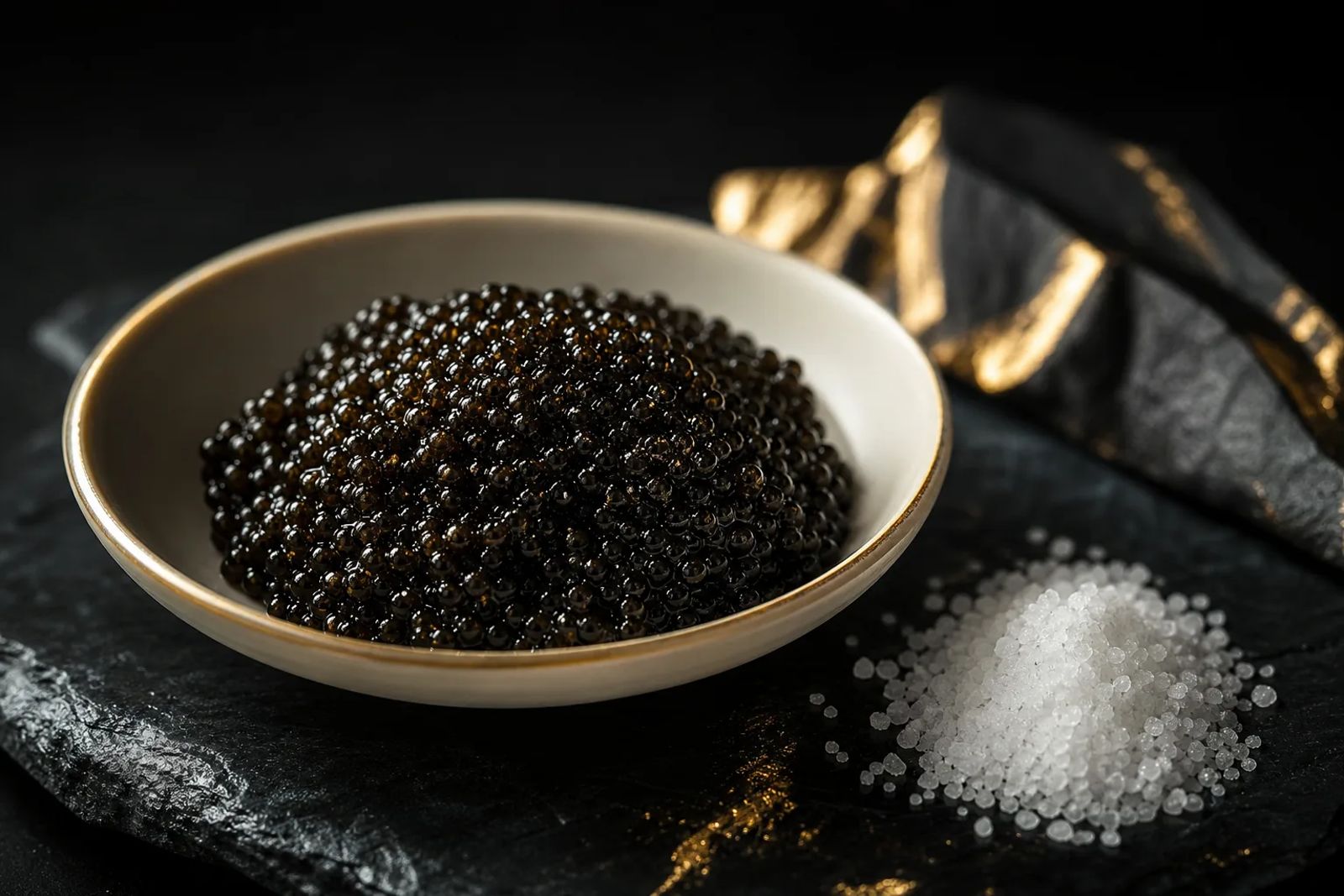
Salt added to roe is not the same as salt remaining in the finished caviar. Codex CXS 291-2010, last modified 2026, specifies 3 to 5 g salt per 100 g of finished granular caviar, not the quantity initially added to the roe.
That measured quantity of food-grade salt transforms prepared sturgeon eggs, developing their flavour and texture while helping to control deterioration. The work calls for even distribution without unnecessarily breaking the eggs.
What salt does to the egg
Salt brings flavour, changes the eggs' physical properties and helps preserve them by reducing available water. Flavour reaches the palate; safety needs verification. Good taste and texture cannot establish whether a batch meets its microbiological safety specification.
The key measure is water activity: a measure of water available to microorganisms, explained in the science of preservation. In practice, a formulation chosen for flavour must also belong to a validated preservation system. Salt dose, temperature, packaging and shelf life have to work together.
Choosing salt: specification before origin
“Sea salt” and “rock salt” tell a processor too little. Codex requires food-grade salt, and its fish-processing code calls for very small crystals, allowing rapid dissolution and absorption while avoiding damage to the eggs. Reliable documentation establishing the use of these particular salt origins in caviar processing was not found.
Purity matters. Calcium and magnesium impurities can affect both flavour and the penetration of sodium chloride. GOST 7442-2017 specifies extra or highest-grade food salt of grinding size zero. That is a defined purchasing specification, rather than an invitation to finely crush whatever culinary salt is to hand.

Three percentages that mean different things
Before reading a salt percentage, ask what it measures.
- Added salt: salt added as a percentage of drained roe weight. A manufacturing input.
- Finished-product salt: salt measured in the finished product. A compositional result.
- Water-phase salt: salt relative to the combined mass of salt and water, excluding the product's other constituents.
Take 40 g salt added to 1,000 g roe: that is a 4% addition on roe weight. If everything stayed in the mixture, the added salt would account for 40 divided by 1,040, or approximately 3.85% of the combined mass, before allowing for salt already present.
The arithmetic is straightforward; the batch is less static. Drainage and moisture movement change the result, so processors need finished-product analysis rather than a percentage copied from a formulation sheet. The example is a calculation, not a processing recipe.
FDA defines water-phase salt as:
Water-phase salt = (salt percentage × 100) ÷ (salt percentage + moisture percentage)
This figure cannot be compared directly with Codex's finished-product range.
Salt and sodium are different measures, too. Nutrition declarations may calculate salt equivalent by multiplying total sodium by 2.5, including sodium from other compounds. That figure is not automatically a laboratory measurement of sodium chloride. Salt and nutrition explains what the distinction means for the diet.
Mixing, resting and the salt master's judgement
Uniform treatment is the aim, not vigorous stirring. Prepared roe is weighed before salting to establish the batch mass, then salt is distributed with care to avoid unnecessarily breaking the eggs.
Resting times vary widely. The Institute of Food Technologists' processing account describes chilling after salting for six minutes to several hours, followed by further draining. It establishes no single mixing duration or absorption time for every caviar.
Kaviari's Hong Kong distributor describes its caviar master monitoring maturation as the eggs absorb salt, but does not explain how salt quantities are set.
Species and firmness matter when assessing raw material, but neither supplies a universal dosing formula. In Shin, Oliveira and Rasco's study of white sturgeon from two farms, involving five fish, salt uptake differed between individual fish of the same species. Reliable documentation explaining how a salt master adjusts the dose for species and firmness was not found.
The master's assessment belongs within an established process, with analysis checking the result. The wider processing sequence places salting alongside preparation, draining, packing and maturation.
Malossol and traditional cures compared
Malossol means lightly salted. It does not name a single internationally harmonised legal specification, so any percentage needs a clear reference: the producer's stated formulation, a national product standard or the Codex standard.
The figures below distinguish salt added from finished-product content; the pressed-caviar figures are maximum limits. These entries are not interchangeable grades within one standard.
| Style | Salt figure and basis | Context | Source |
|---|---|---|---|
| Granular caviar | 3 to 5 g per 100 g finished product | International reference | Codex CXS 291-2010, section 2.2 |
| Extra-grade granular | 2.5% to 3.0% salt mass fraction | Russian specification | GOST 7442-2017, table 1 |
| Highest and first-grade granular | 3.5% to 5.0% salt mass fraction | Russian specification | GOST 7442-2017, table 1 |
| Traditional salting account | 4% to 6% added, not finished-product content | Historical FAO market description | FAO Fisheries Circular 990, 2004 |
| Pressed caviar | Maximum 4.5% for highest grade; 5.0% for first grade | Separate pressed-product specification | GOST 7368-2013, table 1 |
The historical addition figure does not establish finished salt content. The extra grade GOST range also extends below the Codex minimum. Conformity depends on the named document.
Traditional preserved styles should not simply be defined as malossol with extra salt. Pressed caviar is a distinct method: GOST 7368-2013 describes eggs treated with brine and subsequently pressed, with water content no higher than 40%. It does not define the product through an exceptionally high salt minimum.
Malossol explained covers the consumer terminology; pressed caviar explores that distinct method. A preparation outside Codex's granular-caviar composition is not automatically unlawful. Domestic requirements and the product category determine its legal position.

Preservatives: the rules depend on the market
Salt-only and salt-plus-preservative formulations are separate specifications. When other preservatives enter the formulation, check their identity, concentration and permission in the destination market.
The destination matters because acceptance in one country does not establish permission in another.
EU and UK
In the EU, Regulation (EC) No 1333/2008 lists boric acid and sodium tetraborate for sturgeon eggs, with the limit expressed as boric acid. The detailed borax guide distinguishes these additive permissions from the effects of sodium chloride.
General hygiene requirements do not establish a universal caviar salt limit for the EU and UK. Great Britain's assimilated legislation and the EU rules applicable in Northern Ireland need separate checks. Codex's range provides a reference standard; it does not replace those obligations.
United States
In the United States, FDA's fish hazards guidance treats salt as a possible control against Clostridium botulinum in appropriate refrigerated products, using water-phase measurements and validated conditions. The processor's seafood HACCP system must address the actual product, rather than treat the guidance as a recipe for all caviar.
Russia and Iran
For Russia, the GOST figures above describe the product standards, not the full body of binding EAEU food-safety law.
When salting goes wrong
Over-salting is a specification failure before it is a matter of taste. Verify the finished concentration, then decide how the batch can be used. A historical stronger cure cannot justify releasing modern granular caviar against a specification it fails.
Under-salting can weaken the intended preservation control even when the flavour seems right. Uneven salting creates another problem: different parts of a batch may receive different salt exposure. Representative testing and controlled mixing tell the processor more than tasting a few eggs.
Under-salting can weaken the intended preservation control even when the flavour seems right.
Salt alone also has limits. A 2021 study using roe from twelve white sturgeon compared three preservative formulations during refrigerated storage. The salt-only treatment had the highest microbial counts. More salt is no answer to every hazard. Salt evenly, check the outcome through representative testing, and validate the complete formulation and storage system.
Sources
-
FAO and WHO, Codex Alimentarius. Standard for Sturgeon Caviar, CXS 291-2010, amended 2013 and 2018, last modified 2026. Sections 2.2, 2.3 and 3.2 establish the finished-product salt range, process requirements and food-grade salt requirement. Official document. Content
-
FAO and WHO, Codex Alimentarius. Code of Practice for Fish and Fishery Products, CXC 52-2003, revised through 2016, 2020 publication. Section 20 covers sturgeon caviar, including ingredient specifications, blending, draining and maturation. Publication.
-
Interstate Council for Standardization, Metrology and Certification. Granular Sturgeon Caviar: Specifications, GOST 7442-2017, official edition reproduced in the retrieved scan. Table 1 gives salt mass fractions by grade; section 4.3.1 specifies salt quality. Standard text.
-
US Food and Drug Administration. Fish and Fishery Products Hazards and Controls Guidance, June 2022 edition. Chapter 13 addresses Clostridium botulinum, water-phase salt and process validation. Guidance.
-
Food Standards Scotland. Nutrition declarations, undated guidance, retrieved November 2026. Explains the calculation of declared salt from total sodium. Guidance.
-
Institute of Food Technologists. How Caviar Is Processed, Food Technology, 2020. Describes weighing, fine salt, chilling after salting and draining. Article.
-
Plantin Kaviari. Caviar processing steps, undated company account, retrieved November 2026. Distributor guide naming a caviar master who monitors maturation; retail site, link removed. Company account.
-
Shin, J.-H., Oliveira, A. C. M. and Rasco, B. A. Quality attributes and microbial storage stability of caviar from cultivated white sturgeon (Acipenser transmontanus), Journal of Food Science, 75(1), C43 to C48, 2010. The abstract reports five fish from two farms and differing salt uptake. University research record.
-
FAO, Catarci, C. World markets and industry of selected commercially-exploited aquatic species with an international conservation profile, Fisheries Circular 990, 2004, sturgeon chapter. Box 1 describes adding 4% to 6% salt and explains malossol terminology. Chapter.
-
Interstate Council for Standardization, Metrology and Certification. Pressed Sturgeon Caviar: Specifications, GOST 7368-2013. Section 4.2 and table 1 define brine treatment, pressing, maximum moisture and salt limits. Standard text.
-
European Parliament and Council. Regulation (EC) No 1333/2008 on food additives, consolidated text of 16 December 2024 retrieved. Annex II, category 09.3, lists the caviar-specific boron preservatives. Consolidation.
-
UK legislation service. Regulation (EC) No 853/2004 laying down specific hygiene rules for food of animal origin, amended UK text, Annex III, retrieved November 2026. Section VIII addresses fishery-product hygiene rather than a caviar formulation standard. Legislation.
-
Peer-reviewed research, Foods. Evolution of Food Safety Features and Volatile Profile in White Sturgeon Caviar Treated with Different Formulations of Salt and Preservatives during a Long-Term Storage Time, 2021. Section 2.1 describes roe from twelve females and the three formulations; the discussion reports the highest microbial counts in salt-only samples. Research article.
This piece was researched by comparing retrieved food standards, processing guidance and experimental studies, with company practice identified separately.
Last checked: November 2026