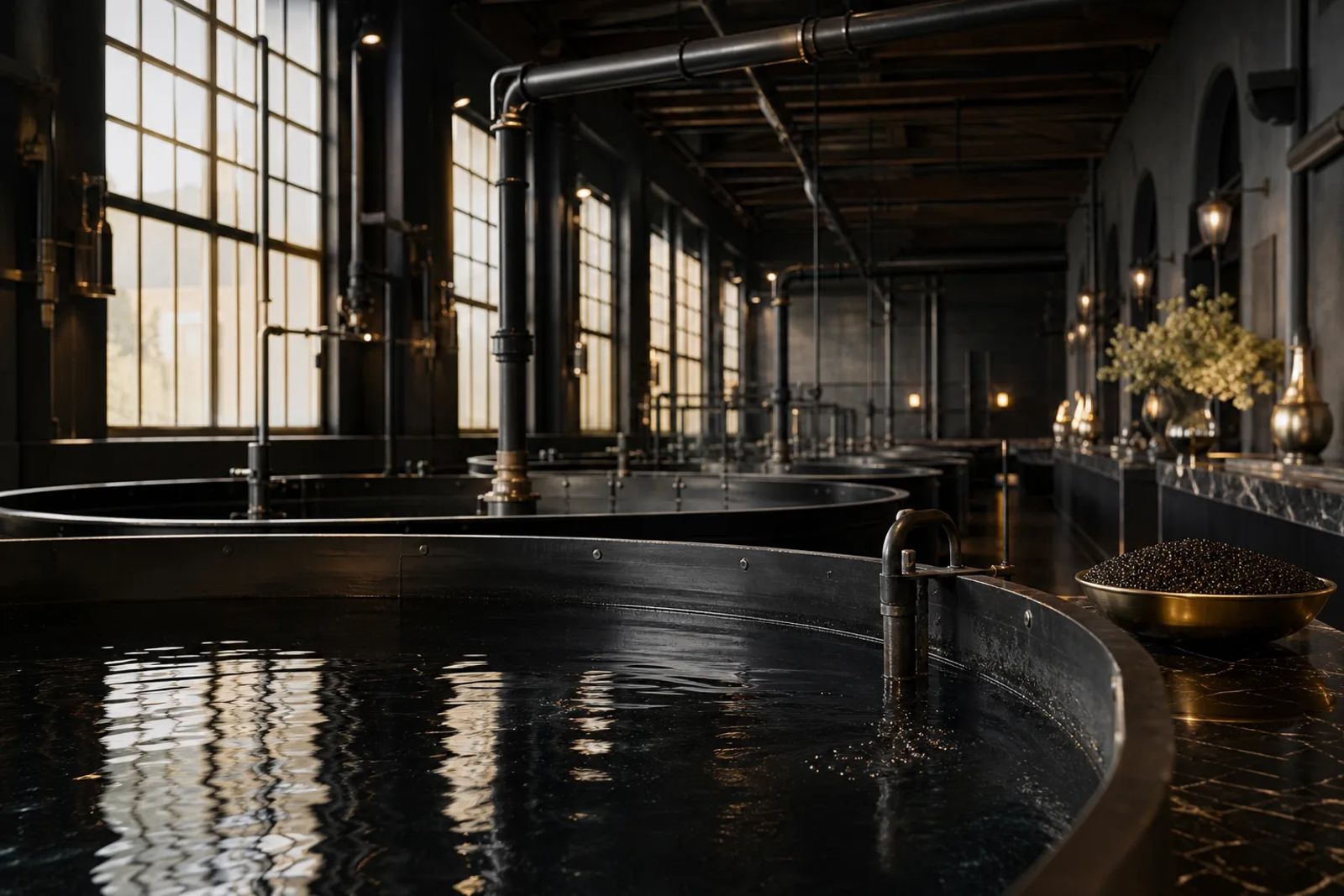
In October 2017, Sveriges Radio reported Siberian sturgeon being reared in a former paper mill in southern Sweden. It is a striking setting for Nordic caviar, far from the familiar image of an icy lake. Finland has produced and exported sturgeon caviar; Sweden has a documented farm, and Carelian production is now reported there. These are distinct from vendace and whitefish roe, products of older regional food traditions.
Finland: country facts
| Species farmed | Siberian sturgeon, Acipenser baerii, documented at Varkaus by Yle in 2012. 3,4 |
| Main farming regions | Historically Varkaus; Carelian production later moved to Småland, according to Ålands Radio. 3,4,5 |
| CITES registered operations | Two entries as of November 2026: Disas Caviar, Loviisa, and Carelian Caviar, Varkaus; processing and repackaging combined. 1 |
| Import and export regime | EU Regulations 338/97 and 865/2006; food information Regulation 1169/2011. 13,14,16 |
| Wild stocks | Atlantic sturgeon, Acipenser oxyrinchus: historical visitor; Luke records no documented breeding in Finnish rivers. 11 |
| Country's role | Historical producer and exporter; Carelian production moved to Sweden, according to Ålands Radio. 3,5 |
Sweden: country facts
| Species farmed | Siberian sturgeon, Acipenser baerii, at Arctic Roe of Scandinavia. 8,9 |
| Main farming regions | Strömsnäsbruk, Småland, southern Sweden. 7,8 |
| CITES registered operations | Not publicly documented. 2 |
| Import and export regime | EU Regulations 338/97 and 865/2006; food information Regulation 1169/2011. 13,14,16 |
| Protected names | Kalix Löjrom PDO, registered in 2010, covers vendace roe. 17,18 |
| Wild stocks | Atlantic sturgeon: listed as nationally extinct in Sweden; Göta älv releases began in 2024, according to WSCS. 12,19 |
| Country's role | Documented farmed roe production and processing. 8,9 |
Sturgeon caviar and löjrom: know the difference
Sturgeon caviar is salted sturgeon roe. Löjrom comes from vendace; whitefish roe is a third product.
The dark beads examined in Swedish sturgeon research contrast with the small orange roe associated with löjrom, though colour alone cannot identify either. The distinction also matters in law. EU customs classifies sturgeon caviar separately from caviar substitutes under heading 1604; consumer information law separately prohibits misleading descriptions.
Kalix Löjrom is a protected designation of origin for vendace roe, not sturgeon caviar. Explore vendace roe and Kalix Löjrom and the wider traditions of Nordic roe culture.
Finland: a caviar history, a changing map
Varkaus put Finland on the sturgeon caviar map. Yle reported in June 2012 that farming there had begun in late 2007. The surviving Carelian Caviar website gives a different starting point, saying it has grown Siberian sturgeon since 2010.
In February 2022, Finland's regional permitting authority authorised Finnforel to expand rainbow trout production into premises formerly belonging to Carelian Caviar. Finnforel planned to use those premises for rainbow trout, with the additional space intended to come into use that year.
Ålands Radio subsequently reported that Carelian's sturgeon had moved to Småland, where production was being undertaken with Arctic Roe of Scandinavia. The brand's undated website, meanwhile, still describes a planned move to Åland.
For anyone tracing a tin's origin, the distinction is straightforward: the proposed Finnish island facility is not a verified operating farm. Nor does a Finnish brand name establish that the roe was produced in Finland. Follow the production location, rather than the name on the lid.
Sweden: a documented farm in Småland
At Strömsnäsbruk in Småland, Arctic Roe of Scandinavia provides Sweden's clearest documented example of sturgeon farming. In its NordicRAS workshop contribution, the company dates its establishment to 2015.
The evidence extends to the caviar itself. Two caviars harvested in 2023 from Siberian sturgeon at this farm became the subjects of a 2025 peer-reviewed study. That gives Sweden's production story a firm foundation: research on roe harvested at a named Swedish farm, rather than simply imported caviar sold under a Swedish name.
Cold countries, carefully controlled water
The documented farms use controlled water, rather than relying on life beneath lake ice. At Varkaus, Stora Enso described indoor recirculating tanks warmed with excess heat from its mill in June 2016, alongside shared water supply and wastewater treatment. That account describes an industrial partnership at a particular site and date, rather than an environmental certification for Finnish caviar.
Arctic Roe's 2023 workshop account describes a different arrangement: well water, district heating, a cooling system and rooftop solar panels. District heating and direct use of a paper mill's waste heat are distinct claims.
The documented farms use controlled water, rather than relying on life beneath lake ice.
What links these accounts is controlled, land-based production. Recirculating aquaculture systems clean and reuse tank water, instead of relying on an open lake to provide the whole growing environment.
Were sturgeon native here?
Sweden had spawning populations of Atlantic sturgeon in the Göta älv. Its authorities describe their disappearance during the twentieth century and the subsequent reintroduction programme. These are conservation fish, distinct from the Siberian sturgeon used at the documented commercial farm.
Finland's history is different. Its Natural Resources Institute, Luke, identifies historical Baltic sturgeon as Atlantic sturgeon, correcting the older assumption that they were European sturgeon, Acipenser sturio. Luke records historical Finnish catches, but says sturgeon are not known to have bred in Finnish rivers. Those fish were probably wanderers.
Sweden has the documented spawning history; Finland has records of visitors, not documented breeding populations.
What shapes Nordic sturgeon caviar?
Processing tells a more useful story than the promise of a single “Nordic” flavour. Carelian describes its own caviar as made with salt as the only additive. Arctic Roe is associated with live egg collection, followed by treatment to stabilise the eggs. These are particular products and methods, not recipes shared by every producer in a country.
The 2025 Swedish study makes the importance of processing tangible. Researchers compared warm-water treatment with pH-adjusted cold-water treatment, using chemical analysis and a trained sensory panel of seven people. The caviars differed in texture, appearance and odour, while taste and flavour were similar.
Ask how the eggs were collected and treated, rather than expecting geography alone to predict the experience. The study included a company-affiliated co-author, and its findings do not establish long-term fish welfare.
Trade, registration and the origin on the label
Read the origin field, not just the address. On a CITES caviar label, FI in the country-of-origin position identifies Finland; SE identifies Sweden. For repacked caviar, that field is separate from the repacking plant's identification. This is traceability information rather than independent verification of the contents, and a Nordic address elsewhere on the packaging cannot settle where the roe originated.
Both countries apply the EU wildlife trade framework through Regulation (EC) No 338/97 and its implementing Regulation (EC) No 865/2006. These govern protected-species trade and caviar marking. Regulation (EU) No 1169/2011 governs consumer food information.
The public CITES register lists processing and repackaging operations, not every farm or business in the supply chain. According to CITES, Finland has two register entries and Sweden three; both registers combine processing and repackaging. Sweden's three reported entries sit alongside the unresolved verification noted in the country table: the register and its plant categories still need direct checking. Neither statement supplies a verified farm count. An entry does not establish that an operation remains active or confer food hygiene approval; a processor or repacker is not necessarily a farm.
Finland's export history includes deliveries to England and Hong Kong reported by Yle in 2012. For travellers, EU personal luggage rules exempt up to 125 g of correctly labelled Annex B caviar per person from CITES permits.
For exporters, the checklist is broader. Potential destinations such as Great Britain, Northern Ireland, the United States, Switzerland, the UAE, China, Japan, Russia and Australia require checks of applicable wildlife and food import requirements, alongside EU export requirements.
Norway belongs in the picture too
Norway also has documented sturgeon farming. Its Scientific Committee for Food and Environment recorded a land-based farm in Nordland in its 2025 report, while Polarfisk describes its operation at Bjærangen in Meløy. According to VKM, the Norwegian farm was not trading caviar internationally in 2025.
Where to go next
- Europe: see where these operations fit within European production.
- Baltic caviar: compare neighbouring countries while keeping Baltic and Nordic origins distinct.
Sources
- CITES Secretariat. Finland: Register of caviar exporters. Undated public register, search-indexed version retrieved November 2026. Country register.
- CITES Secretariat. Sweden: Register of caviar exporters. Undated public register, search-indexed version retrieved November 2026. Country register.
- Yle, Seppo Tikkanen. Herrojen herkkua lähtee Varkaudesta tonnikaupalla maailmalle. Published and updated 7 June 2012. Original report.
- Carelian Caviar. Carelian Caviar. Undated English company statement, retrieved November 2026. Company account.
- Finnish Regional State Administrative Agency. Finnforel Oy:lle lupa laajentaa kalantuotantoa. Official announcement, 1 February 2022. Permit announcement.
- Ålands Radio & TV. Åländsk lyxkaviar återuppstår, blir småländsk. Published and updated 23 September 2026. Report and company interview.
- Sveriges Radio, P4 Kronoberg, Peje Johansson. Rysk kaviar tillverkas i Strömsnäsbruk. 26 October 2017. Original report.
- DTU Aqua. 6th NordicRAS Workshop on Recirculating Aquaculture Systems: Book of Abstracts. DTU Aqua Report 431-2023, 2023. Arctic Roe contribution, printed page 31. Workshop proceedings.
- Jönsson, M., and colleagues. Quality characteristics of Swedish black caviar from live sturgeons (Acipenser baerii): a comparison of hot-water and pH-adjusted cold-water post-harvest processing. International Journal of Food Properties, 28:1, article 2589574, published online 16 November 2025. University-hosted paper.
- Stora Enso. Caviar and board in harmony. Company account, 17 June 2016. Industrial partnership account.
- Natural Resources Institute Finland, Luke. Atlantinsampi on palannut Itämereen, havaintoja kaivataan. Institutional account, published 29 August 2024. Historical occurrence and restoration.
- Regelrådet. RR 2024-132. Official consultation document, 2024, background section on Atlantic sturgeon and the proposed fishing protection. Consultation document.
- European Union. Council Regulation (EC) No 338/97 on the protection of species of wild fauna and flora by regulating trade therein. 1997, as amended. EUR-Lex landing page identifies a consolidated version dated 29 June 2026. Legal instrument.
- European Union. Commission Regulation (EC) No 865/2006 laying down detailed rules concerning the implementation of Council Regulation (EC) No 338/97. 2006, as amended. EUR-Lex landing page identifies a consolidated version dated 18 February 2025. Legal instrument.
- European Commission. EU Wildlife Trade Reference Guide: What are the rules regarding marking of specimens? Online guide, retrieved November 2026. Caviar marking guidance.
- European Union. Regulation (EU) No 1169/2011 on the provision of food information to consumers. 2011, as amended, particularly Article 7. EUR-Lex landing page identifies a consolidated version dated 1 April 2025. Legal instrument.
- European Union. Commission Regulation (EU) No 1025/2010 entering a name in the register of protected designations of origin and protected geographical indications, Kalix Löjrom (PDO). 12 November 2010. Registration regulation.
- Swedish Food Agency, Livsmedelsverket. Redlighet Kalix Löjrom: Kontrollprojekt. Report 38, 2017. Official product and authenticity report.
- Norwegian Scientific Committee for Food and Environment, VKM. Impact of trade on sturgeons and paddlefishes (Acipenseriformes spp.). VKM Report 2025:06, 2025, section 1.2. Available from VKM's official report archive.
- Polarfisk. Om Polarfisk AS (Gammel). Undated company account containing a prospective 2024/2025 production statement. Farm account.
Last checked: November 2026