
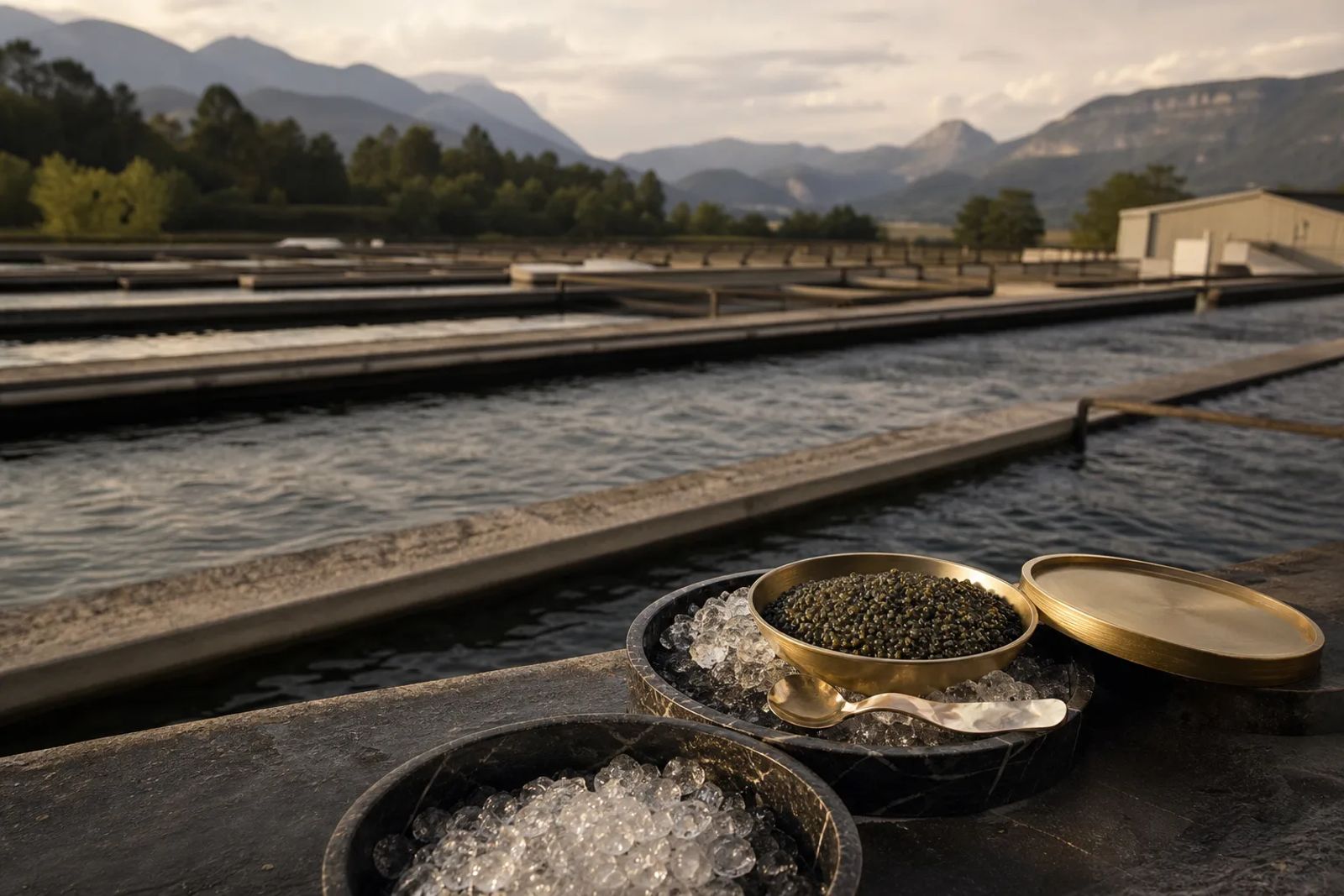
In Ferrara, sturgeon roe was once baked in a wooden container, a preparation linked to a manuscript dated about 1450 and kept alive until the Second World War. It is a vivid chapter in Italy's caviar history, rooted in the wild sturgeon fisheries of the Po and the northern Adriatic.
Today, Italian caviar is farmed roe, produced mainly in northern Italy from white, Siberian, Russian, beluga and Adriatic sturgeons. The journey from river fishery to farm explains both the country's strengths and the distinctions worth understanding before opening a tin.
Italy at a glance
| Field | Documented position |
|---|---|
| Species farmed | White (Acipenser transmontanus), Siberian (A. baerii), Russian (A. gueldenstaedtii), beluga (Huso huso) and Adriatic sturgeon (A. naccarii), plus hybrids. 1,2 |
| Main farming regions | A 2014 review identifies Brescia, Cremona, Milan, Treviso and Novara. 1 |
| CITES registered operations | 14 Italian entries as of November 2026, with separate exporter and combined processing/repackaging columns. 10 |
| Import and export regime | EU Wildlife Trade Regulations, notably Regulations (EC) No 338/97 and No 865/2006, plus separate food law requirements. 11 |
| PGI or PDO | EU protected names are listed in eAmbrosia. 12 |
| Wild stocks | Adriatic sturgeon and beluga were globally Critically Endangered in 2022. European sturgeon was also globally Critically Endangered in the 2022 IUCN assessment. Historical Italian beluga and European sturgeon populations were lost. Recovery work includes Adriatic sturgeon restocking and beluga reintroduction. 8,17 |
| Country's role | Farmed roe producer, processing and repacking centre, and exporter. 2,5,10 |
Italy belongs firmly among the caviar producing countries, rather than simply those that package imported roe. For the connoisseur, three questions reveal more than an Italian brand name: which fish produced the eggs, where it was raised and how the batch was processed.
From the Po fishery to conservation
Three native sturgeons connect Italy's rivers to the Adriatic: Adriatic sturgeon, Acipenser naccarii; beluga, Huso huso; and European sturgeon, Acipenser sturio. A 2011 historical review records all three in the northwestern Adriatic river systems. European sturgeon also inhabited rivers flowing towards the Tyrrhenian Sea. This native geography tells a different story from the species and origins found on today's commercial farms.
The 2026 study reconstructing the Po fishery records roe eaten fresh as well as baked. Its account establishes a local roe tradition, without establishing that medieval cooks made the same lightly salted, chilled caviar familiar today.
The same study traces the fishery's collapse through scientific catches, fish-market records and fishermen's accounts from 1970 to 1990. In that monitoring record, the last beluga catch falls in 1974 and the last European sturgeon catches in 1984. These are the final catches in the evidence examined, rather than exact extinction dates for every Italian waterway. The authors identify overfishing as the principal cause, including fishing during spawning migrations and intensified netting.
Recovery now gives these fish another place in Italy's story. Research published in 2025 describes the Adriatic sturgeon's surviving Italian presence and restocking programmes, alongside beluga reintroduction beginning in 2019. Farming a threatened species does not itself establish recovery of a self-sustaining wild population. That distinction is especially important for Adriatic sturgeon caviar: its native Italian connection does not make it wild-harvested roe.

How Italian sturgeon farming took shape
A fish from the Pacific coast of North America helped build Italy's modern caviar industry. White sturgeon became central to commercial development despite the country's own native sturgeons.
A peer-reviewed review of Italian finfish aquaculture dates experimental sturgeon keeping to 1977, using fish caught in the Po basin. Commercial development with Californian white sturgeon followed in the middle of the 1980s, then Siberian sturgeon farming in the early 1990s.
Calvisius, Agroittica's brand, traces its white sturgeon programme to a 1981 partnership between Gino Ravagnan and Davis researcher Serge Doroshov. This company-reported milestone belongs within that wider development, rather than establishing an independent national first. The fuller account appears in Calvisius and Agroittica Lombarda.
A fish from the Pacific coast of North America helped build Italy's modern caviar industry.
By February 2023, EUMOFA's assessment of production and trade during 2016 to 2020 identified white, Russian and Siberian sturgeons as Italy's principal farmed species. Its wider records also document Italian exports involving beluga, Adriatic sturgeon and hybrids. The picture is of a broad industry with an established export role; a precise world ranking would need its own date and evidence.
The sturgeons behind Italian caviar
The species name tells you more than a grand selection name on a tin. White sturgeon, Acipenser transmontanus, is particularly important to Italy's farming history, but Italian origin alone does not identify the fish.
Russian sturgeon, A. gueldenstaedtii, Siberian sturgeon, A. baerii, beluga and Adriatic sturgeon are all separately documented in Italian production. For a closer understanding of this important farming species, explore white sturgeon caviar on its own terms.
Hybrids also have an established place. The aquaculture review documents a cross between a female Adriatic sturgeon, Acipenser naccarii, and a male Siberian sturgeon, Acipenser baerii. For any particular hybrid product, establish the actual female and male parentage rather than assuming this cross.
The names used here follow CITES-based species records, including Huso huso for beluga. Biological classifications are disputed: Brownstein and Near (2025) widened Huso and proposed Sinosturio dauricus. On 22 October 2025, the SSG and WSCS rejected their and Kottelat and Freyhof’s revisions, supporting Acipenser huso and Acipenser dauricus. For beluga, that means Acipenser huso in the classification they support, while the trade records followed here use Huso huso. A change in biological classification does not automatically change wildlife-trade paperwork.
Northern farms and the water they use
Northern Italy is the heart of production, but it is no single farming environment. A 2014 review places farms chiefly in Brescia, Cremona and Milan in Lombardy, Treviso in Veneto, and Novara in Piedmont. Those locations describe the farming pattern recorded in that review, distinct from a company's office or final packing address.
Water sources differ too. Calvisius describes Calvisano as a spring-water site and says its farms use spring water. Giaveri describes water drawn from a river and geothermal wells, with temperature and water conditions monitored during rearing. These accounts illuminate particular farms, rather than a shared Italian water source or flavour. The Caviar Giaveri profile explores that producer separately.
What the register tells you
As of November 2026, the CITES register lists 14 Italian entries. Read that as a register of operations, not a census of farms: registration does not establish farm ownership or Italian origin for every product handled.
The register also combines processing and repackaging in one column, so it cannot supply separate totals for processors and repackers.
What Italian caviar is known for
The strongest documented distinction is the importance of white sturgeon alongside a wider range of species, rather than a national tasting signature.
Agroittica describes its white sturgeon caviar as having large eggs and a clean, rounded taste. That gives a useful producer's portrait of its caviar, rather than an independent tasting of the category. Species and processing vary between batches, so let the individual roe, not the flag, guide expectations.
Italy's rules and overseas shipments
Italy applies EU wildlife trade and food law. For personal luggage, properly labelled Annex B caviar has a 125 g CITES exemption per person; food rules still apply. Regulation (EC) No 1333/2008 permits boric acid and borax in sturgeon caviar only, up to 4,000 mg per kg expressed as boric acid. Wildlife trade documents do not confer food safety approval, and destination rules may differ.
Outside the EU, check the receiving country's requirements:
- UK: establish whether the destination is Great Britain or Northern Ireland. APHA is the relevant contact for Great Britain CITES guidance on protected foods.
- Switzerland: the FSVO publishes separate species-conservation and food-import requirements.
- Japan: METI provides procedures for CITES imports.
- UAE: the environment ministry offers an import-certificate service for listed species and their derivatives.
- US: 50 CFR 17.44(y) sets special rules for beluga. It says USFWS will consider facility exemptions for aquaculture outside the Caspian and Black Sea littoral states. Italian farming alone does not authorise import.
- China: wildlife and food import controls apply.
- Australia: DAFF biosecurity and EPBC wildlife controls apply.
- Russia: separate checks are required, including applicable EU sanctions.
How to recognise Italian origin
Look for IT in the country-of-origin position of the CITES label. An Italian address or brand name is not enough. Italian roe repacked abroad retains Italy as its origin, with the repacker identified separately.
The label is a traceability tool, not a guarantee of the container's contents. Read country of origin versus country of repacking to distinguish the place the roe came from from the place it was packed.
Sources
-
Parisi, G. et al. Current status and future perspectives of Italian finfish aquaculture. University of Turin repository manuscript, section 2.4; published in Reviews in Fish Biology and Fisheries, 2014.
-
European Commission, EUMOFA. Sturgeon meat and other by-products of caviar: production, trade and consumption in and outside the EU. February 2023 edition.
-
Caviar Giaveri. Sturgeon farm. Undated company webpage, version retrieved November 2026.
-
Calvisius. About us. Undated company webpage, version retrieved November 2026.
-
Agroittica Lombarda. History. Undated company webpage, version retrieved November 2026.
-
Pagani et al., Wiley, River Research and Applications. The Record of the Last Sturgeons Caught in the Po River (North Italy) Tells a Cautionary Tale of Reasons of Their Silent Disappearance. 2026, DOI 10.1002/rra.70053.
-
University of Ferrara research repository. The Historical and Contemporary Status of the European Sturgeon, Acipenser sturio L., in Italy. 2011 research record and abstract.
-
Wiley, Aquatic Conservation: Marine and Freshwater Ecosystems. Unlocking the Secrets of Sturgeon Ecology: Lessons From Conservation Efforts in Northern Italy. 2025, DOI 10.1002/aqc.70079.
-
World Sturgeon Conservation Society, Bronzi, P. IUCN SSG summary report. 13 November 2025.
-
CITES Secretariat. Italy: Register of caviar exporters. Live Italian register of caviar exporters and processing or repacking operations.
-
European Commission. EU Wildlife Trade Reference Guide, Annex XIV: Summary of provisions relating to caviar of sturgeons and paddlefish. Online edition, undated; retrieved November 2026.
-
European Commission. eAmbrosia geographical indications register, API records. EU geographical indications database, checked November 2026.
-
UK Government. Bringing food into Great Britain: Check if you need a CITES permit. Online guidance, version retrieved November 2026.
-
Swiss Federal Food Safety and Veterinary Office. Import of foods from third countries. Online guidance, version retrieved November 2026.
-
Japan, Ministry of Economy, Trade and Industry. Procedures for the Imports of Items under the CITES Agreement. Online guidance, version retrieved November 2026.
-
UAE Ministry of Climate Change and Environment. Import of a species listed in CITES Appendices. Official service factsheet, undated retrieved edition.
-
IUCN. Migratory monarch butterfly now Endangered, IUCN Red List. Press release, 21 July 2022.
-
United States. 50 CFR 17.44(y). Special rule for beluga sturgeon, 50 CFR 17.44(y).
Last checked: November 2026