
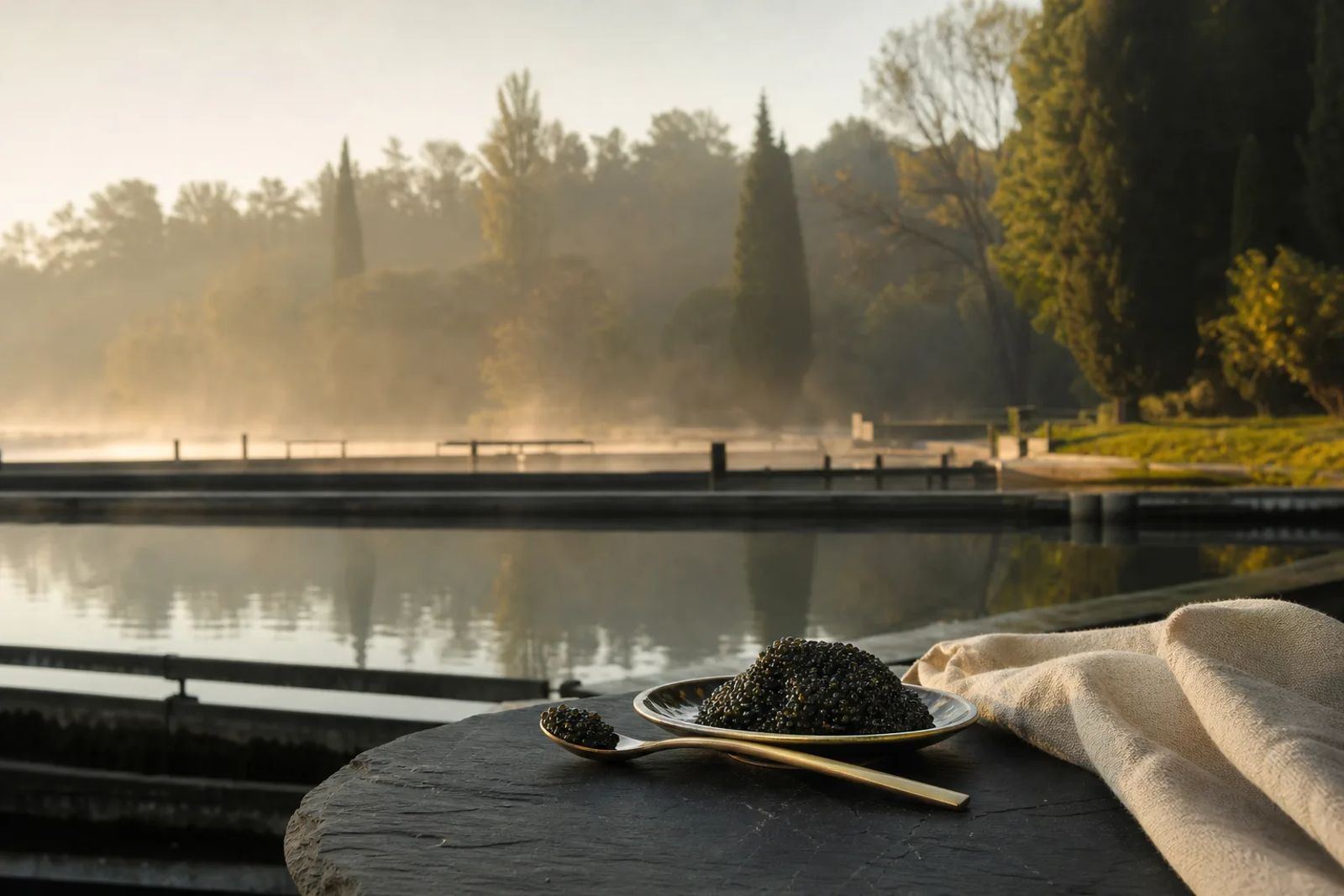
Firm young eggs, separating readily in the mouth. Crème fraîche and nut notes. With maturation, a softer texture and greater intensity. This is the sensory portrait of Caviar d'Aquitaine in the EU's published PGI dossier: one protected regional product, not a single national flavour.
French caviar has two distinct meanings. It can be roe produced on French sturgeon farms, chiefly in the southwest, or caviar selected, processed or repacked by a French house. A Paris address tells you where a business operates. It does not tell you where its fish were raised or its roe originated.
France at a glance
| Species farmed | Siberian sturgeon (Acipenser baerii) and Russian sturgeon (Acipenser gueldenstaedtii), the main farmed species identified by ITAVI in July 2026. |
| Main farming regions | Nouvelle-Aquitaine, especially the southwest's river basins and Arcachon area; production also documented in Sologne. |
| CITES operations | November 2026 register: 31 entries, comprising 23 marked R, seven R/T and one T. |
| Import and export regime | EU wildlife-trade Regulations (EC) No 338/97 and No 865/2006, plus food hygiene, official controls and destination-country requirements. |
| Protected geographical name | Caviar d'Aquitaine PGI, registered by Implementing Regulation (EU) 2025/342, published on 18 February 2025. |
| Wild stock | European sturgeon (Acipenser sturio): depleted Gironde population. Globally Critically Endangered, assessed on 15 September 2020 and published in 2022; protected in France since 1982, according to ICES. 5,7 |
| Country's role | Farmed roe origin, processing and repacking centre, and consumer market. |
Where French caviar is produced
The heart of French caviar farming is Nouvelle-Aquitaine, not Paris. The official geographical account for Caviar d'Aquitaine places the early farms in the Isle and Arcachon basins. The public CITES register names operations in Montpon-Ménestérol, Neuvic, Biganos and Le Teich.
To understand that map, distinguish farms from other operations in the caviar supply chain. A farm's own account can establish that it rears fish; a registered plant address alone does not establish a farm. At Neuvic, operator HUSO describes a Dordogne site encompassing hatchery, rearing and preparation for harvest.
The southwest is the centre, but not the whole story. The Hennequart family's Caviar de Sologne describes its own sturgeon ponds in Sologne, and the CITES register lists Pisciculture HENNEQUART at Saint-Viâtre. The European production guide sets out the wider regional picture. For an individual lot, follow its stated origin rather than a regional reputation or a country's flag.
The Gironde's wild caviar and its surviving sturgeon
The Gironde's caviar history began with wild fish. An ICES scientific working-group report records intensive exploitation of its European sturgeon for caviar from the beginning of the twentieth century. Severe decline followed. Exploitation ended when France protected the species in 1982.
The Gironde's historic caviar belongs to the story of a depleted native population, not a continuing wild supply.
That fish was Acipenser sturio, not the Siberian sturgeon used in much modern French farming. The IUCN classifies the European species as Critically Endangered, with an assessment dated 15 September 2020 and published in 2022. The Gironde's historic caviar belongs to the story of a depleted native population, not a continuing wild supply.
Today, the work is restoration. INRAE describes captive breeding at Saint-Seurin-sur-l'Isle, releases into the natural environment mainly from 2007, scientific monitoring in the estuary and reports of accidental captures from professional fishers. France's national action plan covers 2020 to 2029, bringing population support together with work on threats and habitats. The European sturgeon article follows that conservation story.
How French sturgeon farming developed
Modern French caviar grew from research into Siberian sturgeon, rather than simply bringing the Gironde's native fish into farms. In a 2009 research note, Cemagref scientist Paul Gonthier explains how work on the Siberian species helped develop rearing techniques alongside efforts to conserve the European sturgeon.
The scientific groundwork reaches back to investigations of the wild population around 1975, followed by a shift towards captive-reproduction research in the 1980s. The EU's published geographical-indication dossier dates the first sturgeon farms in the Isle and Arcachon basins to the 1990s. The first sale under the name Caviar d'Aquitaine followed in 1996. Those are documented regional milestones, not proof that every French producer began at the same time or used the same production system.
Species remain essential to understanding the result. ITAVI's July 2026 review identifies Siberian sturgeon, Acipenser baerii, and Russian sturgeon, Acipenser gueldenstaedtii, as France's two main farmed species. French origin does not mean Baerii alone. An Ossetra or Oscietra trade name should also come with the actual species.
Paris houses and the origin of the roe
A caviar house need not farm a single fish. It can select lots, mature them, process or repack roe, distribute it and sell it. The French register includes Paris addresses for Petrossian, Kaviari, Kaspia and Prunier, alongside facilities elsewhere in France. Those entries document their role in the trade, rather than French origin for every caviar they handle.
Prunier makes the distinction particularly clear. The register separately lists PRUNIER MANUFACTURE in Montpon-Ménestérol and PRUNIER in Paris. Its house and farm profile separates those activities. The guide to farmers, processors, repackers and brands explains how farming origin, processing location and the name on the front can belong to different businesses.
For French-origin roe, look for FR in the CITES label's country-of-origin field. A French repacker's registration details or street address are not enough. Imported caviar retains its original country in that field after repacking. The label is a traceability tool, rather than independent verification of the contents.
What the Caviar d'Aquitaine PGI means
Caviar d'Aquitaine protects a specific origin and production method. It is a protected geographical indication, or PGI, rather than another name for all French caviar.
Implementing Regulation (EU) 2025/342, dated 13 February 2025 and published on 18 February, registered the name under the newer EU geographical-indications framework, Regulation (EU) 2024/1143. The EU specification permits only Acipenser baerii baerii. It also requires breeding, rearing, slaughter, processing and primary packing to take place within the defined area.
That area includes all of Gironde, Landes and Lot-et-Garonne, plus designated communes in neighbouring departments. The PGI guide explains the detailed boundaries and production rules.
What French caviar tastes like
French caviar is better understood through its fish husbandry, sorting, salting and maturation than through the promise of one national flavour. France's consumer-protection authority, the DGCCRF, identifies species, rearing conditions and preparation as influences on sensory quality. They help explain why one lot is firmer, saltier or more persistent than another. Nationality alone cannot tell you how firm, saline or persistent a particular lot will be.
The EU's published PGI dossier offers a precise regional description. Young Caviar d'Aquitaine is firm, its eggs separating readily in the mouth. Maturation softens the texture and increases intensity. The dossier identifies crème fraîche and nut notes: useful characteristics of the protected product, rather than a tasting verdict covering every French producer.
Compare lot with lot. Start with the named species, producer and origin, then look for salting and maturation information where available. The Sturia and Caviar de Neuvic profiles explore individual producers and their methods, giving those details their proper context.
Trade rules and export destinations
France operates within the EU wildlife-trade system under Regulations (EC) No 338/97 and No 865/2006. Commercial external trade requires documents; domestic trade requires lawful origin and labels. Personal baggage exemptions cover 125 g of sealed, labelled Annex B caviar per person. CITES plant registration serves traceability. It is neither a national quality grade nor a count of all farms.
Food rules form a separate layer. EU additives Regulation (EC) No 1333/2008 and its Union list authorise boric acid, E284, and sodium tetraborate, E285, for sturgeon eggs only. The maximum is 4,000 mg per kg expressed as boric acid. Permission under that system does not make every formulation acceptable in another country.
For commercial shipments from France to Great Britain, check APHA's CITES permit requirements and any applicable exemptions. Northern Ireland has a separate border regime: check the rules for the particular movement. Switzerland's FSVO likewise specifies CITES documentation and import-permit requirements for protected-species consignments. In both countries, food-import requirements apply separately from CITES documentation.
Before arranging exports to the US, Japan, China, the UAE or Australia, verify the destination's wildlife, sanitary and establishment-approval conditions. French Customs directs exporters of animal products to destination-specific requirements and the Expadon service. It also states that trade involving Russia requires assessment of applicable sanctions and restrictions.
Sources
-
ITAVI. Germain, C., Moustapha, M. and Litt, J. Conditions françaises d’élevage des esturgeons et bien-être animal : quelles spécificités et connaissances mobilisables. Vers une adaptation de l’outil EBENE®. Scientific and technical article, 10 July 2026.
Read at itavi.fr -
Institut national de l'origine et de la qualité. Caviar d'Aquitaine. Product and registration record, 2025.
Read at inao.gouv.fr -
European Commission. Publication of an application for registration of a name: Caviar d'Aquitaine. Single document, C/2024/6592, 31 October 2024.
Read at eur-lex.europa.eu -
European Commission. Commission Implementing Regulation (EU) 2025/342 of 13 February 2025 on the registration of the geographical indication Caviar d’Aquitaine (PGI). Official Journal, 18 February 2025.
Read at eur-lex.europa.eu -
IUCN Red List. Acipenser sturio. Assessment dated 15 September 2020, published in the 2022 Red List, identifier T230A137215851.
Read at doi.org -
Gonthier, P., Cemagref. Esturgeon européen… le retour ? Cahiers Agricultures, volume 18, numbers 2 and 3, pages 195 to 198, 2009.
Read at revues.cirad.fr -
International Council for the Exploration of the Sea. Report of the Working Group on Fish Ecology. ICES CM 2003/G:04, 2003, European sturgeon account.
Read at ices.dk -
INRAE, EABX research unit. IT tools around the European sturgeon. Institutional account, updated 28 April 2026.
Read at eng-eabx.bordeaux-aquitaine.hub.inrae.fr -
French Ministry for Ecological Transition. Plan national d’actions en faveur de l’esturgeon européen Acipenser sturio, 2020 to 2029. National action plan, 2020.
Read at biodiversite.gouv.fr -
HUSO. La ferme piscicole. Company account of its Dordogne operation, undated.
Read at caviar-huso.com -
Caviar de Sologne. Accueil, including its presentation of the Hennequart family's farming activities. Company account, undated.
Read at caviardesologne.fr -
CITES Secretariat. France: Register of caviar exporters. Official register of French caviar operations.
Read at cites.org -
DGCCRF, French Ministry of the Economy. Caviar : lisez les étiquettes ! Updated 19 December 2025.
Read at economie.gouv.fr -
Council of the European Union. Council Regulation (EC) No 338/97 on the protection of species of wild fauna and flora by regulating trade therein. Original Council Regulation, 1997.
Read at eur-lex.europa.eu -
Belgian Federal Public Service Health, Food Chain Safety and Environment. Caviar. Official EU wildlife trade guidance, including original and repacked label fields, undated.
Read at health.belgium.be -
European Parliament, Council and European Commission. Regulation (EC) No 1333/2008 on food additives and Commission Regulation (EU) No 1129/2011, establishing the Union list. EU legislation on authorised food additives.
Read at eur-lex.europa.eu
Read at eur-lex.europa.eu -
APHA and Defra. Check if you need a CITES permit to import or export endangered species. Updated 23 June 2026.
Read at gov.uk -
Swiss Federal Food Safety and Veterinary Office. Permits for import. Official guidance on protected species imports, undated.
Read at blv.admin.ch -
French Directorate-General of Customs and Indirect Taxes. Exporter des marchandises soumises à réglementation vétérinaire. Official veterinary export guidance, undated.
Read at douane.gouv.fr
Last checked: November 2026