
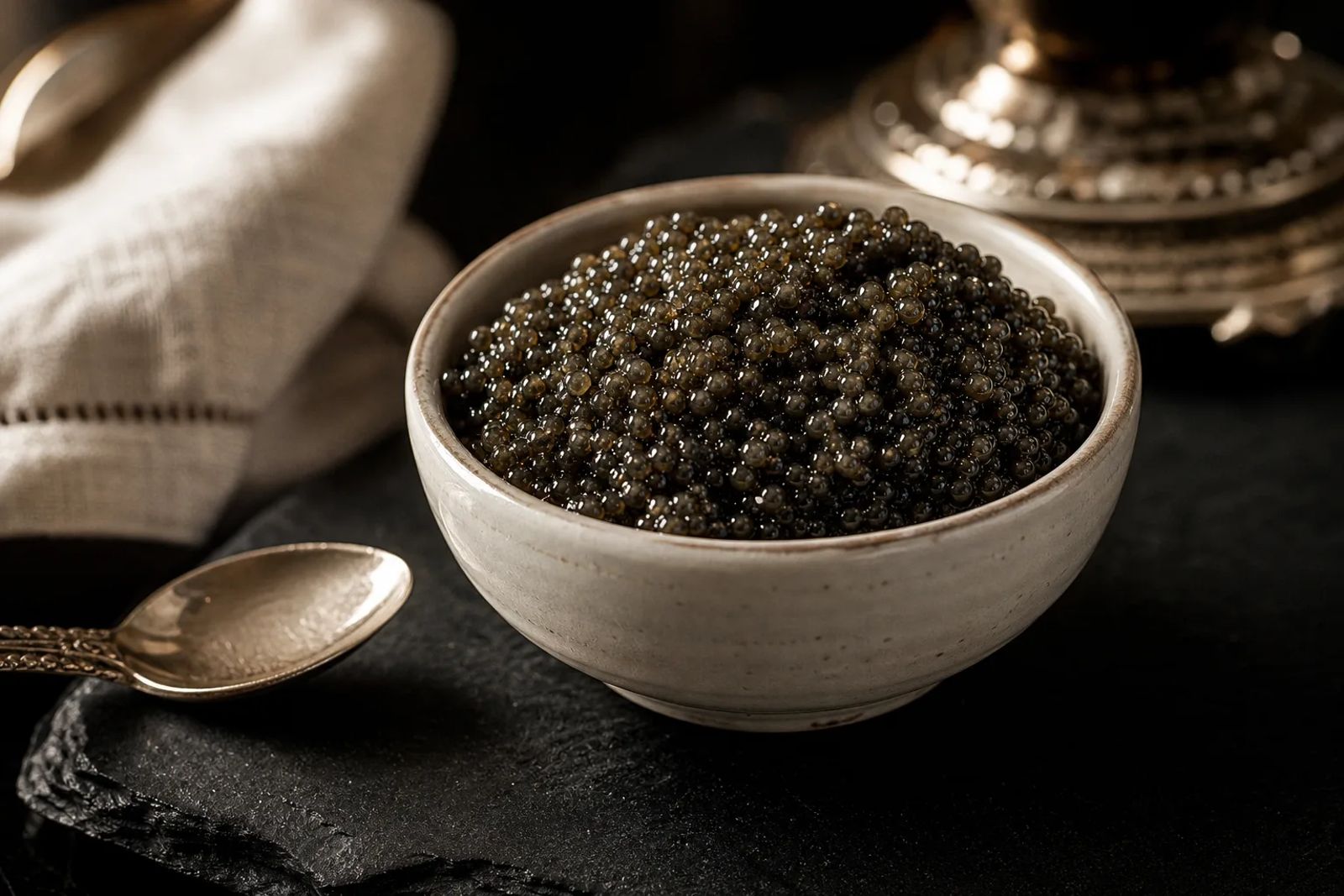
Pearl grey, bronze or amber, with a mild taste and a slight walnut aftertaste: that is how Italian farmer Pisani Dossi describes its Osetra caviar. The eggs measure 2.8 to 3.2 mm. Behind the familiar name lies a cross between two species, rather than pure Russian sturgeon roe.
Ossetra x Siberian caviar comes from Russian sturgeon, Acipenser gueldenstaedtii, crossed with Siberian sturgeon, Acipenser baerii. Which parent is which matters. CITES labels put the male parent's code first, so GUExBAE and BAExGUE declare different parental combinations.
Russian x Siberian hybrid: quick reference
| Field | Documented position |
|---|---|
| Parents and direction | Male Russian sturgeon (Acipenser gueldenstaedtii), female Siberian sturgeon (Acipenser baerii); the reverse has a male Siberian and female Russian sturgeon. 5,6 |
| CITES label codes | GUExBAE for the first direction; BAExGUE for the reverse. 1,11 |
| Source codes documented in trade | |
| Farming countries and study date | Chinese farms supplied specimens for a 2013 study; an Italian producer also describes this hybrid. 7 |
| Egg diameter and colour | Pisani Dossi reports 2.8 to 3.2 mm eggs, from pearl grey through bronze to amber. |
| Parents' IUCN status | Russian sturgeon: Critically Endangered (2022). Siberian sturgeon: Critically Endangered (2022). 11 |
Ossetra x Siberian: get the parents in order
Two species names tell only half the story. To identify the cross precisely, establish which parent was male and which was female.
Here, crosses are described in words as male parent and female parent; codes follow the male-first CITES convention. Scientific names joined by an x do not establish direction unless the writer explains the parent order.
Both directions appear in the 2013 study Genetic variation and relationships of seven sturgeon species and ten interspecific hybrids: male Russian with female Siberian sturgeon, and male Siberian with female Russian sturgeon. Caviar Colony also declares the latter combination as its Russian hybrid.
Codex and CITES use different ordering conventions. A female Russian sturgeon crossed with a male Siberian sturgeon is written GUExBAE under that Codex convention, but BAExGUE on a CITES label. Keep the two systems distinct.
For the wider conventions, see hybrid caviar and how hybrid labels work. A trade name or a slash between species names leaves the parents' sexes unresolved.
From the farm to the bead
Pisani Dossi identifies its Osetra caviar as a Russian and Siberian sturgeon hybrid and describes its farm at Cisliano. Its account gives the roe a tangible character: eggs of 2.8 to 3.2 mm, pearl grey through bronze to amber, with a mild taste and a slight walnut aftertaste. Those are descriptions of this producer's caviar, rather than a flavour promise for the whole cross.
The farming record also reaches China. The 2013 genetic study examined specimens of this cross from Chinese farms, collected between 2008 and 2011.
Three questions need separate answers: does the cross exist, is it farmed, and is its roe traded internationally? A hatchery experiment establishes the first. Evidence of farming and international trade must come separately. Equally, a country farming both parent species may not be farming their hybrid.

Another Russian sturgeon cross
Russian sturgeon has also been crossed with sterlet. A 2023 aquaculture study reared offspring of male Russian sturgeon and female sterlet in a recirculating system.
Why plain Ossetra can mislead
Ossetra is a trade name, not a genetic test or a legal quality grade. Put it prominently on a hybrid while concealing the Siberian parent, and the reader may reasonably expect pure Russian sturgeon roe.
The issue is the description, not hybridisation. A clearly identified hybrid remains sturgeon caviar within the scope of Codex and deserves assessment as the cross it is.
Ossetra is a trade name, not a genetic test or a legal quality grade.
For the pure-species reference points, see Russian sturgeon caviar and Siberian sturgeon caviar. Their descriptions are useful comparisons, not ingredients in a promised halfway flavour for their offspring.
What DNA can tell us
Identifying both parents takes more than a maternal DNA result. Mitochondrial DNA follows the maternal line, so it cannot establish a hybrid's full parentage. Russian sturgeon and its close relatives make the task particularly demanding: a sequence resembling Siberian sturgeon does not necessarily indicate a recent farm cross.
The 2022 multistep study combined eight microsatellite markers, three nuclear gene markers and mitochondrial barcoding. Microsatellites are repeated DNA sequences used to compare genetic profiles; nuclear markers examine material inherited from both parents. The authors found that mitochondrial barcoding alone could not discriminate members of the Russian sturgeon complex.
A separate 2023 study, Species Identification of Caviar Based on Multiple DNA Barcoding, examined 21 batches on the Chinese market using mitochondrial COI and D-loop sequences. It reported 33.4% mislabelling at the maternal-source level. The study explicitly acknowledged that mitochondrial testing could not identify hybrid parentage, so that percentage measures maternal-source mislabelling, not the prevalence of hybrids sold as Ossetra.
The 2022 identification review likewise found that hybrids involving Russian or Siberian sturgeon remained difficult to identify accurately. Establishing both parents requires markers validated for this cross. Even the 2022 study's microsatellites could not distinguish Russian from Siberian sturgeon.

Naming rules and trade rules do different jobs
A CITES label records declared identity and trade history. A food description must tell the buyer what the food is without misleading them. Customs classifications serve another purpose again; they do not settle the truthfulness of a retail description.
| Jurisdiction | Rule | Legal source | Checked |
|---|---|---|---|
| EU | Food information must not mislead about identity, nature or composition. | Regulation (EU) No 1169/2011, Article 7 | November 2026 |
| Great Britain | Assimilated food information rules prohibit misleading descriptions. | Assimilated Regulation (EU) No 1169/2011; FSA guidance | November 2026 |
| Northern Ireland | EU food information law generally continues to apply. | Regulation (EU) No 1169/2011; FSA guidance | November 2026 |
| United States | International caviar trade rules require male-first hybrid codes. | 50 CFR 23.71(b)(2)(i) | November 2026 |
The US rule addresses wildlife trade, rather than the whole of retail naming. FDA CPG 540.150 is nonbinding guidance in the United States: it recommends similarly prominent fish names and permits compliant colouring with a prominent declaration of artificial colour.
In the EU and Northern Ireland, Regulation (EC) No 865/2006 implements CITES trade measures. Great Britain applies Regulation 865/2006, Article 66. National rules differ, including exemptions for 125 g personal effects.
Read the identity before judging the beads
Start with the declared parent species. If the wording leaves their sexes unclear, ask. Then match the declaration to the species field on the CITES label: GUE alone declares Russian sturgeon; GUExBAE and BAExGUE declare the two Russian and Siberian directions. A hybrid description beside a pure-species code calls for clarification from the supplier.
Read the source code separately. It concerns the specimen's documented origin, not which parent was male. Country of origin is also distinct from processing or repacking details. An Italian address on a brand's website does not, by itself, establish where the roe originated.
The CITES label is a traceability declaration, not laboratory verification of the contents. If the documents disagree, ask for clarification backed by records or appropriately designed testing. Egg colour cannot resolve the identity. For the detailed checks, see spotting hybrids sold as pure species.
Where to go next
- Caviar Forensics: DNA, Isotopes and Origin Testing: how different tests address species identity and geographical origin.
Sources
-
US Fish and Wildlife Service, Electronic Code of Federal Regulations. 50 CFR 23.71: How can I trade internationally in sturgeon caviar? Current online text retrieved November 2026, particularly paragraph (b)(2). Official text.
-
FAO and WHO, Codex Alimentarius. Standard for Sturgeon Caviar, CXS 291-2010. Adopted in 2010; the Codex register records modification in 2026. Sections 1, 2 and 7.1; Annex A. Canonical document address.
-
Food Standards Agency. Packaging and labelling. Updated 4 September 2026. Explains the assimilated legislation applying in Great Britain and EU legislation applying in Northern Ireland. Official guidance.
-
Food Safety Authority of Ireland. Food Labelling. Undated online guidance, retrieved November 2026. Official guidance.
-
Genetics Selection Evolution, original research article. Genetic variation and relationships of seven sturgeon species and ten interspecific hybrids. Volume 45, article 21, 2013. Published article.
-
Caviar Colony. Caviar Colony. Undated producer website, retrieved November 2026. Italian-language description explicitly identifies a female Russian sturgeon and male Siberian sturgeon. Producer statement.
-
Azienda Agricola Pisani Dossi. Pisani Dossi Farm - Sturgeons Breeding. Undated producer page, retrieved November 2026. Producer statement.
-
Foods, original research article. A Multistep DNA-Based Methodology for Accurate Authentication of Sturgeon Species. Volume 11, article 1007, 2022. Full-text repository record.
-
Niu and colleagues, Biodiversity Science. Integration and application of sturgeon identification methods. 2022, DOI 10.17520/biods.2022034. Table 1. Publisher's article PDF.
-
Molecules, original research article. Species Identification of Caviar Based on Multiple DNA Barcoding. Volume 28, article 5046, 2023. Full-text article.
Last checked: November 2026