
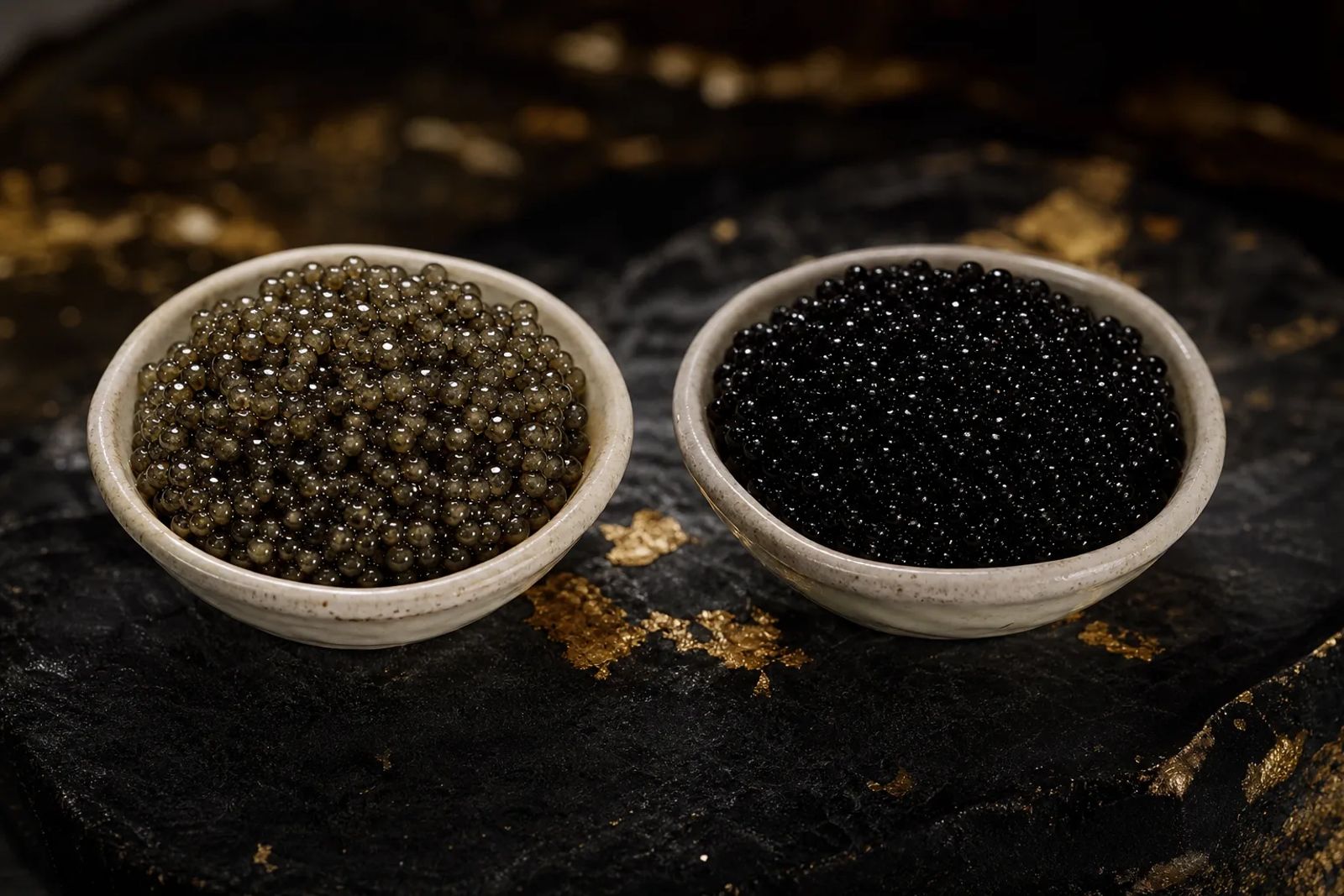
Hackleback is salted roe from a true sturgeon, the shovelnose sturgeon; paddlefish roe comes from a different family within the same fish order. That makes hackleback sturgeon caviar under the Codex standard, while paddlefish falls outside that standard but is included in the broader caviar rules used for CITES wildlife trade.
Hackleback vs paddlefish: the essential comparison
The names are not interchangeable. Hackleback is a trade name for shovelnose sturgeon, whereas spoonbill is another common name for American paddlefish; neither name identifies a salting method, a harvest location or a quality grade.
| Criterion | Hackleback | Paddlefish |
|---|---|---|
| Scientific name | Scaphirhynchus platorynchus | Polyodon spathula |
| Family | Acipenseridae | Polyodontidae |
| Order | Acipenseriformes | Acipenseriformes |
| Shared native river basin | Mississippi | Mississippi |
| CITES species code | PLA | SPA |
| IUCN category reproduced in 2022 | Vulnerable | Vulnerable |
The conservation categories above are reproduced in the North American Sturgeon and Paddlefish Society's 2022 summary of IUCN classifications. They describe global extinction risk, not permission to fish a particular river, and they do not establish that a particular commercial fishery is well managed.
The fish and their rivers
Both fish belong to Acipenseriformes, the order containing sturgeons and paddlefishes, but only hackleback belongs to Acipenseridae, the true sturgeon family. Paddlefish belongs to Polyodontidae, so calling it a sturgeon is a biological error even when wildlife legislation groups their roe together.
Their native ranges overlap across the Mississippi drainage, including the Missouri system. The US Geological Survey also records paddlefish in Gulf Slope drainages from Mobile Bay to Galveston Bay and formerly in the Lake Erie drainage; that wider historical description should not be mistaken for an account of present abundance.
They also feed differently. Shovelnose sturgeon take aquatic invertebrates from the river bottom, while paddlefish filter small organisms from the water through their gill rakers.

Egg size, colour, flavour and texture
According to the American Fisheries Society, mature paddlefish eggs measure about 2 to 4 mm before processing.
For a useful comparison at home, record the named species, ingredients and processing style before recording your own impressions. Compare bead separation, resistance under the tongue, salt impression and finish, rather than treating a seller's tasting language as a promise about every batch.
Wild harvest is not the same as farming
Wild harvest is documented for both species. The federal shovelnose rule addresses commercial capture and roe, while Oklahoma's paddlefish management report documents a programme that used angler-harvested fish for stock assessment and recovered roe for caviar production. According to ODWC, its caviar programme ended in 2023; research continues.
USGS records paddlefish escaping a Georgia aquaculture facility during Tropical Storm Alberto in July 1994.
Hatchery stocking needs its own distinction. Missouri documents releasing young paddlefish into reservoirs, including populations that cannot reproduce successfully without stocking. A hatchery origin for a juvenile does not, by itself, tell a buyer how the adult was harvested or which CITES source code, indicating the specimen's documented origin, its roe should carry.
Which one counts as caviar?
There is no single definition that can be carried unchanged between food standards, wildlife trade and retail naming. The short answer is to ask which authority is using the word, then keep that authority's purpose attached to the answer.
| Source and purpose | Hackleback | Paddlefish |
|---|---|---|
| Codex CXS 291-2010, food standard | Within its Acipenseridae scope | Outside its scope |
| CITES caviar system and US 50 CFR 23.71, wildlife trade | Included | Included |
| FDA CPG 540.150, US naming guidance | Salted sturgeon roe may use unqualified caviar | Other-fish naming principle requires the fish name alongside caviar |
| EU Combined Nomenclature, customs | Sturgeon caviar: 1604 31 00 | Classification not reliably established |
Codex is an international reference standard, not automatically binding domestic law. Its family-level scope excludes paddlefish, even though US wildlife regulations expressly include processed roe from both sturgeons and paddlefish under their caviar provisions.
FDA's policy guide is nonbinding guidance. It says unqualified caviar should apply only to salted sturgeon roe; for other fish, the fish name and caviar should have substantially the same type size and prominence. Applying that general principle gives paddlefish caviar, although the guide does not mention paddlefish individually. It also calls for ingredient disclosure and a prominent declaration when artificial colour is used.
Customs classification must not be presented as permission to use a particular retail name. Under EU Regulation 1169/2011, food names must identify the food accurately and must not mislead consumers. For the broader distinction, see caviar and roe.

US federal and state harvest rules
At federal level, the shovelnose similarity-of-appearance rule protects endangered pallid sturgeon by restricting commercial activity involving lookalike shovelnose sturgeon and their roe where the species commonly coexist. It is not a simple nationwide statement that every shovelnose harvest is prohibited. Missouri's current guidance identifies the entire Missouri River and the Mississippi below Melvin Price Locks and Dam as closed to commercial shovelnose harvest. Under US rules, international shipments require labels and normally CITES documents; a conditional personal effects exemption covers up to 125 g per person.
At state level, paddlefish rules distinguish recreational fishing from commercial roe activity. Missouri's 2026 recreational guidance prohibits buying, selling or offering paddlefish eggs for sale and restricts possession and transport of extracted eggs. Oklahoma requires a paddlefish permit alongside a fishing licence, immediate tagging of retained fish and harvest reporting within 24 hours. These examples, checked in November 2026, are not transferable between states or between licence categories. Read paddlefish fishery rules before treating a lawful catch as a lawful source of saleable roe.
How to read the label
Start with the species: PLA identifies shovelnose sturgeon and SPA identifies American paddlefish. A product described only as American caviar leaves that distinction unresolved, so ask for the scientific name rather than guessing from a photograph or a seller's address.
For US international trade, the first processor's non-reusable label carries the species code, source code, country of origin, harvest year, processing plant code and lot identification. Non-reusable means the label cannot be removed intact and transferred to another container. The lot identifies a batch within the plant's tracking system.
Repacking changes part of that information, not the fish's origin. Under 50 CFR 23.71, repacking labels require species, source, origin, repacking year, repacker's code including country where different, and a lot number or, for reexports, the CITES import document number. A UK or EU repacking location is therefore not evidence that the roe originated there.
Treat this as traceability information, not an independent test of the contents or a quality score. Keep the food name, ingredients and handling instructions in view as well: a wildlife-trade label answers different questions from a food label, and neither should be used as a substitute for the other.
Choosing between them
If your purpose is specifically to try roe from a true sturgeon, choose verified hackleback. If you want to explore paddlefish roe, choose a product that names paddlefish plainly and explains its source. Neither the word wild nor an American business address supplies the missing harvest history.
For either choice, ask the supplier to connect the food name to the species and the batch documentation. That is a more useful starting point than assuming that a familiar trade name establishes provenance, or that a conservation category alone tells you whether a particular harvest was lawful.
Use caviar comparisons to compare other clearly identified roes. The individual hackleback guide and paddlefish guide provide the species-specific reading paths.
Sources
-
Missouri Department of Conservation. Shovelnose sturgeon. Live field-guide edition, undated; retrieved November 2026. Taxonomy, feeding and habitat.
-
Missouri Department of Conservation. Paddlefish. Live field-guide edition, undated; retrieved November 2026. Taxonomy, feeding, habitat and reliance of some populations on stocking.
-
Wisconsin Department of Natural Resources. Shovelnose sturgeon. Live species account, undated; retrieved November 2026. Mississippi drainage distribution.
-
US Geological Survey, Nonindigenous Aquatic Species programme. Paddlefish (Polyodon spathula): species profile. Live database edition; retrieved November 2026. Native range and documented aquaculture escape.
-
North American Sturgeon and Paddlefish Society. IUCN assessment 2022. Published 1 August 2022. Reproduces Vulnerable classifications for both species in the 2022 reassessment.
-
Codex Alimentarius Commission, FAO and WHO. Standard for sturgeon caviar, CXS 291-2010. According to the Codex register, last modified in 2026. Sections 1 and 2 define its Acipenseridae scope.
-
US Food and Drug Administration. CPG Sec. 540.150: Caviar, use of term, labeling. October 1989 edition, live guidance page retrieved November 2026. Food naming, prominence, ingredients and artificial-colour disclosure.
-
CITES. Conservation of and trade in sturgeons and paddlefish, Resolution Conf. 12.7 (Rev. CoP17). According to the post-CoP20 CITES register, Rev. CoP17 remains in effect. Annexes 1 and 2 cover caviar labelling and species codes.
-
US Fish and Wildlife Service. Threatened status for shovelnose sturgeon under the similarity of appearance provisions of the Endangered Species Act. Final rule, Federal Register, 1 September 2010, volume 75, starting at page 53598. Commercial activity, geographical scope and protection of pallid sturgeon.
-
Missouri Department of Conservation. Shovelnose sturgeon: regulations. Live guidance retrieved November 2026. Identifies waters closed to commercial shovelnose harvest.
-
Missouri Department of Conservation. Paddlefish: fishing season. 2026 guidance, retrieved November 2026. Recreational roe possession, transport and sale restrictions.
-
Oklahoma Department of Wildlife Conservation. Paddlefish. Live guidance retrieved November 2026. Permits, tagging and reporting.
-
Oklahoma Department of Wildlife Conservation. Oklahoma paddlefish management annual report 2024. Reporting year 2024; retrieved November 2026. Introduction describes the angler-harvest research and roe-recovery programme.
-
US federal regulations. 50 CFR 23.71: How can I trade internationally in sturgeon caviar?. Regulatory text reproduced by Cornell Legal Information Institute, retrieved November 2026. Paragraphs (a), (b) and (c): scope, primary-container labels, repacking and documentation.
Last checked: November 2026