Around 1907, spicy pollock roe was being produced commercially in Busan and exported to Shimonoseki. That journey, documented in a study by Iwama, is part of the Korean history behind one of Japan's distinctive foods.
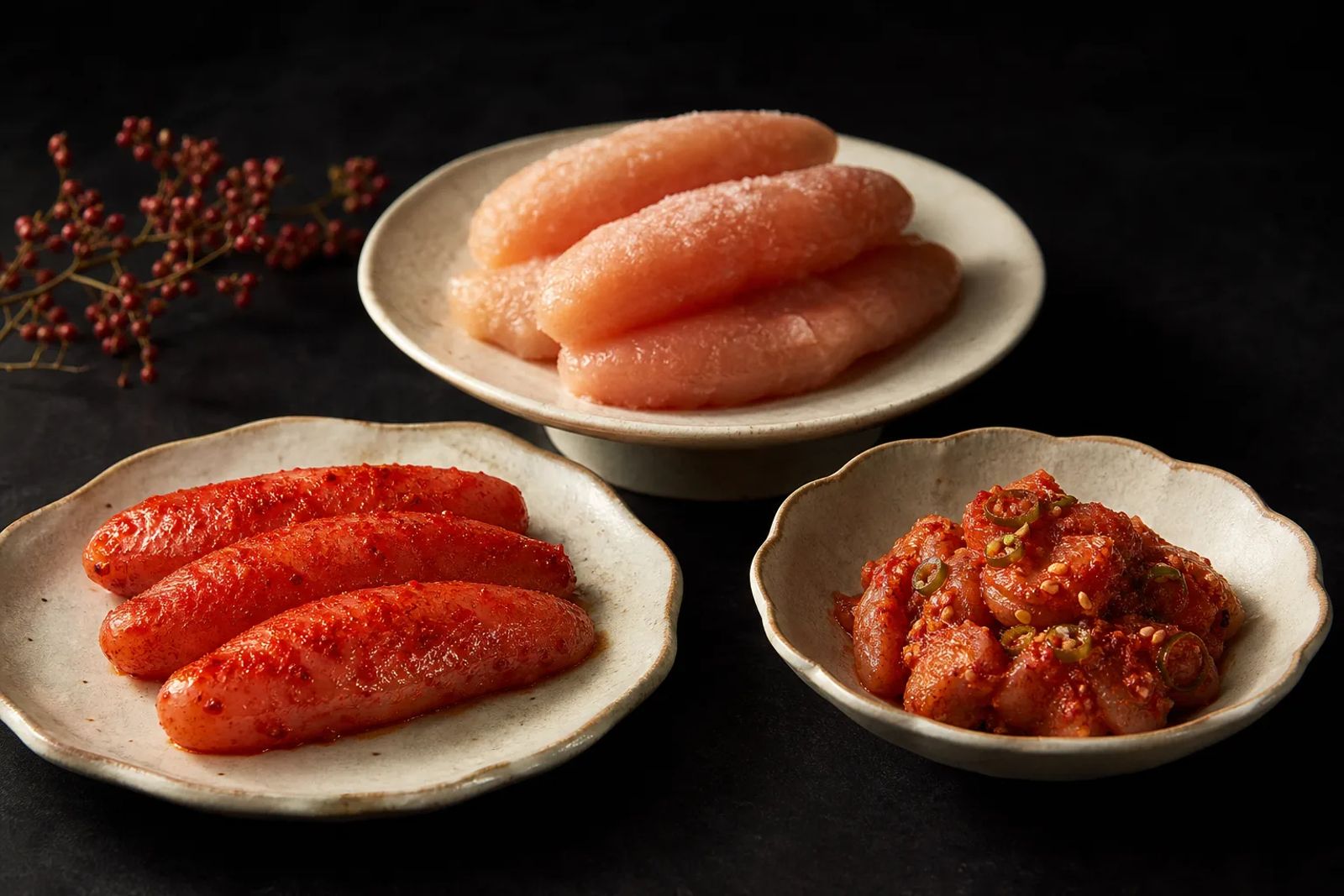
Today, three closely related preparations tell that story: Japanese tarako is salted roe kept in its sacs; mentaiko is seasoned roe, usually associated with chilli; and Korean myeongnanjeot is salted, fermented pollock roe. Their relationship runs from Korean food traditions into Japanese adaptation.
The fish behind the roe
“Alaska” names the species, not necessarily the place of the catch. Alaska pollock is Gadus chalcogrammus, formerly widely recorded as Theragra chalcogramma. NOAA uses the current Gadus name, while the Marine Stewardship Council's fishery records explicitly connect the two.
Commercial supplies come from major North Pacific fisheries, including those of the United States and Russia. The scale is considerable. NOAA reports landings of more than 1.36 million tonnes (3 billion pounds) from the Bering Sea and Gulf of Alaska in 2024. Russia's VNIRO reported 351,000 tonnes from four Sea of Okhotsk subzones by 23 February 2025, covering only part of that year.
Both countries have fisheries recorded as MSC certified in November 2026: the combined Bering Sea, Aleutian Islands and Gulf of Alaska fishery, and Russia's Fishery Shipowners Association Sea of Okhotsk fishery. Certification covers specified fishing units rather than every pollock product.
NOAA identifies salmon bycatch as a particular concern in the US fishery, where management uses catch limits and monitoring. VNIRO describes scientific observers collecting biological and fishing data during Russia's Okhotsk season. Check Russia's federal fisheries agency for its management measures.
Three names, three treatments
The treatment of the roe makes the difference, not a different fish behind each name. Each tradition allows variations in seasoning.
| Tarako | Mentaiko | Myeongnanjeot |
|---|---|---|
| Japanese salted pollock roe, generally kept in the ovarian membrane. | Japanese seasoned pollock roe; karashi mentaiko specifies the chilli-seasoned style. | Korean salted, fermented pollock roe, from the jeotgal family of preserved seafood. |
| Salt curing defines it; other ingredients vary. | Salted roe marinated in liquid with red chilli and other seasonings. | Salted roe seasoned and fermented; Maangchi's version includes chilli, garlic and ginger. |
Each sac is an ovary holding many small eggs, rather than a single large bead served separately. The distinction also helps explain single beads versus whole sacs, although that article explores a different roe tradition.
Japan's agriculture ministry describes mentaiko production as salting followed by marinating in a chilli-spiced liquor. Korean cookery writer Maangchi washes and drains the roe for myeongnanjeot, coats it with salt and seasonings, then ferments it under refrigeration. These process descriptions should not be used as instructions for safely curing raw roe at home.
From Korea to Japan
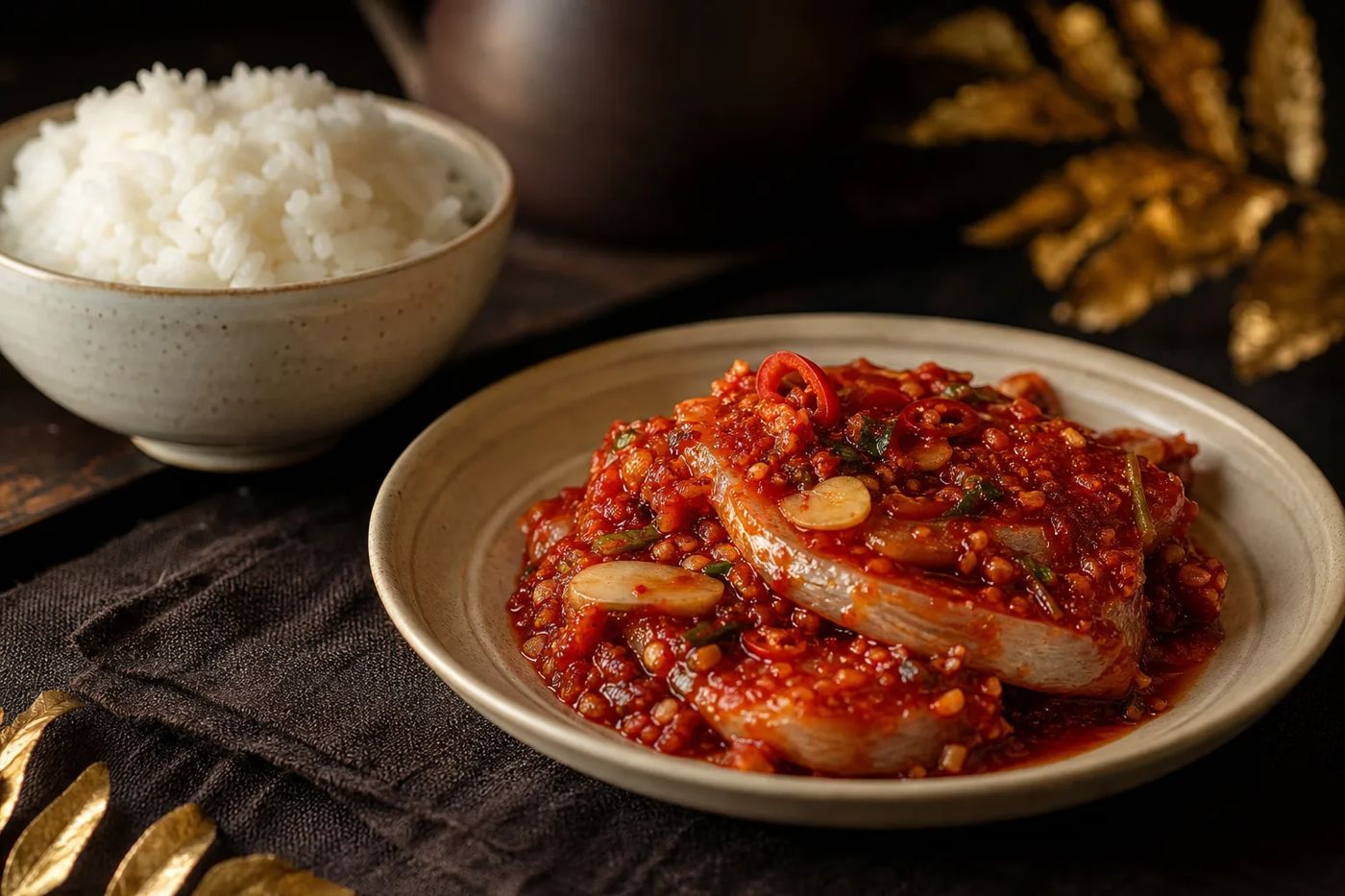
Mentaiko's Korean roots are documented through food, trade and migration. Iwama's study describes spicy pollock roe entering wider Japanese imperial food networks, including commercial production and exports from Busan to Shimonoseki around 1907. Colonial rule belongs to this history too.
The Japan Center for Asian Historical Records identifies three revealing documents: a 1900 fisheries report describing salted roe sold in Korea, a 1914 trade-statistics entry for pollock roe, and a 1917 manual describing its expanding market. Together, they trace an established Korean food and early cross-border trade, without identifying a single inventor.
After 1945, Japanese repatriates helped establish production in Shimonoseki and Fukuoka. The archive distinguishes those activities from Toshio Kawahara's later development of a liquid-seasoned version in Hakata. Company founding stories mark the beginnings of particular businesses or formulations, rather than the invention of Korean salted roe.
MAFF now identifies karashi mentaiko as a Hakata speciality introduced from the Korean peninsula. Its place in Japanese food sits alongside that Korean inheritance; Japanese roe culture explores the broader context.
Salt, chilli and a fermented tang
Salty and spicy: that is MAFF's description of karashi mentaiko. Maangchi describes a slightly tangy flavour developing in her fermented myeongnanjeot, which she serves with the sacs cut into pieces rather than every egg separated. Seasoning strength and fermentation give individual products their character.
The salt content deserves attention. Japan's official food composition database gives salt equivalents of 4.6 g per 100 g for uncooked tarako and 5.6 g per 100 g for karashi mentaiko. A 15 g portion therefore supplies about 0.69 g or 0.84 g respectively. These reference entries provide a useful guide; the nutrition label gives the figure for a particular product.
Salt equivalent is calculated from sodium, including sodium supplied by ingredients other than sodium chloride. For tarako, mentaiko or myeongnanjeot, read that label rather than estimating saltiness from colour, chilli coverage or the name.
What the label tells you
A red surface may reflect chilli, but it cannot tell you the full formulation. Sodium nitrite is a colour fixative, distinct from an added colouring. Japan's official standards permit it in salted pollock ovaries, with no more than 5 mg/kg remaining as nitrite ion. Producers may use it; they are not required to.
South Korea's published Food Additives Code has listed a maximum of 5 mg per kg as nitrite ion for myeongnan jeot and salmon roe jeot. Check the code's current provision. An MFDS import record lists sodium nitrite, vitamin C and sorbitol in one sliced pollock roe formulation, but current authorisation must be established separately.
The United States takes a different approach. Sodium nitrite permissions in 21 CFR 172.175 name particular cured fish products, not pollock roe. Japan's export guidance expressly says sodium nitrite is not permitted in tarako exported to the US. A formulation lawful in Japan may therefore be unsuitable for US sale.
Each sac is an ovary holding many small eggs, rather than a single large bead served separately.
In the EU, additive permissions depend on the food category under Regulation (EC) No 1333/2008. Great Britain has its own authorisation register; Northern Ireland generally follows the EU system. Check current permissions for nitrite and colours in pollock roe in each market.
Read the ingredients for colours, colour fixatives, flavour enhancers and allergens introduced by seasonings. The translated product name tells only part of the story.
Distinguish the fish's origin from its place of processing, too. “Hakata” describes a food association, not where the fish was caught. A Japanese co-operative's tarako label, for example, identifies Russian roe and a Fukuoka manufacturer separately. For commercial imports into the EU, Great Britain, Northern Ireland or the United States, check entry and sanitary requirements against the actual product and its origin before shipment.
At the table
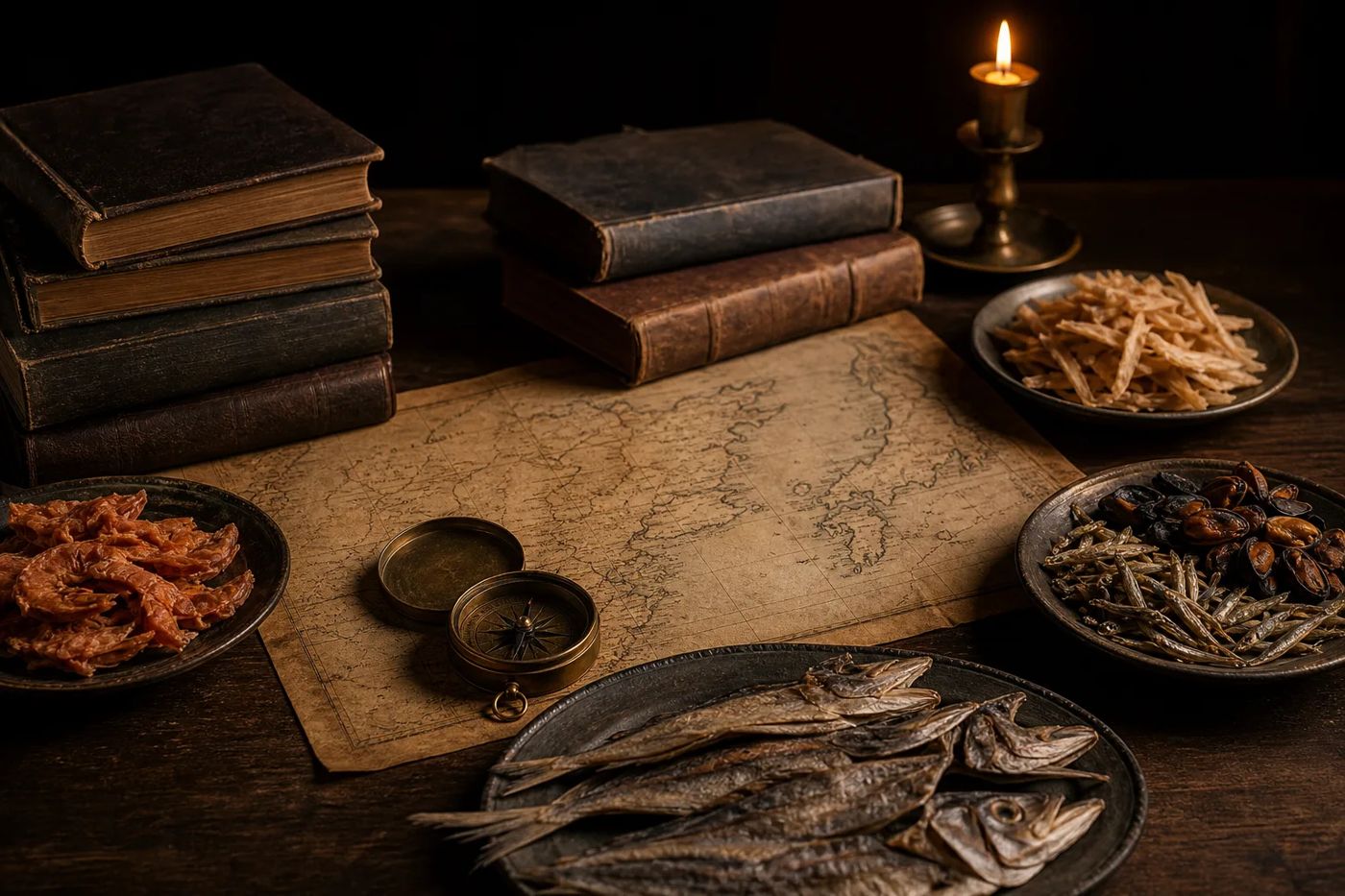
Mentaiko can flavour a dish rather than simply decorate it. MAFF lists it in rice balls, ochazuke, rice served with tea poured over it, and spaghetti. For the cooking method, follow the dedicated mentaiko pasta recipe, where seasoned roe becomes part of the dish itself.
Maangchi serves sliced myeongnanjeot with spring onion, toasted sesame oil and sesame seeds, alongside rice, soup and other side dishes. It is a serving suggestion from her recipe, with the roe remaining in pieces.
For other preparations sold as cod roe, see fresh, smoked and cured cod roe. For the wider family, start with other fish roe.
Keep it cold, check its intended use
Start with a clear label: is the roe ready to eat, or does it require cooking? Salting, marinating and fermentation alone do not establish that raw roe is safe. Follow the producer's storage, thawing and after-opening instructions, including any requirement to keep it frozen until use.
US FDA guidance sets a refrigerator temperature of 4°C (40°F) or below and recommends thawing seafood in the refrigerator. Use a colder temperature if the pack specifies one. Keep ready-to-eat roe separate from raw seafood and use clean utensils. A pleasant smell or appearance cannot establish safety.
In the United States, the FDA advises pregnant people, children, older adults and the immunocompromised to avoid raw or undercooked seafood. Chilled ready-to-eat products can present a Listeria risk, which refrigeration does not eliminate. People with a fish allergy should avoid pollock roe. For personal pregnancy advice, speak to a doctor or midwife.
Sources
-
NOAA Fisheries. Alaska Pollock. Current online species account, retrieved November 2026; includes 2024 landings, scientific name, management and bycatch information. Official account.
-
Russian Federal Research Institute of Fisheries and Oceanography, VNIRO. Pollock fishery and its scientific support in the Far Eastern fishery basin. 25 February 2025. Research institute report.
-
Marine Stewardship Council. BSAI and GOA Alaska pollock: assessments. Live register, including certification documents published in March 2026. Fishery assessment record.
-
Marine Stewardship Council. Fishery Shipowners Association (FSA) Russia Sea of Okhotsk pollock. Live register, retrieved November 2026. Fishery record.
-
Japan Ministry of Agriculture, Forestry and Fisheries, MAFF. Local dishes loved by the nation. Undated English-language booklet, Fukuoka entry, pages 12 to 13. Official booklet.
-
Japan Ministry of Health, Labour and Welfare, MHLW. Appropriate use of sodium nitrite in tarako [Japanese title: 亜硝酸ナトリウムのたらこに対する適正な使用方法について]. Notice dated 30 September 1983, official online text. Official notice.
-
Maangchi. Fermented pollock roe (Myeongnanjeot: 명란젓). Published 5 September 2019; updated 6 October 2026. Used for an attributed preparation and serving account, not as a validated commercial safety process. Author's recipe.
-
Iwama. How Taiwanese, Korean, and Manchurian Cuisines Were Designed. Scholarly article, volume 1, 2021; section discussing mentaiko and colonial food networks. Article PDF.
-
Japan Center for Asian Historical Records, National Archives of Japan. JACAR Newsletter Number 19, historical account by Yasuaki Maruyama. 4 February 2016. Newsletter and archival references.
-
Japan Ministry of Education, Culture, Sports, Science and Technology, MEXT. Food Composition Database, food entries 10202, uncooked tarako, and 10204, karashi mentaiko; associated Standard Tables of Food Composition in Japan 2020, eighth revised edition. Tarako entry; mentaiko entry; official tabular data.
-
MEXT. Salt equivalent [Japanese title: 食塩相当量]. Undated database methodology page, retrieved November 2026. Calculation method.
-
Japan Consumer Affairs Agency. Specifications and Standards for Foods, Food Additives, etc., food additive provisions, official text reflecting the notice of 6 February 2024. Sodium nitrite conditions of use. Official standards PDF.
-
South Korea Ministry of Food and Drug Safety, MFDS. Food Additives Code, item-specific usage standards, sodium nitrite entry. Official Korean-language PDF, edition date not reliably established; corroborated by the English code, Regulation No 2019-63, 25 July 2019. Official usage standards; archived English code.
-
MFDS. Imported food information: Frozen Sliced Pollack Roe. Product declaration record 202600062919, 2026. Official ingredient record.
-
United States Food and Drug Administration. 21 CFR 172.175: Sodium nitrite. Current eCFR text retrieved November 2026. Federal regulation.
-
MHLW. Handling of fishery foods exported to the United States [Japanese title: 対米輸出水産食品の取扱いについて]. Official online guidance, section 7; revision date not reliably established. Export guidance.
-
European Union. Regulation (EC) No 1333/2008 on food additives. Consolidation dated 19 March 2020 retrieved; not treated here as verification of the complete November 2026 roe-specific permissions. Retrieved consolidation.
-
Food Standards Agency. Guidance on using the Register of Food Additive Authorisations. Online edition retrieved November 2026, explaining the register's legal role from 1 April 2025. Also Guidance for local authorities and district councils on Grey Market goods, sections 9 to 10, on Great Britain and Northern Ireland. Register guidance; grey-market guidance.
-
Japanese Consumers' Co-operative Union. Uncoloured reduced-salt tarako, 60 g. Undated product specification, retrieved November 2026. Used only as a documented ingredient and origin-label example. Product specification.
-
United States Food and Drug Administration. Selecting and Serving Fresh and Frozen Seafood Safely. Online consumer guidance retrieved November 2026. Seafood safety guidance.
This piece was researched through government fisheries records, official additive texts, certification registers, archival food history, national food composition data and attributed Korean cookery writing.
Last checked: November 2026