
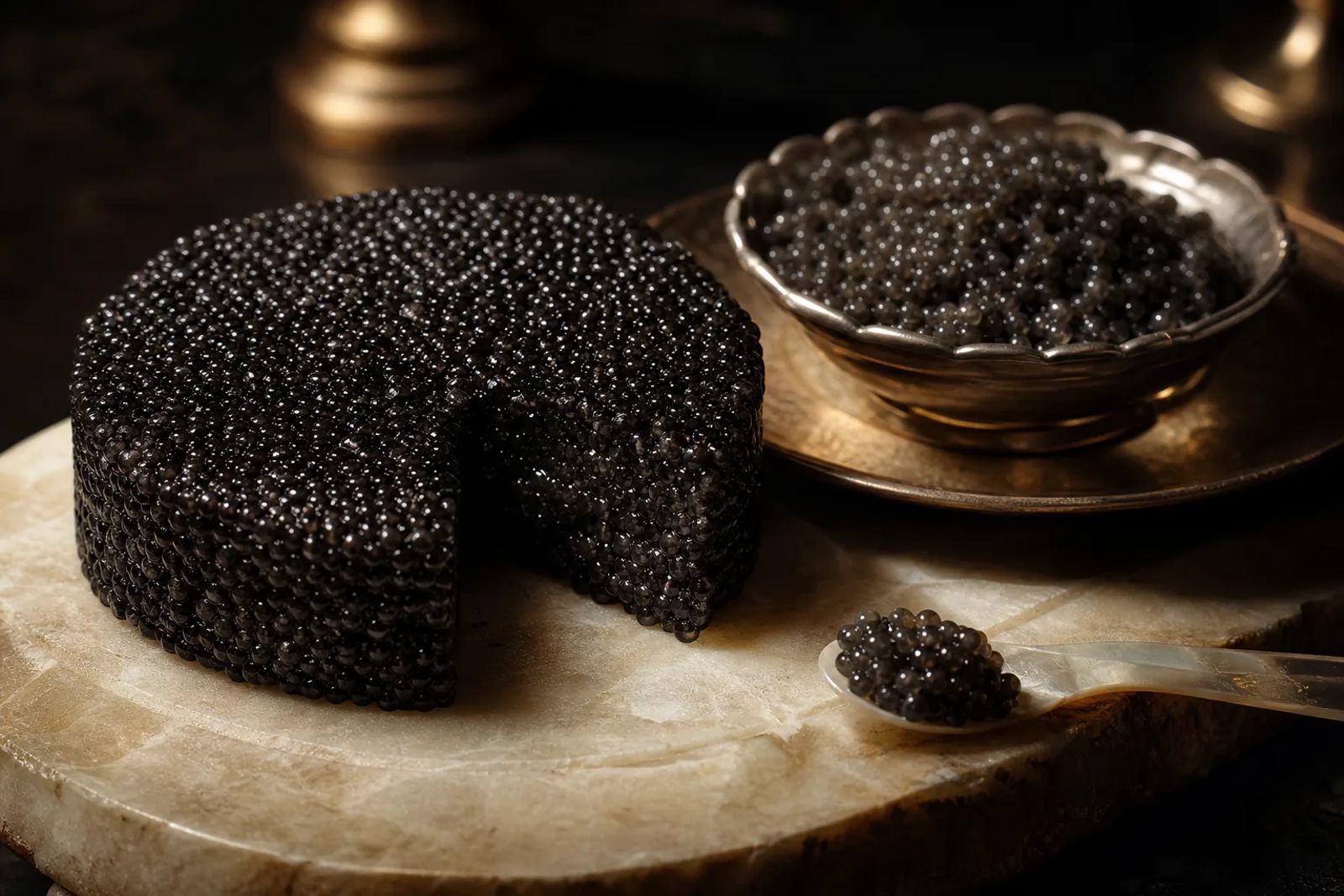
Black, spreadable and strong tasting: that is the pressed caviar recorded in a 2002 TRAFFIC report. Instead of separate beads on the spoon, payusnaya offers salted sturgeon roe compressed into a dense, spreadable paste. The pleasure lies in its cohesive texture and, in published descriptions, its more assertive flavour. This is caviar made for spreading, with less emphasis on the individual egg.
What the name means
Dictionaries connect payusnaya with payus, the membrane or sac enclosing fish eggs, rather than simply with a Russian verb meaning “to press”. Payusnaya is the usual English transliteration of the Russian паюсная; payusnaya ikra means pressed caviar in culinary usage.
Vladimir Dal’s dictionary describes caviar salted in these sacs and pressed under a weight. Max Vasmer’s etymological dictionary leaves the deeper origin uncertain. “Pressed caviar” is a useful culinary translation, but a literal “pressed form” claims more than the linguistic evidence supports.
How pressed caviar is made
Salting and pressing transform the roe. Simply mashing a spoonful of finished caviar is not the same process. GOST 34884-2022, the interstate terminology standard, describes roe salted in a warmed, saturated salt solution, then pressed into a homogeneous mass.
The 2002 TRAFFIC report gives a more tangible picture of a traditional commercial method: damaged roe stirred in warm brine, transferred to fabric pouches and pressed to squeeze out excess liquid. Its recorded blend of ossetra and sevruga became a black, spreadable paste. Sevruga comes from starry sturgeon, Acipenser stellatus; the species behind the ossetra in this account is not recorded.
Broken eggs therefore have a documented place in pressed caviar, without defining the entire preparation. The cited sources do not record whether overripe eggs or eggs from a late season harvest were traditionally used.

What pressed caviar tastes like
Expect a compact paste, not loose grains. Russia’s GOST 7368-2013 describes a dark grey to black product of medium softness; the traditional example in the TRAFFIC report was dry and spreadable, with a strong taste.
For a more sensory description, Jacques Pépin, quoted by California Caviar Company, calls its pressed blend of sturgeon and paddlefish roe intense and assertive, dense and smooth. Those words describe that particular preparation.
The GOST sensory specification permits a barely perceptible, short-lived bitterness in its higher grade; it does not require that note in every preparation. This precise allowance is more useful than calling the style universally “fishy”. Rancid or otherwise defective flavours are not defining characteristics of pressed caviar.
Is it still made today?
Company descriptions point to contemporary pressed preparations. Petrossian describes a pressed preparation as a house blend and a paste, while California Caviar Company describes one developed with Jacques Pépin. These descriptions do not independently confirm current production or establish the manufacturing methods.
Its place in Russian and Soviet food culture
Dal’s dictionary records caviar pressed and transported in rounds, placing this recognised preparation in the Russian food vocabulary long before contemporary product descriptions. Its history goes beyond an improvised use for damaged eggs.
The 1952 edition of The Book of Tasty and Healthy Food presents payusnaya alongside granular caviar as a normal category of sturgeon roe. It singles out sevruga pressed caviar and the output of the Achuyev fish factory for praise. That records a Soviet preference, rather than a quality ranking for all pressed caviar.
Sevruga, the trade name for starry sturgeon roe, has a clear historical association with the style. It is not the only ingredient: the TRAFFIC account records ossetra and sevruga together. For the wider customs surrounding the food, turn to Russian caviar traditions, which extend beyond this one processing method.
Codex and the Russian standard
Pressed caviar has a dedicated Russian standard, but falls outside the scope of the international standard for granular sturgeon caviar. Codex CXS 291-2010 covers granular caviar and supplies no separate definition of payusnaya. Its requirements are not a pressed-caviar specification.
The relevant Russian standard is GOST 7368-2013, Pressed sturgeon caviar. Specifications. Rosstandart lists it as current, effective from 1 July 2015, replacing GOST 7368-79. It defines a pressed, salted mass of sturgeon eggs containing no more than 40 per cent water.
Falling outside this particular Codex standard does not make pressed caviar imitation roe or an unrecognised food. Applicable food laws and CITES controls on sturgeon products still apply. Codex is a reference standard, not automatically binding national law; the Russian GOST specifies the product but does not replace applicable food-safety requirements.
How to serve and use it
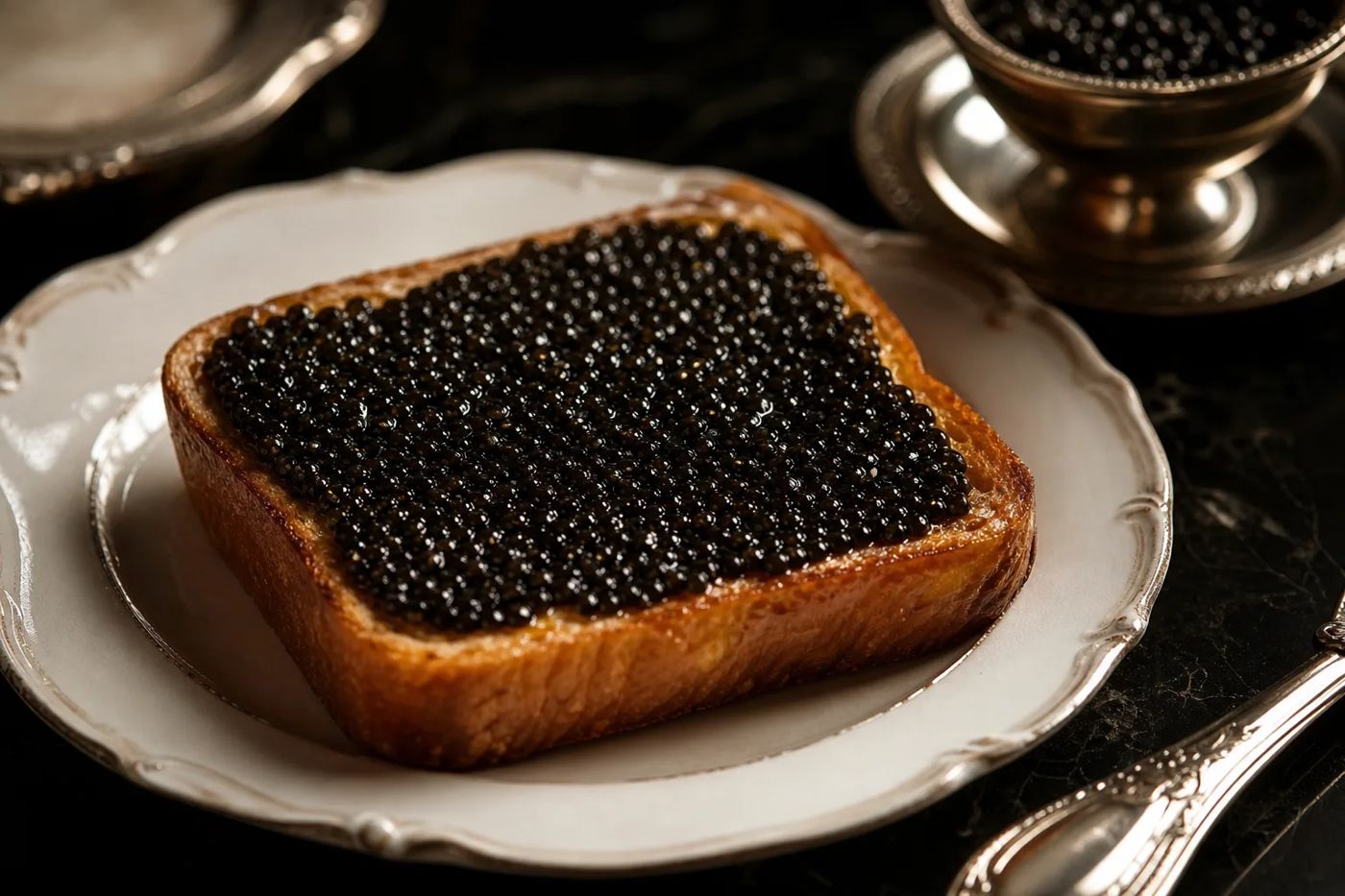
Spread it thinly and let the texture do the work. For a simple first taste, use plain bread, with a little unsalted butter if wanted. This keeps attention on the paste’s texture and strength, rather than asking it to behave like loose roe.
For a more sensory description, Jacques Pépin, quoted by California Caviar Company, calls its pressed blend of sturgeon and paddlefish roe intense and assertive, dense and smooth.
California Caviar Company suggests buttered brioche toast, rolling the paste thinly and cutting shapes for seafood tartare, or adding it to sauces just before serving. These are the company’s documented serving ideas, rather than recipes tested for this site.
When cooking, add the paste off the heat as a finishing ingredient. Heat can change caviar’s texture and flavour.
Follow the product’s storage instructions and use-by date. Historical descriptions of improved keeping qualities do not establish that a modern preparation is safe without refrigeration.
Pressed is not dried or powdered
Pressing squeezes out liquid mechanically to form a cohesive mass. Drying removes moisture through a different process. Both preparations can contribute concentrated roe flavour, but a pressed paste is not interchangeable with dehydrated roe or powder: the processing and texture differ.
Even a firm pressed preparation that can be shaved is not necessarily dried caviar. Shaving describes the shape of the garnish, not how it was made. Nor does pressing specify an ageing period. It describes how caviar is formed, not how long it has matured. For the broader terminology, start with what caviar is; for changes during storage and maturation, read fresh versus aged caviar.
Sources
-
Codex Alimentarius Commission. Standard for sturgeon caviar, CXS 291-2010, official text amended 2011 and 2013; the Codex register records a further modification in 2026. Sections 1 and 2.
Official Codex text. -
Rosstandart. GOST 7368-2013: Pressed sturgeon caviar. Specifications, official catalogue record, 2013; effective 2015; corrections listed for 2019 and 2021.
Official standard record. -
Interstate Council for Standardisation, Metrology and Certification. GOST 7368-2013: Pressed sturgeon caviar. Specifications, 2013, incorporating corrections published in 2019 and 2021. Full text reproduced by Meganorm. Sections 3 and 4, table 1.
Reproduced standard text. -
Interstate Council for Standardisation, Metrology and Certification. GOST 34884-2022: Fish, aquatic invertebrates, aquatic mammals, algae and products from them. Terms and definitions, 2022. Entry 141. Full text reproduced by Meganorm.
Reproduced terminology standard. -
TRAFFIC. Fish Roe in Europe: Supply and Demand Conditions, 2002. Description of pressed caviar, payusnaya.
Report hosted by WWF. -
Vladimir Dal and Max Vasmer. Dictionary entries for паюс, undated electronic reproductions on Lexicography Online; underlying editions are not identified on the retrieved page.
Dictionary extracts. -
Pishchepromizdat. Книга о вкусной и здоровой пище (The Book of Tasty and Healthy Food), 1952 edition, page 128, “Икра”. Digitised copy.
Scanned book. -
California Caviar Company. Undated company description attributed to Jacques Pépin, retrieved November 2026. Pépin quotation and recommended culinary uses;
-
Petrossian. Undated company description of a pressed caviar preparation, retrieved November 2026. Description as a paste and house blend;
This piece was researched through food standards, Russian dictionary entries, a digitised Soviet cookbook, a TRAFFIC report and explicitly attributed producer descriptions; no tasting or recipe testing was undertaken.
Last checked: November 2026