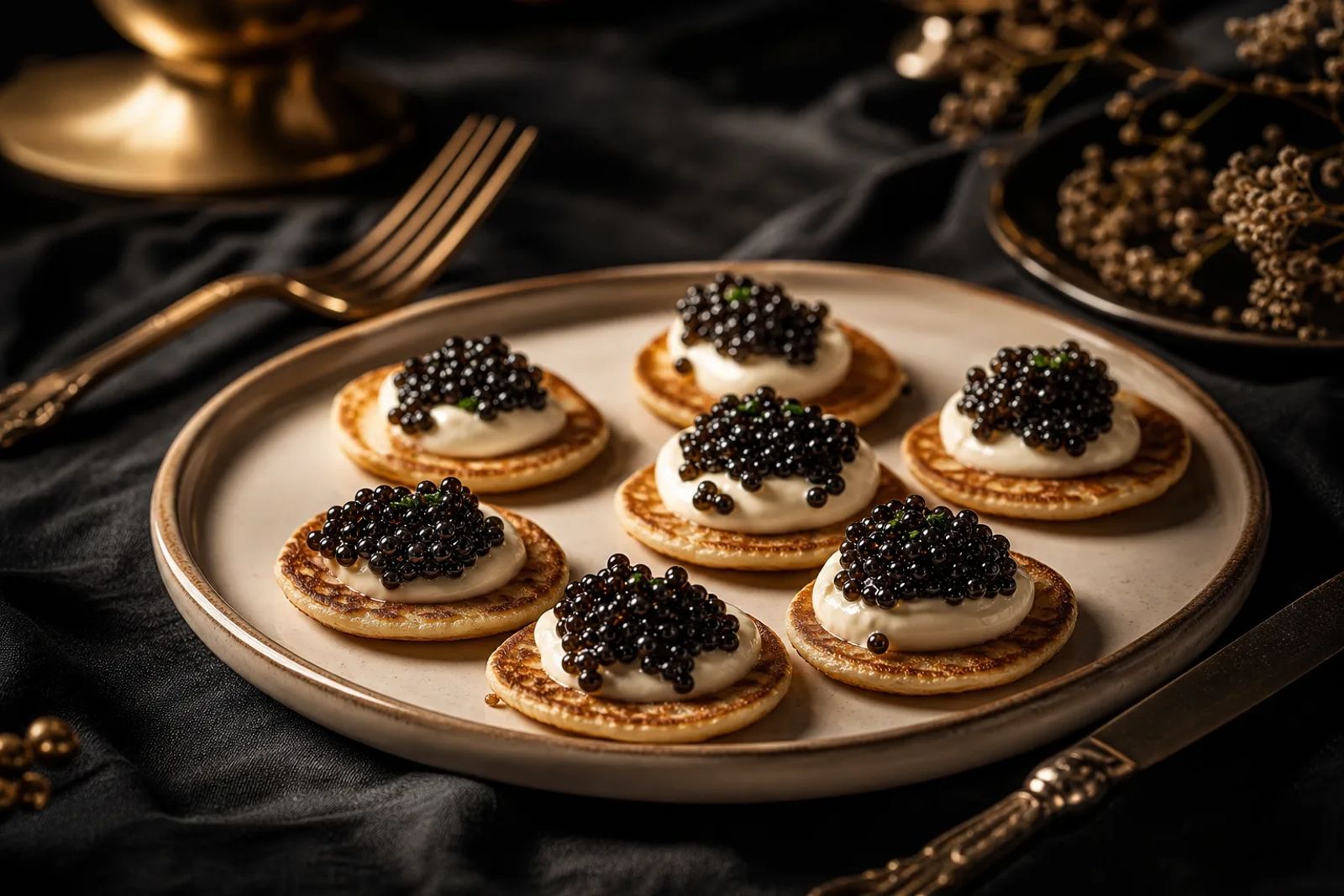
Richard Corrigan serves his caviar over ice, beside pancakes and sour cream. Each person assembles a bite: warm pancake, cream, chilled beads of roe. The pleasure is in that contrast. Cook the blinis first; add the caviar at the table, never in the frying pan.
The pancake can be a small, raised buckwheat round or a thin, pan-sized Russian blin folded around its filling. Both have a place beside caviar.
- Buckwheat contains no gluten, but many blini recipes also contain wheat flour.
- Cocktail size describes the format, not the flour or raising method.
- Freeze plain pancakes, not assembled caviar canapés.
What does blini mean?
One pancake is a blin (блин) in Russian; several are blini (блины), also transliterated bliny. English has borrowed the plural and made it its own: Oxford records blini and blinis, while Cambridge also accepts blini as a singular noun. This page uses blinis in its English title and blini when discussing the Russian forms.
The pairing with caviar belongs to a broader pancake tradition. Writing in The Moscow Times in 2023, Russian Culinary Historians link blini with Maslenitsa and list caviar among their toppings. Their account supports the pairing, but does not establish today's miniature cocktail pancake as the only authentic shape. Read Russian caviar traditions for the cultural setting. At the table, the useful distinction is simpler: does the pancake hold its topping or wrap around it?
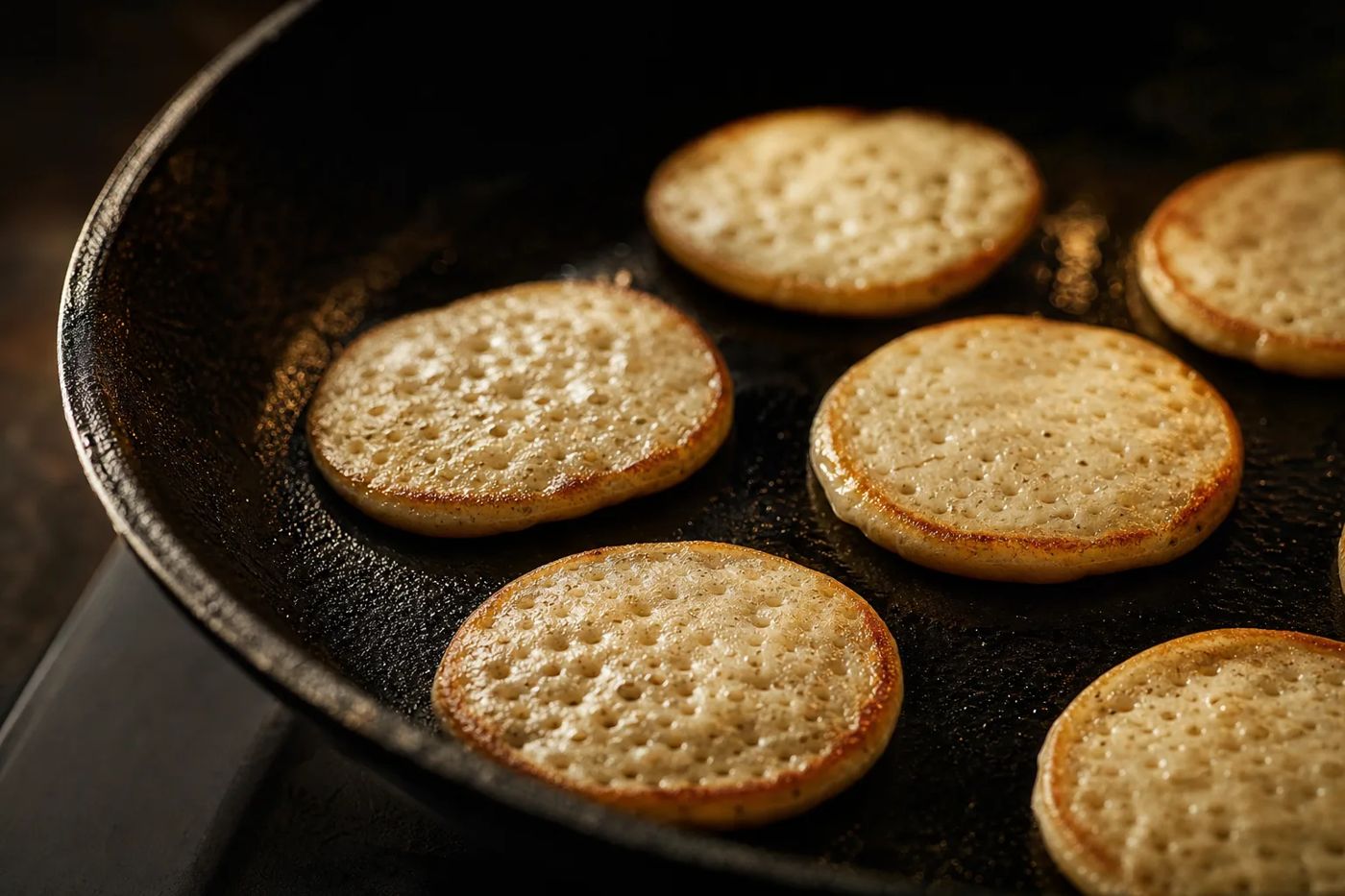
Buckwheat blinis
Buckwheat earns its place through flavour, not just colour. King Arthur Baking describes its taste in blini as earthy and sweet. In the recipe below, yeast raises the batter during fermentation, then folded egg whites add another source of lightness. Look for a golden surface and a tender middle. A hard, crisp disc is not the aim.
Recipe card: yeasted buckwheat blini
Adapted from Brinna Sands's recipe for King Arthur Baking, with metric spoon conversions.
Yield: about 24 pancakes, roughly 10 cm across. Serves: not stated by the source.
Time: source estimate 2 hours. Equipment: two bowls, whisk, heavy frying pan or griddle, spatula.
Ingredients
- 159 g buckwheat flour; 14 g skimmed milk powder; 4.5 g instant yeast
- 340 ml warm water; 113 g milk
- 2 large eggs, separated; 57 g unsalted butter, melted
- 4 g sugar; 3 g table salt; fat for greasing
Method
- Combine buckwheat, milk powder, yeast and water. Cover for 30 to 60 minutes.
- Mix yolks, milk, sugar and salt into the sponge. Cover for another 30 to 45 minutes.
- Stir in butter. Whisk whites to soft peaks and fold in.
- Cook 2 to 3 tablespoons per pancake on a lightly greased pan over moderate heat. Turn when the edges dry and bubbles persist; cook the second side until golden, about 1 minute.
Allergens: buckwheat, milk and egg; fish with caviar. Caviar per person: not stated in the source.
Thin Russian blini and cocktail blinis
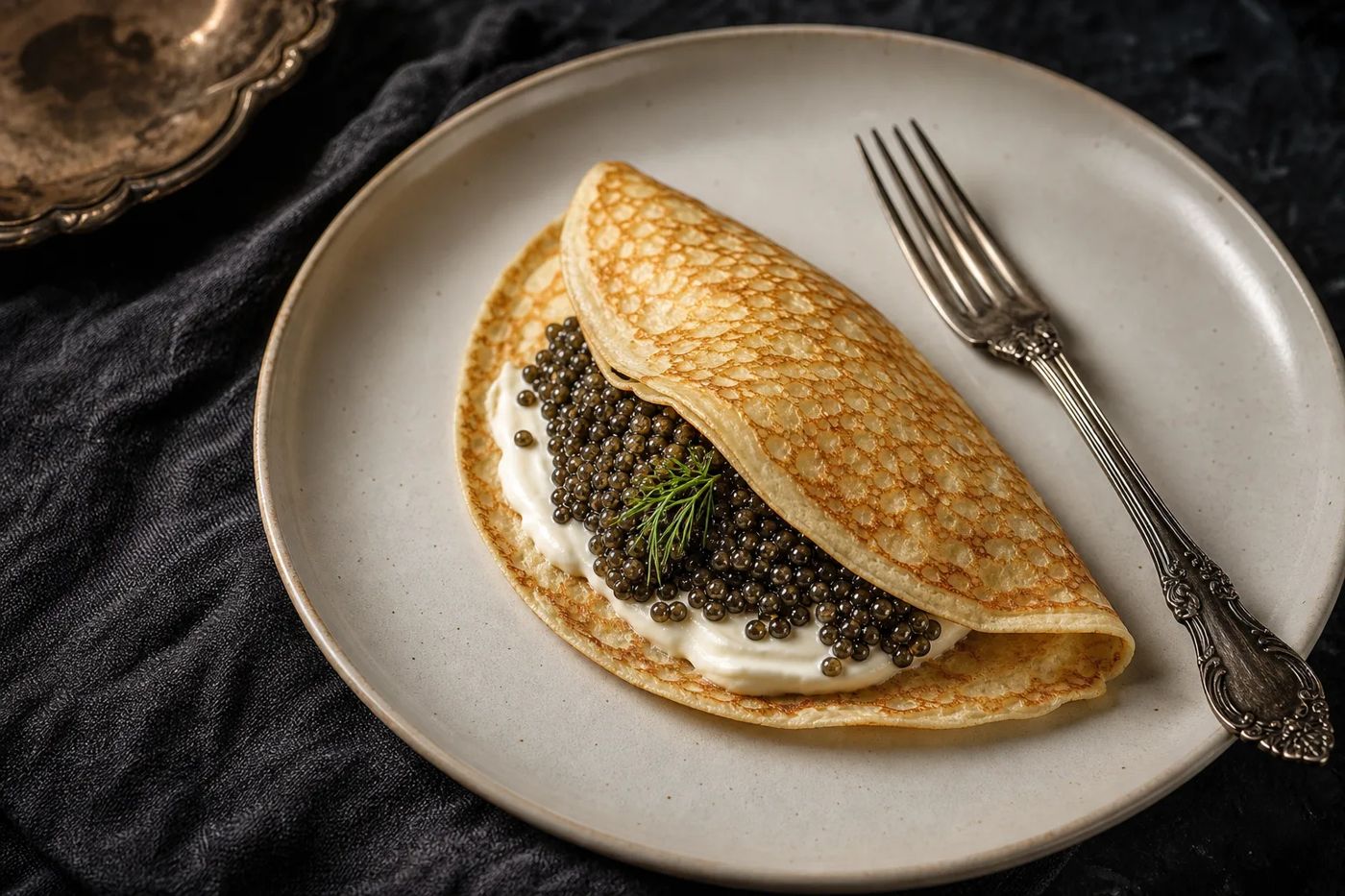
Thin Russian blini are suited to folding or rolling. Alissa Timoshkina's batter in Salt & Time combines wheat flour, milk, egg and boiling water, without yeast. Swirl it across the pan rather than dropping it into separate rounds. The result is a flexible sheet, quite different from the small cushion of a cocktail blini.
Recipe card: thin blini
Adapted from the pancake component of Timoshkina's Salmon & Caviar Blini Cake, rather than its layered filling.
Yield: about 30 thin pancakes. Serves: the complete source cake serves 8; separate pancake servings are not specified.
Time: source gives 35 to 40 minutes for the whole dish. Equipment: bowl, whisk, ladle, frying pan and spatula.
Ingredients
- 300 g plain wheat flour; 2 pinches salt
- 57 g melted butter; 1 egg
- 350 ml whole milk; 300 ml boiling water
- 50 to 70 g butter for frying
Method
- Whisk the batter ingredients together until smooth and runny.
- Butter the hot pan. Add half a medium ladleful and swirl into a thin layer.
- Cook for 40 to 60 seconds, turn, then cook for another 30 seconds. Stack on a plate and repeat.
Allergens: wheat, milk and egg; fish with caviar. Caviar per person: not specified for plain pancakes.
Making cocktail blinis
Small spoonfuls make cocktail blinis. Drop them onto the pan with room between each, and choose the batter for the flavour and texture you want. Buckwheat is optional: James Beard's recipe uses wheat flour and yeast; Richard Corrigan's uses wheat flour, mashed potato and cream cheese. A packet's name alone will not tell you its mixture.
Williams Sonoma specifies one tablespoon of batter for a pancake about 7.5 cm across, cooked over medium heat for 2 to 3 minutes per side. This is a separate cocktail method, rather than a yield guide for either recipe above. Change the spoonful size and you change both the number of pancakes and their cooking time.
Getting the pan and heat right
Choose a pan that suits the movement. A flat frying pan or griddle gives several separate rounds room to cook. For thin blini, use a frying pan you can lift and tilt comfortably. No dedicated pan is needed to begin; the guide to blini pans explains the equipment without changing either batter.
Let the first pancake teach you the hob. Corrigan cooks his small blinis over medium heat; Anson Mills specifies medium-low heat for its raised buckwheat cakes. Follow the heat instruction for your chosen recipe, then watch the colour and how the pancake sets as well as the clock. Adjust before committing the rest of the batter.
Making ahead, reheating and freezing
Freshly made is best, according to Anson Mills, but its buckwheat cakes can be prepared a few hours ahead. Reheat them uncovered at about 95°C (200°F) for 20 minutes. The mill's overnight batter is a different formulation: keep the resting times in the two recipe cards above rather than adding an overnight rest.
For the freezer, start with plain, cooled pancakes. Williams Sonoma lets its blini reach room temperature, then packs them airtight with paper towels between the layers. Its plan is to make them up to a week ahead and reheat from frozen at about 95°C (200°F) for 15 to 20 minutes. Those timings and that storage period belong to its recipe; they do not establish a storage life for every pancake.
Serving blinis with caviar
Have the pancakes ready before opening the caviar. Cook or reheat them, set out the cream and serving spoons, then open the tin. Serve the blini warm, not scorching from the pan, and keep the caviar separately chilled. Corrigan's arrangement of caviar over ice, pancakes and sour cream lets everyone build their own bite.
The result is a flexible sheet, quite different from the small cushion of a cocktail blini.
Malossol Russian sturgeon caviar (Acipenser gueldenstaedtii), a lightly salted style, is a suggested topping for either card, rather than part of the source recipes. Add it off the heat. A topped blin must not go back into the pan or oven: heat changes the roe's texture.
For quantities, Williams Sonoma gives 113 to 170 g (4 to 6 oz) of caviar for 50 to 60 blini. Divided evenly, that works out to approximately 1.9 to 3.4 g per blini, depending on the total and yield. Corrigan gives 35 g for two people, or 17.5 g each. To plan a whole service rather than a single bite, use portions by occasion.
Be restrained with the dairy topping: the pancake should still fold or lift cleanly. Compare crème fraîche, smetana and butter when choosing accompaniments, and see classic caviar service for the wider table arrangement.
Buckwheat, wheat and gluten
Buckwheat is naturally gluten-free. A buckwheat blini, however, may contain wheat: many recipes mix the two flours, and the thin recipe above uses wheat. The first card contains no wheat flour, but suitability for someone with coeliac disease also depends on the other ingredients and freedom from gluten contamination during preparation.
In the UK, Coeliac UK warns that naturally gluten-free flours can be contaminated where wheat is milled and recommends flour labelled gluten-free. Check every other ingredient and use clean equipment too. These are practical dietary checks, rather than a statement about any particular country's commercial labelling threshold.
Shop-bought blinis are a useful shortcut. Follow the packet's heating instructions and read its ingredients: the name guarantees neither buckwheat nor a gluten-free pancake.
Where to go next
- Accompaniments and Pairings: compare what else to serve beside caviar.
- Caviar Canapé Recipes: build a broader selection of bites around the pancakes.
Sources
- Oxford University Press, Oxford Advanced Learner's Dictionary, “Blini”, online edition, undated. Records Russian plural origin, singular blin, and English plural variants. Dictionary entry.
- Cambridge University Press, Cambridge Dictionary, “Blini”, online edition, undated. Records English singular usage and plurals blini and blinis. Dictionary entry.
- The Moscow Times, “The Long Lost History of Russian Blinis”, 18 February 2023. “Making Blini, or Russian Pancakes” discusses Maslenitsa and traditional toppings. Museum guide.
- King Arthur Baking, Brinna Sands, “Blini”, revised 24 June 2022. Source for the buckwheat recipe, yield, rests and cooking cues. Recipe.
- King Arthur Baking, Ingredient Weight Chart, online edition, undated. Used for metric conversions of yeast, sugar, salt and butter. Weight chart.
- Alissa Timoshkina, Salt & Time, 2019, “Salmon & Caviar Blini Cake”, reproduced by Another Pantry, online edition, undated. Only the pancake component is adapted here. Author's recipe.
- James Beard Foundation, James Beard, “Blini with Caviar”, archive edition, undated. Documents a wheat-flour, yeasted small-pancake version. Recipe.
- Great British Chefs, Richard Corrigan, “Ossetra caviar with blinis and sour cream”, first published 2015. Source for potato-based blinis, medium heat, separate chilled service and the two-person caviar quantity. Chef's recipe.
- Williams Sonoma, “Blini with Caviar and Crème Fraîche”, online edition, undated. Source for cocktail dimensions, cooking times, freezing, reheating and caviar quantity. Recipe and make-ahead instructions.
- Anson Mills, Raised Buckwheat Cakes (Buckwheat Blini), downloadable recipe, undated. Source for medium-low cooking heat and same-day reheating. Recipe document.
- Coeliac UK, “Grains”, online guidance, undated. Identifies buckwheat as gluten-free and explains flour contamination risks. Dietary guidance.
This piece was researched from published recipes, dictionary entries, museum interpretation and Coeliac UK guidance; the adaptations have not been kitchen-tested by caviar.uk.
Last checked: November 2026