
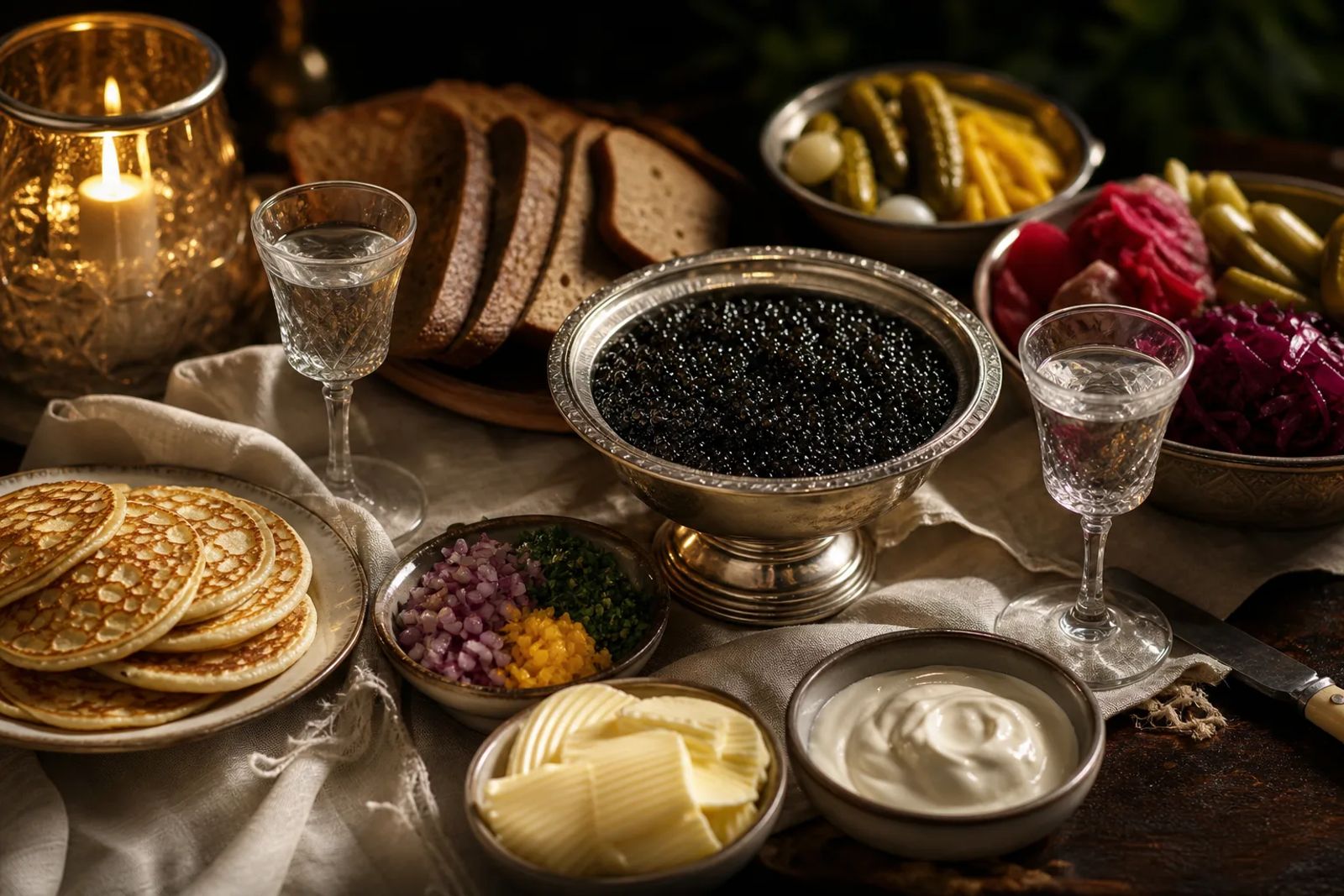
Hot blini, butter, caviar over ice and chilled vodka: Benjamin Kemper’s account in Saveur, drawing on cookery writer Anya von Bremzen, captures the contrasts of a Russian zakuski table. French restaurant service shares much of that vocabulary, with iced presentation and champagne among its documented conventions. The pleasure lies in the arrangement as much as the ingredients: a generous spread for sharing, or a tasting that puts the roe centre stage.
These traditions overlap. Dated cookbooks and restaurant descriptions show borrowing, variation and some lively disagreement, rather than two national rulebooks.
The Russian table: caviar among company
Zakuski are small dishes served as an appetiser spread. Caviar takes its place among them, rather than necessarily becoming a separate course with its own place setting.
A drawing reproduced by the Culinary Historians of Ann Arbor from Elena Molokhovets’s A Gift to Young Housewives, twentieth edition, 1897, shows dishes surrounding bottles of vodka and glasses at the table’s centre. It is an arrangement for entertaining, not a portrait of every Russian household. Kemper’s modern account brings together caviar, blini, butter and vodka, with bread, pickled vegetables and fish belonging to the wider spread. The organising idea is sociable: several dishes, shared across the table. Read more about Russian caviar traditions.
Blini are pancakes, but need not be the small, thick discs familiar from catered receptions. Russian Culinary Historians’ 2025 Shrovetide article offers thin yeast blini for caviar, with sour cream as one possible addition. Smetana is soured cream. Set it beside the butter and let guests choose; neither needs to become a compulsory layer beneath every spoonful of roe.
The same authors reproduce a memoir account of blini and caviar at Alexander III’s table. It gives the combination a place in court hospitality, without making it an everyday Tsarist menu. At home, pancakes, bread and dairy capture the useful part of the arrangement. There is no need to reconstruct an imperial banquet.
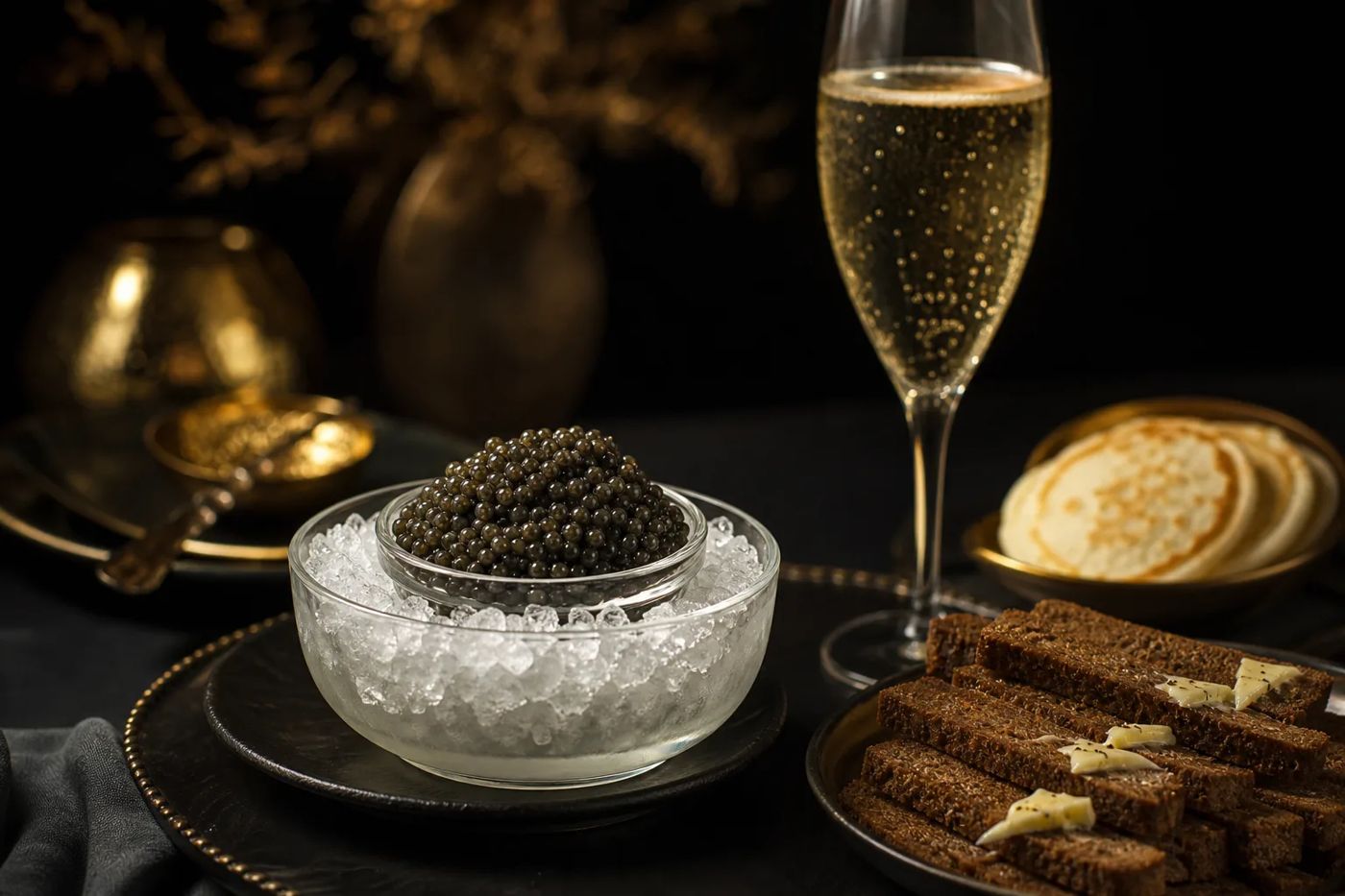
The French table: ice, blini and champagne
Auguste Escoffier’s instructions are wonderfully direct. In Le Guide Culinaire of 1903, caviar goes into a special vessel surrounded by ice, accompanied by blini and thin buttered slices of rye bread. Foods sometimes assigned to opposite sides of a Russian versus French comparison already sit together in this French reference: blini belong here, and bread belongs to both traditions.
Contemporary Parisian service offers further variations. Le Meurice’s description of caviar tastings at Bar 228 pairs blini and crème fraîche with champagne or a martini. Guests can choose shared or individual tastings. This is the hotel’s published presentation, rather than a dated turning point in the history of service.
Blini beside caviar can recall a Russian zakuski spread or Escoffier’s French service: the two traditions meet on the same plate.
Toast also has a documented place in the French restaurant repertoire. As of 2026, Le Bernardin’s lounge menu lists caviar with blini, toast and crème fraîche. The restaurant is in New York: a useful example of French restaurant cooking abroad, rather than an origin story for Parisian toast points.
For champagne, there is a specific recommendation. The Comité Champagne’s Champagne: From Cellar to Table proposes vintage brut blanc de blancs with caviar served plain. That advice comes from the wine’s professional body; it does not establish that champagne has always accompanied caviar in France. For a French-inspired table, it offers a clear pairing to follow, while leaving vodka an entirely reasonable choice. Explore the wider history in French caviar culture.
Russian and French service at a glance
| Focus | Russian settings | French restaurant settings | Sources |
|---|---|---|---|
| Bread and pancakes | Blini; bread and butter | Blini and buttered rye bread in 1903; toast on a French restaurant menu | Kemper; Escoffier; Le Bernardin |
| Dairy | Optional soured cream with blini | Crème fraîche with blini or toast | Russian Culinary Historians; Le Meurice; Le Bernardin |
| Presentation | Shared zakuski spread; caviar can sit over ice | Special iced vessel; shared or individual tastings | Molokhovets reproduction; Kemper; Escoffier; Le Meurice |
| Drink | Chilled vodka in the modern zakuski account | Champagne recommended with plain caviar | Kemper; Comité Champagne |
The strongest distinction is often the occasion, not the nationality: a mixed appetiser table on one side, a focused restaurant tasting on the other. These recorded examples offer ways to serve, rather than obligations to observe.
Egg, onion and lemon: an old disagreement
Escoffier wanted fresh caviar left alone. In his 1903 entry, he explicitly rejected finely chopped onion, arguing that the roe needed no supporting condiment. His objection also tells us that people were serving it.
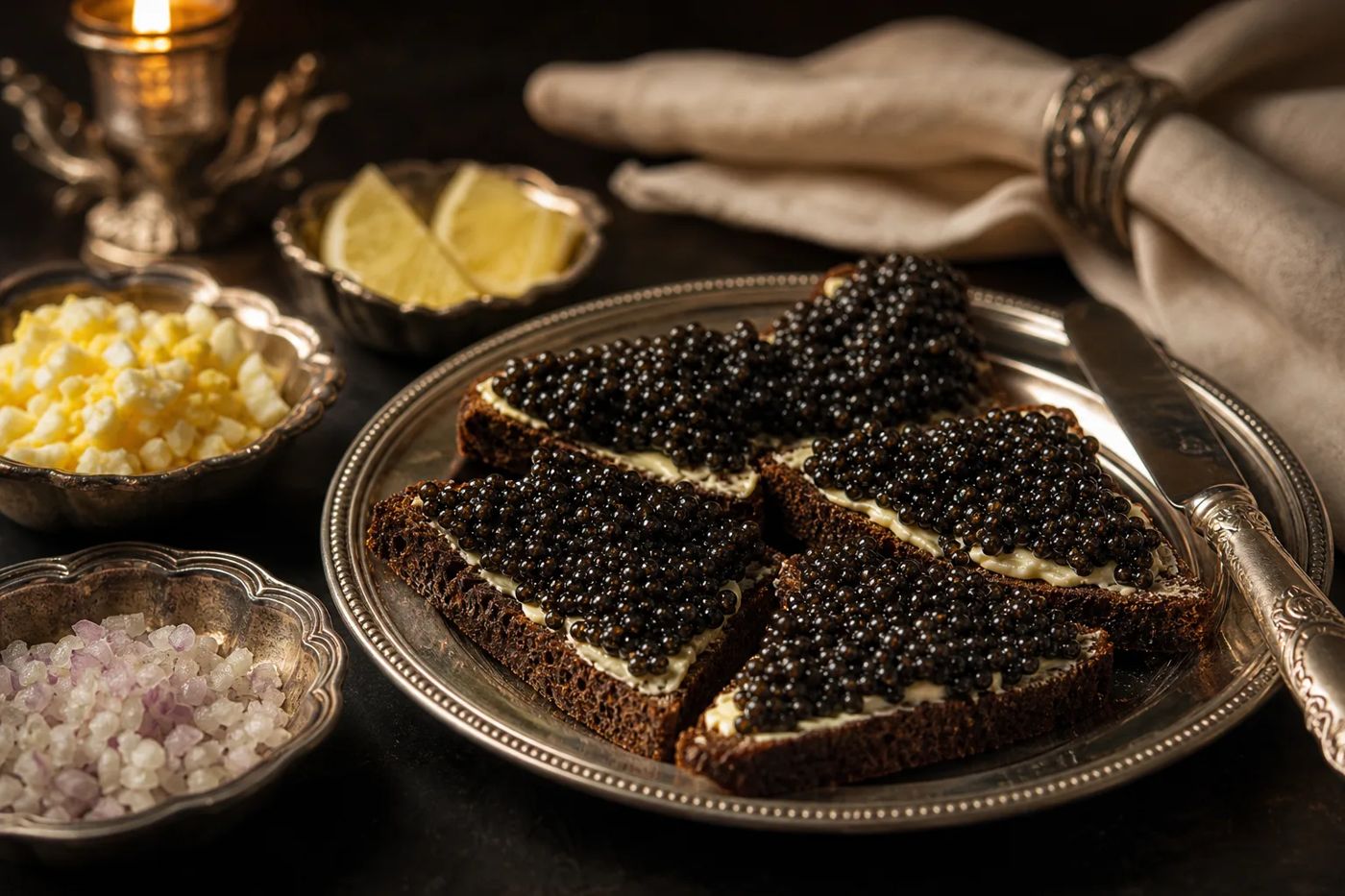
Eva Greene Fuller’s American The Up-to-date Sandwich Book, published in 1909, takes the opposite approach: finely chopped onion and a lemon garnish join caviar on buttered rye bread. The book’s 1927 canapé supplement also uses hard-boiled egg with caviar. Where Escoffier concentrates attention on the roe itself, Fuller composes a savoury bite from several ingredients. Egg, onion and lemon have a documented history beyond recent hotel dining rooms, although these international sandwich and canapé examples do not identify who devised each garnish first.
On flavour balance, Wayne Gisslen’s textbook Professional Cooking sides with restraint: onion, lemon, chopped egg and sour cream can overwhelm delicate caviar. That judgement does not establish that garnishes began as a way to disguise inferior roe. If you enjoy them, keep them optional and serve them separately. The fuller debate belongs in caviar etiquette.
Portions, spoons and the right glass
Choose the portion for the occasion. A small taste and a distinct course ask different things of the same tin. Decide which you are serving, then divide the available amount fairly. These sources establish no reliable national portion rule, and no requirement that Russians eat more caviar than French diners.
A porcelain or mother of pearl spoon suits either table; Gisslen lists both as suitable for eating caviar. The records do not establish nationally exclusive kinds of spoon. More useful than matching utensils to a country is making the table easy to use: give cream and garnishes separate utensils, and provide a small plate so guests can build bites without working over the shared caviar.
Let the drink determine the glass. Kemper’s zakuski account describes a chilled shot glass. The Comité Champagne recommends a tulip-shaped glass to concentrate wine aromas. Use those for vodka and champagne respectively, rather than choosing elaborate glassware as a badge of authenticity. Neither drink is essential to enjoying the food.
Bring either style to your table
Set the table before bringing out the caviar. Follow the producer’s instructions for refrigeration, opening and any leftovers; the separate serving guide covers handling in detail. The arrangements below borrow the practical pleasures of each tradition without turning dinner into a historical reenactment.
A Russian-inspired spread
Start with a shared caviar dish, a plate of blini, thin bread, butter and a small bowl of smetana. For a wider zakuski setting, add a dish of pickled vegetables rather than surrounding the roe with numerous toppings.
Let guests assemble each bite: pancake or bread first, butter or cream if wanted, then a spoonful of caviar. Keeping the elements separate makes the choices clear and leaves the roe at the centre of the bite.
The blini guide explains the pancake choices, while smetana, crème fraîche and butter helps you choose the dairy. If serving vodka, offer it chilled in small glasses, with water alongside. Caviar and vodka explores the pairing; alcohol need not define Russian hospitality.
A French-inspired tasting
Put thin toast and crème fraîche alongside the caviar, or choose blini, which have an equally clear place in French service. To follow Escoffier’s presentation, use a stable dish surrounded by ice, keeping the ice outside the food container.
If serving champagne, offer it in tulip glasses. Caviar and champagne discusses the wine choices.
The original tin is another practical way to present caviar. The sources examined do not establish when that habit began, or whether export trade shaped either tin service or the familiar garnish set. Use the tin for its convenience, without giving it an invented pedigree. Blini beside caviar can recall a Russian zakuski spread or Escoffier’s French service: the two traditions meet on the same plate.
Sources
-
Culinary Historians of Ann Arbor. Repast, volume XXVII, number 1, Winter 2011, page 5: reproduction of the zakuska table from Elena Molokhovets, A Gift to Young Housewives, twentieth edition, 1897. Documents the arrangement of dishes, vodka bottles and glasses. Retrieved issue.
-
Saveur, Benjamin Kemper. “For a Garden Party to Remember, Bring out the Zakuski”, updated 19 May 2021. Account drawing on Anya von Bremzen, author of Please to the Table and Mastering the Art of Soviet Cooking; documents the modern zakuski spread and chilled vodka service. Retrieved article.
-
The Moscow Times, Russian Culinary Historians. “Shrovetide, Blinis and the Mystery of Red Caviar”, 1 March 2025. Includes thin yeast blini, optional sour cream and a reproduced memoir account of court dining. Retrieved article.
-
Auguste Escoffier. Le Guide Culinaire: Aide-mémoire de cuisine pratique, first edition, 1903, “Caviar”, printed page 156. Original French text documents iced service, blini, buttered rye bread and the objection to onion. Retrieved page transcription and scan.
-
Dorchester Collection, Le Meurice. “Caviar tastings at Bar 228”, undated event page, retrieved November 2026. The hotel’s own account documents shared and individual tastings, blini, crème fraîche, champagne and martinis; the event year is not stated. Retrieved page.
-
Le Bernardin. Lounge Menu, web page, checked 2026. Primary restaurant menu documents caviar accompanied by blini, toast and crème fraîche at its New York address. Retrieved menu.
-
Comité Champagne. Champagne: From Cellar to Table, undated online edition, pages 20 and 27. Recommends tulip glassware and vintage brut blanc de blancs with plain caviar. Retrieved booklet.
-
Eva Greene Fuller, A. C. McClurg & Co. The Up-to-date Sandwich Book: 400 Ways to Make a Sandwich, 1909, “Caviare Sandwich”. Primary cookery text documents buttered rye bread, chopped onion and lemon. Retrieved edition.
-
Eva Greene Fuller. The Up-to-date Sandwich Book, 1927 edition, “Canapes” supplement. Documents caviar preparations with hard-boiled egg, lemon and onion juice. Retrieved supplement.
-
Wayne Gisslen, Wiley. Professional Cooking, chapter 24, “Hors d’oeuvres”, “Serving Caviar”, printed page 756. Undated online teaching extract, edition not identified in the extract; used for attributed garnish preferences and spoon materials only. Retrieved chapter.
This piece was researched by comparing historical cookery texts, a reproduced Russian table plan, culinary writers’ accounts and primary restaurant and wine-service publications, keeping documented practice separate from editorial suggestions.
Last checked: November 2026