
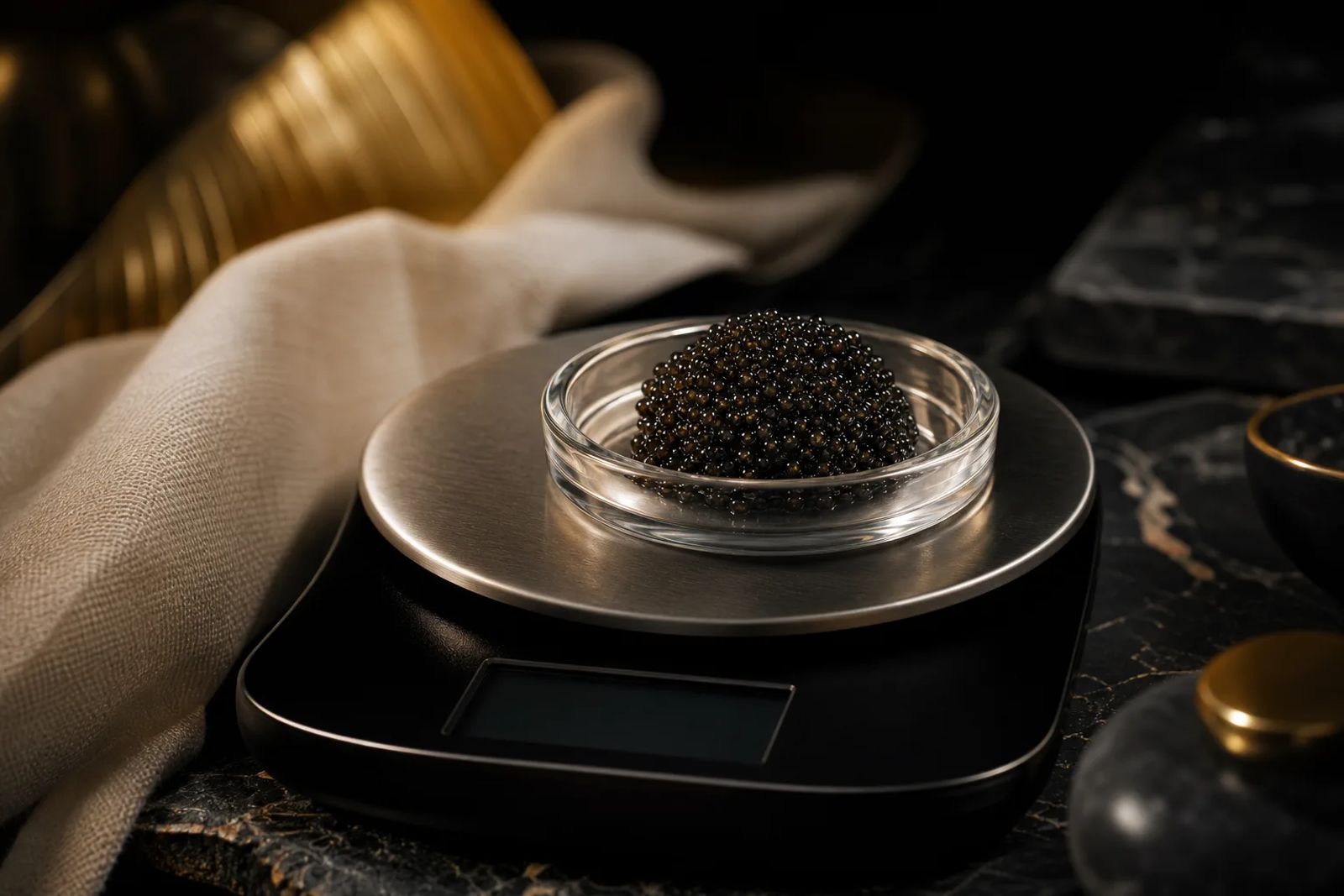
“Lightly salted” caviar can still be a high salt food. The distinction is there in the figures: the Codex standard specifies 3 to 5 g of salt per 100 g of finished sturgeon caviar, while NHS guidance counts anything above 1.5 g per 100 g as high in salt. A 15 g serving within that Codex range contains 0.45 to 0.75 g.
How salty caviar tastes is one thing. The nutrition label and the portion you serve tell you how much salt you consume.
- Compare products per 100 g, then calculate your portion.
- “Lightly salted” does not mean nutritionally low in salt.
- Count the whole day's salt or sodium, including accompaniments.
Salt and sodium: know the difference
Salt and sodium are not interchangeable figures. Table salt is sodium chloride, and sodium accounts for only part of its weight. For nutrition labelling, the conversion is salt = sodium × 2.5, with both quantities first expressed in the same unit.
Regulation (EU) No 1169/2011, Annex I, point 11 defines salt using that factor. The salt figure on a nutrition declaration is therefore a salt equivalent calculated from sodium, rather than simply a record of the table salt added during manufacture.
To turn milligrams of sodium into grams of salt, multiply by 2.5 and divide by 1,000. To work backwards, multiply grams of salt by 400 to get milligrams of sodium. Thus 0.6 g salt corresponds to 240 mg sodium.
Reading labels around the world
Start with the weight behind the number: per 100 g or per stated serving. It matters when comparing tins.
In the EU, a nutrition declaration, where required, includes salt, normally expressed per 100 g; additional portion information is permitted. Regulation (EU) No 1169/2011 supplies the rules. The per 100 g figure lets you compare products with different stated serving sizes.
Great Britain's corresponding assimilated food information rules also use salt in the nutrition declaration. Northern Ireland follows applicable EU food information law rather than the GB legal framework. The salt conversion is the same for this calculation.
Caviar terminology and nutritional labelling answer different questions, so “lightly salted” and “high in salt” can both accurately describe the same product.
In the US, the Nutrition Facts panel declares sodium in milligrams per stated serving, alongside its percentage Daily Value. FDA uses 2,300 mg as the sodium Daily Value. Check the serving weight before comparing that percentage with a European salt figure.
A percentage needs two pieces of context: its reference amount and its portion weight. Without them, a US percentage based on sodium and an EU percentage based on salt cannot be compared directly.
What the Codex salt range means
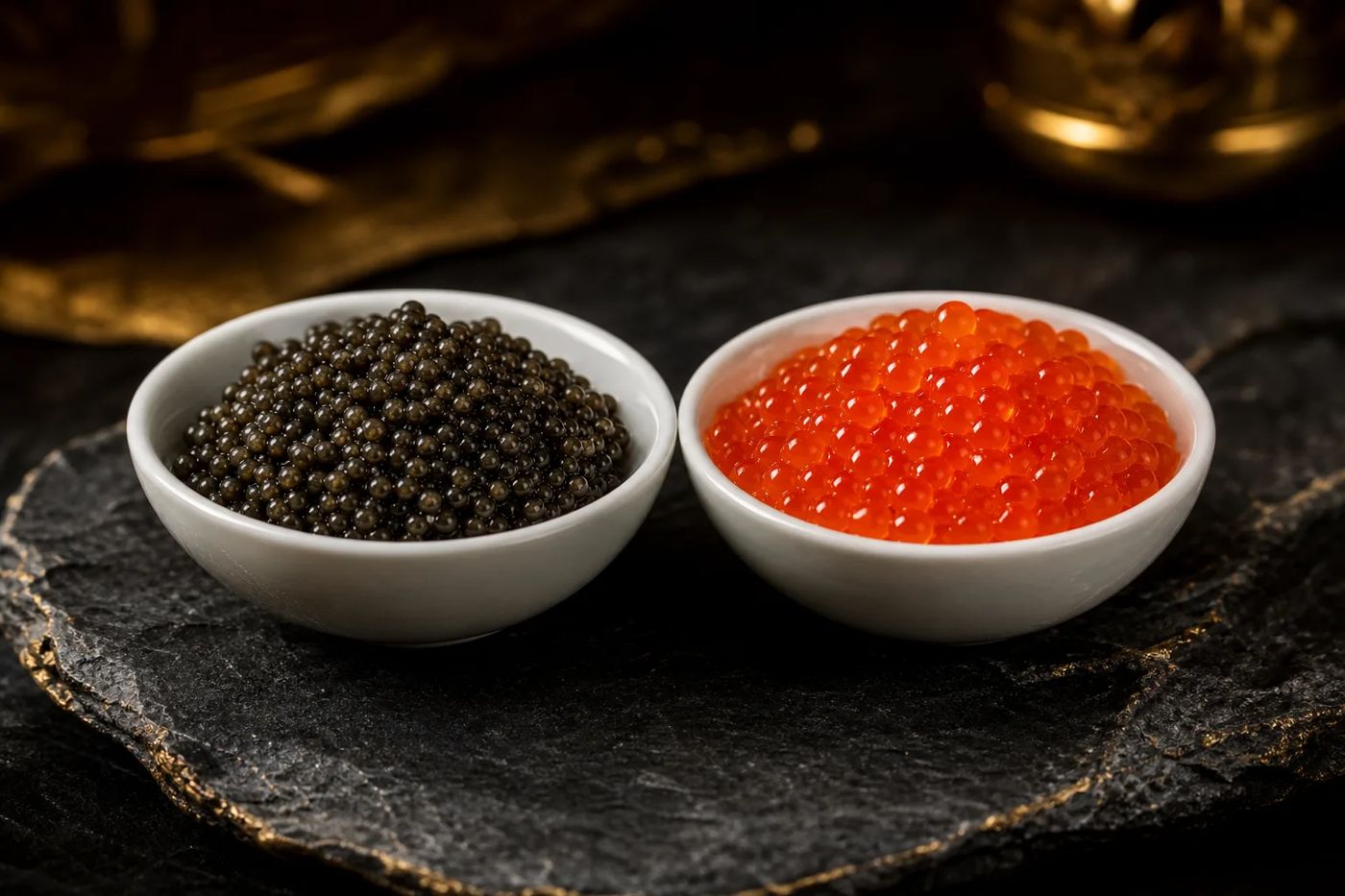
The Codex range is precise: at least 3 g and no more than 5 g of salt per 100 g of finished product. It comes from Codex CXS 291-2010, Standard for Sturgeon Caviar, an international reference standard rather than an automatically binding national rule or a description of every product sold as caviar.
The document lists amendments in 2013, 2018 and 2024; the Codex register records a further modification in 2026. Its scope is granular sturgeon caviar, not pressed caviar. The range does not govern recipes for salmon roe, tobiko or lumpfish roe.
Alongside the standard is the traditional term malossol, meaning lightly salted. University of Florida extension guidance describes traditional malossol caviar as containing 3 to 4% salt. That traditional description is not a measurement of a particular product; its own nutrition declaration tells you its salt content. Malossol explained explores the terminology in detail.
The UK nutritional threshold is much lower: NHS food label guidance classes more than 1.5 g salt per 100 g as high in salt. Caviar terminology and nutritional labelling answer different questions, so “lightly salted” and “high in salt” can both accurately describe the same product.
Salt in caviar and other roes
The figures below put named products beside the Codex reference band. They are not averages for entire categories. 15 g, about half an ounce, is the site's standard comparison serving, rather than a regulatory serving size.
Salt figures come from the named sources. Sodium is calculated from salt using the conversion above, except for salmon roe, where Japan's official composition table reports sodium directly. Label rounding can affect the estimates. The Codex row gives a standard range, not an analysed food sample; the calculated figures are conversions, not fresh laboratory measurements.
| Food and source | Salt, g/100 g | Sodium, mg/100 g | Salt, g/15 g | Sodium, mg/15 g |
|---|---|---|---|---|
| Sturgeon caviar, Codex reference band | 3 to 5 | 1,200 to 2,000 | 0.45 to 0.75 | 180 to 300 |
| Pressed sturgeon caviar, Sturia | 7.64 | 3,056 | 1.15 | 458 |
| Pasteurised sturgeon caviar, Coop Fine Food | 2.8 | 1,120 | 0.42 | 168 |
| Tobiko Black, Yutaka | 4.4 | 1,760 | 0.66 | 264 |
| Lumpfish roe, Royal Greenland | 4.4 | 1,760 | 0.66 | 264 |
| Salted chum salmon roe (ikura), MEXT food 10140 | 2.3 | 910 | 0.35 | 137 |
The salmon roe entry is Japan's official composition record for salted chum salmon roe, MEXT food 10140. It reports 910 mg sodium and 2.3 g salt equivalent per 100 g. Preparation matters here: Japan's Ministry of Agriculture, Forestry and Fisheries distinguishes salt brined ikura from soy sauce marinated preparations. Identify which you have before assigning a figure.
Processing style cannot tell you the sodium content
Read the declaration, not just the style name. Sturia declares 7.64 g salt per 100 g for its pressed caviar; Coop declares 2.8 g for its pasteurised sturgeon caviar. Both sit outside the Codex reference band, whose scope is granular caviar only. The figures describe these products, rather than establishing a ranking of styles: neither a traditional name nor a heat treatment replaces the nutrition figure.
Different recipes can also arrive at the same declared salt content. Yutaka's Tobiko Black contains flying fish roe, salt, soy sauce and monosodium glutamate, among other ingredients. Its 4.4 g salt per 100 g matches the figure Royal Greenland publishes for the lumpfish roe shown here.
Salt helps restrict microbial growth by reducing available water. It is one part of preservation, explored in how salt preserves caviar. Borax, sodium tetraborate or E285, is a separate preservative listed by Sturia, not table salt. Check ingredients alongside nutrition when reading a caviar label.
A serving against daily advice
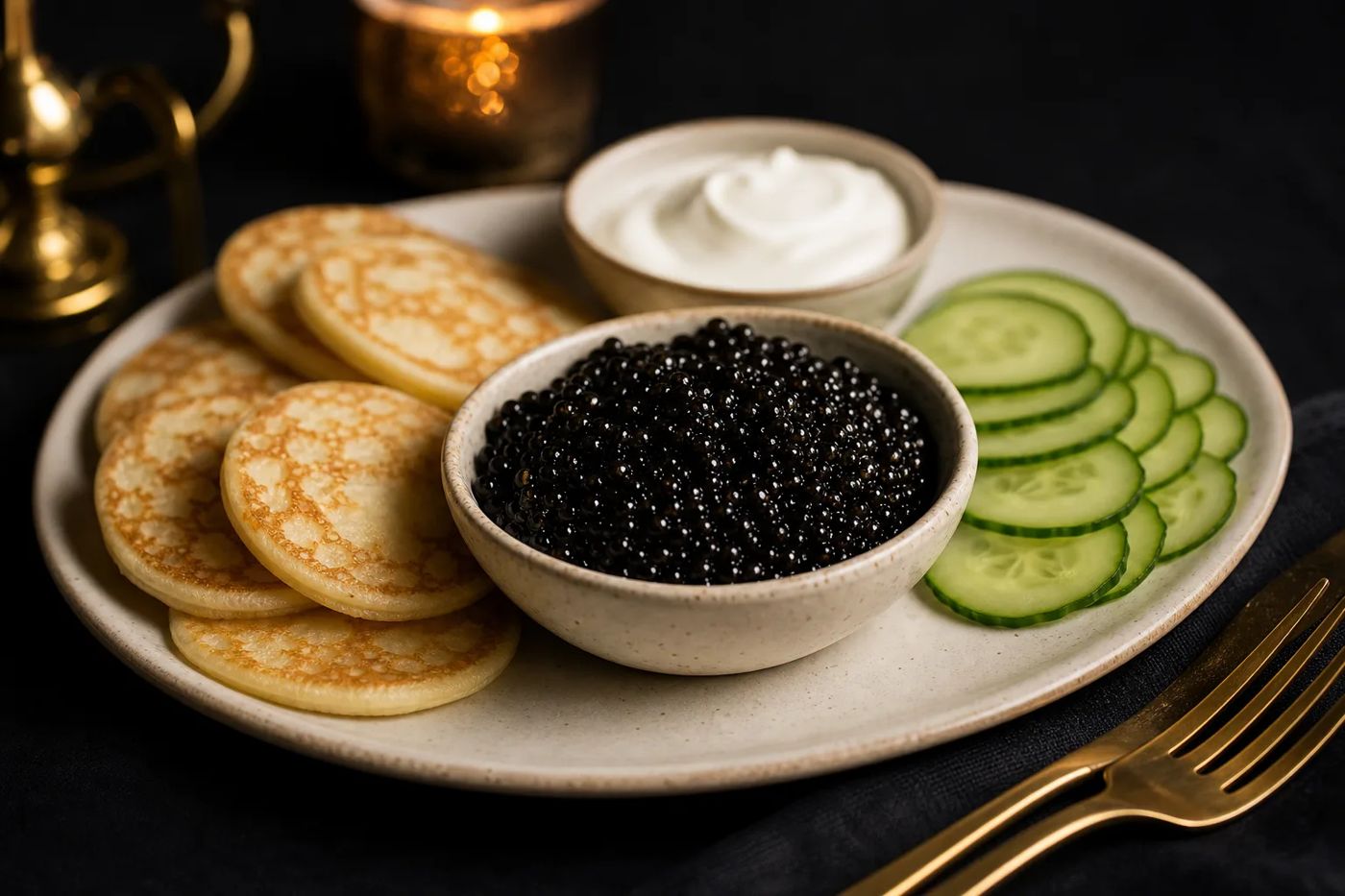
A 15 g serving within the Codex band supplies a calculated 180 to 300 mg sodium, equivalent to 0.45 to 0.75 g salt. Here is how that compares with daily advice and labelling references, which cover everything eaten during the day, not just salt added at the table.
| Authority and population | Daily advice or reference | Share from 15 g |
|---|---|---|
| WHO, adults | Less than 2,000 mg sodium | 9 to 15% |
| NHS, adults | No more than 6 g salt | 7.5 to 12.5% |
| US DGA 2025 to 2030, ages 14 and over | Less than 2,300 mg sodium | About 8 to 13% |
| FDA label Daily Value | 2,300 mg sodium | About 8 to 13% |
These percentages show shares of the stated comparison amounts, not targets to reach. WHO's adult recommendation is stricter than the NHS adult maximum. The FDA Daily Value serves a different purpose as a labelling reference. Name the authority when discussing a daily allowance, because there is no single universal figure.
The product makes a substantial difference. A 15 g serving of the pressed example supplies about 458 mg sodium, approximately 20% of the FDA Daily Value. The pasteurised example supplies 168 mg, approximately 7%. That difference reflects these products' declarations, not an assumption that pasteurisation removes sodium.
Calculate the salt in your own portion
Use the label on the product in front of you. The table offers comparisons; your tin supplies the figure for your serving. Weigh the portion on a small kitchen scale rather than letting the size of a spoon determine the calculation.
- Check the declaration's basis: per 100 g or per stated serving. Keep salt in grams separate from sodium in milligrams.
- For 15 g, multiply a per 100 g figure by 0.15. For any other portion, multiply by its weight in grams divided by 100.
- Scale US sodium figures to the amount you eat. If the label gives sodium per serving, adjust for your portion. Convert to salt equivalent only when your chosen guidance uses salt.
- Count the accompaniments too. The caviar's sodium figure is only part of the total for the complete dish.
For example, Yutaka declares 4.4 g salt per 100 g. Multiply by 0.15 to get 0.66 g salt in 15 g, then multiply by 400 to get 264 mg sodium. That is about 11% of the NHS adult salt maximum or 11.5% of FDA's sodium Daily Value.
If your doctor has advised a salt or sodium restriction, follow that individual advice rather than these population comparisons. Ask your doctor or dietitian how a measured portion fits your plan. For the wider nutritional picture, see the caviar nutrition guide.
Sources
- Codex Alimentarius Commission. Standard for Sturgeon Caviar, CXS 291-2010, adopted 2010, amended 2013, 2018 and 2024, retrieved edition; the Codex register records a further modification in 2026. Section 2.2 supplies the finished product salt range. Official document.
- European Parliament and Council. Regulation (EU) No 1169/2011 on the provision of food information to consumers, 2011, consolidated text dated 1 January 2018 retrieved through the official search index. Annex I, point 11; Articles 30, 32 and 33. EUR-Lex text.
- Department of Health and Social Care. Technical guidance on nutrition labelling, 2013, updated 3 March 2017, accessed November 2026. Publication page.
- Food Standards Agency. Nutrition labelling, Northern Ireland guidance, web edition retrieved November 2026. Official guidance PDF.
- US Food and Drug Administration. Sodium in Your Diet, current web edition retrieved November 2026. Official guidance.
- US Food and Drug Administration. Daily Value on the Nutrition and Supplement Facts Labels, current web edition retrieved November 2026. Official reference table.
- University of Florida, IFAS Extension. Technically Speaking, What Is Sturgeon Caviar?, FA194, web edition indexed November 2026; revision date not established in the retrieved extract. Extension publication.
- NHS. Food labels, current web edition retrieved November 2026. Official guidance.
- Sturia. Caviar Pressé, undated product specification and nutrition declaration, retrieved November 2026. Manufacturer's declaration, not independent analysis;
- Coop. Fine Food Swiss Caviar, product number 4360563, undated own-brand product specification, retrieved November 2026;
- Yutaka. Tobiko Black 500g, undated ingredient list and nutrition declaration, retrieved November 2026;
- Royal Greenland. Greenlandic Lumpfish Roe, Red; Greenlandic Lumpfish Roe, Black, undated product specification, retrieved November 2026. Specification PDF.
- Japan MEXT. Standard Tables of Food Composition in Japan, eighth revised edition, 2023 supplement, food 10140, salted chum salmon roe. Composition. Japan Ministry of Agriculture, Forestry and Fisheries. Salted Foods, Traditional Foods in Japan, undated web edition retrieved November 2026. Official reference.
- World Health Organization. Sodium Reduction, fact sheet, 11 May 2026. Official fact sheet.
- NHS. Salt in Your Diet, current web edition retrieved November 2026. Official guidance.
- US Department of Health and Human Services and US Department of Agriculture. Dietary Guidelines for Americans, 2025 to 2030, 2026, page 5. Official guidelines PDF.
- Food and Drug Administration. Voluntary Sodium Reduction Goals, draft guidance, edition 2, August 2024. Background discussion identifies sodium's roles in microbial safety and stability. Official draft guidance.
This article was researched from official standards, legislation and health guidance, with named commercial nutrition declarations used only as product-specific examples.
Last checked: November 2026