
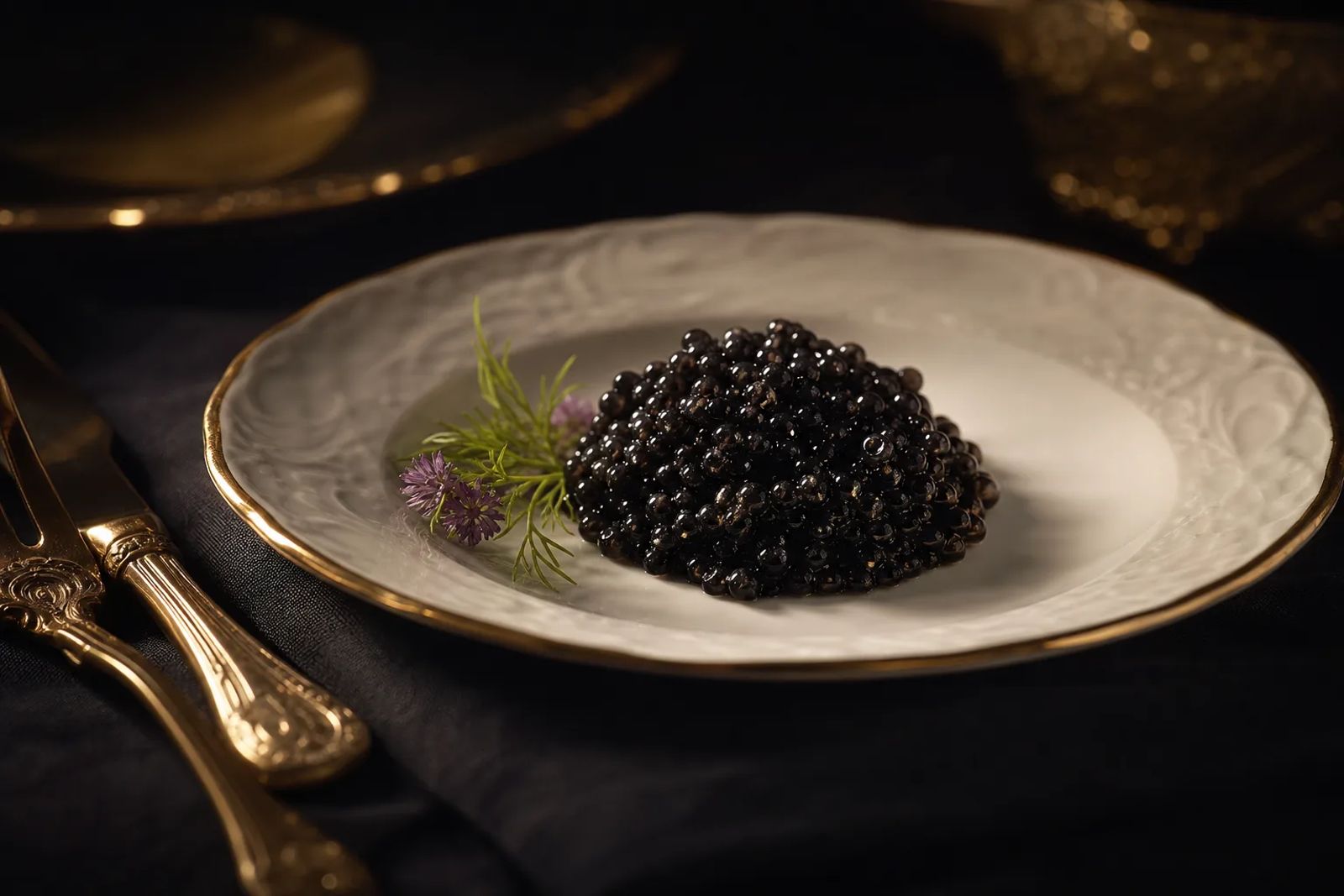
About 980 mg of EPA plus DHA in just 15 g, or roughly half an ounce: that is the estimate from a widely used USDA caviar reference. These are the same omega-3 fatty acids found in oily fish. The figure is a useful starting point, with one important limit: the USDA's generic “black and red” caviar entry records no analytical observations for these fatty acids and is not a species-specific measurement of sturgeon roe.
Which omega-3 fatty acids are in caviar?
EPA and DHA are the two to look for. EPA is eicosapentaenoic acid; DHA is docosahexaenoic acid. Both are long-chain polyunsaturated fatty acids, fats with several double bonds in their molecular structure.
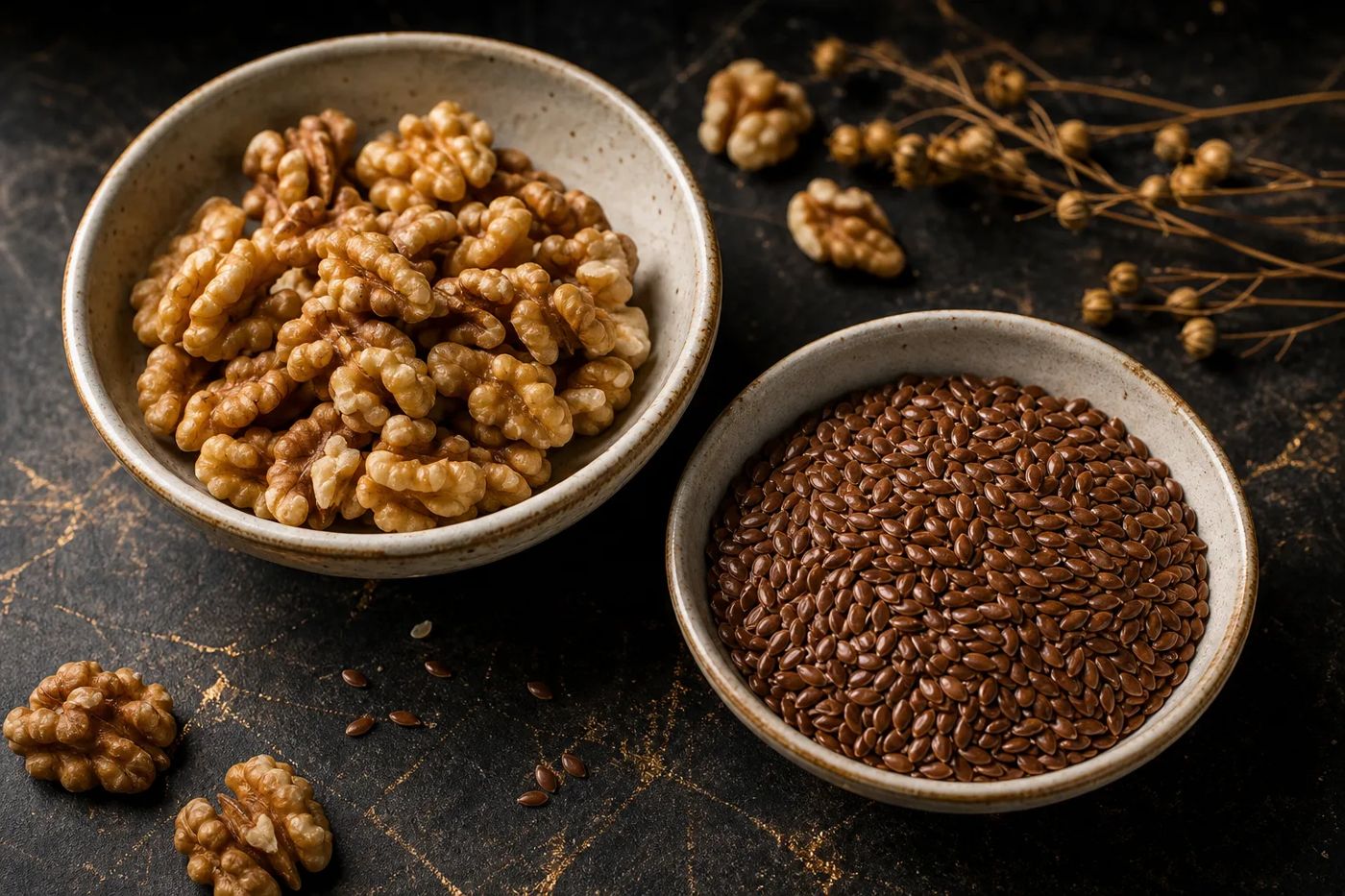
ALA, alpha-linolenic acid, is the shorter-chain omega-3 found in foods such as flaxseed and walnuts. Humans can convert some ALA to EPA and then DHA, but only to a limited extent. An ALA figure therefore cannot stand in for an EPA-plus-DHA figure. For the wider nutrient picture, start with caviar nutrition.
How much omega-3 is in a serving of caviar?
The USDA reference calculation puts EPA plus DHA at 981 mg in a 15 g serving. The figures below come from the USDA National Nutrient Database for Standard Reference, Release 28, entry 15012, “Fish, caviar, black and red, granular”.
These legacy values describe a combined database entry, not a laboratory analysis of a particular tin. The entry does not establish which species supplied each measurement, so the figures should not be presented as the composition of all sturgeon caviar.
| Fatty acid | Per 100 g | Per 15 g | Source |
|---|---|---|---|
| EPA | 2,741 mg | 411 mg | USDA entry 15012 |
| DHA | 3,800 mg | 570 mg | USDA entry 15012 |
| EPA plus DHA | 6,541 mg | 981 mg | Calculated from USDA values |
The site's standard serving is 15 g, rather than a regulatory serving size. Each serving figure is calculated by multiplying the per-100-g value by 0.15 and rounding to the nearest milligram.
The entry also reports an undifferentiated 18:3 fatty-acid value, without enough detail to identify that number specifically as ALA.
What sturgeon studies reveal
A fatty acid's proportion in extracted fat is not its amount in the food. Results expressed per 100 g of fatty acids cannot be read as amounts per 100 g of caviar.
Lopez and colleagues' 2020 study examined raw eggs and matured caviar from Siberian, Russian and white sturgeons at one Italian producer, including five raw-egg samples per species. The team extracted lipids and measured fatty acids using gas chromatography with flame ionisation detection, which separates fatty acids and measures their relative amounts.
Russian sturgeon caviar had the highest EPA proportion; Siberian sturgeon caviar had the highest DHA proportion. Those results used the fatty-acid denominator, not the weight of caviar. Species matters, but this comparison does not establish a permanent nutritional ranking.
If DHA represents 14% of analysed fatty acids, that does not mean there are 14 g of DHA in 100 g of food. To calculate a serving amount from a fatty-acid profile, additional analytical information is needed, including the amount of fatty acids in the food. Total fat alone is not enough.
Wild and farmed: look beyond the label
Wild roe does not necessarily contain more EPA and DHA. In DePeters and colleagues' 2013 preliminary study, farmed white sturgeon eggs had higher EPA than their wild counterparts, while DHA did not differ significantly by origin.
The study compared eggs from ten farmed white sturgeons with nine wild fish in California. Most wild samples came from enforcement confiscations. Researchers analysed the fatty-acid composition of lipids extracted from the eggs.
The finding challenges a simple “wild is richer” assumption. Its scope remains specific: one species, a small sample and eggs rather than a survey of finished retail caviar. It does not establish that farmed caviar is always richer, either.
How farm feed shapes the picture
Feed can change a caviar's fatty-acid profile, but the roe does not simply copy the diet. Egg formation involves selective deposition of fatty acids, and different fatty acids respond differently.
Caprino and colleagues' 2008 study analysed 20 white sturgeon caviar samples from fish given two experimental diets with different lipid sources, including squid oil and soybean oil. The researchers measured chemical composition, fatty acids and volatile compounds, the molecules associated with aroma.
EPA and DHA concentrations were similar between the two dietary treatments, even though the wider lipid profile could reflect feed. “Vegetable oil in feed” therefore tells you too little to calculate the omega-3 content of the finished caviar.
For a producer-specific figure, ask for an analysis of edible caviar that lists EPA and DHA separately and states the measurement basis. For the husbandry background, see sturgeon feed and water quality. Neither a feed ingredient nor a species name can replace that analysis.

How a serving compares with intake advice
On the USDA reference calculation, a 15 g portion supplies several times EFSA's adult daily reference amount for EPA and DHA. This compares a calculated nutrient amount with intake advice, not a measured serving with a demonstrated health effect. These are population reference points rather than personalised prescriptions.
European Union: EFSA
EFSA's 2010 dietary reference values set an adequate intake of 250 mg a day for EPA and DHA combined in adults. On the USDA calculation, 15 g of caviar provides about 3.9 times that amount.
“Adequate intake” has a precise meaning: it is a reference value used when evidence is insufficient to establish a population reference intake. It does not mean that the amount must come from caviar.
United Kingdom: NHS and SACN
The NHS advises at least two portions of fish a week, including one of oily fish, with a portion around 140 g. The joint SACN and Committee on Toxicity report of 2004 related that eating pattern to approximately 0.45 g, or 450 mg, of long-chain omega-3 daily, averaged across the week.
The reference serving's 981 mg is about 2.2 times 450 mg. But portion and frequency both matter: a small serving of roe is not the NHS's fish portion, and eating that amount once a week contributes an average of about 140 mg daily across seven days.
United States: current dietary guidance
The Dietary Guidelines for Americans, 2025 to 2030, released in January 2026, encourage seafood among varied protein foods. They also identify omega-3-rich seafood among whole-food sources of fat.
The main guidance sets no numerical adult EPA-plus-DHA daily target, so it supplies no target against which to calculate a percentage for caviar.
US adequate intakes of 1.6 g daily for adult men and 1.1 g for adult women who are not pregnant or breastfeeding refer to ALA. They are not EPA-plus-DHA targets and cannot be used as the denominator for the caviar figures above.
Nutrient figures and health claims are different things
A nutrient calculation does not authorise a health claim for a particular caviar. The EU and US also treat claims differently.
In DePeters and colleagues' 2013 preliminary study, farmed white sturgeon eggs had higher EPA than their wild counterparts, while DHA did not differ significantly by origin.
EU: authorised wording with conditions. Regulation (EC) No 1924/2006 governs nutrition and health claims. Regulation (EU) No 432/2012 authorises the wording “EPA and DHA contribute to the normal function of the heart”. Its conditions include qualifying as a source of EPA and DHA and informing consumers about the specified daily intake of 250 mg.
US: qualified claims under a different standard. FDA qualified health claims operate under specified enforcement-discretion conditions, rather than the standard for an authorised health claim. FDA describes the evidence behind its 2019 EPA-and-DHA claims as “inconsistent and inconclusive”.
For cardiovascular evidence and cholesterol, see caviar and heart health. The figures here compare composition with intake advice; they do not measure health outcomes.
Putting the numbers to use
Compare portions you would actually eat. NIH's food table gives 1.83 g of EPA plus DHA in 85 g (3 oz) of cooked farmed Atlantic salmon. Explore realistic portions in caviar, roe and oily fish. This is a comparison of portions and composition, not a reason to replace a meal with a spoonful of roe.
A portion comparison is only a starting point: storage can change the lipids themselves. Omega-3-rich lipids can oxidise, changing their chemistry and contributing to changes in flavour. Lipids and caviar shelf life explains the process. Follow the product's storage instructions rather than treating a database value as a guarantee throughout its life.
For the wider nutritional picture, read the salt declaration alongside any fatty acid analysis. Caviar is salted, and the amount varies by product. Salt and sodium are different measures: 1 g of sodium corresponds to about 2.5 g of salt. An omega-3 estimate alone is therefore only part of the food's nutritional picture.
Using caviar as food is also distinct from choosing an omega-3 supplement. Fish oil, algal oil and prescription omega-3 products are not interchangeable with caviar. For individual advice about supplementation or a medically restricted diet, speak to a doctor, pharmacist or registered dietitian rather than choosing a dose from this table.
Sources
-
US Department of Agriculture, Agricultural Research Service. USDA National Nutrient Database for Standard Reference, Release 28: Finfish and Shellfish Products. 2015. Entry 15012, “Fish, caviar, black and red, granular”. Official nutrient report.
-
Researched from the dated sources listed above.
-
Lopez, A., Vasconi, M., Bellagamba, F., Mentasti, T. and Moretti, V. M., University of Milan. Sturgeon Meat and Caviar Quality from Different Cultured Species. Fishes, 5(1), 9, 2020. Publisher's full paper.
-
DePeters, E. J., Puschner, B., Taylor, S. J. and Rodzen, J. A. Can fatty acid and mineral compositions of sturgeon eggs distinguish between farm-raised versus wild white (Acipenser transmontanus) sturgeon origins in California? Preliminary report. Forensic Science International, 229, 128 to 132, 2013. National Library of Medicine record and abstract.
-
Caprino, F. and colleagues, University of Milan. Fatty acid composition and volatile compounds of caviar from farmed white sturgeon (Acipenser transmontanus). Analytica Chimica Acta, 617, 139 to 147, 2008. University research record and abstract.
-
European Food Safety Authority, Panel on Dietetic Products, Nutrition, and Allergies. Scientific Opinion on Dietary Reference Values for fats, including saturated fatty acids, polyunsaturated fatty acids, monounsaturated fatty acids, trans fatty acids, and cholesterol. EFSA Journal, 8(3), 1461, 2010. Published scientific opinion.
-
Scientific Advisory Committee on Nutrition and Committee on Toxicity. Advice on fish consumption: benefits & risks. 2004. Paragraphs 1.10 and 2.70. Official report.
-
NHS. Fish and shellfish. Current online edition retrieved November 2026. Official dietary guidance.
-
US Department of Health and Human Services and US Department of Agriculture. Dietary Guidelines for Americans, 2025 to 2030. Tenth edition, January 2026. Official guidelines.
-
European Commission, EUR-Lex. Commission Regulation (EU) No 432/2012 establishing a list of permitted health claims made on foods. Consolidated text dated 17 May 2021, Annex, EPA/DHA entry and its reference to Regulation (EC) No 1924/2006. Retrieved consolidated text.
-
US Food and Drug Administration. FDA Announces New Qualified Health Claims for EPA and DHA Omega-3 Consumption and the Risk of Hypertension and Coronary Heart Disease. Constituent update, 19 June 2019. Official regulatory explanation.
-
Research article archived by the US National Library of Medicine, PubMed Central. Multi-omics combined approach to analyze the mechanism of flavor evolution in sturgeon caviar (Acipenser gueldenstaedtii) during refrigeration storage. 2024. Full research article.
Researched using official composition and dietary guidance, regulatory texts and peer-reviewed sturgeon studies; serving values were calculated from the stated reference data.
Last checked: November 2026