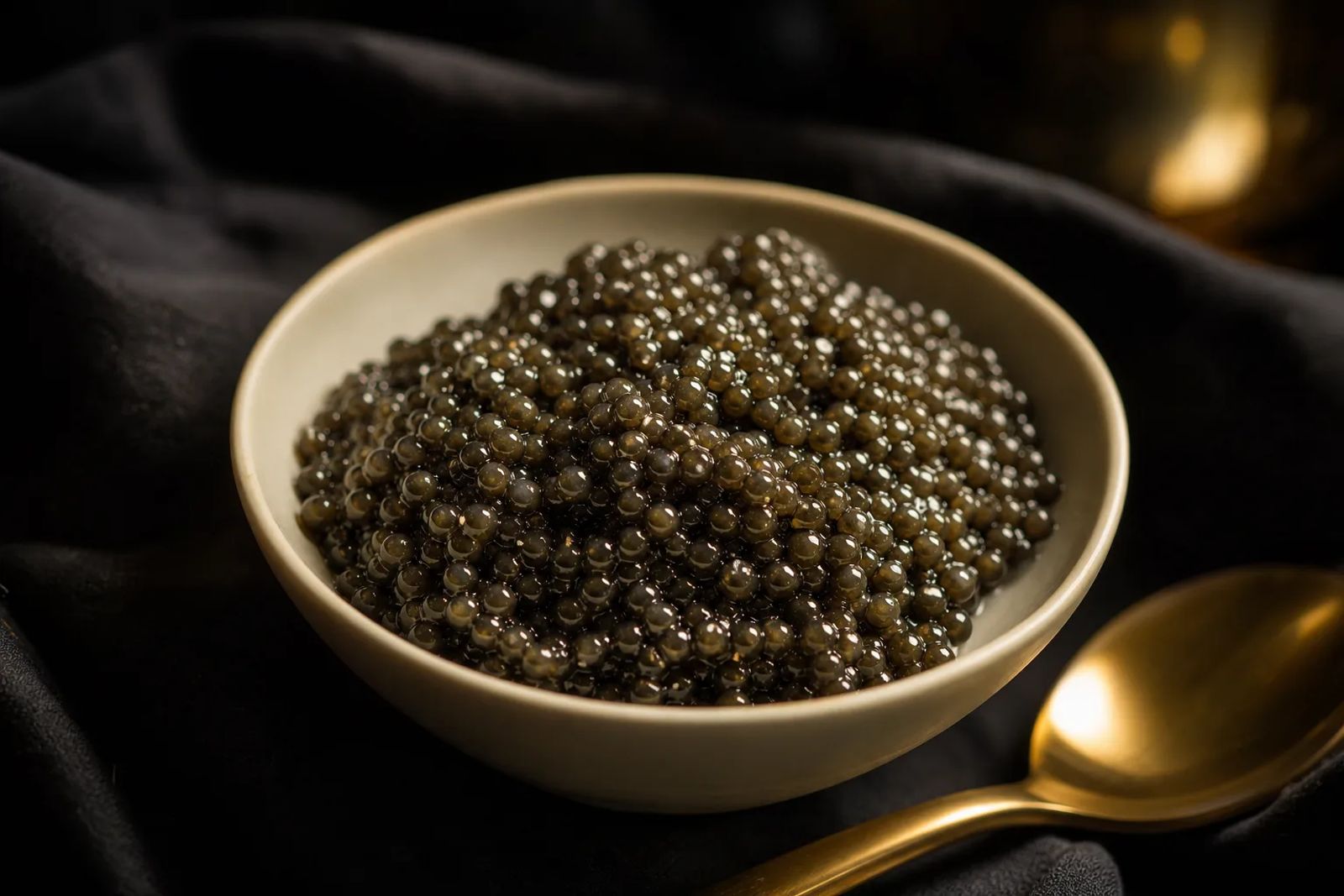
Anthracite grey beads, aromas recalling seawater and tannin: this is how Calvisius describes its sevruga. These small eggs carry a famous caviar name, but that name belongs to a particular fish, not a general grade.
Sevruga is the salted roe, or fish eggs, of the stellate sturgeon, Acipenser stellatus, also called starry sturgeon or sevruga. Caviar Giaveri reports farming it and processing its caviar in northern Italy. In the wild, the species is Critically Endangered.
Species at a glance
| Field | Detail |
|---|---|
| Common and trade names | Stellate sturgeon; starry sturgeon; sevruga; sevruga caviar. 1,5 |
| Scientific name | Acipenser stellatus Pallas, 1771. Historical synonyms: Acipenser helops and Acipenser seuruga. 1,5 |
| CITES | Appendix II; species code STE. 3 |
| Conservation | Critically Endangered, 2022 update. IUCN results reproduced by NASPS. 4 |
| Native range | Caspian, Black and Azov seas and tributaries, including the Danube. 1 |
| Egg diameter | 2.7 to 3.2 mm: biological egg measurements, not a finished caviar specification. 2 |
| Roe colour | Light to dark grey; colour alone cannot identify the species. 5 |
| Farm harvest age | Depends on maturity and rearing conditions. 1,7 |
| Farming | Caviar Giaveri reports farming the species in northern Italy. 7 |
| Wild trade | International trade requires the relevant CITES permits or certificates. 3 |
The fish behind sevruga caviar
An exceptionally long, narrow, flattened snout gives the stellate sturgeon its distinctive profile. This projecting rostrum sits in front of the mouth; rows of scutes, the bony plates characteristic of sturgeons, run along the body. In a verified photograph of a living fish, the snout is a useful identification feature. Loose roe offers no such clue.
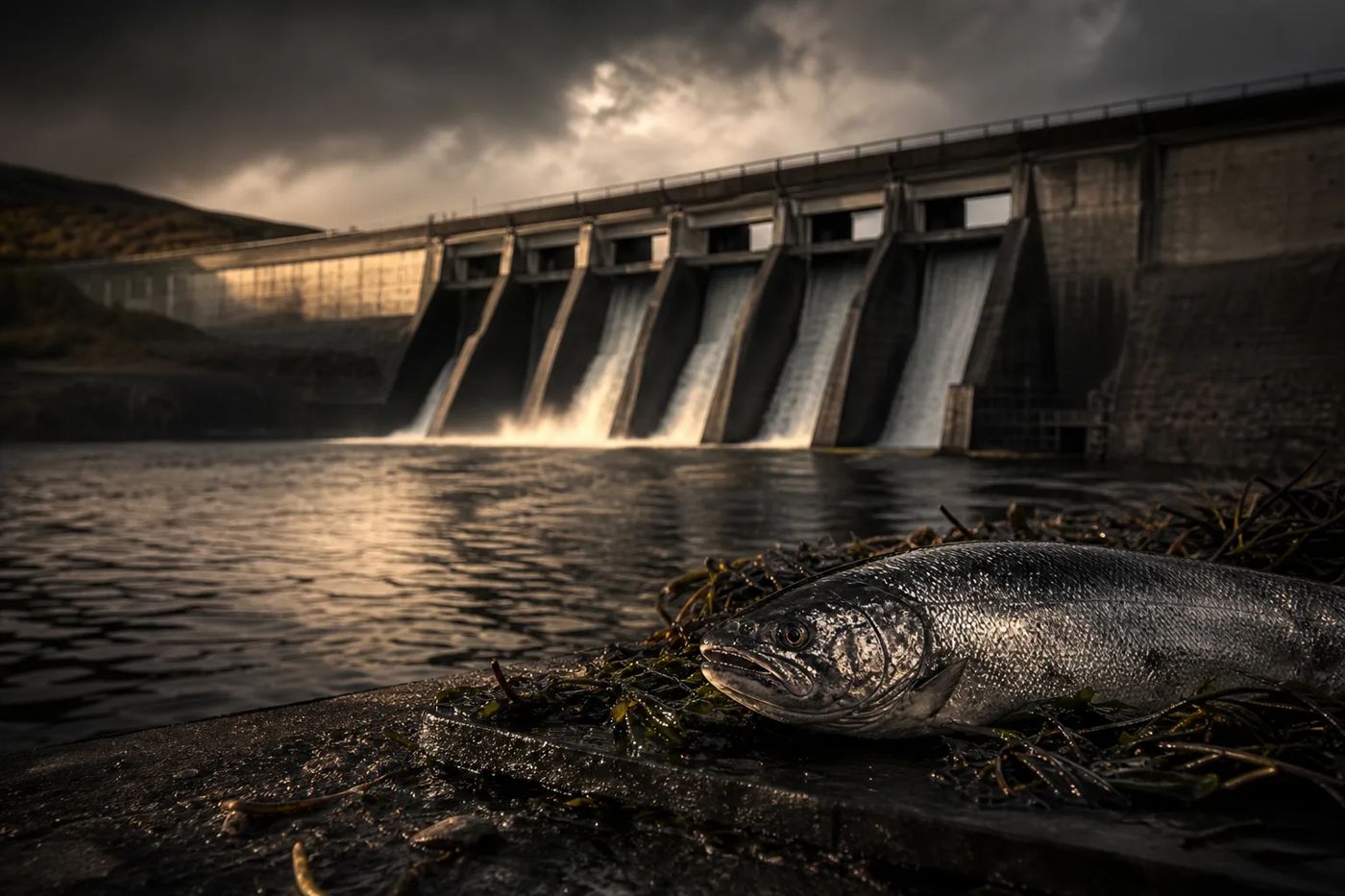
Stellate sturgeon move between sea and river. Adults feed in coastal and sea waters, then enter rivers to reproduce. Their native range takes in the Caspian, Black Sea and Sea of Azov, with the Danube among the spawning rivers. Dams and population losses have cut off access to much of that river network, so a historical distribution map does not show where the fish still occur today.
The US Fish and Wildlife Service gives reported maxima of 220 cm and 80 kg. Calvisius describes the fish supplying its sevruga as rarely exceeding 25 kg, a description of its supply rather than a verified species maximum. For wild fish, FAO gives maturity at 5 to 6 years for males and 8 to 10 years for females, with differences between populations. These reproductive ages are not a farm harvest timetable.
Dams and population losses have cut off access to much of that river network, so a historical distribution map does not show where the fish still occur today.
Acipenser stellatus is the CITES name used here. According to WSCS, the SSG and WSCS rejected both 2025 genus revisions on 22 October 2025 and proposed a conservative classification retaining Acipenser stellatus. That taxonomic debate does not itself change the CITES species code. Scientific classifications and wildlife-trade documentation have their own authorities; check each name against the authority governing its use.
Small beads, distinctive character
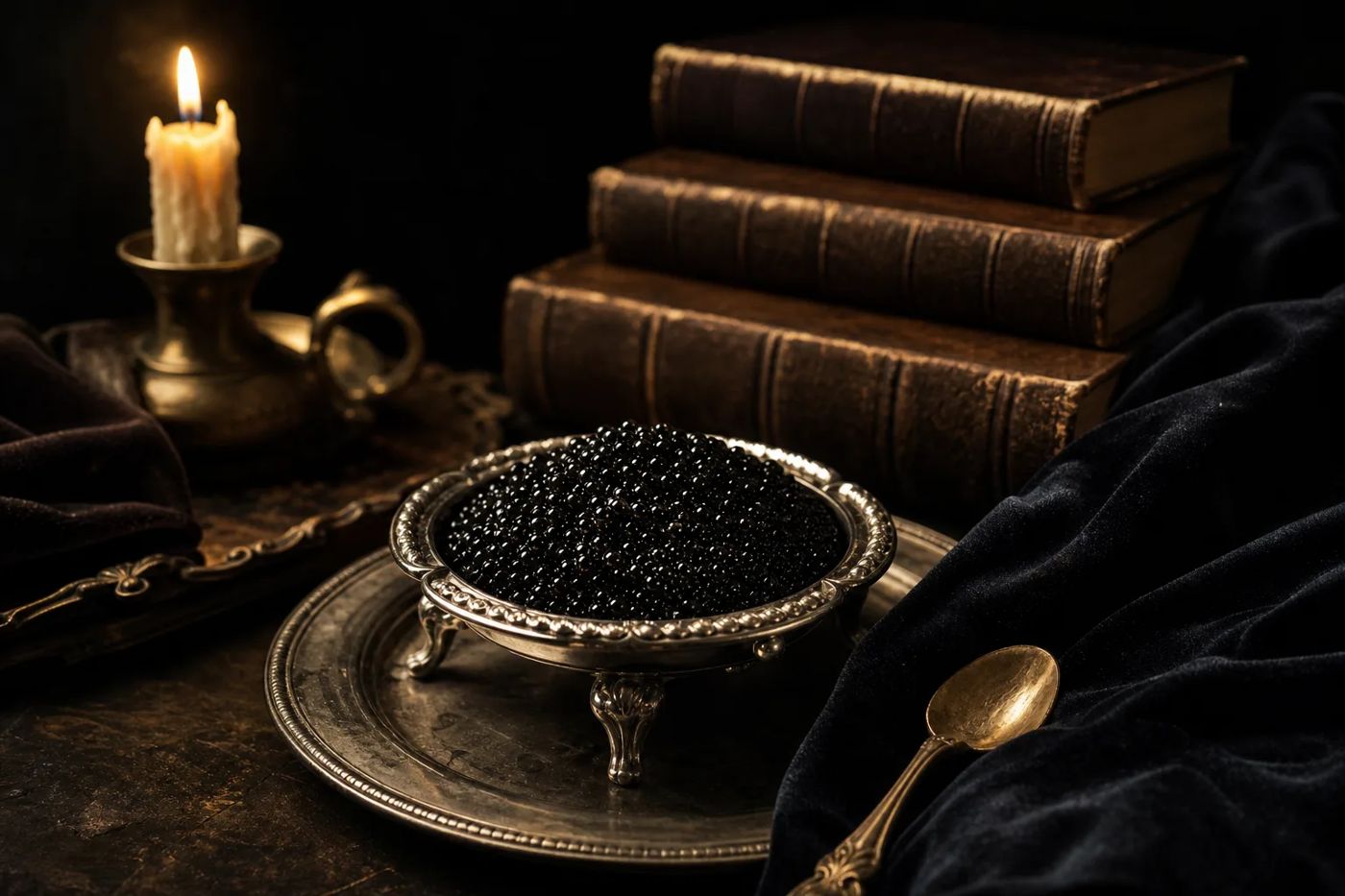
Sevruga's small beads are part of its identity, not a mark of lesser quality. The reference range for stellate sturgeon eggs is 2.7 to 3.2 mm, given in the University of Florida's account of egg maturity assessment. Those are biological measurements. Calvisius describes smaller beads in its finished sevruga, so the two sources concern different materials rather than interchangeable specifications. Prepared caviar need not fall within the biological range.
FAO gives the colour as light to dark grey. Calvisius describes its own caviar as anthracite grey to grey, with a silky, fairly firm texture and a full taste, using seawater and tannin as aromatic references. This is the producer's sensory account of its product, rather than a tasting for this article or a flavour profile promised by every tin of sevruga.
Neither bead size nor a pronounced flavour can establish the species on its own. For a direct comparison of the traditional names, read the classic three compared.
Why a familiar trade name became scarce
Sevruga once held the largest market share among internationally traded sturgeon products. That was the picture in FAO's historical trade review, drawing on CITES material from 2000. It was a major commercial caviar, not simply a rare accompaniment to beluga and ossetra. Relative abundance in the Caspian and earlier maturation than some larger sturgeons help explain that former importance.
Abundance did not spare it from depletion. The 2022 IUCN update retained stellate sturgeon as Critically Endangered, with overfishing and poaching, dams that interrupt migration and alter spawning habitat, and pollution among the principal pressures. A 2022 US Fish and Wildlife Service listing proposal, still not finalised in 2026, reported severe losses and insufficient natural reproduction.
Farmed caviar supply and wild recovery answer different questions. A farm may produce roe while natural spawning runs remain depleted. Hatchery work intended to rebuild a wild population, meanwhile, does not establish a commercial caviar supply. Claims about saving the species through farming need to distinguish between producing caviar and restoring fish to their native waters.
What is actually documented on farms?
Caviar Giaveri states that it breeds Acipenser stellatus and processes the caviar on its own farms in northern Italy. Its account documents a producer's report of farmed sevruga production; it does not independently establish current stocks, annual output or commercial scale.
The location named on a caviar business's paperwork also needs careful reading. An exporter's country is not automatically a farming country. Caviar can be processed or repacked somewhere other than the place where the fish were raised, so those stages should remain distinct when tracing a product's origin.
Wild fishing and international trade
CITES Appendix II controls international trade in stellate sturgeon; it does not make every domestic transaction unlawful. CITES Resolution Conf. 12.7 provides the caviar labelling framework. Annex 1 sets out the labelling guidelines, while Annex 2 identifies Acipenser stellatus as STE. National and regional legislation determines how those requirements are enforced.
For the EU, Regulation (EC) No 865/2006 sets caviar marking requirements. APHA distinguishes GB from Northern Ireland; qualifying personal baggage may contain 125 g of caviar in individually marked containers without CITES permits.
In the US, 50 CFR 23.71 governs caviar trade, and a 2022 endangered listing proposal remains pending as of 2026. Switzerland, the UAE, China, Japan, Russia and Australia also have differing national requirements.
Fishing bans and export controls must be checked separately. Romania introduced an indefinite sturgeon fishing ban in 2021. Bulgaria's environment ministry announced an indefinite ban effective from 1 January 2026 for its Danube and Black Sea waters. These fishing restrictions are separate from CITES export quotas. For the fishing rules, see Caspian fishing restrictions.
How to recognise genuine sevruga on a label
Start with the species declaration and CITES label, not the name on the lid. Pure stellate sturgeon caviar should carry STE in the species field, and any scientific name supplied should agree with Acipenser stellatus. The country of origin and the identity of a later repacker are separate details. A European brand name alone does not establish that the fish were farmed in Europe.
Two distinctions help resolve loose descriptions:
- Paddlefish roe is sometimes offered as an alternative resembling sevruga. Its CITES species code is SPA, not STE. It is not stellate sturgeon roe.
- Sterlet is Acipenser ruthenus, code RUT, a different species. Small eggs do not make its caviar sevruga. A hybrid involving stellate sturgeon is likewise not pure Acipenser stellatus.
A CITES label is a traceability record, not scientific authentication of the contents. Read its details together: the common name, species code, origin and supplier's explanation should agree. If they conflict, ask for clarification before accepting the identification. For the full sequence of label fields, turn to the CITES code explained.
Royal and Imperial may describe a producer's selection, but they are not CITES quality grades or substitutes for a species name. They cannot tell you whether the eggs came from stellate sturgeon. Use the species, origin and lot documentation as the identification record. Treat the selection name as supplementary wording, however prominent it appears on the lid.
Where to go next
- Sturgeon Species: the parent guide to identifying the fish behind the roe.
- Sturgeon Species and Their Caviar: The Complete Guide: a broader guide to species names and their relationship to caviar.
Sources
- FAO. Chebanov, M. S. and Galich, E. V. Sturgeon Hatchery Manual. Fisheries and Aquaculture Technical Paper 558, reprinted 2013. Section 1.2.4 covers stellate sturgeon distribution, morphology and reproductive biology. Retrieved PDF.
- University of Florida, IFAS Extension. Chapman, F. A. and Van Eenennaam, J. P. Sturgeon Aquaculture: Specialized Techniques: Determining the Stage of Sexual Maturity in Female Sturgeon for Artificial Spawning: The Egg Polarization Index or PI. FA153, 2007, reviewed August 2025. Retrieved PDF.
- CITES. Conservation of and trade in sturgeons and paddlefish. Resolution Conf. 12.7 (Rev. CoP17), 2016 revision, published in the CoP19 resolutions collection. Annex 1 gives the labelling guidelines; Annex 2 gives species codes. Resolution.
- North American Sturgeon and Paddlefish Society. IUCN Assessment 2022. Published 1 August 2022; reproduces the 2010 and 2022 assessment categories. Assessment summary.
- FAO. Sturgeons (Acipenseriformes), historical trade review, undated online edition citing material through 2003. Species table and “Starry sturgeon” discussion. Chapter.
- World Sturgeon Conservation Society. Bronzi, P. IUCN SSG summary report. 13 November 2025, reporting the specialist meeting of 22 October 2025. Report.
- Caviar Giaveri. Italian caviar: Our caviar sturgeons. Undated company account, retrieved November 2026. Retrieved farm account.
- Calvisius. Ars Italica Sevruga Royal. Undated producer specification, retrieved November 2026. Calvisius product specification.
- European Commission. Commission Regulation (EC) No 865/2006, 4 May 2006, Articles 64 to 66. Legal text.
- APHA and Defra. Check if you need a CITES permit to import or export endangered species. Updated 23 June 2026. Guidance.
- United States, Code of Federal Regulations. 50 CFR 23.71: How can I trade internationally in sturgeon caviar? Online text retrieved November 2026 through Cornell Legal Information Institute. Regulation.
- US Fish and Wildlife Service. Endangered and Threatened Wildlife and Plants; Endangered Species Status for Russian, Ship, Persian, and Stellate Sturgeon. Proposed rule, 25 May 2022, 87 FR 31834. Proposed rule.
- ICPDR. Danube River Basin Management Plan Update 2021. Final version, 20 December 2021. Plan.
- Bulgarian Ministry of Environment and Water. An indefinite national ban on fishing for sturgeon species has been introduced in the Bulgarian section of the Danube River and the Black Sea. 10 December 2025. Ministry announcement.
Last checked: November 2026