
A shortnose sturgeon in Canada's established population can live for up to about 60 years. A female typically spawns only every 3 to 5 years: a long life, with widely spaced opportunities to produce the next generation. Protecting those breeding opportunities is central to its conservation. For this small Atlantic-coast sturgeon, Acipenser brevirostrum, the caviar trade turns on a separate distinction: wild fish or qualifying captive-bred stock.
Its wild populations are protected from international commercial trade by CITES Appendix I. Caviar from qualifying captive-bred fish has a narrow route into legal trade, governed by breeding registration, documentation and national protections.
Species at a glance
| Field | Details |
|---|---|
| Common and trade names | Shortnose sturgeon; shortnosed sturgeon. |
| Scientific name | Acipenser brevirostrum Lesueur, 1818; Huso brevirostrum is a proposed alternative combination, not the CITES name. |
| CITES listing and species code | Appendix I; BVI. |
| IUCN Red List | Vulnerable. 6 |
| Native range | Atlantic coastal rivers and estuaries from New Brunswick, Canada, to the south-eastern United States; historical range reaches Florida. |
| Main farming countries | Canada has a registered commercial breeding operation, according to CITES. 10 |
| Wild international commercial trade | Excluded under ordinary Appendix I rules; national restrictions also apply. |
Shortnose is the name of the species, not a caviar size grade. Understanding its place in the caviar world means separating three things: the fish's wildlife trade classification, its national conservation status and the registration of a particular breeding operation.
How to recognise shortnose sturgeon
Start with the snout: short and blunt, with four fleshy feelers called barbels beneath it. Five rows of bony plates, or scutes, run along the body. These are the features to look for, rather than colour alone.
Shortnose is the smaller of the two sturgeons native to North America's Atlantic coast. Massachusetts' species account gives an upper length of about 1.4 m. Small for a sturgeon, then, but still a substantial river fish.
Its mouth is proportionally wider than that of Atlantic sturgeon. Young Atlantic sturgeon can be mistaken for shortnose, so size by itself will not settle the identification. The Atlantic sturgeon comparison examines that neighbouring species, while the sturgeon species guide places both within their wider family.
A river fish with a varied life history
The shortnose sturgeon's world is the river and estuary, where fresh and salt water meet. It does not spend long periods far offshore. Nor does it form one continuous population along the Atlantic coast: its range is fragmented, with Canada's established population in New Brunswick's Saint John River system.
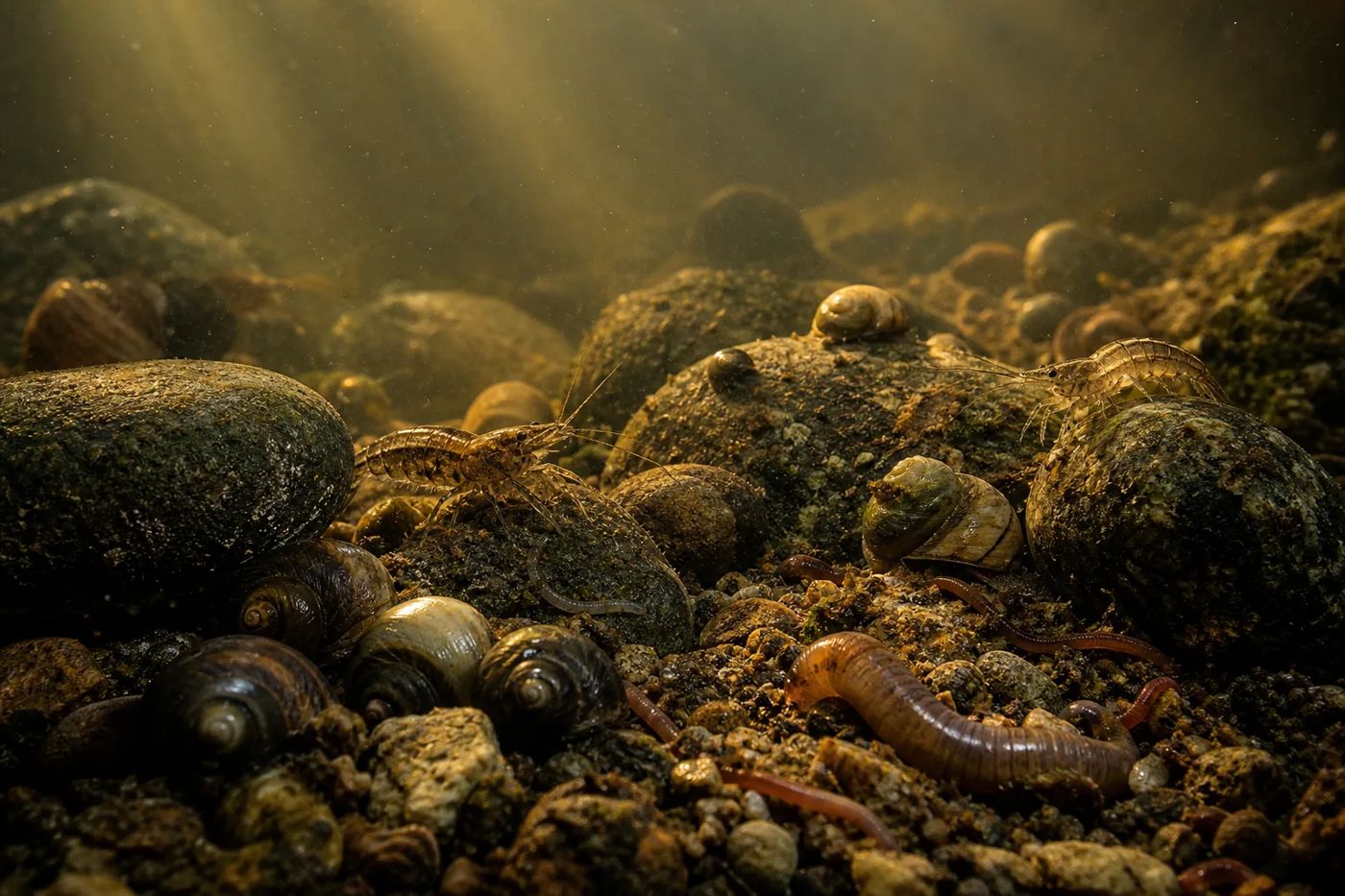
All spawning takes place in freshwater. Adults feed along the river bed, finding crustaceans, molluscs and worms with their barbels and taking them in through a protrusible mouth.
Sex, latitude and water temperature shape the pace of life. NOAA reports different ages at maturity in northern and southern populations; those wild figures are not a universal farm harvest schedule.
Adults feed along the river bed, finding crustaceans, molluscs and worms with their barbels and taking them in through a protrusible mouth.
The contrast in longevity is striking. NOAA describes lifespans of up to about 60 years in the Canadian population, compared with about 10 to 20 years in the southern populations it covers. Females typically spawn every 3 to 5 years. Keeping an adult alive can therefore preserve several future breeding opportunities.
Names and conservation status
Acipenser brevirostrum remains the CITES name. Brownstein and Near proposed Huso brevirostrum in 2025, but the IUCN Sturgeon Specialist Group and World Sturgeon Conservation Society rejected that revision at their October 2025 workshop. They supported a different classification that keeps this species in Acipenser.
The IUCN Red List identifies shortnose sturgeon as Vulnerable. That assessment describes extinction risk; the legal rules on catching and trading the fish come from other instruments, and national categories can differ.
In the United States, the species remains endangered under the Endangered Species Act. Its original listing dates to 11 March 1967, under the Endangered Species Preservation Act, before the present ESA was enacted in 1973.
Canada takes a different legal approach. COSEWIC assessed shortnose sturgeon as Special Concern in May 2015, confirming earlier assessments in 1980 and 2005. It has appeared as Special Concern on SARA Schedule 1 since 2009. SARA's automatic prohibitions for endangered and threatened species do not apply to this category.
Canadian fish remain regulated through the Fisheries Act and fisheries regulations, while wildlife trade legislation implements CITES. The federal management plan treats fisheries controls, habitat protection and international trade as distinct responsibilities.
Appendix I: strong protection, a narrow route to trade
Shortnose sturgeon has been in CITES Appendix I since 1975. This appendix covers species threatened with extinction whose international trade requires particularly strict control. Ordinary international commercial trade in wild specimens is excluded.
The listing reflects the need for protection without suggesting that every river holds the same abundance of fish. Reconstructing its decline is difficult: historical fishing records often combined shortnose and Atlantic sturgeon, obscuring the smaller species' history in commercial landings.
For today's caviar trade, the crucial boundary is the national border. CITES controls cross-border movements of listed animals and their parts and derivatives. That includes roe, the eggs taken from fish. Domestic conservation law continues to apply, and stricter national restrictions take precedence over any exception available under the Convention.
The wider system is explained in CITES and caviar. For shortnose, the decisive question is whether a particular specimen meets the captive-breeding provisions. The protection of the wild animal remains unchanged.
The narrow captive-breeding exception
There is a documented route for commercially bred shortnose caviar. Article VII(4) of CITES allows Appendix I animals bred in captivity for commercial purposes to be treated as Appendix II specimens for trade. The qualifying specimens receive different treatment; the species stays in Appendix I.
Resolution Conf. 12.10 (Rev. CoP20) sets out the relevant registration framework for operations breeding Appendix I animals commercially. This is separate from the register of caviar processors and repackers. A processor's or repacker's registration does not establish eligibility for the breeding exception.
Under Resolution Conf. 12.3 (Rev. CoP20), the applicable source code is D. It covers Appendix I animals commercially bred in registered operations, together with their parts and derivatives. The description “captive-bred”, or a different captive-origin code, does not by itself establish that these conditions have been met.
The public CITES register contains a Canadian entry for Acipenser brevirostrum, registered on 16 December 2012 under A-CA-515. Caviar is expressly included among the products described. That registration does not certify a particular consignment, establish present production volumes or authorise entry into every country.
A CITES label supports traceability rather than independent verification of a tin's contents. The source codes guide explains the different questions answered by source and species codes.

National and regional rules: what still applies
In the EU, shortnose sturgeon is listed in Annex A to Regulation (EC) No 338/97. Article 8 establishes the general prohibition on commercial activities involving Annex A specimens. Article 62(5) of Regulation (EC) No 865/2006 provides a specific exemption for qualifying captive-bred shortnose caviar and its hybrids in correctly labelled containers. This covers commercial use within the EU, not border controls: the Commission's guidance explains that qualifying captive-bred Annex A specimens receive Annex B treatment for import and export purposes, with the relevant permits and other import conditions still required.
Great Britain's wildlife trade framework uses assimilated, amended legislation derived from Regulations 338/97 and 865/2006. APHA guidance expressly exempts legally marked shortnose caviar with source code D from the Article 10 commercial-use certificate requirement. Import documentation is a separate requirement, not removed by that exemption.
Northern Ireland remains within the EU wildlife trade framework and has different border arrangements from Great Britain. In the United States, the Endangered Species Act restricts take and trade, subject to applicable authorisations. NOAA Fisheries administers the species' protection; an overseas CITES breeding registration cannot override those controls.
Switzerland, the UAE, China, Japan, Russia and Australia also apply national wildlife trade controls. For travellers, APHA states that the 125 g personal effects exemption requires marked containers. Check the destination's rules as well: stricter national controls can still apply.
What conservation work needs to achieve
A protected fish still needs a functioning river. Dams interrupt access to habitat. River alterations and water withdrawals change conditions. Bycatch, the accidental capture of fish in other fisheries, can kill shortnose sturgeon even where nobody is deliberately fishing for them.
Effective conservation brings together fish passage, habitat and water-quality protection, monitoring and work with fisheries. Acoustic tracking and other population studies help establish where the fish feed, overwinter and spawn. That knowledge helps direct protection towards the places and seasons that matter.
Captive breeding and wild recovery answer different questions. A registered operation documents a regulated breeding and trade framework. Recovery depends on evidence from the rivers themselves: secure wild populations and the habitats that sustain them.
Sources
- NOAA Fisheries. Shortnose Sturgeon. Species account covering protection, life history and conservation.
- COSEWIC. COSEWIC assessment and status report on the Shortnose Sturgeon Acipenser brevirostrum in Canada. 2015 assessment and report.
- Fisheries and Oceans Canada. Management Plan for the Shortnose Sturgeon (Acipenser brevirostrum) in Canada. Final plan, 2016.
- Massachusetts Division of Fisheries and Wildlife. Shortnose Sturgeon. Species account.
- US Geological Survey. Life history and status of Shortnose Sturgeon (Acipenser brevirostrum LeSueur, 1818). Publication record and abstract, 2017.
- IUCN. Acipenser brevirostrum. The 2004 assessment page identifies the latest assessment as Vulnerable, 2022.
- Brownstein, C. D. and Near, T. J. Toward a phylogenetic taxonomy of sturgeons. Bulletin of the Peabody Museum of Natural History, volume 66, 2025.
- World Sturgeon Conservation Society and IUCN Sturgeon Specialist Group. IUCN SSG summary report. Workshop of 22 October 2025; published 13 November 2025.
- CITES Secretariat. Resolutions of the Conference of the Parties in effect after the 20th meeting. Resolutions index, including Conf. 12.3 (Rev. CoP20), Conf. 12.7 (Rev. CoP17) and Conf. 12.10 (Rev. CoP20).
- CITES Secretariat. Canada: Register of captive-breeding operations. Entry A-CA-515, registered on 16 December 2012.
- CITES, through UNEP's InforMEA portal. Permits and certificates. Resolution Conf. 12.3, portal edition labelled Rev. CoP20, source-code table.
- UNEP InforMEA, reproduced by ECOLEX. Registration of operations that breed Appendix-I animal species in captivity for commercial purposes. Resolution Conf. 12.10 (Rev. CoP20).
- CITES, through UNEP's InforMEA portal. Review of trade in animal specimens reported as produced in captivity. Rev. CoP20 text, including its account of Article VII(4).
- European Commission. Are there any exemptions from the internal trade prohibition for Annex A-listed species?. EU Wildlife Trade Reference Guide, section 5.2, current online edition.
- European Commission. What procedures apply to import and (re-)export of captive-bred animals and of artificially propagated plants?. EU Wildlife Trade Reference Guide, section 4.1, current online edition.
- French CITES authority. Fiche Taxon: Acipenser brevirostrum. Species listing record.
- Czech Ministry of the Environment. Caviar information and species codes, 12 December 2007.
- APHA and Defra. Commercial use of endangered species: check if you need a CITES certificate. Updated 23 June 2026.
- APHA and Defra. Check if you need a CITES permit to import or export endangered species. Import and export guidance.
- UK Government. The Control of Trade in Endangered Species (Amendment and Revocation) Regulations 2026. SI 2026/627, made edition.
Last checked: November 2026