
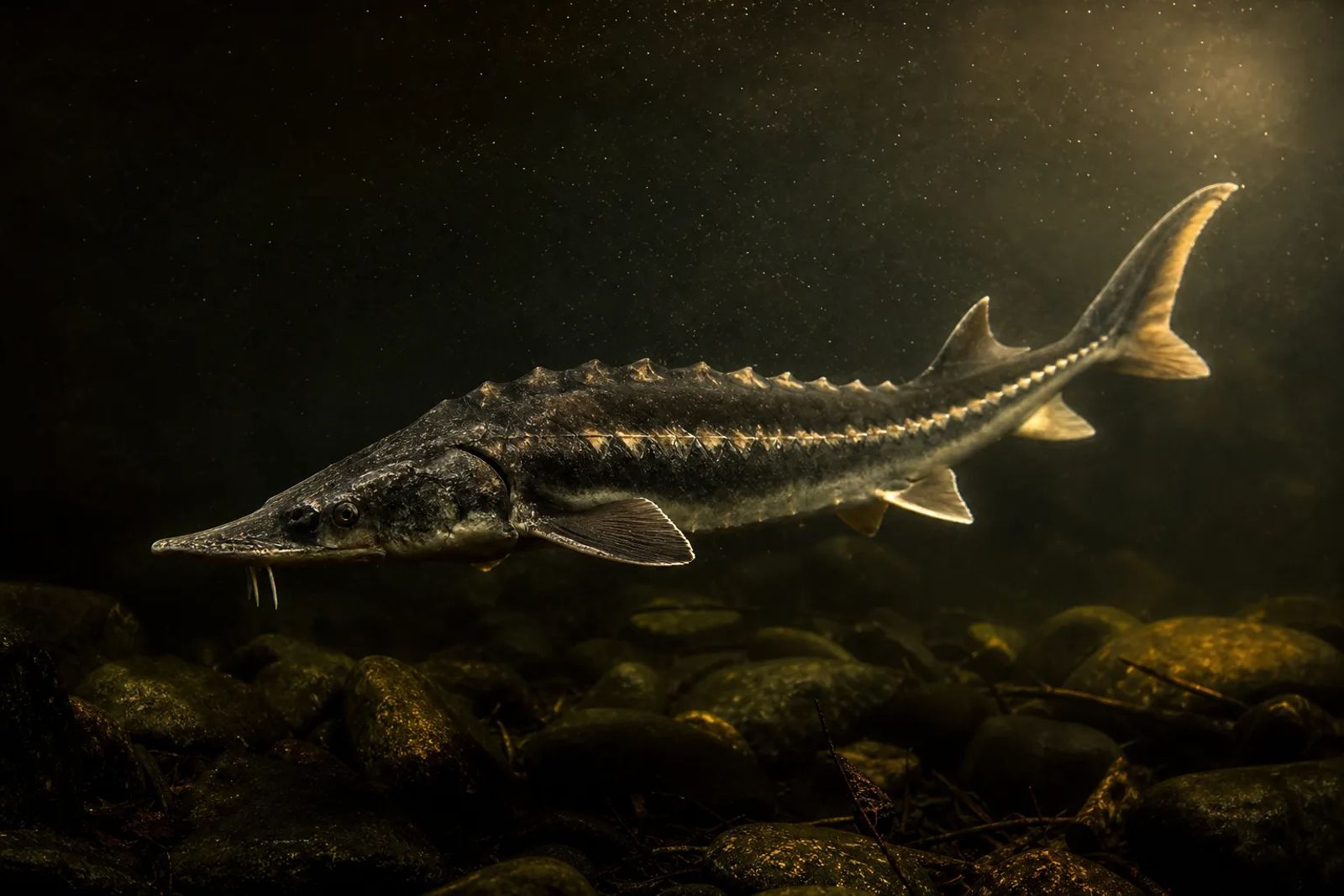
In the global reassessment published in 2022, 25 of 27 sturgeon and paddlefish species were in the three threatened categories; one was Extinct in the Wild and one was Extinct.
How to read sturgeon Red List categories
The IUCN Red List evaluates extinction risk using standard categories and criteria. In its technical vocabulary, threatened means Vulnerable, Endangered or Critically Endangered; Extinct and Extinct in the Wild are reported separately.
- Extinct (EX): no reasonable doubt remains that the last individual has died.
- Extinct in the Wild (EW): survives only in captivity, cultivation or naturalised populations outside its former range.
- Critically Endangered (CR): an extremely high risk of extinction in the wild.
- Endangered (EN): a very high risk of extinction in the wild.
- Vulnerable (VU): a high risk of extinction in the wild.
- Near Threatened (NT): close to qualifying for a threatened category, or likely to qualify soon.
- Least Concern (LC): assessed but not qualifying for a higher category.
- Data Deficient (DD): available information is inadequate for a direct or indirect assessment of extinction risk.
Data Deficient does not mean safe, and Least Concern does not mean that every population is secure. Not Evaluated, a ninth category, means that the taxon has not yet been assessed against the criteria.
The five criteria address population reduction (A), restricted geographic range (B), small population size and decline (C), very small or restricted populations (D), and quantitative extinction analysis (E). A species need meet only one applicable criterion: the letter and accompanying numbers explain why its category was assigned.
The complete species table
The table records the 2022 global reassessment baseline, using CITES names rather than silently applying later taxonomic proposals. It contains 17 Critically Endangered, three Endangered and five Vulnerable species, alongside the two extinction categories.
The categories are from the 2022 update and must not be treated as a verified current inventory.
| Species | Scientific name as CITES lists it | IUCN category | Assessment year | Summary checked |
|---|---|---|---|---|
| Siberian sturgeon | Acipenser baerii | CR | NRE | 5 November 2026 |
| Shortnose sturgeon | Acipenser brevirostrum | VU | NRE | 5 November 2026 |
| Yangtze sturgeon | Acipenser dabryanus | EW | NRE | 5 November 2026 |
| Lake sturgeon | Acipenser fulvescens | EN | NRE | 5 November 2026 |
| Russian sturgeon | Acipenser gueldenstaedtii | CR | NRE | 5 November 2026 |
| Green sturgeon | Acipenser medirostris | EN | NRE | 5 November 2026 |
| Sakhalin sturgeon | Acipenser mikadoi | CR | NRE | 5 November 2026 |
| Adriatic sturgeon | Acipenser naccarii | CR | NRE | 5 November 2026 |
| Ship sturgeon | Acipenser nudiventris | CR | NRE | 5 November 2026 |
| Atlantic sturgeon | Acipenser oxyrinchus | VU | NRE | 5 November 2026 |
| Persian sturgeon | Acipenser persicus | CR | NRE | 5 November 2026 |
| Sterlet | Acipenser ruthenus | EN | NRE | 5 November 2026 |
| Amur sturgeon | Acipenser schrenckii | CR | NRE | 5 November 2026 |
| Chinese sturgeon | Acipenser sinensis | CR | NRE | 5 November 2026 |
| Starry sturgeon | Acipenser stellatus | CR | NRE | 5 November 2026 |
| European sturgeon | Acipenser sturio | CR | 2020 | 5 November 2026 |
| White sturgeon | Acipenser transmontanus | VU | NRE | 5 November 2026 |
| Kaluga | Huso dauricus | CR | NRE | 5 November 2026 |
| Beluga | Huso huso | CR | NRE | 5 November 2026 |
| Syr Darya shovelnose sturgeon | Pseudoscaphirhynchus fedtschenkoi | CR | NRE | 5 November 2026 |
| Dwarf Amu Darya shovelnose sturgeon | Pseudoscaphirhynchus hermanni | CR | NRE | 5 November 2026 |
| Amu Darya shovelnose sturgeon | Pseudoscaphirhynchus kaufmanni | CR | NRE | 5 November 2026 |
| Pallid sturgeon | Scaphirhynchus albus | CR | NRE | 5 November 2026 |
| Shovelnose sturgeon | Scaphirhynchus platorynchus | VU | NRE | 5 November 2026 |
| Alabama sturgeon | Scaphirhynchus suttkusi | CR | NRE | 5 November 2026 |
| American paddlefish | Polyodon spathula | VU | NRE | 5 November 2026 |
| Chinese paddlefish | Psephurus gladius | EX | NRE | 5 November 2026 |
The Atlantic sturgeon row is the species assessment, not a separate count of its subspecies. Gulf sturgeon was reported as Endangered in the 2022 update under the name Acipenser oxyrinchus desotoi; adding that subspecies to the total would double count part of the species.
Assessment dates are not publication dates
An assessment date records when the extinction risk evaluation was completed. The publication year identifies when that assessment appeared on the Red List, while the date checked records when an editor consulted the evidence.
For example, the European sturgeon assessment published in 2022 gives 15 September 2020 as its assessment date. Writing simply “assessed in 2022” would therefore be wrong, even though the category was included in that year's update.
For professional citation, retain the taxon, assessment scope, category and criteria, assessment date, publication year and assessment identifier together. A later website access date does not make the underlying population evidence newer.
Global and regional assessments answer different questions
A global assessment considers the species across its worldwide range; a regional assessment considers extinction risk within a defined area. Different boundaries, population trends and assessment dates can produce different categories without either assessment being mistaken.
The European Red List of Freshwater Fishes was updated in 2026, with results for Europe and the European Union. Those regional results should be labelled by scope, not substituted into a global status table.
Ship sturgeon illustrates the distinction: its global category was Critically Endangered in the 2022 reassessment, while the accompanying specialist account reported its disappearance from the Danube. Regional loss is not global extinction, and survival elsewhere does not establish that a lost river population has returned.
What changed in the major reassessment
The 2022 update followed the major assessment cycle reported in 2010. Lake sturgeon moved from Least Concern to Endangered, green sturgeon from Near Threatened to Endangered, and white sturgeon from Least Concern to Vulnerable.
Chinese paddlefish was confirmed Extinct, whereas Yangtze sturgeon moved from Critically Endangered to Extinct in the Wild. These are different findings: the latter category allows survival under captive management, and released animals alone do not demonstrate recovery of a self-sustaining wild population.
Adriatic sturgeon provided evidence of improvement through sporadic natural reproduction in the Po basin. According to the NASPS comparison, Adriatic sturgeon was Critically Endangered, possibly extinct in the wild, in 2010 and Critically Endangered in 2022.
Chinese paddlefish was confirmed Extinct, whereas Yangtze sturgeon moved from Critically Endangered to Extinct in the Wild.
Read the extinct Chinese paddlefish for the extinction evidence, and why sturgeon are the most endangered group of species for the wider causes of decline.
How the 2025 taxonomy debate affects names
Brownstein and Near proposed substantial generic changes in 2025, including the use of Sinosturio for kaluga. Kottelat and Freyhof subsequently challenged aspects of that nomenclature; these were taxonomic proposals, not new extinction risk assessments.
At their joint meeting on 22 October 2025, the IUCN SSC Sturgeon Specialist Group and World Sturgeon Conservation Society did not support those revisions. Their alternative position nevertheless proposed dissolving Huso and recognising Atlantic and Gulf sturgeons as distinct taxa, so “the specialists rejected all name changes” is also inaccurate.
Legal nomenclature, assessment names and alternative classifications serve different purposes and may differ. The specialists proposed Acipenser huso for beluga, a name now accepted by WoRMS; the detailed 2025 sturgeon taxonomy debate concerns classification rather than extinction risk.
IUCN, CITES and domestic law are separate systems
IUCN categories are scientific risk assessments, not legal listings. CITES regulates international trade: shortnose and European sturgeons are in Appendix I, while the other sturgeons and paddlefishes are covered by Appendix II; neither appendix is an IUCN category. In the United States, the Endangered Species Act separately lists four Atlantic sturgeon distinct population segments as endangered and the Gulf of Maine segment as threatened. In the EU, the Habitats Directive lists Adriatic and European sturgeons in Annexes II and IV, connecting habitat conservation and strict species protection to that legislation rather than to their Red List category. Consequently, a Red List status cannot by itself establish whether a particular catch, domestic sale or import is lawful; the relevant wildlife and fisheries rules must be checked separately.
Where to go next
- Sturgeon Conservation: the parent guide to recovery, protection and conservation evidence.
- Sturgeon Species and Their Caviar: The Complete Guide: species identification and the distinction between fish biology and roe terminology.
Sources
-
IUCN. Migratory monarch butterfly now Endangered: IUCN Red List. Press release, 21 July 2022. The sturgeon section supplies the category totals and principal changes. Official release.
-
North American Sturgeon and Paddlefish Society, Molly Webb. IUCN Assessment 2022. Published 1 August 2022. Includes a comparison of the 2010 and 2022 categories. Assessment summary.
-
IUCN Red List. Summary statistics. Live resource, retrieved November 2026. Explains category totals, taxonomic changes and the separation of species statistics from subspecies and subpopulation assessments. Summary statistics.
-
IUCN, Gessner and colleagues. Acipenser sturio. Global assessment published in the 2022 Red List, assessment dated 15 September 2020, identifier e.T230A137215851. Assessment DOI.
-
World Sturgeon Conservation Society, Paolo Bronzi. IUCN SSG summary report. Published 13 November 2025, reporting the meeting of 22 October 2025. Workshop statement.
-
Oryx. IUCN Red List reassessment reveals further decline of sturgeons and paddlefishes. 2023. Specialist account of the reassessment, including Adriatic sturgeon reproduction and regional losses. Published account.
-
European Commission, Ford and colleagues. Measuring the pulse of European biodiversity: European Red List of Freshwater Fishes. 2026 edition, DOI 10.2779/880135. Official publication record.
-
IUCN. Almost half of European freshwater fishes at risk of extinction, new IUCN Red List reveals. Press release, 13 April 2026. Official release.
-
CITES Secretariat and UNEP World Conservation Monitoring Centre. Checklist of CITES Species, Part 1: CITES species index. 2011 edition. Historical reference for CITES nomenclature in 2011. Species index.
-
European Commission. Commission Regulation (EU) 2026/1383, 22 June 2026, amending Regulation (EC) No 338/97. The annex records the Acipenseriformes CITES Appendix I and II distinction. Official regulation.
-
NOAA Fisheries. Atlantic Sturgeon. Live species and management account, retrieved November 2026. Official species account.
-
European Union. Council Directive 92/43/EEC on the conservation of natural habitats and of wild fauna and flora. European Commission-hosted consolidated copy incorporating amendments through 2007. Commission-hosted text.
-
IUCN SSC. Freshwater fishes of potential interest for inclusion in CMS. Information brief, January 2024. Includes the Critically Endangered listing of Pseudoscaphirhynchus kaufmanni. Official information brief.
Last checked: November 2026