
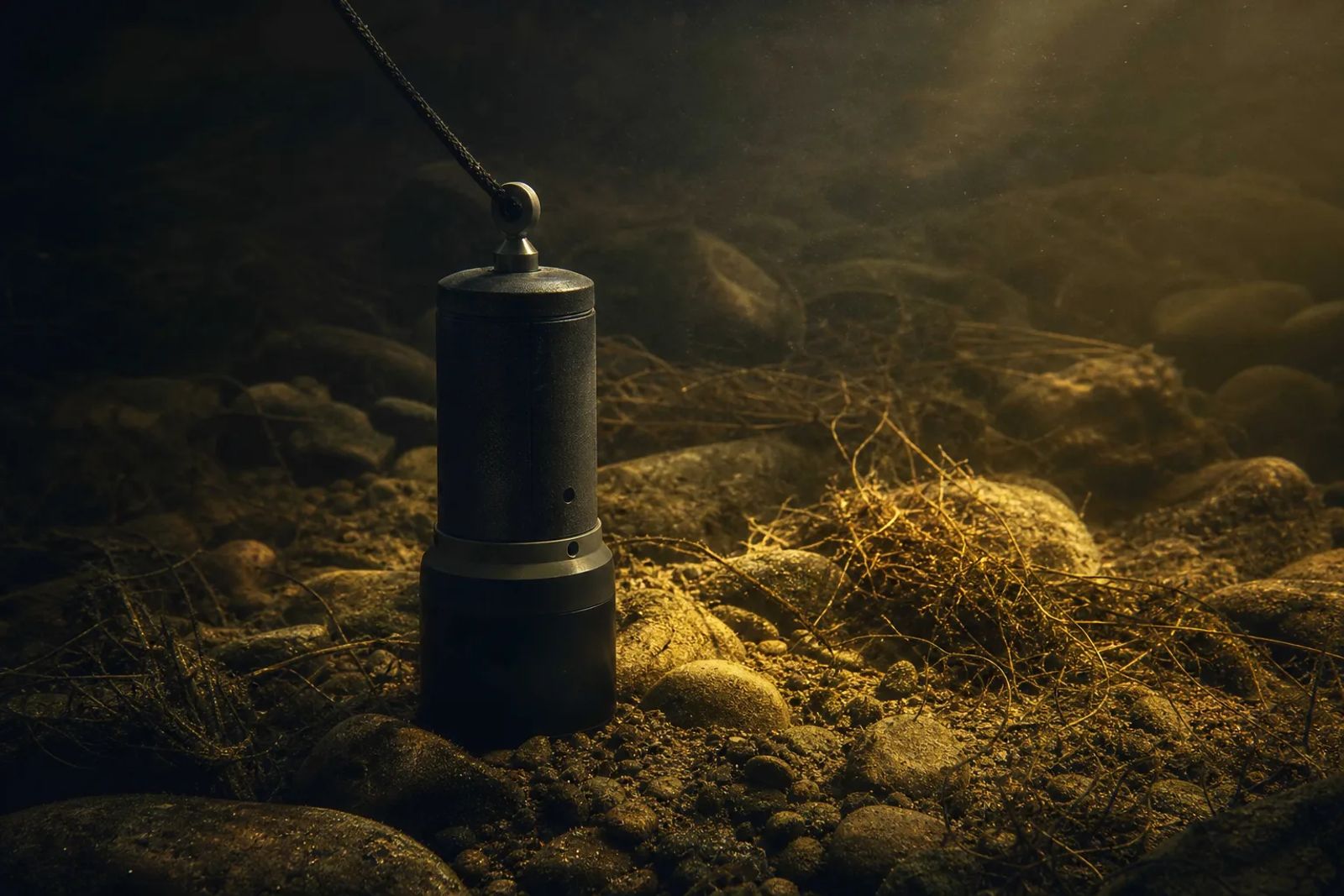
At The Dalles Dam on the Columbia River, a 2007 study tracked 148 white sturgeon. It recorded eight upstream passages through fish ladders. Following the fish revealed something the presence of a ladder alone could not: passage was possible, but uneven.
That is the challenge of tracking wild sturgeon: following long-lived fish through deep, turbid water, across river mouths, coastlines and borders. Scientists use tags, underwater listening networks, satellite-linked recorders, DNA sampling, sonar, surveys, and mark and recapture. Each reveals something different. A missed detection need not mean a missing fish.
- Acoustic receivers record tagged fish within listening range, not a continuous journey.
- Environmental DNA can reveal a species in water but does not directly count fish.
- Fin ray sections can help estimate age, but growth increments can be misread.
What the methods reveal
Following a fish and counting a population are different jobs. A movement study follows selected individuals; a population survey asks how many fish occupy an area, or how that number changes. Strong sturgeon conservation programmes combine methods, matching each instrument to the question it can answer.
| Method | What it measures | Main limits | Example | Year |
|---|---|---|---|---|
| Acoustic telemetry | Movement near receivers | Coverage and battery life | Parsley et al., Columbia River | 2007 |
| Pop-up satellite tags | Offshore depth, temperature and inferred routes | Uncertain geolocation | Erickson et al., Hudson River | 2011 |
| PIT tags and recapture | Identity, growth and survival | Needs re-encounters | Ghere et al., Kootenai basin | 2024 |
| Environmental DNA | Species detection in water | No direct fish count | Meulenbroek et al., Danube | 2022 |
| Population genetics | Probable natal stock | Reference samples and assignment error | White et al., Atlantic rivers | 2021 |
| Fin ray sections | Estimated age | Older fish can be misread | Ghere et al., Kootenai basin | 2024 |
| Side-scan sonar | Distribution and occupancy | Missed detections | Flowers and Hightower, Carolina rivers | 2013 |
How tags follow a fish
An acoustic tag announces a fish’s presence with coded sound pulses. When a receiver detects the signal, it records the tag’s identity and the time. An array of receivers, positioned along a river, around an obstacle or across a migration corridor, builds a record of arrivals, departures and time spent in an area.
The result is a sequence of encounters, not an unbroken line on a map. Fish passing beyond receiver coverage leave gaps in the record. Researchers interpret those gaps against receiver coverage and tag lifespan before drawing conclusions about survival.
Pop-up satellite archival tags follow fish offshore without receivers along the route. They store depth, temperature and light measurements, then detach, float to the surface and transmit to satellites. Earlier positions must be reconstructed, with uncertainty: these are archival recorders, not underwater GPS trackers.
A passive integrated transponder, or PIT tag, gives a fish a tiny electronic identity marker. A scanner reads it at close range; it does not broadcast a journey. When the fish is caught again, its code connects new measurements with its earlier record. Farm tracking uses some related identification tools to answer different management questions. Ghere and colleagues’ 2024 study used PIT records for 162 known-age white sturgeon sampled in the Kootenai River in 2015.
Reading DNA from water and fish
A water sample can reveal evidence of sturgeon without a single fish entering a net. Environmental DNA, usually shortened to eDNA, is genetic material collected from the environment rather than directly from a captured animal. Scientists filter river water, extract DNA and test it against reference sequences.
In a 2022 study, Meulenbroek and colleagues sampled 29 Danube sites and 18 tributary sites. Their metabarcoding method reads DNA from multiple species together. It detected sterlet at 14 main-river sites and two tributary sites, creating a broad snapshot of distribution rather than a count of the fish living there.
DNA can travel downstream, become diluted or enter rivers through wastewater or aquaculture, without a living wild fish nearby. A rare fish, meanwhile, may leave too little material to detect. Replicate samples and laboratory controls help, but a blank sample cannot establish that a species is absent.
Population genetics answers another question: where did this fish probably come from? White and colleagues’ 2021 Atlantic sturgeon baseline included 2,510 fish representing 18 genetically distinct groups from 13 rivers and one estuary. Tests assigned fish to their river of origin with over 80% accuracy, demonstrating both the method’s usefulness and its remaining error.
A water sample can reveal evidence of sturgeon without a single fish entering a net.
Identifying hatchery origin also takes the right reference material. Genetic parentage compares a fish with recorded broodstock, the adults used for breeding. A 2014 Atlantic sturgeon assay tested 16 microsatellite markers, variable stretches of DNA, in 603 wild and hatchery fish. These tools support stock and relatedness analysis; they do not make every hatchery fish recognisable without suitable breeding records.
Counting fish and reading their age
Mark and recapture turns repeated encounters into estimates of abundance and survival. Researchers identify fish, release them and record later encounters. The pattern of new captures and recaptures allows models to account for fish that escape detection.
Those models must also account for lost tags and movement beyond the study area. Otherwise, a fish that leaves can be counted as a fish that died.
Age poses a different challenge. Researchers may examine thin sections of a pectoral fin ray for growth increments. The rings can look readable yet give the wrong age. In a 2024 paper, Ghere and colleagues tested fin ray ageing against 162 known-age white sturgeon in the Kootenai basin.
Consensus estimates matched known ages in only 30.7% of cases. Accuracy declined as fish grew older. That matters for estimates of recruitment, the addition of young fish to a population: an apparent shortage of particular age groups may partly reflect ageing error, not simply failed reproduction.
Finding fish with sonar and public observations
Sound can reveal fish where visibility defeats the eye. Sonar uses echoes to image fish or riverbed features. In their 2013 study, Flowers and Hightower surveyed the lower reaches of six rivers in North and South Carolina on three occasions. By combining side-scan sonar, telemetry and video, they detected sturgeon in five rivers and modelled occupancy: whether a surveyed stretch was used.
An image alone may not establish the species or the population total. Repeated surveys help estimate missed detections. Capture surveys add measurements and tissue that remote images cannot supply, while fisheries records offer another perspective. Catches, however, measure encounters with fishing gear rather than an unbiased census.
Observations from river users can help direct formal monitoring. In September 2026, Maine’s marine resources department reported that sightings submitted since 2025 had helped guide expansion of its acoustic receiver network. Its programme accepts sightings and accidental catches, giving fishers and other river users a way to contribute without conducting research captures.
What tracking has revealed
Satellite tags have helped reveal the different journeys taken by fish from the same river. Erickson and colleagues’ 2011 paper followed 23 adult Hudson River Atlantic sturgeon tagged in 2006 and 2007. Fifteen returned to sea carrying satellite tags. Of those, 13 stayed within the Mid-Atlantic Bight during the tracked period; two travelled farther north or south. These were individual journeys inferred with uncertainty, rather than a migration map for all Atlantic sturgeon.
At The Dalles Dam on the Columbia River, a 2007 study tracked 148 white sturgeon during 2004 and 2005. Nineteen fish made 26 recorded passages, including eight upstream events through fish ladders. The figures distinguish the number of passage events from the number of fish making them, an important difference when assessing access.
Mapping also helps locate potential spawning habitat. In Virginia’s James River, researchers combined acoustic riverbed mapping with underwater video to locate suitable rock and gravel habitat. Those maps identify places to investigate and protect; they do not establish that eggs were deposited at every mapped site.
Tracking is just as important after fish are released. The Kootenai Tribe of Idaho’s October 2023 plan reported lower initial survival in later release groups, especially among smaller fish. It also explained that delays in capturing smaller fish had initially caused survival to be underestimated.
The lesson is practical: follow what survives, rather than simply counting what is released. The wider benefits and risks are covered in restocking and hatchery releases.
Read sturgeon migration for the biology behind these movements, and dams and lost habitat for the pressures that monitoring helps assess.
Permits and fish welfare
Permission comes before capture or tagging where protected-fish rules require it. Animal welfare authorisation may be needed separately; wildlife permission does not replace it. The frameworks below were checked in November 2026. Exact permit requirements depend on the work and jurisdiction.
In the United States, research involving prohibited take of ESA-listed sturgeon needs the appropriate Endangered Species Act authorisation. NOAA Fisheries’ section 10(a)(1)(A) research permit process covers Atlantic and shortnose sturgeon and requests animal-care committee approvals where applicable. Green sturgeon applications follow its West Coast route.
In the EU, the Habitats Directive strictly protects European sturgeon through Annex IV. Research derogations under Article 16 require specified conditions, including no satisfactory alternative and no detriment to favourable conservation status. Separately, Directive 2010/63/EU governs scientific procedures meeting its animal-welfare threshold, with national implementation and project authorisation.
In England, Natural England lists a science and conservation licence route. Natural Resources Wales licenses relevant sturgeon work under the Habitats Regulations. For regulated scientific procedures in Great Britain, the Animals (Scientific Procedures) Act 1986 requires establishment, project and personal licences. According to Home Office guidance, Northern Ireland’s Department of Health administers scientific procedure licensing and compliance.
Good welfare planning means suitable tag size, trained handling and recovery monitoring. NOAA’s published sturgeon protocol also cautions against fin spine sampling in mature fish of the species it covers, because of ageing error and abnormal regrowth. Non-lethal does not mean harmless.
Sources
-
PLOS ONE. Research Tools to Investigate Movements, Migrations, and Life History of Sturgeons (Acipenseridae), with an Emphasis on Marine-Oriented Populations. Published research review, 2013.
-
US Geological Survey; Parsley and colleagues. White sturgeon (Acipenser transmontanus) passage at the Dalles Dam, Columbia River, USA. Journal of Applied Ichthyology, volume 23, 2007.
-
Erickson and colleagues; Journal of Applied Ichthyology. Use of pop-up satellite archival tags to identify oceanic-migratory patterns for adult Atlantic Sturgeon, Acipenser oxyrinchus oxyrinchus Mitchell, 1815. Volume 27, published paper, 2011.
-
Meulenbroek and colleagues; Springer Nature. Sturgeons in large rivers: detecting the near-extinct needles in a haystack via eDNA metabarcoding from water samples. Biodiversity and Conservation, volume 31, version of record, 2022.
-
US Geological Survey; White and colleagues. Establishment of a microsatellite genetic baseline for North American Atlantic sturgeon (Acipenser o. oxyrhinchus) and range-wide analysis of population genetics. Conservation Genetics, published paper, 2021.
-
Journal of Applied Genetics, archived by PubMed Central. Microsatellite multiplex assay for the analysis of Atlantic sturgeon populations. Volume 55, published paper, 2014.
-
US Geological Survey; Ghere and colleagues. Evaluation of techniques for estimating the age and growth of known-age White Sturgeon. North American Journal of Fisheries Management, volume 44, 2024.
-
US Geological Survey; Flowers and Hightower. A novel approach to surveying sturgeon using side-scan sonar and occupancy modeling. Marine and Coastal Fisheries, volume 5, 2013.
-
Virginia Institute of Marine Science, Center for Coastal Resources Management. Atlantic Sturgeon. Research project summary, undated online edition.
-
Kootenai Tribe of Idaho. Hatchery Management Plan Supporting Kootenai River White Sturgeon Restoration. Published October 2023.
-
Maine Department of Marine Resources. DMR Launches Public Education Campaign to Support Sturgeon Recovery. Agency announcement, 23 September 2026.
-
NOAA Fisheries. ESA Scientific Research and Enhancement Permits. Online permit guidance.
-
Council of the European Communities; EUR-Lex. Council Directive 92/43/EEC on the conservation of natural habitats and of wild fauna and flora. Official text, 1992, particularly Articles 12 and 16 and Annex IV.
-
European Parliament and Council; EUR-Lex. Directive 2010/63/EU on the protection of animals used for scientific purposes. Official text, 2010, particularly Articles 1, 3 and 36.
-
Natural England and Defra. Freshwater and migratory fish licences. Online collection, including the research licence entry dated April 2025.
-
Natural Resources Wales. Fish licensing. Online licensing guidance.
-
Home Office. Research and testing using animals: licences and compliance. Online guidance, updated 13 July 2026.
-
NOAA Fisheries. A Protocol for Use of Shortnose, Atlantic, Gulf, and Green Sturgeons. Published protocol, 2010.
Last checked: November 2026