
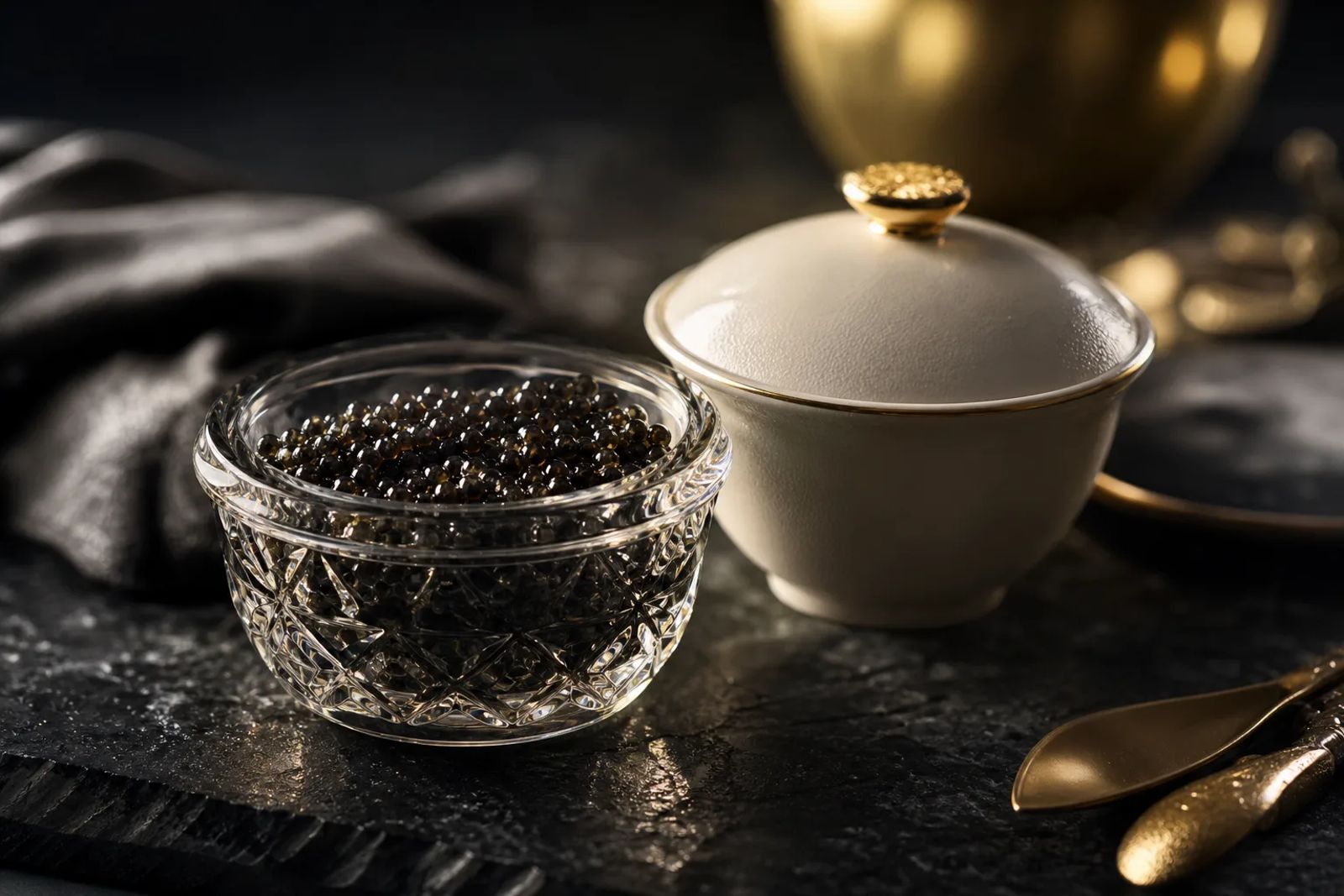
Clear glass puts the colour of the eggs on show. A closed tin keeps them out of sight, but shuts out the light. One offers a view; the other offers shade. The container material alone does not prove quality or origin.
Both formats can protect caviar well. What matters is the complete pack: its closure, whether the roe has been heat-treated and how much you will use after opening.
Tins vs glass jars at a glance
Look beyond the material. The container, closure and handling instructions must work together for the particular roe inside.
| Criterion | Tin | Clear glass jar |
|---|---|---|
| Light protection | Opaque body blocks light | Uncovered glass admits light |
| Closure | Press-fit lid, sometimes held by an elastic band; vacuum-packed formats also exist | Sealed cap; vacuum closures are used |
| Documented use | Salted sturgeon caviar; pasteurised roe in suitable packs | Salted sturgeon caviar; pasteurised roe in suitable packs |
| Pasteurisation | Possible with a suitable hermetic pack and validated process | Possible with a suitable hermetic pack and validated process |
| Viewing the roe | Hidden while closed | Visible through uncovered glass |
Inside the tin: lids, bands and linings
A traditional caviar tin closes with a closely fitting lid pressed down over the contents. An external rubber or silicone band can help hold the lid in place. Packaging manufacturer Guzhan describes its silicone bands as lid fasteners: they support the closure rather than replace it.
Pressing out air is not the same as applying a vacuum. Vacuum packing removes air before sealing, and both tins and jars can use it. A traditional press-lid tin has not necessarily been machine vacuum-packed.
Nor is caviar simply resting against bare metal. Food tins commonly have a protective lacquer lining, which must suit both the food and its intended processing conditions. That construction gives no basis for claiming that tins inevitably impart a metallic taste.
Why glass jars are used for pasteurised roe
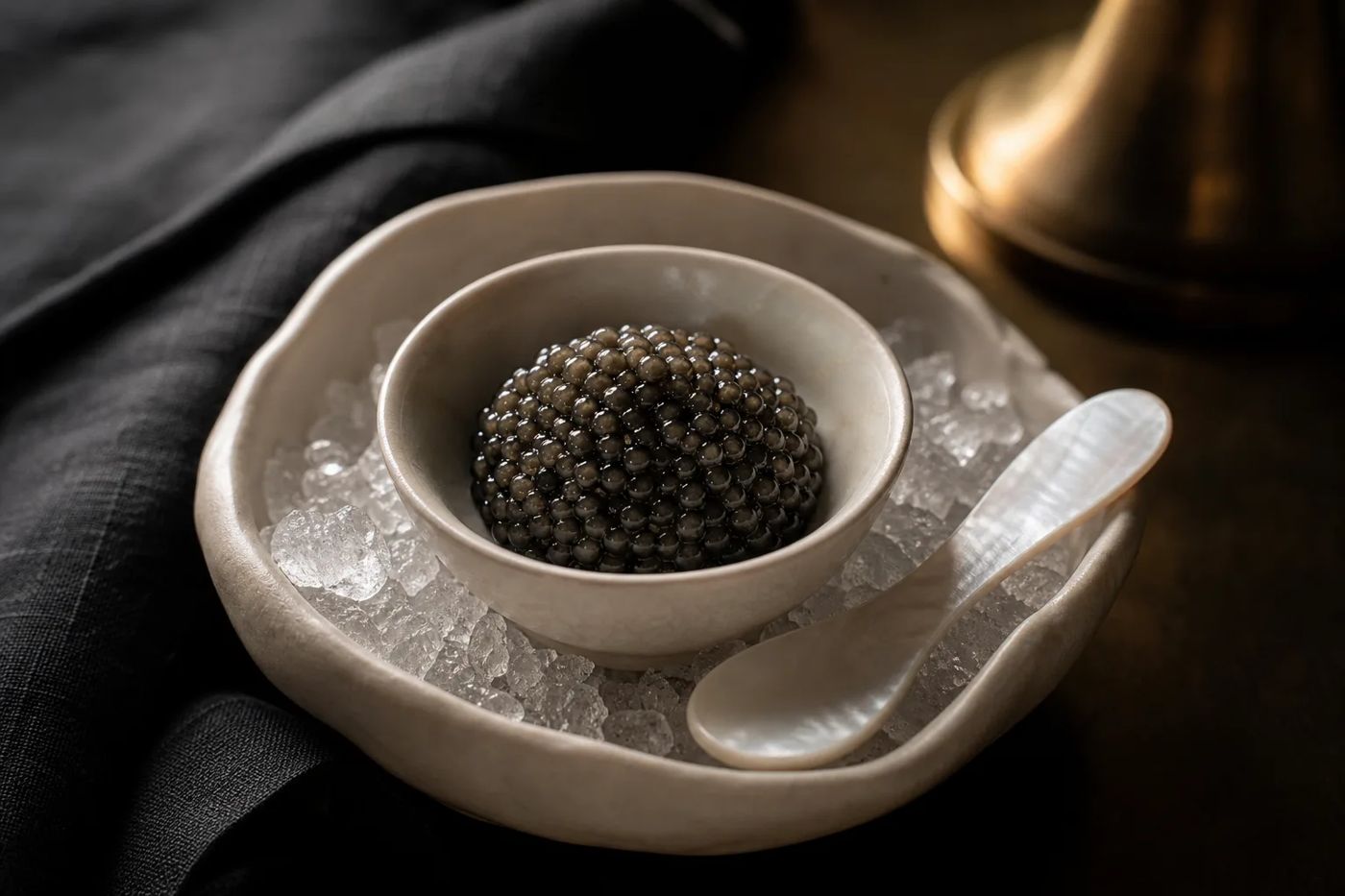
A suitable jar and closure can form a hermetic, or airtight, package for controlled heating. Glass is an established format for pasteurised roe, although the jar alone does not tell you whether its contents have been pasteurised.
Putting the lid back on does not recreate the original sealed conditions or restart the unopened shelf life.
A Canadian government processing report describes the sequence clearly: lumpfish roe is packed into jars, vacuum sealed and then heated. It records a method, rather than the proportion of modern caviar sold in either format.
Tins can also form a suitable hermetic package. Codex guidance explicitly covers both materials, with the heating process adjusted for the container's volume, shape and material.
Pasteurisation is a stated heat treatment, not a packaging style. It reduces microbial hazards and can extend keeping time, but heat can also harden the eggs and alter their flavour. Read the processing description rather than guessing from the lid.
Light and oxygen: what matters inside the pack
A tin blocks light. A clear, uncovered jar does not. The research addresses two distinct questions: light exposure and oxygen control.
On light, a 1994 master's thesis on dried salted mullet roe found that exposure accelerated lipid oxidation and browning. This was not peer-reviewed journal evidence and does not establish a shelf-life advantage for sturgeon caviar in tins.
On oxygen, peer-reviewed research on pasteurised chum salmon roe compared two packaging films over 60 days at 4 °C (39 °F). After day 29, the more oxygen-permeable film was associated with greater lipid oxidation, measured using an oxidation assay. The finding supports the importance of oxygen control; the study did not compare tins with glass.
Keep a clear jar away from prolonged light and follow its storage instructions. Neither material reveals how much oxygen remained at packing or whether the closure has performed properly. Lipids and oxidation explains those mechanisms.
Storage and opening: follow the product, not the container
Follow the producer's validated instructions for the product in hand. The Codex sturgeon caviar standard gives a reference temperature for packaging, storage and retail of 2 to 4 °C (36 to 39 °F), with no tin-versus-jar storage rule or separate allowance for glass. Codex is an international reference standard, not automatically domestic law.
Opening either container admits air and creates an opportunity for contamination. Putting the lid back on does not recreate the original sealed conditions or restart the unopened shelf life.
Use clean utensils and observe the stated after-opening limit. An intact seal or pleasant appearance cannot establish safety.
What to check before choosing
Choose a quantity you can finish within the after-opening instructions. Compare declared net weight, not the apparent size of the tin or jar.
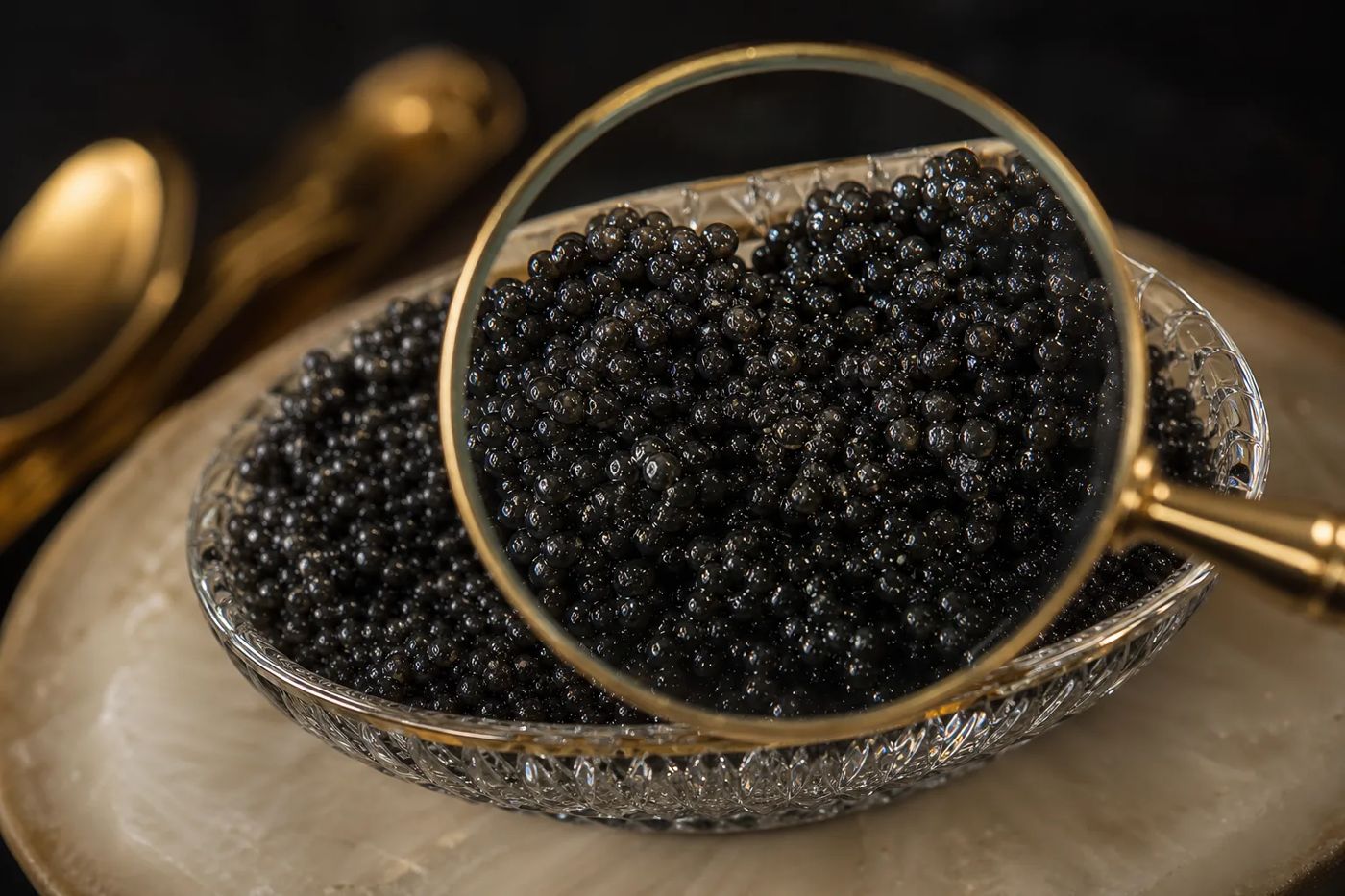
Clear glass offers a useful preview of egg colour, broken grains and liquid. It cannot reveal taste, microbiological safety or the entire contents. Use that view alongside the species and storage information, and read the processing description before choosing.
Check the container, lid or cap and any outer packaging for species, ingredients, net weight, dates and storage instructions. CITES traceability information may sit on a separate label, with its position depending on the pack and applicable rules. That label supports traceability rather than independently verifying the contents. How to buy caviar covers the wider buying decisions.
When the pack is empty, follow local collection rules for the body, lid and band separately.
Food-contact rules in brief
The packaging must be suitable for contact with the food inside. Food-contact rules govern those materials, not the grade of caviar. The following frameworks were checked in November 2026.
- EU: Regulation (EC) No 1935/2004, Article 3, requires materials not to transfer constituents at levels that endanger health or unacceptably change food composition, taste or smell.
- UK: Great Britain applies assimilated Regulation 1935/2004; Northern Ireland follows the EU framework, subject to applicable Windsor Framework arrangements.
- US: FDA food-contact requirements apply to packaging components and their intended uses, through applicable authorisations or exemptions, including relevant provisions of 21 CFR.
Sources
-
FAO and WHO, Codex Alimentarius. Standard for Sturgeon Caviar, CXS 291-2010. Adopted 2010; amendments in 2013, 2018 and 2024, as stated on the retrieved official PDF; the Codex register records a further modification in 2026. Sections 2.3 and 7 cover handling and storage instructions.
-
FAO and WHO, Codex Alimentarius. Code of Practice for Fish and Fishery Products, CXC 52-2003, 2020 collected edition, incorporating revisions through 2016. Section 20 covers packaging, vacuum application, pasteurisation and storage. Official copy:
https://www.rsu.lv/sites/default/files/book_download/9789240013179-eng.pdf -
Institute of Food Technologists. How Caviar Is Processed, web edition, publication date not established from the retrieved extract. The packing account describes lacquer-lined tins, gentle pressing to remove air and tight sealing.
https://www.ift.org/food-technology-magazine/how-caviar-is-processed -
Xiamen Guzhan Industry & Trade. Custom Logo Food Grade Silicone Sleeve for Caviar Tins Good Elastic Flat Silicone Rubber Bands, undated manufacturer specification. Used only for the manufacturer's description of the band’s lid-fastening function.
https://www.xmguzhan.com/silicone-band-good-elastic-flat-silicone-rubber-band.html -
Canadian fisheries research report, Fisheries and Oceans Canada digital collection. Processing lumpfish caviar: a progress report of work in 1970. Publication year not established from the retrieved extract. Sections on jar packing and pasteurisation document vacuum-sealed glass jars.
https://waves-vagues.dfo-mpo.gc.ca/Library/40645095.pdf -
Chuang, Kuo Hung, Fu Jen Catholic University. Effect of Modified Atmosphere Packaging on Quality of Dried-Salted Mullet Roe, master's thesis, 1994. English abstract retrieved through Taiwan’s National Digital Library of Theses and Dissertations.
-
Journal of Aquatic Food Product Technology, Taylor & Francis. Quality Changes in Chum Salmon (Oncorhynchus keta) Caviar (ikura) Affected by Thermal Pasteurization, Storage Time, and Packaging Material, volume 27, issue 2, 2018. Publisher abstract retrieved; DOI 10.1080/10498850.2017.1417340.
https://doi.org/10.1080/10498850.2017.1417340 -
CITES Animals Committee. Identification and traceability of sturgeons and paddlefishes (Acipenseriformes spp.): report of the Animals Committee, Standing Committee SC74 Doc. 47, March 2022. Includes the commissioned review of identification methods and weaknesses in caviar labelling.
https://cites.org/sites/default/files/eng/com/sc/74/E-SC74-47.pdf -
European Parliament and Council, EUR-Lex. Regulation (EC) No 1935/2004 on materials and articles intended to come into contact with food, 2004, Article 3.
https://eur-lex.europa.eu/eli/reg/2004/1935/oj/eng -
Food Standards Agency. Food contact materials authorisation guidance, live guidance retrieved November 2026. Identifies assimilated Regulation 1935/2004 as Great Britain’s general framework.
https://www.food.gov.uk/print/pdf/node/5661 -
Invest Northern Ireland, nibusinessinfo.co.uk. Food contact materials and packaging, live guidance retrieved November 2026. Explains the EU framework in Northern Ireland and the separate Great Britain position.
https://www.nibusinessinfo.co.uk/content/food-contact-materials-and-packaging -
US Food and Drug Administration. Determining the Regulatory Status of Components of a Food Contact Material, live guidance retrieved November 2026. Explains applicable regulations, notifications and exemption routes.
https://www.fda.gov/food/packaging-food-contact-substances-fcs/determining-regulatory-status-components-food-contact-material
This piece was researched using Codex texts, official food-contact guidance, documented processing methods and roe-packaging research, distinguishing experimental findings from practical inference.
Last checked: November 2026