
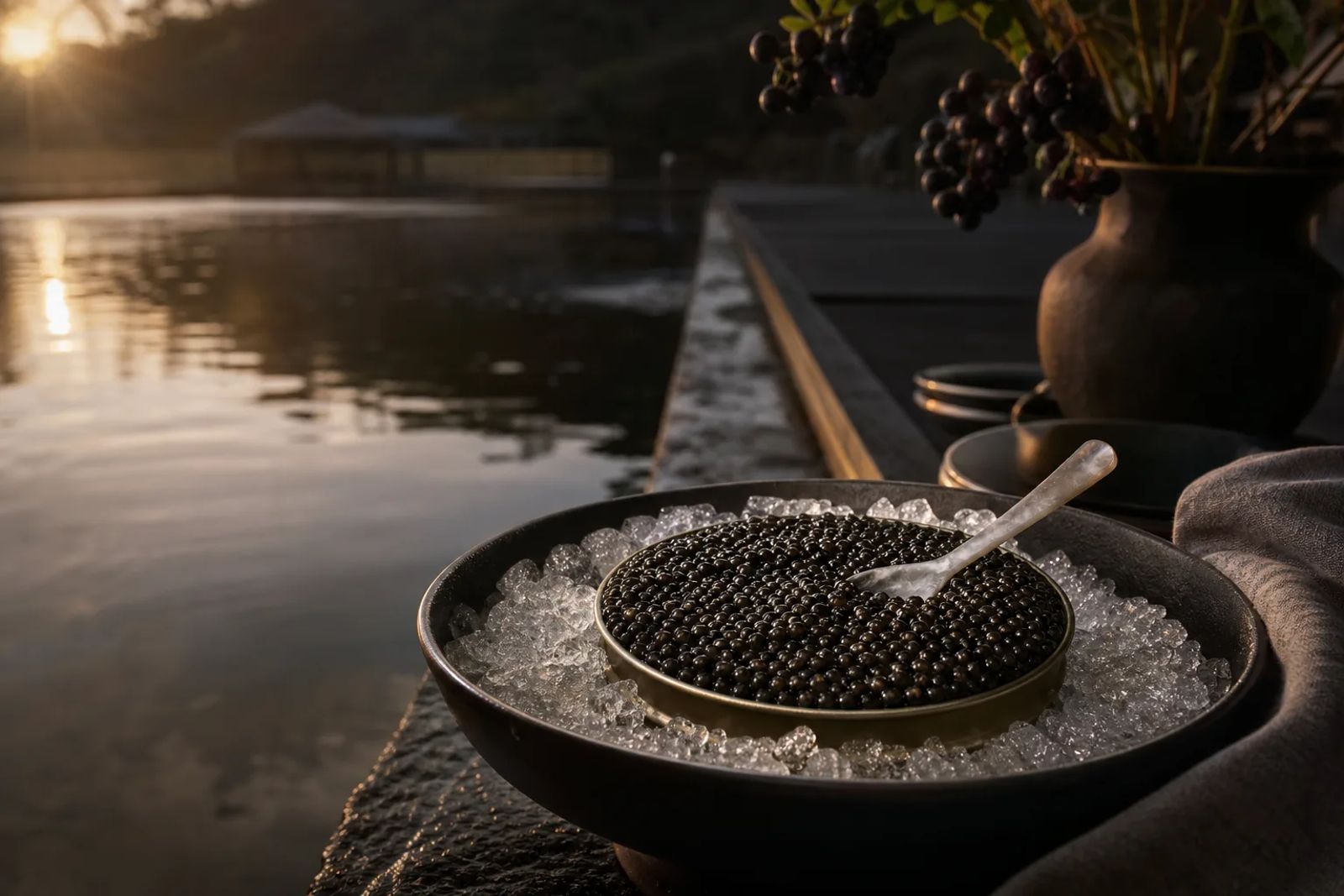
A walk beside sturgeon rearing ponds, then a tasting: that is the visit described by one French programme 2. In New Jersey, the route takes a different shape: the operator describes indoor tanks, an outdoor pond area and recirculating equipment 1. Two programmes, two ways into the world behind the caviar on the spoon.
Eggs being sieved, salted and packed may also be part of the picture, but ask before expecting to watch. A visit follows a controlled route through a working fish and food business, rather than an open door to every tank, hatchery and processing room.
What a caviar farm visit actually includes
Three experiences can sit behind the words “caviar farm visit”: seeing fish being raised, learning how caviar is produced and tasting caviar at a visitor centre. They need not happen together, or even at the same address. An explanation of production may be included without any opportunity to watch the work itself.
Ask which experiences are included and confirm the route offered on your date before booking. Published programmes describe what operators offer; they do not independently assess farming standards. For wider trip planning, use caviar travel, rather than treating a tasting reservation as confirmation of farm access.
Tanks, ponds and flowing water
Look at the tanks, the pond edges and the water's route through the site. Systems can overlap: young fish and adults may be raised differently, while “pond” describes an enclosure rather than how its water is managed.
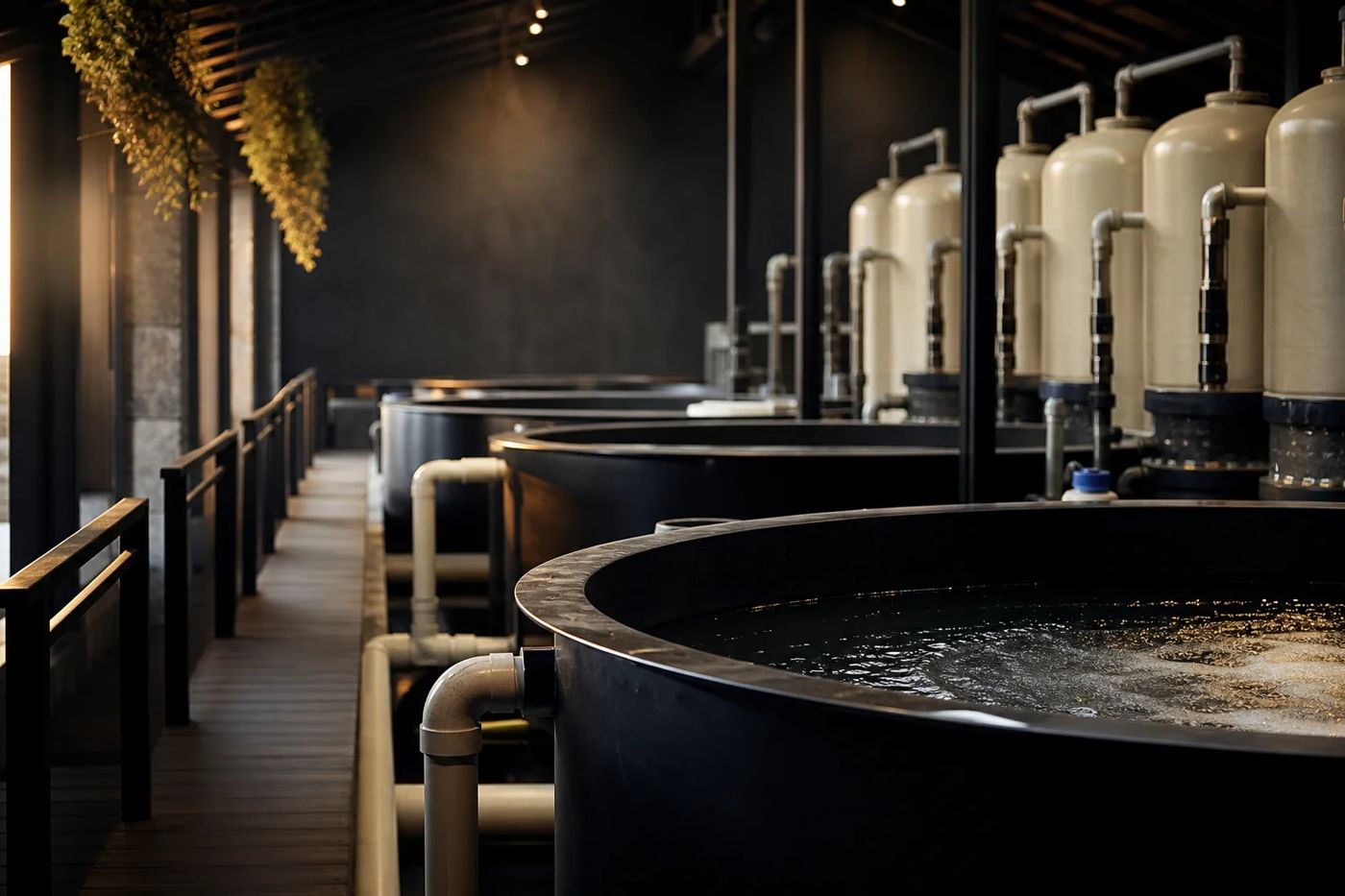
In a recirculating aquaculture system, often shortened to RAS, water is treated and reused. Ask the guide to explain the tanks, filtration and water monitoring equipment visible from the visitor route. Machinery and fish handling areas may remain off limits.
Pond visits bring more of the tour outdoors. Check how close the route comes to the water and whether fish will be visible without staff bringing them to the surface. Walking beside a pond does not necessarily mean seeing clearly beneath it.
In a flow-through system, water passes through the rearing units rather than being predominantly recirculated. Where does it enter? How is it monitored? What happens before discharge? The sturgeon farming guide explains these systems in detail. On site, establish which arrangement you are looking at.
Hatcheries and processing: what can you see?
A hatchery is where eggs are incubated and young fish are reared. Ask whether the tour includes one, whether it will be operating and whether you enter or observe from outside. Do not assume that every farm breeds its own replacement fish.
Processing needs a separate question. Will you watch through a window, see a film or attend a demonstration away from production? Will work actually be taking place? A view of a clean room is different from watching eggs being sieved, salted and packed.
Biosecurity is part of the experience
Clean footwear, protective clothing and closed doors all serve a purpose: reducing the risk of introducing or spreading disease. That is biosecurity.
The World Organisation for Animal Health, WOAH, recommends controlled visitor access, records of previous aquatic animal exposure, protective clothing or footwear, hand disinfection and footbaths within an establishment's biosecurity plan. Its guidance is an international reference, not one identical visitor law everywhere.
Tell the farm about recent visits to other fish farms, hatcheries or aquatic animal facilities before arranging consecutive tours. Ask whether a gap is required and follow the farm's stated interval. WOAH's visitor provisions set no universal waiting period, so do not assume a fixed number of hours.
Arrive with clean footwear and use supplied protective equipment as instructed. Iowa State University's Center for Food Security and Public Health advises reducing or prohibiting visitors' direct contact with animals and production water. Keep hands out of tanks, leave equipment alone and feed fish only with specific authorisation. Follow instructions about touching tank surfaces as well.
Stay with the guide and respect closed doors, however quiet the space beyond looks. Read fish farm biosecurity before going to understand the reasons behind these restrictions.
Will you see a harvest?
Harvest is something to ask about explicitly, not discover halfway through a tour. Check whether visitors see live fish handling, stunning, killing or egg collection. Request a route without those stages if preferred, especially before bringing children or anyone who would find them upsetting.
Conventional caviar harvest involves killing the fish and removing the ovaries containing the eggs. WOAH recommends stunning before killing, with immediate loss of consciousness and no recovery before death. Ask how the operator checks that stunning has worked. “Humane” needs an explanation.
Collection from a living fish follows a different procedure. Hormones may be used to induce ovulation, the release of eggs from their follicles. Stripping then uses pressure on the abdomen to expel the eggs. Codex permits caviar from ovulated farmed sturgeon eggs under specified conditions, but that food standard establishes no welfare advantage.
Conventional caviar harvest involves killing the fish and removing the ovaries containing the eggs.
If a tour describes a no-kill approach, ask exactly what happens, including any sedation or surgery. Immediate survival, later health and successful reproduction are separate outcomes. Ask what follow-up records support each, beyond seeing a fish return to its tank.
Questions to ask before and during the visit
- What is included? Confirm rearing areas, hatchery access, processing observation, tasting, language and total duration, plus possible changes for weather or farm work.
- Which fish will I see? Request species, hybrid parentage, the group's age and the farm's own harvest age records.
- What are they fed? Check feed ingredients and sourcing, plus whether and how the farm manages purging, a pre-harvest holding period intended to address unwanted flavours.
- Whose roe will I taste? Confirm which samples come from fish raised here, which are bought in, and where harvesting, processing and repacking happen.
- Which legal entity handles the caviar? Request the processing or repackaging plant's CITES registration details where applicable, and its relationship to the visitor site.
A farm, a repacker or a shop?
A farm raises fish. A repacker transfers caviar into new primary containers, meaning the containers directly holding the roe. One business may do both and operate a shop as well. Live sturgeon on site do not establish the origin of every sample or container sold there.
The public CITES register records caviar operations, including processing and repackaging facilities. It is not a complete census of farms or retailers: registration does not establish farm ownership, while a retailer's absence does not establish unlawful activity. Use the CITES register guide to check the relevant entity and facility.
Tasting and taking caviar away
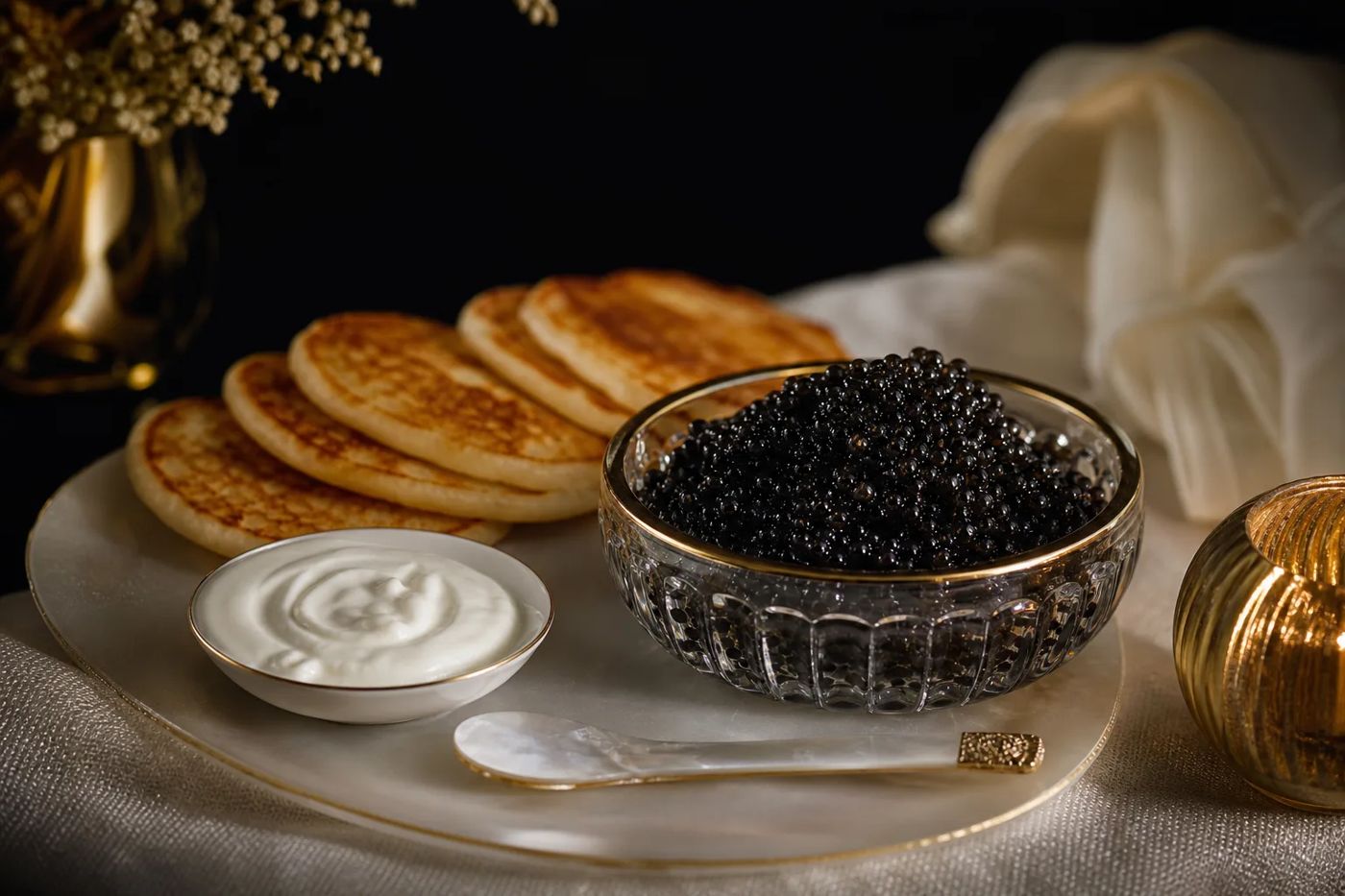
Ask which sample is which before starting. Then try a little caviar on its own. Notice the firmness of the eggs, the salt and how the beads separate before adding accompaniments. A polished tasting description is unnecessary. Use the utensil provided and keep a used tasting spoon out of shared dishes.
If buying on site, request a sealed container and an explanation of its origin. Ask whether it carries a CITES label, especially if you intend to cross a border. The label supplies traceability information; it does not verify the contents. National implementation differs, so this label check is not a claim that every domestic transaction worldwide follows identical rules.
Bring a cool bag with suitable cold packs. Ask staff to pack the caviar for your journey according to the product's storage instructions, and arrange refrigeration at your destination before buying.
In the EU and UK, a personal allowance of up to 125 g of properly labelled caviar applies only under set conditions. To plan what can travel home across borders, start with planning a caviar trip, then check the relevant authorities.
Footwear, access, children and photographs
Check the whole route, not just the tasting room. Ask about walking distances, steps, uneven ground, seating and toilets, and whether a wheelchair or pushchair can reach the fish viewing areas. Published farm tour advice includes footwear suitable for dirt and potentially damp ground. Choose enclosed shoes with secure grip.
Find out how much time is outdoors and what happens in rain, heat or cold. For children, check minimum ages, supervision near water and whether the tasting can be adapted. Request a non-alcoholic drink if wanted. Disclose food allergies before the visit, rather than waiting until the tasting table.
Ask permission before taking photographs, including whether flash, video or close views of equipment are allowed. Stay on the visitor route and obtain staff consent before photographing them. A good visit fits around the farm's work. It should never require fish to be handled for the camera.
Sources
-
King Caviar Farms. Private Caviar Farm Tours in New Jersey. Undated visitor information, retrieved November 2026. Read at kingcaviarfarms.com. Operator's account of possible tour contents, not independent verification of production or environmental claims.
-
Caviar de Neuvic. Home: Domain visits. Undated visitor information on the operator's website, checked November 2026. Operator's description of pond visits and tastings.
-
Marshallberg Farm. Marshallberg Farm Tours & Caviar Tastings. Undated visitor information on the operator's website, checked November 2026. Footwear advice and tour activities.
-
World Organisation for Animal Health. Aquatic Animal Health Code, 2025 edition, Chapter 4.1, “Biosecurity for aquaculture establishments”. Aquatic Code, 2025 edition. International guidance on risk-based biosecurity and visitor controls.
-
Iowa State University, Center for Food Security and Public Health. Aquaculture Biosecurity: Vectors, People on Your Farm. Undated guidance sheet, retrieved November 2026. Read at cfsph.iastate.edu. Visitor footwear, supervision and restrictions on animal and production-water contact.
-
World Organisation for Animal Health. Aquatic Animal Health Code, Chapter 7.3, “Welfare aspects of stunning and killing of farmed fish for human consumption”, retrieved text dated 2 July 2024. Read at woah.org.
-
FAO and WHO, Codex Alimentarius Commission. Standard for Sturgeon Caviar, CXS 291-2010, listed in the Codex register as last modified in 2026, particularly sections 2.3, 5 and 7.2. Official standards register: Read at fao.org. The document was retrieved through the register's PDF delivery service.
-
United States Geological Survey. Comprehensive Sturgeon Research Project Blog, 2023, entry “Laboratory Studies Begin with Spawning”, 18 May 2023. Read at usgs.gov. Direct account of hormonal induction and hand stripping in research broodstock.
-
Van Eenennaam and colleagues. Tank spawning of first generation domestic green sturgeon. Journal of Applied Ichthyology, 2012, DOI 10.1111/j.1439-0426.2012.02012.x. Read at onlinelibrary.wiley.com. Primary research distinguishing collection methods and subsequent outcomes.
-
CITES. Conservation of and trade in sturgeons and paddlefish, Resolution Conf. 12.7 (Rev. CoP17), particularly Annex 1. Official text, checked after CoP20: CITES resolution.
-
CITES Secretariat. United States of America: Register of caviar exporters. Live public register, retrieved November 2026. Read at cites.org. Used to establish the register's published fields, not to recommend businesses.
-
United States Environmental Protection Agency. Technical Development Document for the Final Effluent Limitations Guidelines and New Source Performance Standards for the Concentrated Aquatic Animal Production Point Source Category, 2004, section 4.3.6.6, “Sturgeon”. Read at epa.gov. Production-system descriptions only.
-
FAO. Chebanov, M.S. and Galich, E.V., Sturgeon Hatchery Manual, FAO Fisheries and Aquaculture Technical Paper No. 558, 2013. Read at fao.org. Hatchery functions, rearing systems and reproductive management.
-
FAO, Committee on Fish and Fishery Products. Report of the Thirty-fourth Session, REP16/FFP, session held 19 to 24 October 2015, Appendix V, proposed draft caviar code and example flow chart. Read at fao.org.
This piece was researched from operators' published visitor information, international animal-health guidance, primary research and official food-standard and wildlife-trade documents; no visit or tasting was undertaken for it.
Last checked: November 2026