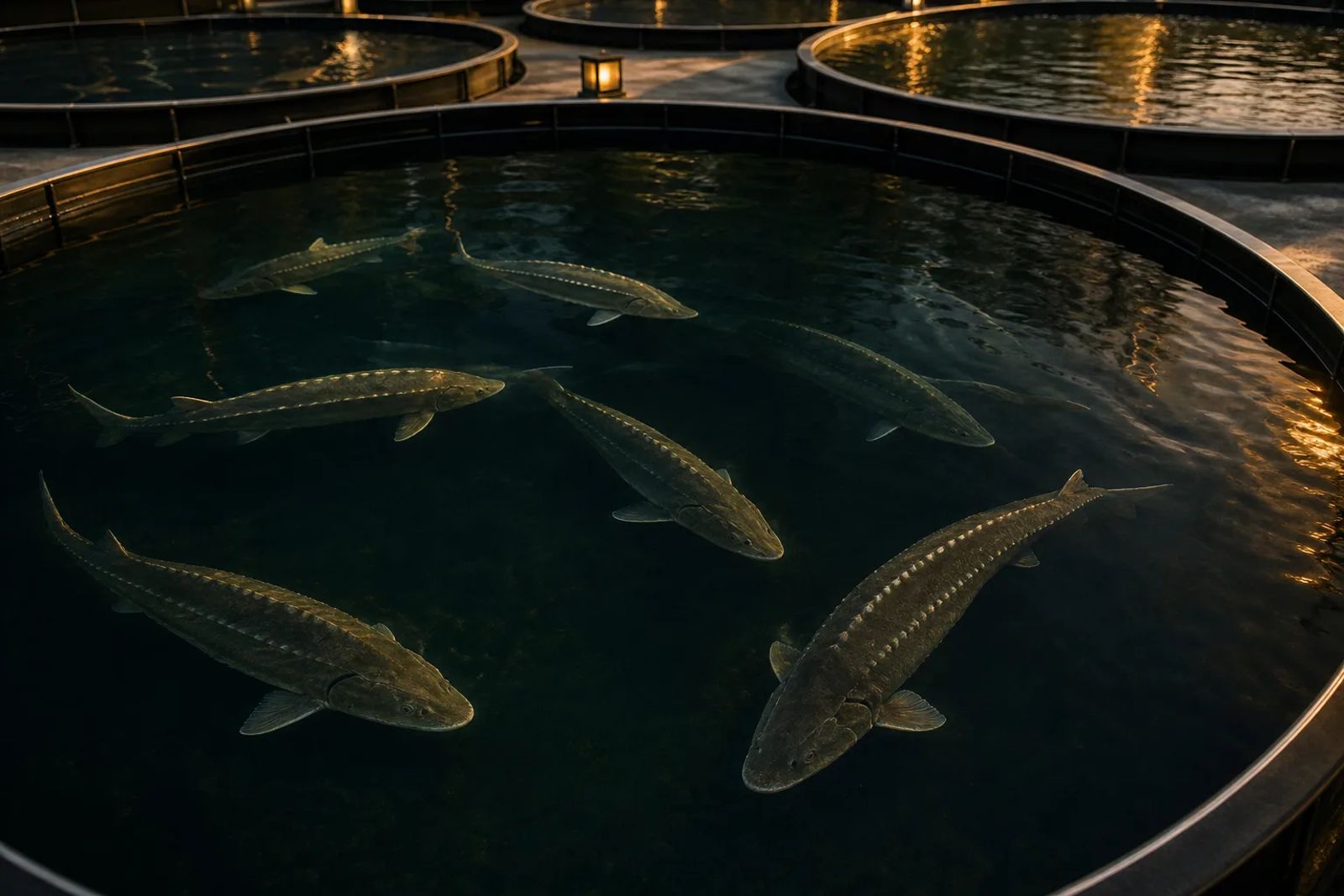
Male sturgeon can reach the table before females are ready to produce caviar. University of Florida aquaculture guidance describes males being slaughtered for meat before females reach caviar maturity. Others stay on the farm as breeding fish, helping produce the next generation.
Meat and breeding are two documented destinations for male sturgeon. Farms can separate males once their sex is identifiable, although no reliable worldwide figures establish how often each outcome occurs.
How farms identify male sturgeon
A young sturgeon's appearance does not reliably reveal its sex. To distinguish males from females, farms use ultrasound, examine the reproductive organs through a small opening, or take tissue samples.
The timing depends on the species, its growth and the method used. FAO's Siberian sturgeon farming account describes sexing at about three years; other fish and methods require different timetables. The guide to sexing methods explains how these procedures differ.
Meat, breeding fish and milt
A male that will never produce caviar can still produce food. Meat is a documented production route for males not selected for breeding, rather than automatic disposal. Alongside the University of Florida guidance, California Sea Grant records the separation of males for meat in the development of California's white sturgeon industry.
The distinction is not between a useful female and a useless male, but between a food-producing animal and a breeding animal.
Breeding males have a different role. Kept as broodstock, the adult fish used to produce the next generation, they supply milt: the fluid containing sperm. Hatcheries collect it and use it to fertilise eggs outside the female's body. FAO describes sperm collection and artificial fertilisation in its Siberian sturgeon account.
These males are retained to breed, rather than reared for a caviar harvest. The distinction is not between a useful female and a useless male, but between a food-producing animal and a breeding animal. The wider uses of carcasses are explored in using the whole fish.
Why separate males early?
Separating males lets a farm plan for meat and caviar on different schedules. Males destined for meat need not stay through the additional years it takes females to mature. Sexing makes those separate rearing plans possible, as the University of Florida guidance explains.
The resource calculation is straightforward. Keeping males that are not needed for breeding takes feed, tank space and husbandry time without bringing a future caviar harvest. Identifying them earlier gives the farmer more control over those resources.
That incentive does not dictate a single production plan. The age at which males are sold, and the way they are reared beforehand, can differ between farms.
Could farms produce all-female stocks?
Researchers are working towards all-female sturgeon stocks through genetic sex identification, controlled breeding and experimental sex reversal. The tools do different jobs. A DNA test identifies genetic sex; sex reversal changes how the reproductive organs develop. To understand how a commercial batch was produced, the method matters more than the label.
One approach is gynogenesis. Sperm whose genetic material has been inactivated activates an egg, leaving the offspring's inherited nuclear genetic material to come from the mother. In a 2025 study of bester, a hybrid of female beluga and male sterlet, researchers used DNA testing to identify WW individuals among gynogenetic offspring. These fish have two W sex chromosomes. They are called superfemales, a breeding term, not a quality grade.
A separate study published in December 2025, and corrected in February 2026, identified WW offspring after researchers bred genetic females with genetic females experimentally masculinised using methyltestosterone. They tested 48 offspring using sex-linked DNA markers. The result marked progress towards all-female production, rather than its establishment as standard practice across caviar farms.
The December study's authors also reported that some Japanese aquaculture farms were already using their genetic sexing approach under their supervision. That is practical uptake of a test. It is distinct from routine commercial production of all-female sturgeon, an important difference when assessing farm claims.
Experimental sex reversal has also feminised genetic male Siberian sturgeon using oestradiol. Whether such a treatment may be used in food production is a separate legal question. Crossing species is another subject again, covered in hybrid breeding.
What do the rules allow?
Permission depends on the jurisdiction, the substance and its authorised use. A successful breeding experiment does not itself authorise treatment on a food-producing farm.
In the EU, Directive 96/22/EC generally prohibits certain hormonal substances in aquaculture. It provides a conditional exception for authorised androgenic medicines used for sex inversion during a young fish's first three months, not a general authorisation for oestrogen-based feminisation. Organic production has stricter limits: Regulation (EU) 2018/848 prohibits hormones for aquaculture breeding and artificial monosex production other than hand-sorting.
UK legislation also restricts hormone use. In Great Britain, separate national residue regulations apply. The Welsh rules include an androgenic sex-inversion exception for fish aged three months or less; Northern Ireland has separate implementing regulations. The existence of an exception does not confirm that a particular medicine is authorised for sturgeon.
In the US, FDA approval attaches to a specific drug and its approved use. The US Fish and Wildlife Service's investigational methyltestosterone programme concerns tilapia, not sturgeon. It is not general commercial approval, and a sturgeon farmer cannot use it as authority to treat sturgeon with the same hormone.
Welfare does not depend on sex
Producing no eggs does not exempt a fish from welfare protection. Male sturgeon slaughtered for meat fall under the same applicable welfare framework as females.
In the EU, Regulation (EC) No 1099/2009 requires fish to be spared avoidable pain, distress or suffering. Its detailed slaughter provisions for other animals do not apply to fish. In Great Britain, assimilated Regulation (EC) No 1099/2009 likewise gives fish general protection at killing without extending those detailed slaughter provisions to them.
In the US, fish are outside the federal livestock humane-slaughter provisions. That gap says neither that handling is humane nor what every state's law requires. The UK Animal Welfare Committee recommends effective stunning and killing without recovery of consciousness. Those recommendations are advisory, rather than binding rules.
When assessing a farm, ask how males are handled, where slaughter takes place and how unconsciousness is checked. Those questions give a clearer picture of welfare than the fish's sex or its eventual use.
For the detailed discussion, see sturgeon welfare, slaughter and no-kill. The broader sustainability and ethics hub also distinguishes animal welfare from claims about resource use.
Sources
- FAO. Acipenser baerii, Cultured Aquatic Species Information Programme, 2009 edition. Sections on seed supply, broodstock and hatchery production. Source.
- University of Florida IFAS Extension. Chapman, F. A. and Van Eenennaam, J. P. Sturgeon Aquaculture: Specialized Techniques: Determining the Sex of Sturgeon by Direct Examination of the Gonad Using a Minimally Invasive Surgical Procedure. FA183, published November 2012, reviewed August 2024. Source.
- California Sea Grant. Roe Crops: How Sacramento Became the Caviar Capital of the U.S., 2023. Source.
- Elsevier, Aquaculture. First evidence of WW superfemale for hybrid sturgeon, the bester (Huso huso × Acipenser ruthenus). Volume 596, Part 1, article 741808, 2025. Source.
- MDPI, Fishes. Generation of WW Superfemale Sturgeons Through Hormonal Masculinization of ZW Females. Volume 10(12), article 618, published 2 December 2025, corrected 13 February 2026. Source.
- Elsevier, Aquaculture. Estradiol-17β but not 11β-hydroxyandrostenedione induces sex transdifferentiation in Siberian sturgeon. Volume 596, Part 1, article 741735, 2025. Source.
- PubMed Central. Potential Physiological and Molecular Mechanisms Underlying Low Viability of Gynogenetic WW-Type Super-Female Sterlet (Acipenser ruthenus), International Journal of Molecular Sciences, 27(1), 207, 2026. Source.
- Council of the European Union. Council Directive 96/22/EC concerning the prohibition on the use in stockfarming of certain substances having a hormonal or thyrostatic action and of beta-agonists. Consolidated edition dated 18 December 2008, particularly Articles 1, 3 and 5. Source.
- European Commission, Directorate-General for Agriculture and Rural Development. Organic rules: frequently asked questions. Online edition consulted November 2026, explaining Regulation (EU) 2018/848, Annex II, Part III, point 3.1.2.2. Source.
- UK legislation. The Animals and Animal Products (Examination for Residues and Maximum Residue Limits)(England and Scotland) Regulations 2015. SI 2015/787, revised contents consulted November 2026. Source.
- Welsh legislation. The Animals and Animal Products (Examination for Residues and Maximum Residue Limits) (Wales) Regulations 2019. WSI 2019/569, particularly regulations 5 and 29. Edition dated 28 March 2019. Source.
- Northern Ireland legislation. The Animals and Animal Products (Examination for Residues and Maximum Residue Limits) Regulations (Northern Ireland) 2016. SR 2016/54, online text consulted November 2026. Source.
- US Food and Drug Administration. Letter to Aquaculture Professionals. Online edition and approved-drug tables consulted November 2026. Source.
- US Fish and Wildlife Service. 17α-methyltestosterone in Tilapia, Investigational New Animal Drug programme 11-236. Online protocol summary consulted November 2026. Source.
- Council of the European Union. Council Regulation (EC) No 1099/2009 on the protection of animals at the time of killing, 2009, particularly Articles 1(1) and 3(1). Consolidated version dated 6 August 2026. Source.
- Animal Welfare Committee, published by Defra. *Update to the 2014 FAWC Opinion on the welfare of farmed fish at the time of killing, first published September 2023; GOV.UK edition 12 March 2024. Source.
- House of Commons Library. Debate on the Animal Welfare Strategy for England. Research briefing CDP-2026-0010, 2026, section on fish. Source.
- US House of Representatives, Office of the Law Revision Counsel. 21 USC 610: Prohibited acts. Text incorporating laws in effect through 7 October 2026, particularly the opening species list and subsection (b). Source.
Last checked: November 2026