
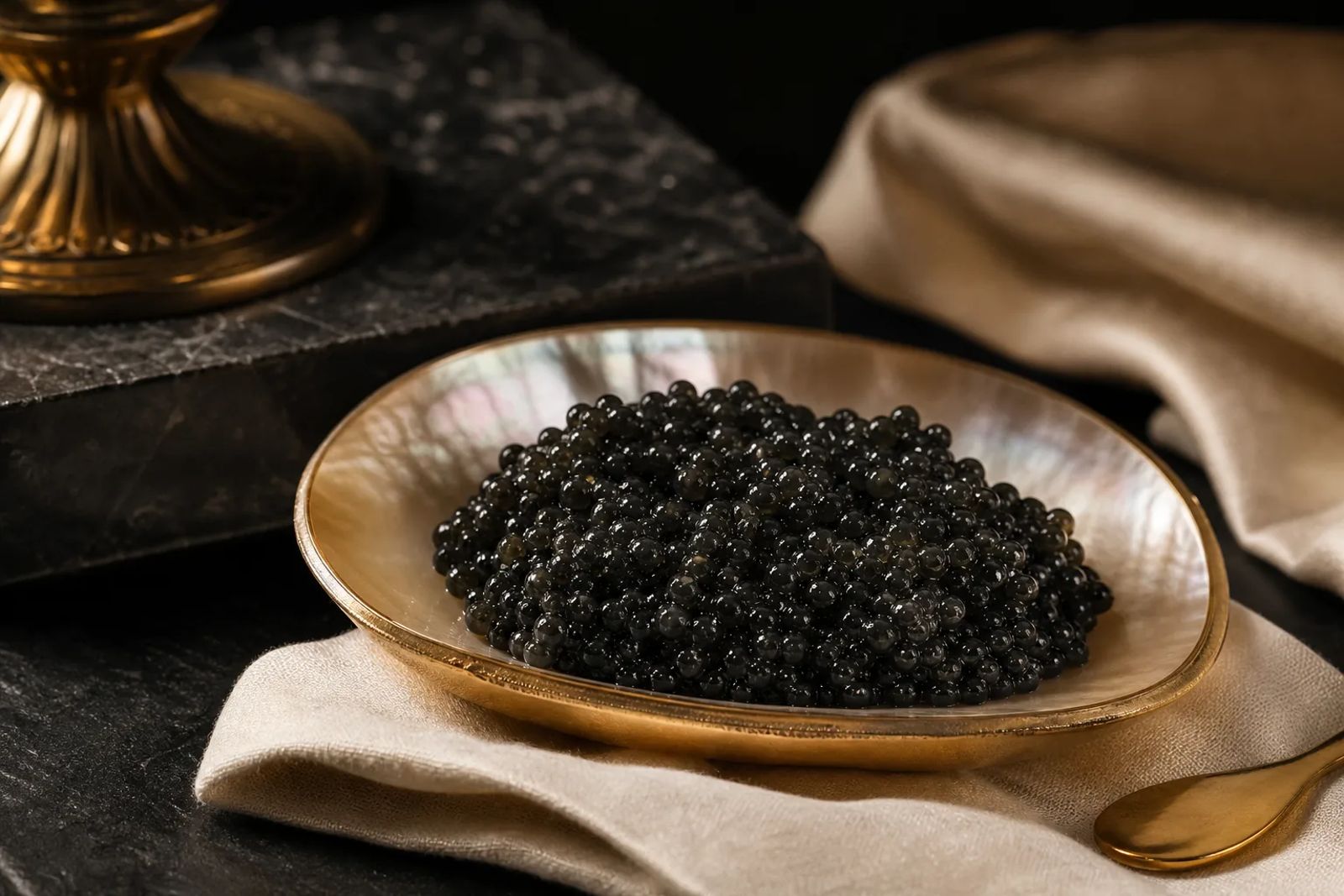
Dark brown to black and smooth in texture: this is how Calvisius describes its Adriatic sturgeon caviar. The product is documented. The future of the fish in its native rivers is much less certain. Acipenser naccarii, a fish native to the Adriatic basin, is classified as Critically Endangered in the 2022 IUCN Red List publication. Its survival is closely tied to captive breeding and releases. Documented farming also supplies commercial roe, but protecting wild fish and permitting trade in captive products are separate matters. The United States imposes additional endangered species restrictions.
Adriatic sturgeon facts
| Field | Record |
|---|---|
| Common and trade names | Adriatic sturgeon; storione cobice. Da Vinci is a documented product name, not a species. |
| Scientific name | Acipenser naccarii Bonaparte, 1836. Historical synonyms: Acipenser heckelii, Acipenser nasus and Acipenser platycephalus. |
| Alternative generic combinations | Huso naccarii and Sterletus naccarii, proposed in 2025 classifications. |
| CITES | Appendix II; species code NAC. |
| IUCN | Critically Endangered (2022). |
| Native range | Northern and eastern Adriatic basin, including the Po and other Adriatic rivers. |
| First farm harvest | About 10 years, according to Calvisius. |
| Documented roe colours | Intense black to dark brown, according to Calvisius. |
| Main documented farming countries | Italy, documented through exports and producer accounts of farming. |
| Wild trade | Wild populations are subject to fishing prohibitions and endangered species protections. |
The fish and its Adriatic home
The Adriatic is this fish's home, not merely a place where it is farmed. Ticino Park identifies its historical Italian range as the Po and its tributaries, alongside the Adige, Brenta, Piave and Tagliamento. Its wider native range also extended along the eastern Adriatic drainage. That historical geography describes where the species lived, rather than where populations necessarily survive today.
Adriatic sturgeon generally move between coastal waters and rivers, entering fresh water to reproduce. Yet the landlocked population in the Ticino shows that a journey to sea is not essential for every population. Norway's 2025 scientific assessment describes a fish reaching about 2 m in length.
Its scientific name is less settled than its identity. This page follows the site's CITES-based record, Acipenser naccarii. Brownstein and Near's 2025 classification proposed Huso naccarii; Kottelat and Freyhof proposed Sterletus naccarii. All refer to the same fish, placed in competing genera. On 22 October 2025, SSG and WSCS proposed a conservative classification retaining it in Acipenser. For the wider family, see sturgeon species.
Does it still survive in the wild?
Yes. Its published status is Critically Endangered, not Extinct in the Wild. But neither sightings nor releases alone demonstrate a recovered, self-sustaining population. The 2022 specialist announcement drew hope from discoveries of young fish, suggesting that descendants of earlier conservation releases were reproducing naturally.
One tiny fish brought that possibility into sharp focus. In an observation published by Congiu and colleagues in Oryx in 2021, a fisher caught, photographed and released a juvenile approximately 4 cm long in the Po mainstream. Its size, considered alongside the timing of previous releases, supported the interpretation that it had hatched in the river rather than been stocked there.
That juvenile is evidence consistent with natural reproduction, rather than a population census. Norway's 2025 assessment calls the wild component likely extinct, while acknowledging possible surviving spawners and restocked populations. The uncertainty concerns their origins and ability to sustain themselves; the published Red List category remains Critically Endangered.
Captive broodstock and the long conservation effort
The Italian rescue depended on living fish kept by farmer Giacinto Giovannini. Those animals formed the founding broodstock: parents retained to produce future generations. The 2021 Oryx account describes releases of their descendants. At a time when natural recruitment, the addition of young fish to the population, had almost disappeared, captivity preserved the possibility of breeding.
Breeding was only part of the task. Ticino Park's LIFE conservation project paired releases with research into river populations; the European Commission records its completion in 2007. LIFE CON.FLU.PO., which ran from 2012 to 2018, tackled river fragmentation and delivered fish passage at Isola Serafini. Opening a migration route addresses a cause of decline that producing more juveniles cannot fix.
The current LIFE RESTORE programme runs from 1 September 2025 to 31 December 2031, according to ISPRA. Coordinated by the University of Padua, with partners including ISPRA and Ticino Park, it commits to genetically informed breeding, restocking and a shared monitoring network. These are project commitments, not completed recovery results.
The decisive measure is what happens after a hatchery release. Fish must survive, retain sufficient genetic diversity and eventually reproduce in suitable habitat. Counting released juveniles captures only the beginning of that story.
Adriatic sturgeon caviar: what is documented
Adriatic sturgeon is farmed for caviar as well as bred for conservation. Ars Italica's farm account identifies Acipenser naccarii among the fish raised in Ticino Park and dates its farming there to 2002. Agroittica also names Adriatic sturgeon within its Ars Italica production. The species can serve both activities, although their purposes differ.
Calvisius identifies this species as the source of roe sold under the Da Vinci name. Its description evokes dark brown to black eggs, a smooth texture and iodine, oyster, seaweed and fresh fish notes. These tasting details describe the producer's product, not established characteristics of every Adriatic sturgeon caviar. They document what is offered commercially, while the river population's future remains uncertain.
Expect a long wait for the first harvest. Calvisius gives about 10 years. Sexual maturity is a separate measure: NOAA's species account places it at 6 to 7 years for males and 8 to 12 years for females. Those biological figures do not establish a farm caviar harvest range.
Explore the national production story in Italian caviar, and the company background in Calvisius and Agroittica Lombarda. Together they explain the commercial setting, while recovery of threatened river populations remains a separate question.

How to recognise it
Look for a short, broad snout with a rounded tip. Ticino Park also describes five rows of bony scutes and four barbels in front of the mouth on the underside of the fish. These features help orient an observer, though specialist identification is still needed. The European sturgeon is a different species.
For prepared roe, turn to documentation rather than appearances. Colour and photographs cannot reliably identify the species. Calvisius reports eggs of 2.3 to 2.7 mm for its product, a product measurement rather than a diagnostic species range. NAC is the species code in the CITES-based record. A label supplies traceability, but cannot by itself verify the actual contents.
Protection and the legal route for farmed roe
Three different frameworks do different jobs. IUCN assesses extinction risk; its assessment does not authorise or prohibit a shipment. CITES Appendix II controls international trade. The Habitats Directive addresses habitat conservation and strict protection of wild animals.
European Union
Under the Habitats Directive, Annex II gives this species priority conservation status, while Annex IV requires strict protection.
In Italy, Presidential Decree 357/1997, Article 8, implements protection against capture of wild specimens. Regional provisions explicitly prohibit capture of Acipenser naccarii at every developmental stage. Products from lawfully maintained captive fish are a separate legal matter. Their commercial legality depends on origin, documentation and the destination's rules.
Under Regulation (EC) No 338/97, as amended by Regulation (EU) 2026/1383, Adriatic sturgeon appears in Annex B. Farmed origin does not automatically exempt a shipment from trade controls.
Under CITES, C denotes specimens bred in captivity under the applicable criteria; F denotes specimens born in captivity that do not meet those criteria. The correct code follows the consignment's documented origin and the applicable CITES rules.
Great Britain
APHA's guidance, updated in June 2026, explains CITES permitting and personal-effects exemptions. Movements between Great Britain and Northern Ireland normally require CITES permits.
EU and Great Britain rules conditionally exempt up to 125 g per person of Annex B caviar in individually CITES labelled containers, carried in personal luggage for personal use. That allowance covers neither commercial consignments nor exceptions to another country's species restrictions.
United States
NOAA Fisheries listed Adriatic sturgeon as endangered under the ESA in 2014. Captive breeding does not itself remove that protection, and a CITES label does not authorise an ordinary commercial import. A product available in Italy may therefore be unlawful to bring into the United States.
Where conservation and caviar farming meet
Farming has helped preserve living fish, breeding knowledge and facilities that conservation programmes can draw upon. ISPRA's LIFE RESTORE partnership includes a farming enterprise alongside universities and public bodies. That documented collaboration shows an institutional connection, rather than a conservation contribution from every commercial harvest or product.
The juvenile photographed and released in the Po, approximately 4 cm long, offers a glimpse of that possibility: a young fish whose size and timing pointed towards a river birth.
Conservation still needs its own clear objectives. Broodstock must support genetic diversity; rivers must support survival and reproduction. Norway's 2025 assessment found the conservation effect of international trade in captive-produced Adriatic sturgeon inconclusive. It considered wild-sourced trade detrimental. The availability of farmed roe does not resolve the question of recovery.
Keeping a species alive in captivity and restoring its ecological future are different achievements. Captive breeding keeps possibilities open. Lasting recovery also needs functioning rivers and subsequent generations born within them. The juvenile photographed and released in the Po, approximately 4 cm long, offers a glimpse of that possibility: a young fish whose size and timing pointed towards a river birth.
Sources
- Norwegian Scientific Committee for Food and Environment (VKM). Scientific assessment of risk from trade to CITES-listed species of sturgeons and paddlefishes. VKM Report 2025:06, 2025, section 4.3. Official report.
- Parco Lombardo della Valle del Ticino. SCHEDA: Storione cobice (Acipenser naccarii). Undated official species account. Species account.
- California Academy of Sciences. Eschmeyer's Catalog of Fishes, species record for Acipenser naccarii. Online edition, retrieved November 2026. The record documents the alternative combinations and retains Acipenser naccarii as its current valid name.
- Convention on Migratory Species. Taxonomy and nomenclature. UNEP/CMS/COP15/Doc.29.3/Rev.1, March 2026, paragraphs 19 to 24. Official document.
- World Sturgeon Conservation Society. Press release on the 2022 IUCN sturgeon assessments, July 2022. Specialist announcement.
- Congiu and colleagues. Resumption of natural reproduction of the Adriatic sturgeon in the River Po. Oryx, 2021. Published observation.
- University of Milano-Bicocca institutional repository. Published research article in Aquatic Conservation: Marine and Freshwater Ecosystems, article identifier aqc.70079, 2025. Labria and colleagues, Unlocking the Secrets of Sturgeon Ecology: Lessons From Conservation Efforts in Northern Italy.
- ISPRA. Life Restore: Recovery of Endangered Sturgeons Through Optimized Restocking Efforts. LIFE24-NAT-IT-LIFE-RESTORE, current project account, retrieved November 2026. Official project account.
- Ars Italica. The farm. Undated producer account, retrieved November 2026. Farm account.
- Agroittica. Corporate production account identifying the species associated with Ars Italica. Current website, retrieved November 2026. Corporate account.
- Calvisius. Ars Italica Da Vinci Royal. Undated producer specification, retrieved November 2026.
- NOAA Fisheries. Adriatic Sturgeon. Current official species account, retrieved November 2026. Species account.
- European Union. Council Directive 92/43/EEC. Official European Commission Joint Research Centre-hosted text, 2004 compilation, Annexes II and IV. Official-hosted text.
- Regione Friuli Venezia Giulia. Acipenser naccarii, conservation measures annex to Resolution 546 of 28 March 2013. Records Annexes II and IV of the Habitats Directive. Regional conservation document.
- Italian Ministry for Nature Conservation. Testo coordinato del Decreto del Presidente della Repubblica 8 settembre 1997, n. 357. Coordinated text hosted by Gran Sasso and Monti della Laga National Park; Article 8. Coordinated decree. Gazzetta Ufficiale, regional provision, Misure di tutela degli storioni autoctoni, Article 5, published 6 September 2003, corroborates the capture prohibition.
- University of Bologna. Reproduction and artificial restocking of Acipenser naccarii. Repository thesis, academic year 2013/2014; section 1.6.3. Repository document.
- APHA and Defra. Check if you need a CITES permit to import or export endangered species. Updated 23 June 2026. Official guidance.
- Netherlands Enterprise Agency (RVO). Kaviaar. Current official guidance on EU caviar trade and personal baggage, retrieved November 2026. Official guidance.
- United States, Electronic Code of Federal Regulations. 50 CFR 224.101: Enumeration of endangered marine and anadromous species. Displayed as current to 3 November 2026. NOAA Fisheries, Endangered Species Act, statutory text. Species listing; statutory text.
- European Commission. Reference Guide to the European Union Wildlife Trade Regulations. December 2020 edition, caviar labelling discussion, hosted by Italy's environment ministry. Official-hosted guide.
Last checked: November 2026