
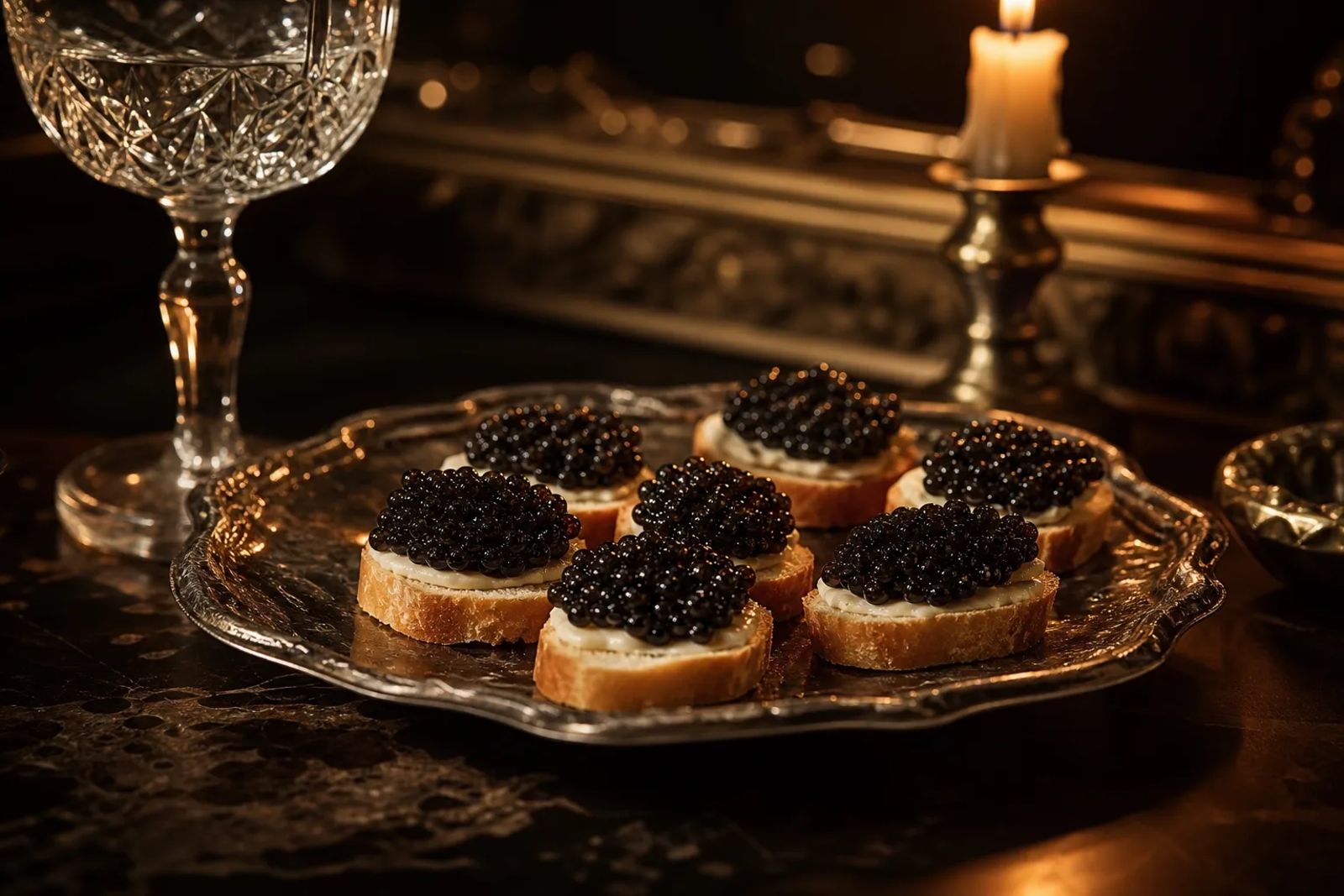
In late nineteenth century New York, some bars gave away caviar sandwiches to encourage drink orders. Historian Inga Saffron records the practice: a striking contrast to tasting menus and theatrical bites from the back of a hand.
That culture has never belonged to one table. It runs through Jewish appetizing shops, western sturgeon farms, regional fisheries and restaurants serving roe with fried chicken. Its character lies in the company caviar keeps: local foods, immigrant traditions and a conspicuous appetite for play.
Four phases of American caviar culture
Abundance. American river roe, or fish eggs, entered European trade as well as domestic eating in the late nineteenth century. The supply connected a working waterfront with an export business: the Delaware and Hudson river boom places those fisheries at the heart of the story.
Decline. That abundance did not last. By the opening years of the twentieth century, the Atlantic fisheries had suffered severe losses. A TRAFFIC review records falling catches in the Delaware fishery and the intensive targeting of females. The river fisheries' collapse gives the abundance its sobering context: this was the beginning of the story, not a model for its future.
Imports. Soviet and Iranian caviar became closely connected with the American market in the twentieth century. The US was a leading importer in 2000, according to FAO's historical account, which also identifies distributors serving the country. New York and Miami's caviar culture follows the urban settings where imported roe acquired its restaurant associations.
Domestic farming. The next American chapter was cultivated, not recovered from the wild. UC Davis documents the research and industry partnerships behind white sturgeon farming in Sacramento County, giving caviar a foundation as a regional farm product. California and the Pacific Northwest tells that western story, which now sits alongside imported caviar rather than replacing it.
An older relationship with the fish
The four commercial phases above describe the history of a food business, not the beginning of North American relationships with sturgeon. In a 2007 oral history, Menominee tribal historic preservation officer David Grignon described awaiting the spring return, giving thanks after the first catch and holding a communal feast.
In July 2022, a Bon Appétit writer described eating caviar from a wooden mannequin hand at Martiny's in New York, a theatrical variation on eating it from one's own hand.
His account centres the fish, seasonal food and obligation. It offers a different starting point from a restaurant garnish or a fashionable service. Indigenous sturgeon traditions deserve to be read in their own terms.
New York's appetizing tradition
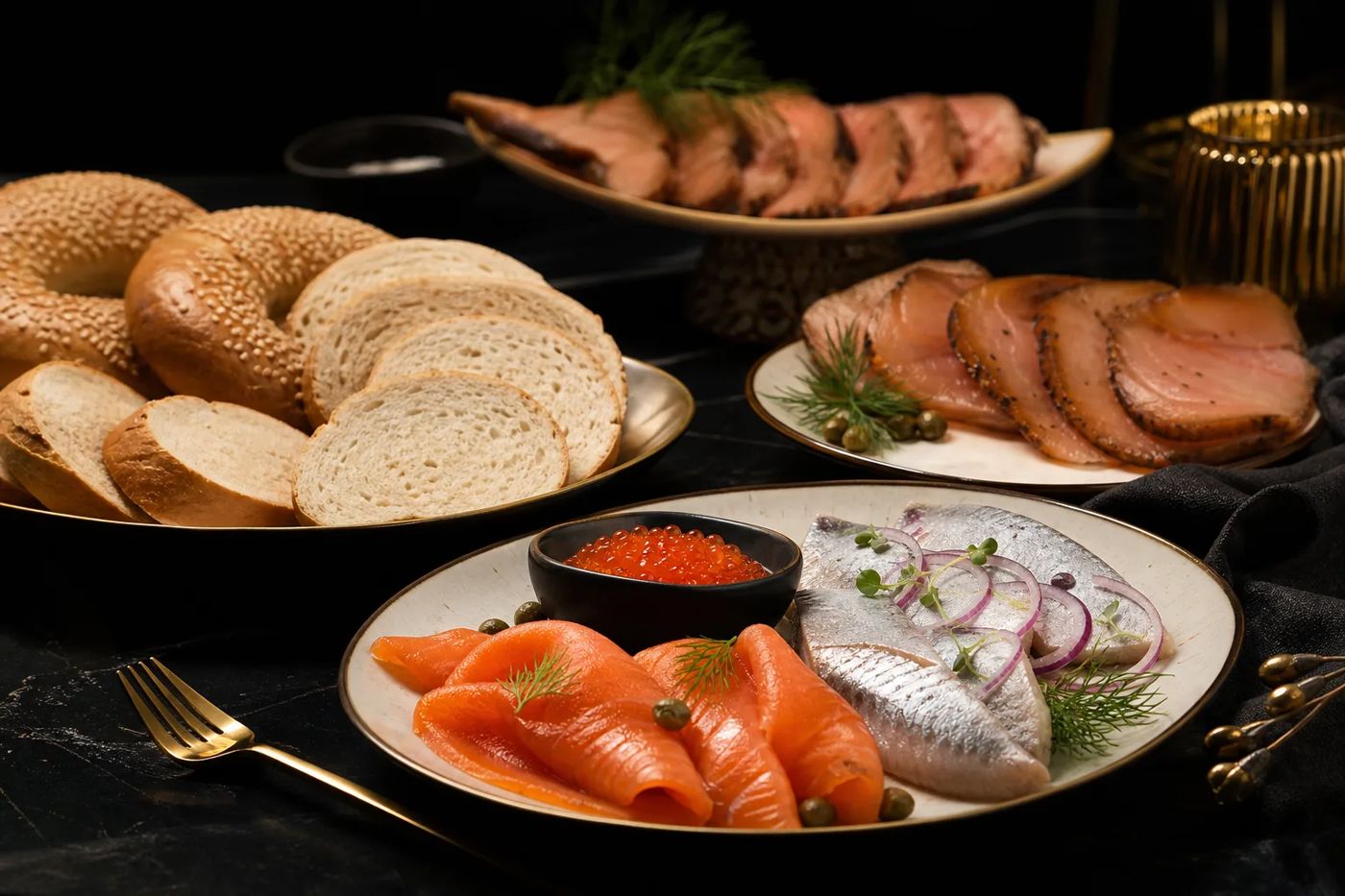
In New York Jewish food culture, appetizing is a noun as well as an adjective. Russ & Daughters explains it as the foods eaten with bagels and identifies it as a particularly New York Jewish tradition. The word names a culinary inheritance, not simply a tempting counter.
According to the company's history, Joel Russ began selling herring after arriving in 1907. He opened his shop in 1914 and moved to East Houston Street in 1920. Its menu places smoked salmon, herring and smoked sturgeon beside caviar and other roe. Salmon roe and a sandwich finished with flying fish roe put eggs firmly within the wider fish counter, rather than reserving them for a separate ceremony.
That vocabulary matters. Calling every smoked fish shop a delicatessen flattens a distinction its practitioners deliberately preserve; Russ & Daughters' account describes its own tradition, not every American deli. The counter makes another distinction equally clear: roe belongs to a family of foods, but its members are not interchangeable.
Domestic roe has more than one geography
In Sacramento County, university research helped build commercial white sturgeon farming. UC Davis's account connects that work with broodstock development and collaboration with farmers. The old Atlantic harvest depended on river fisheries. Both give American roe a sense of place, but through different relationships with the fish, rather than simply through a European serving ritual.
Domestic roe also includes hackleback and paddlefish roe from the Mississippi basin. Hackleback is the trade name for shovelnose sturgeon roe. Missouri documents shovelnose roe fishing, limited since 2010 to the Mississippi above St Louis, as well as spring paddlefish snagging. Hackleback and paddlefish belong to that regional story, with a clear distinction between recreational fishing and commercial roe supply.
Choupique gives Louisiana its own local vocabulary for bowfin. Louisiana Sea Grant's 1999 account describes an established roe fishery and research in the Atchafalaya Basin. That gives choupique a documented home and history, rather than merely an identity as a substitute for something else. The eastern and southern American story reaches well beyond the western farms.
The label should make the fish clear. FDA's nonbinding CPG Sec. 540.150 says unqualified caviar should mean salted sturgeon roe. Caviar from other fish should name the fish in type of substantially the same size and prominence, and declare any artificial colour.
From tasting menus to crisps and bumps
Caviar can arrive as a composed restaurant dish or as something to eat with the fingers. Thomas Keller's published menu includes Oysters and Pearls with caviar, placing it within the tasting menu. House-made potato chips, crème fraîche and chives provide a different setting for sturgeon caviar on Pearl & Horn's March 2026 menu.
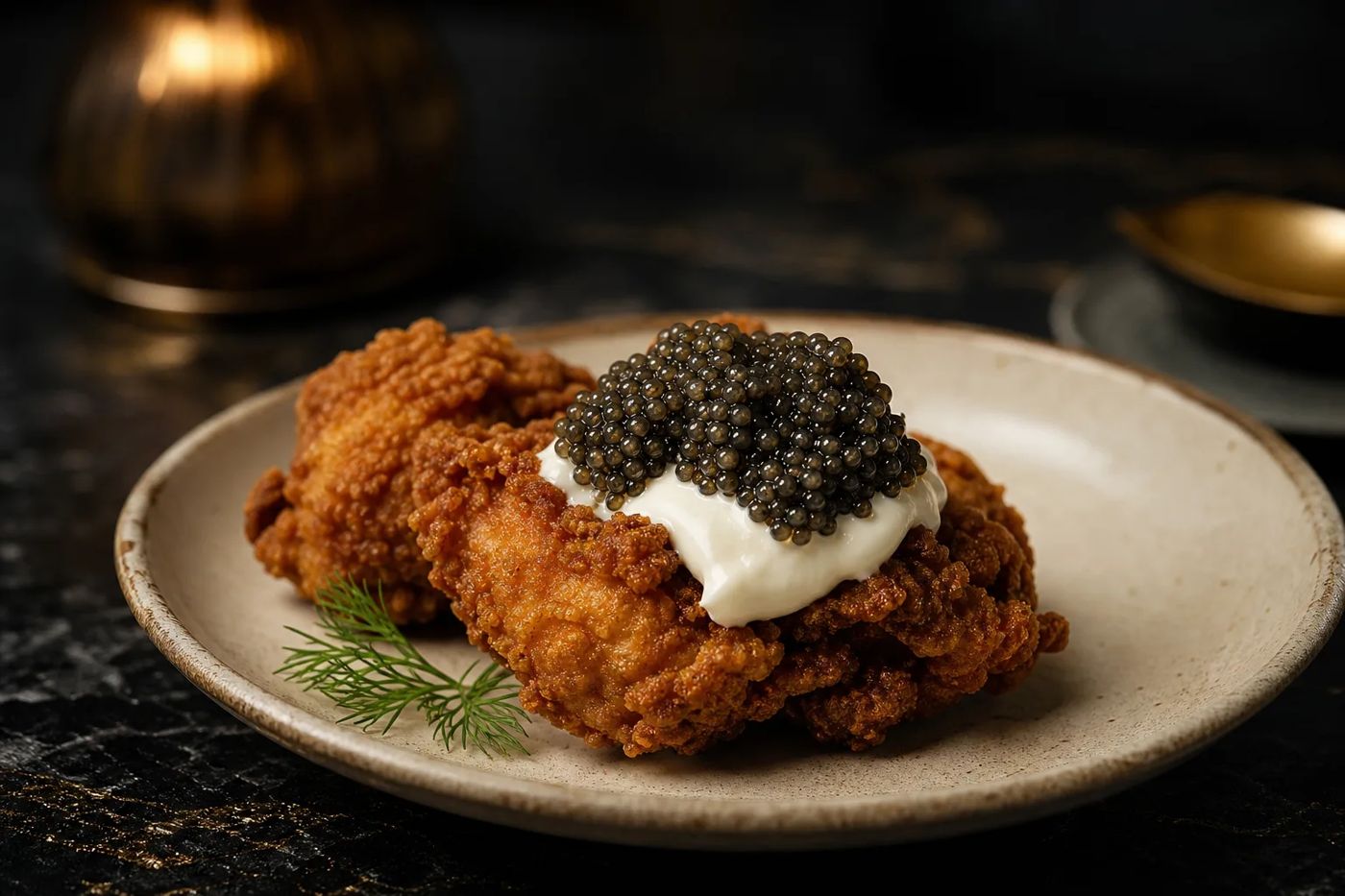
Fried chicken takes that contrast further. Momofuku has advertised it with biscuits, potato chips and an optional caviar addition. Familiar fried food becomes the setting for roe; the diner need not adopt an entire formal service to enjoy it. Caviar with fried chicken and crisps explores that meeting of foods and expectations.
The caviar bump strips the service back further. Even the crisp disappears. In July 2022, a Bon Appétit writer described eating caviar from a wooden mannequin hand at Martiny's in New York, a theatrical variation on eating it from one's own hand. The report captures a moment in the ritual's visibility rather than its invention; the caviar bump explains the practice more fully.
From restaurant tables, these informal bites also reach screens. Eater's reporting on caviar snacks brings potato chips, crackers and online food videos into the same frame. It is a lively snapshot of viral caviar trends on social media, showing a visible style of eating rather than measuring what Americans as a whole eat.
Behind the freedom of presentation sit firm limits on supply. The 2005 US suspensions restricted imports of beluga products from the Caspian and Black Sea basins, changing what menus could offer. The special rule provides for qualifying exceptions and case by case aquaculture exemptions; the US beluga rule sets out the details.
The local calendar still matters
For fishing communities, these fish mark the year as well as the menu. Missouri listed its main 2026 paddlefish season as 15 March to 30 April, with different spring and autumn dates under its Mississippi River rules. Buying or selling paddlefish eggs is prohibited; possession and transport of extracted eggs are restricted.
In Wisconsin, the Winnebago System's lake sturgeon spearing season began on 14 February 2026, subject to harvest caps. The state's account emphasises shanty life, registration stations and shared photographs. The fish can organise a community event without being reduced to its eggs.
These are local calendars, not national fishing instructions or a general right to collect or sell roe. Species, waters, permits and annual closures matter; harvest caps limit fishing, and a recreational season cannot establish the origin of a particular jar. The regional accounts keep questions of supply distinct from the customs built around the catch.
A short American timeline
| Date | Cultural marker |
|---|---|
| Late nineteenth century | Saffron documents caviar sandwiches in some New York bars, alongside the export trade. |
| 1914 | Russ & Daughters dates the opening of Joel Russ's first shop to this year. |
| 1987 and 1988 | UC Davis records an industry broodstock committee, then publication of its white sturgeon hatchery manual. |
| 2005 | USFWS announces Caspian and Black Sea beluga trade suspensions, changing which imports could legally reach American tables. |
| 2022 | Bon Appétit documents the bump's theatrical presentation at a New York cocktail bar. |
Where to go next
- Caviar Around the World: compare the American story with other eating traditions.
- Indigenous Sturgeon Traditions in North America: explore relationships with the fish that precede the commercial caviar trade.
Sources
- NOAA Fisheries. History of Sturgeon Fishing on the East Coast, undated teaching pack reproducing excerpts from Inga Saffron's Caviar, 2002. Retrieved PDF.
- TRAFFIC North America. Caviar and Conservation: Status, Management, and Trade of North American Sturgeon and Paddlefish, 2008. Report.
- FAO. Sturgeons (Acipenseriformes), undated report chapter containing historical production, distribution and import data. Chapter.
- University of California, Davis. Farming Caviar: A UC Davis Innovation, 19 May 2025. Article.
- Russ & Daughters. What is appetizing, undated company account, retrieved November 2026. Account.
- Russ & Daughters. History, undated company account, retrieved November 2026. History.
- Russ & Daughters. Menu, undated company menu, retrieved November 2026. Menu.
- Missouri Department of Conservation. Bring Back the Sturgeons, March 2026; Paddlefish: Tips For Fishing, undated current guidance. Conservation article; fishing guidance.
- Louisiana Sea Grant and Louisiana Cooperative Extension Service. Lagniappe, volume 23, number 2, 3 February 1999, bowfin account. Issue.
- US Food and Drug Administration. CPG Sec. 540.150: Caviar, Use of Term, Labeling, reissued October 1989, current guidance page retrieved November 2026. Guidance.
- Thomas Keller Restaurant Group. Oysters and Pearls, undated published dinner menu, retrieved November 2026. Menu.
- Pearl & Horn. Dinner menu, 25 March 2026 edition. Menu.
- Momofuku. Noodle Bar Uptown menu, online menu and indexed menu text, retrieved November 2026. Menu.
- Bon Appétit. What It's Like Trying Martiny's Mannequin Caviar Bump, 15 July 2022. First-person report.
- Eater. Why Caviar Is TikTok's Favorite Snack Food Right Now, 2022. Contemporary report.
- US Fish and Wildlife Service. Service Suspends Trade in Threatened Beluga Sturgeon, 28 October 2005, also recording the September Caspian announcement. Announcement.
- 50 CFR 17.44(y), beluga sturgeon special rule, current text reproduced by Cornell Legal Information Institute, retrieved November 2026. Legal text.
- Missouri Department of Conservation. Paddlefish, 2026 season and roe restrictions. Season guidance.
- Missouri Department of Conservation. Paddlefish: Special Area Regulations, current guidance retrieved November 2026. Waterbody rules.
- Wisconsin Department of Natural Resources. 2026 Sturgeon Spearing Season Opens Feb. 14, 9 February 2026; Winnebago System Sturgeon Spearing, current season archive and guidance. Announcement; season archive.
- NOAA Voices Oral History Archives. Dave Grignon Oral History, interviewed by Kathleen Schmitt Kline, 10 January 2007, People of the Sturgeon collection. Transcript.
Research combined fisheries histories, official naming and wildlife guidance, a Menominee oral history, attributed business histories, restaurant menus and contemporary cultural reporting.
Last checked: November 2026