
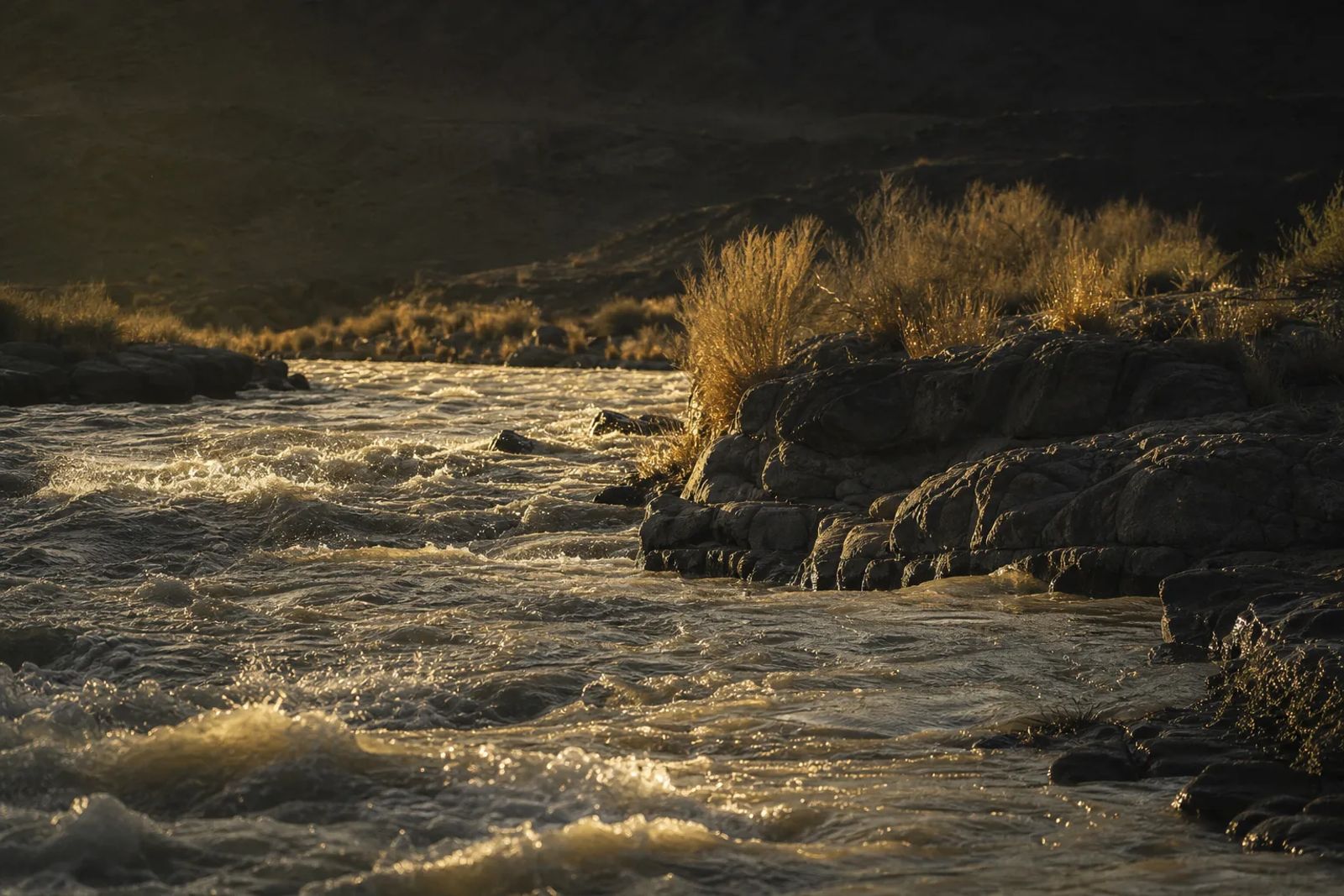
A sturgeon with a historical maximum length of just 27 cm lives in the fast, turbulent, turbid waters of the Amu Darya. This is the small Amu Darya shovelnose, its maximum length recorded in its IUCN account, and one of three small, river-dwelling species in the Central Asian genus Pseudoscaphirhynchus. Both Amu Darya species survive. Their Syr Darya relative may be extinct: no confirmed record has emerged for decades.
Species at a glance
| Species and common name | River basin | IUCN record | CITES |
|---|---|---|---|
| P. kaufmanni, large Amu Darya shovelnose sturgeon | Amu Darya | Critically Endangered A2c; assessment published 2022 | Appendix II; KAU |
| P. hermanni, small Amu Darya shovelnose sturgeon | Amu Darya | Critically Endangered A2c; assessed 14 September 2019, published 2022 | Appendix II; HER |
| P. fedtschenkoi, Syr Darya shovelnose sturgeon | Syr Darya | Critically Endangered A2bc; assessed 2019, published 2022 | Appendix II; FED |
Their story belongs to conservation, rather than caviar. This profile offers no route to purchase.
Three species, two great river systems
Two rivers define this genus. P. kaufmanni and P. hermanni belong to the Amu Darya; P. fedtschenkoi belongs to the Syr Darya. All three are members of the sturgeon family, Acipenseridae.
Eschmeyer's Catalog of Fishes recognises three valid species, although a genus search returns four records. The fourth name, Pseudoscaphirhynchus rossikowi, is a synonym of P. hermanni, not another surviving species.
Older literature places all three under Scaphirhynchus. Those historical names need care: the living American genus is distinct. The Amu Darya system connects Uzbekistan, Turkmenistan, Tajikistan and Afghanistan, while the Syr Darya species has a historical range spanning Kazakhstan, Uzbekistan and Tajikistan.
That river map does not establish viable populations in every country. One recent piece of evidence comes from Afghanistan: the 2026 study reports photographs of P. kaufmanni at Heyratan.
For their place among other sturgeons, see sturgeon species. The basin's other historically important sturgeon has its own profile in ship sturgeon.

Shovel snouts, spines and a revealing tail
These fishes have flattened, shovel-shaped snouts and the rows of bony plates characteristic of sturgeons. They resemble American shovelnose sturgeons.
The traditional identifying features are striking. P. kaufmanni has sharp spines on its head and snout, plus a tail filament. P. hermanni lacks both the spines and the filament; instead, look for a distinctive fold or groove at the outer edge of the pectoral fin. Use the full combination of features, particularly with damaged specimens.
Genetics complicates the picture suggested by those similar snouts. A 2020 study reconstructed four complete mitochondrial genomes representing all three species, including museum material. Another mitochondrial analysis placed P. kaufmanni close to the stellate sturgeon rather than American Scaphirhynchus. Together, these findings challenge a family tree drawn simply from outward resemblance. The American fish covered in hackleback caviar belongs to a different genus.
Life in a changing river
These are freshwater river sturgeons, not fishes dependent on a migration out to sea. The small Amu Darya species feeds on aquatic invertebrates along the bottom. Dependable current estimates of its abundance and reproductive timing remain lacking.
Irrigation and river diversion tie their story to the shrinking Aral Sea. But the shrinking sea and the damage to freshwater habitat are distinct parts of that story. Water abstraction, dams and altered flows transformed the rivers themselves, while agricultural drainage carried salts and pollutants, including pesticides, into the water. For these river specialists, the loss was more than a smaller sea downstream: it was the disruption of the freshwater habitat they need.
Do the Amu Darya and Syr Darya sturgeons still survive?
Both Amu Darya species persist. A study published in June 2026 combined surveys undertaken from 2019 to 2024 with measurements, mitochondrial DNA and interviews. Its field and bycatch records included 13 P. hermanni from Uzbekistan. Survival is established; recovery is not.
Decades without a confirmed sighting leave its survival uncertain, rather than establish extinction.
Within P. hermanni, the picture is more complicated. The researchers documented the short-snouted form but considered the long-snouted form likely extinct. That distinction matters: the possible loss of one form does not mean the loss of the whole species. IUCN's 2022 assessment lists P. hermanni as Critically Endangered, without a species-level Possibly Extinct flag.
The Syr Darya species, P. fedtschenkoi, remains the unresolved case. IUCN's 2010 assessment used the exact wording “Critically Endangered (Possibly Extinct)” and reported no records since the 1960s. That entry explicitly directs readers to a replacement assessment published in 2022, which lists the species as Critically Endangered under criterion A2bc.
Decades without a confirmed sighting leave its survival uncertain, rather than establish extinction.

Protection starts with the river
All three species fall within CITES Appendix II, which controls international trade. Appendix II status does not certify a secure population, and the species codes identify the fish rather than indicate a commercial caviar fishery. National law governs domestic capture and possession separately from CITES.
IUCN's 2022 account reports national protection for P. hermanni in its range countries and identifies habitat within Turkmenistan's Amu Darya Nature Reserve. It also records an unsuccessful attempt to maintain the species in captivity in Uzbekistan. These legal protections and conservation efforts are distinct from IUCN threat categories, which describe extinction risk.
The 2026 researchers recommend stronger action against illegal fishing, flow management to restore sediment and spawning conditions, and further development of conservation breeding. These proposed interventions are not evidence of an established recovery programme. Protecting remaining fish and the river processes they need must proceed together.
Sources
-
California Academy of Sciences. Eschmeyer's Catalog of Fishes: genera, species, references, online records retrieved November 2026. Genus and species records for Pseudoscaphirhynchus, including historical combinations and P. rossikowi.
-
IUCN, Mugue, N. and Karimov, B. Pseudoscaphirhynchus hermanni. The IUCN Red List of Threatened Species, 2022 publication, assessment dated 14 September 2019. Assessment record.
-
IUCN, Mugue, N. Pseudoscaphirhynchus fedtschenkoi. The IUCN Red List of Threatened Species, 2010 publication, assessment dated 24 October 2009. Superseded assessment record. Mugue and Karimov published the current assessment in 2022.
-
IUCN, Mugue, N. Pseudoscaphirhynchus kaufmanni. The IUCN Red List of Threatened Species, 2010 publication, assessment dated 24 October 2009. Superseded assessment record. Mugue and Karimov published the current assessment in 2022.
-
CITES Secretariat. Appendices I, II and III, valid from 5 March 2026. Official appendices.
-
CITES. Conservation of and trade in sturgeons and paddlefish, Resolution Conf. 12.7 (Rev. CoP17), Annex 2. Resolution text.
-
Nedoluzhko and colleagues. Molecular phylogeny of one extinct and two critically endangered Central Asian sturgeon species (genus Pseudoscaphirhynchus) based on their mitochondrial genomes. Scientific Reports, volume 10, article 722, 2020. Research record.
-
Sheraliev, B. and Peng, Z. Complete mitochondrial genome sequence and phylogenetic position of the Amu Darya sturgeon, Pseudoscaphirhynchus kaufmanni (Acipenseriformes: Acipenseridae). Journal of Applied Ichthyology, first published 28 April 2020. Publisher record.
-
Brownstein, C.D. and Near, T.J. Toward a Phylogenetic Taxonomy of Sturgeons (Acipenseridae). Bulletin of the Peabody Museum of Natural History, volume 66, issue 1, April 2025. Author-hosted paper.
-
FAO. Fisheries in irrigation systems of arid Asia, Fisheries Technical Paper 430, 2003, Uzbekistan chapter. Aral Sea basin discussion.
-
npj Biodiversity. Multidimensional crisis in the conservation of Amu Darya false shovelnose sturgeons, published 1 June 2026. Full research article.
Last checked: November 2026