
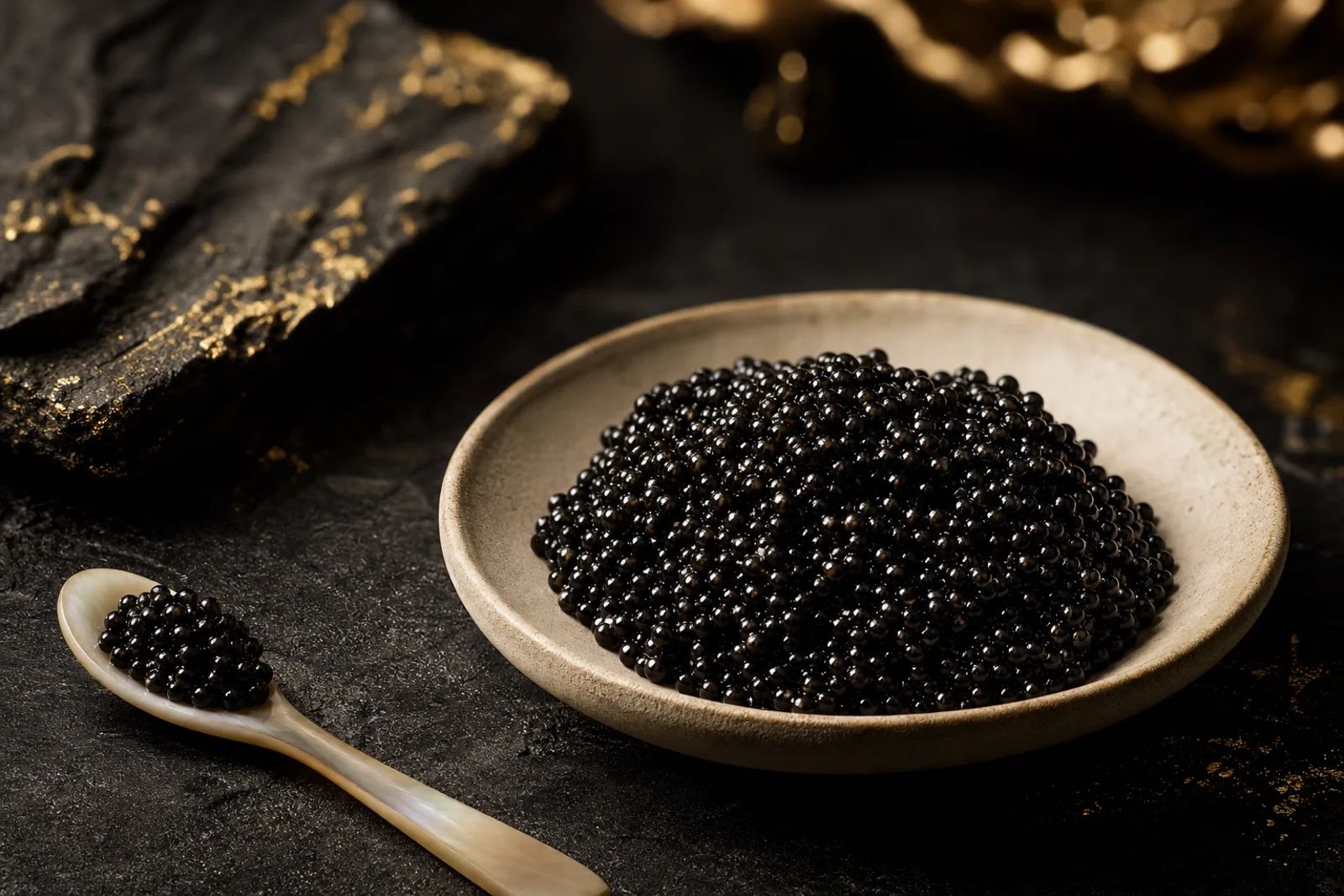
Small, jet black beads, firm, with a light pop: that is how Paramount Caviar describes hackleback. Harvesting this roe means navigating rules designed to protect another sturgeon.
Hackleback is salted roe from the shovelnose sturgeon, Scaphirhynchus platorynchus, a small river sturgeon native to the Mississippi basin, including the Missouri system. It closely resembles the endangered pallid sturgeon. That resemblance makes both fish and their roe difficult to police in mixed fisheries, so commercial harvest is tightly controlled.
Shovelnose sturgeon at a glance
| Field | Detail |
|---|---|
| Common and trade names | Shovelnose sturgeon; hackleback; sand sturgeon; switchtail. |
| Scientific name | Scaphirhynchus platorynchus, as used in the US federal rule. 1,7 |
| CITES | Appendix II; species code PLA. 6,15 Labelling follows Resolution Conf. 12.7 (Rev. CoP17). |
| IUCN Red List | Vulnerable in the IUCN results published in July 2022. |
| Native range | Mississippi drainage, including the Missouri basin and major tributaries. |
| Roe colour | Black, according to Paramount Caviar. |
| Wild trade | Restricted US commercial fisheries; CITES documentation for international trade. Checked November 2026. |
What hackleback caviar means
Hackleback names the fish. It is not a quality grade, a processing method or a hybrid. Indiana's Department of Natural Resources also records sand sturgeon and switchtail as names for the same species: regional accounts may use different names for the same fish.
This is sturgeon caviar, not paddlefish roe. The sturgeon species guide places hackleback among its relatives; hackleback vs paddlefish explains the two products and the distinction between their trade names.
The river fish behind the roe
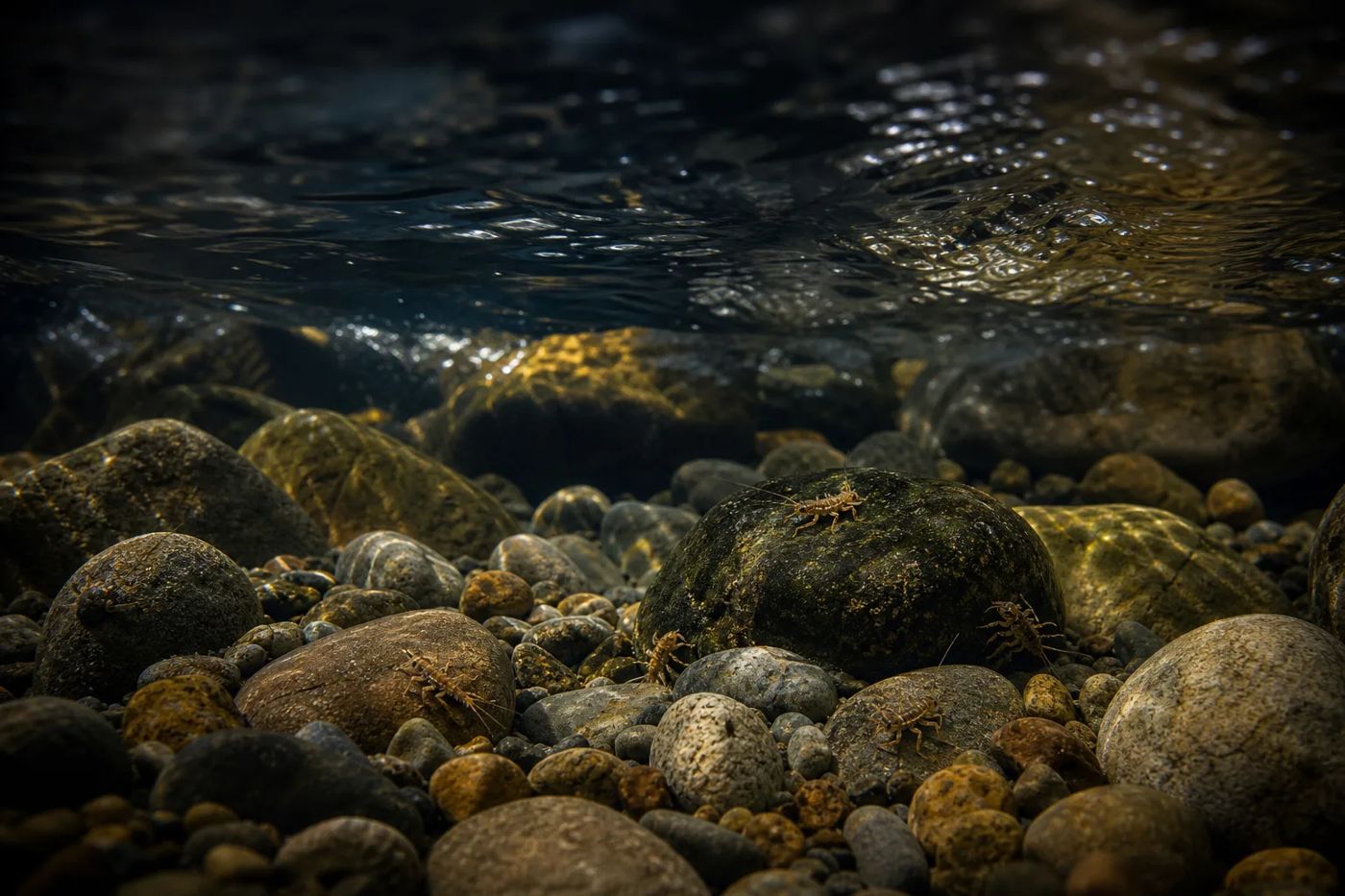
Shovelnose live in flowing river channels, commonly over sand or gravel, feeding on bottom-dwelling invertebrates. Their home is the Mississippi drainage, a geography much broader than the main river alone. It includes the Missouri and tributary systems.
Mississippi's wildlife agency gives typical adult lengths of about 56 to 66 cm (22 to 26 inches), with sexual maturity at 5 to 10 years. Females do not spawn every year. These figures describe the fish's biology, rather than a permitted harvest size or a timetable for farm production.
The 2022 IUCN results reproduced by the North American Sturgeon and Paddlefish Society classify shovelnose as Vulnerable. This global assessment concerns its extinction risk. The separate US similarity of appearance listing helps protect a different species, the endangered pallid sturgeon.
How to recognise the fish
The shovelnose has a flattened, spade-shaped snout, rows of bony plates called scutes, and a narrow, plated section just before the tail. Four barbels, or sensory feelers, hang beneath the snout. The upper tail lobe trails into a fine filament, although this may be broken in adults.
Missouri's identification guide describes a shorter, less pointed snout than the pallid sturgeon's, along with plates on the belly. Yet even detailed physical measurements can leave identification uncertain, as the federal listing documents.
These features describe the fish; they do not establish permission to retain it. Neither a photograph nor the appearance of loose roe replaces documented identity and lawful origin. The guide to protected sturgeon lookalikes explains the conservation context, rather than serving as a harvesting key.
Bead size, colour and eating qualities
Firmness and a light pop are central to Paramount Caviar's description of its small, jet black hackleback beads. Another supplier, Hackleback Caviar, describes firm roe with clean salinity and mild umami. These are suppliers' product descriptions, not our tasting results or a promise that every batch will taste alike.
Black colour alone cannot authenticate hackleback. Nor should a retailer's bead measurement become a fixed biological specification for the species: it describes the product being offered.
Missouri's wildlife agency documents commercial harvest of wild shovelnose for caviar. If roe is described as farmed, ask for evidence identifying the operation and the batch.
Why the wild harvest is so tightly controlled
Processed roe was especially difficult to distinguish. That was one of the findings behind the US Fish and Wildlife Service's similarity of appearance listing, published on 1 September 2010 and effective from 1 October 2010.
A fish caught accidentally in otherwise lawful commercial gear must be released immediately at the capture point, with all roe intact.
The operative special rule, 50 CFR 17.44(aa), prohibits commercial fishing-related take of shovelnose sturgeon, shovelnose-pallid hybrids and their roe in specified waters shared with pallid sturgeon.
Those waters include the Missouri River, the Mississippi below Melvin Price Locks and Dam, specified reaches of the Platte, Kansas and Yellowstone rivers, and Louisiana's Atchafalaya River. A fish caught accidentally in otherwise lawful commercial gear must be released immediately at the capture point, with all roe intact.
The problem was more serious than a naming mistake. The 2010 finding documented pallid sturgeon entering the commercial shovelnose fishery. Its discussion of the limitations of genetic identification reflects the evidence available in 2010.
Where commercial roe harvest is permitted
A state name is not enough to establish a lawful harvest. Permission depends on the waters, season, licences and fish involved. These selected state conditions are a starting point; check the applicable state and federal rules before harvesting.
| State | Verified scope and principal conditions | Official source | Checked |
|---|---|---|---|
| Illinois | Mississippi above Melvin Price, subject to the Niota exclusion; Ohio and Wabash. Mississippi and Wabash season: 1 October to 31 May; Ohio: 15 October to 15 May. Roe permit required. Fork length: 61 to 81 cm (24 to 32 inches) on Mississippi and Ohio; at least 64 cm (25 inches) on Wabash. | 17 Illinois Administrative Code 830.13; 2026 fishing regulations | November 2026 |
| Iowa | Mississippi, not Missouri. Season: 15 October to 15 May. Minimum fork length: 69 cm (27 inches); maximum on Wisconsin boundary waters: 86 cm (34 inches). Fish must remain intact to the processing facility. | 571 IAC 82.2, effective June 2026 | November 2026 |
| Kentucky | Ohio River Basin only. Season: 15 October to 15 May. Fork length: 61 to 81 cm (24 to 32 inches). Roe harvester permit required; no unprocessed shovelnose roe after 20 May. | 301 KAR 1:155 | November 2026 |
| Indiana | Commercial fishing and roe harvester licences required. These licences do not authorise harvest in every water. | Indiana DNR species information | November 2026 |
| Missouri | A March 2026 agency account identifies commercial harvest in Mississippi Pools 20, 21, 22, 24, 25 and 26. | Missouri Conservationist, March 2026 | November 2026 |
The inch measurements are the legal thresholds; the metric figures are rounded equivalents. A recreational fishing entitlement does not authorise commercial roe supply. On a boundary river, do not assume the same rule applies on both banks.
Exporting from the US and importing elsewhere
Wild shovelnose caviar needs a CITES export permit to leave the United States. USFWS directs applicants to form 3-200-76, supported by fishing licences, harvest reports and supplier documentation. Commercial exporters also need the Service's import and export licence and wildlife inspection arrangements. Submit the application, then wait for permission before shipping.
EU and British imports require CITES import permits. For Switzerland, the UAE, China, Japan, Russia and Australia, consult the national authorities. APHA handles Northern Ireland permits. Personal luggage exemptions allow 125 g per person, correctly labelled. Food import requirements still apply alongside wildlife trade documents.
In the United States, the Lacey Act prohibits certain trade in fish taken, possessed, transported or sold in violation of applicable law, including state law. This includes interstate or foreign trade in fish taken contrary to state law. The US caviar rules guide explains the wider federal framework.
How to recognise genuine hackleback on a label
Start with the species, not the decorative trade name. Look for Scaphirhynchus platorynchus in the product information. For internationally traded caviar, look for PLA in the standardised species field on the CITES label.
Under US 50 CFR 23.71, the primary container must carry a non-reusable label recording species, source, origin country, year, plant and lot information, with different details for repacking. Read the origin and repacking countries separately. American roe repacked abroad remains American in harvest origin.
A CITES label provides traceability information, not scientific proof of its contents. If the account is unclear, ask for the harvest origin and batch documentation. A broad river-basin description is not a lawful source in itself.
Sources
-
Indiana Department of Natural Resources. Shovelnose Sturgeon (Scaphirhynchus platorynchus), Animal Information Series, undated edition retrieved November 2026. Common names, physical features, habitat and commercial licensing statement. Agency species information.
-
Mississippi Department of Wildlife, Fisheries, and Parks. Shovelnose Sturgeon, Fish ID Guide, undated live edition retrieved November 2026. Adult size, maturity, spawning frequency and protection in Mississippi. Agency species account.
-
Missouri Department of Conservation. Shovelnose Sturgeon, Field Guide, undated live edition retrieved November 2026. Identification, common names, river habitat and distribution. Federal commercial harvest restrictions apply in specified shared waters. Agency field guide.
-
North American Sturgeon and Paddlefish Society. IUCN Assessment 2022, 1 August 2022. Table reproducing the 2022 conservation categories. Assessment summary.
-
US Fish and Wildlife Service. Endangered and Threatened Wildlife and Plants; Threatened Status for Shovelnose Sturgeon Under the Similarity of Appearance Provisions of the Endangered Species Act, final rule, Federal Register 75, pages 53598 to 53606, 1 September 2010. Final rule.
-
CITES Secretariat. Conservation of and trade in sturgeons and paddlefish, CoP17 Doc. 50, 2016. This 2016 working document includes the species code PLA. The resolution is Conf. 12.7 (Rev. CoP17). CoP17 document.
-
US Fish and Wildlife Service; Electronic Code of Federal Regulations. 50 CFR 17.44, Species-specific rules, fishes, current online text retrieved November 2026, paragraph (aa). Federal special rule.
-
US Fish and Wildlife Service; Electronic Code of Federal Regulations. 50 CFR 23.71, How can I trade internationally in sturgeon caviar?, current online text retrieved November 2026. Paragraphs (b) and (c) cover labels and accompanying documentation. Federal caviar-trade requirements.
-
Illinois General Assembly. 17 Illinois Administrative Code 830.13, Special regulations for the commercial harvest of roe-bearing species, live codified text retrieved November 2026. Commercial roe regulations.
-
Illinois Department of Natural Resources. 2026 Illinois Fishing Regulations, 2026 edition, commercial fishing section. Regulations booklet.
-
Iowa Department of Natural Resources; Iowa Administrative Rules. ARC 0272D, Chapter 82, commercial fishing, filed 17 April 2026, effective 17 June 2026. Adopted rules notice.
-
Kentucky Legislative Research Commission. 301 KAR 1:155, Commercial fishing requirements, live text retrieved November 2026, especially sections 9 to 11. Kentucky regulation.
-
Missouri Department of Conservation. Missouri Conservationist, March 2026, “Saving the sturgeons”. Identifies commercial shovelnose harvest in specified upper Mississippi pools. March 2026 issue.
-
US Fish and Wildlife Service. 3-200-76: Export of Caviar or Meat of Paddlefish or Sturgeon Removed from the Wild under CITES, live permit-service instructions retrieved November 2026. Export application guidance.
-
European Commission. EU Wildlife Trade Reference Guide, online edition retrieved November 2026, “What are the rules for the issuance of import permits for specimens of Annex A or B-listed species?” and Annex XIV, sturgeon and paddlefish. Import-permit guidance; sturgeon annex.
-
UK Government; Animal and Plant Health Agency. Check if you need a CITES permit to import or export endangered species, live guidance retrieved November 2026. UK CITES guidance.
-
Paramount Caviar. Hackleback Sturgeon, undated product description retrieved November 2026. Supplier description.
-
Hackleback Caviar. About Us, undated company statement retrieved November 2026. Company description.
Last checked: November 2026