
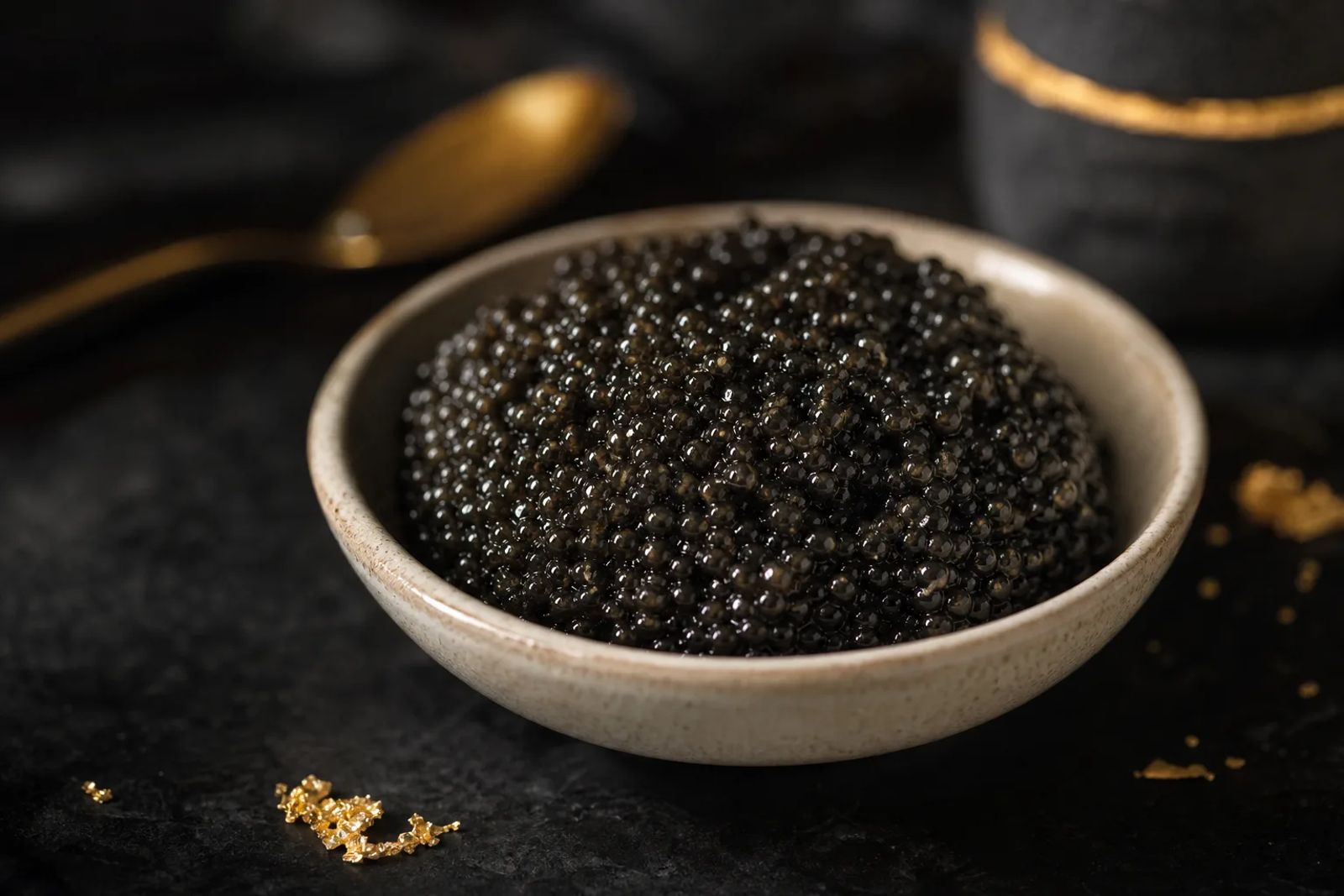
Wild sturgeon once swam in Belgian waters. Today's Belgian caviar comes from farms, not a wild fishery: a modern aquaculture industry rather than a harvest of migrating river fish. Documented producer accounts describe controlled water systems and a production chain spanning Flanders and Wallonia.
Belgium's documented sturgeon production includes Siberian and Russian sturgeon, sterlet and beluga. The essential distinction is origin: a Belgian brand or packing address does not necessarily mean Belgian caviar.
Belgium at a glance
| Species farmed | Siberian sturgeon (Acipenser baerii), Russian sturgeon (Acipenser gueldenstaedtii), sterlet (Acipenser ruthenus) and beluga (Huso huso) 1,2. |
| Documented farming areas | Turnhout in Antwerp province and the Mouscron area in Hainaut, identified in a producer interview rather than a national census 3. |
| CITES registered operations | Three Belgian facilities as of November 2026, under a combined processing and repackaging heading. |
| Import and export regime | EU Wildlife Trade Regulations, notably Regulation (EC) No 338/97 and Regulation (EC) No 865/2006, plus EU food hygiene and information rules 11,12,13,14,15. |
| PGI or PDO | Not stated |
| Wild stocks | Historical records cover European sturgeon (Acipenser sturio) and Atlantic sturgeon (Acipenser oxyrinchus), generally without distinguishing them 7. |
| Country's role | Roe production and imports 1,8, with an approval route for processing and repacking 9. |
How Belgian caviar production developed
Belgium's modern caviar industry grew from aquaculture, not the harvest of migrating river fish. Royal Belgian Caviar dates its commercial launch to 2002 in its brochure and on its website. That establishes the producer's account of its own launch, rather than an independently verified national starting date or national first.
An independent snapshot follows in ICES's 2007 working group report. The Belgian national report describes sturgeon cultivation in Turnhout during 2006, with Siberian sturgeon already supplying caviar. Work on other species was also under way: the farming programme extended beyond a single finished product.
The fuller company story belongs in the Royal Belgian Caviar profile. For understanding the industry's development, keep three milestones separate: breeding fish, growing them to maturity and selling processed roe. They need not begin in the same year, and a company's foundation date is not automatically the date of its first caviar harvest.
Were sturgeon native to Belgian rivers?
Wild sturgeon occurred in waters associated with Belgium, although their presence does not establish a native spawning population at every location. A 2022 peer-reviewed reconstruction examined more than 5,000 historical fisheries and sales records across north-western Europe, including Belgium. It documented catches in the Scheldt system and occurrences near Visé and Liège on the Meuse, particularly before 1850.
A farm can produce roe locally from a species whose natural range lies elsewhere; that is a different achievement from restoring a native population.
The study covers European and Atlantic sturgeon. Historical catch records generally cannot distinguish the two. Some fish apparently entered smaller waterways as strays, so an occurrence alone does not establish spawning habitat.
These records tell the story of wild fish, not of an established Belgian wild-caviar industry continued by today's farms. The species documented in modern Belgian commercial farming differ from the historically recorded river fish. A farm can produce roe locally from a species whose natural range lies elsewhere; that is a different achievement from restoring a native population. Farm production and wild-sturgeon recovery should be understood on their own terms.
Which sturgeon are farmed, and how?
“Russian” identifies a species here, not the country where the fish was raised. Russian sturgeon is Acipenser gueldenstaedtii. Belgian beluga likewise means roe from the species CITES lists as Huso huso, rather than a separate Belgian species or a description of egg size. Taxonomic usage differs: in October 2025 the IUCN Sturgeon Specialist Group adopted Acipenser huso, now used by WoRMS; Brownstein and Near (2025) retain Huso.
The Commission's account follows the fish from a hatchery stage to growing facilities near Mouscron, where a recirculating aquaculture system, or RAS, treats and reuses water. The Flemish aquaculture directory independently describes Aqua Bio's sturgeon farm as a closed system. That directory describes aquaculture operations; it is separate from the CITES registration record.
VLAM, the Flemish agricultural marketing organisation, quotes the producer describing hatching in Turnhout and the transfer of young fish to Mouscron. This account supports a production chain spanning Flanders and Wallonia, but does not establish the location of every farming stage. The brand's address alone cannot supply that detail. For the mechanics of water treatment and reuse, see recirculating aquaculture systems.
What Belgian caviar is known for
Belgium's documented production story runs from developing feed to preparing fish for harvest. The Flemish aquaculture directory describes Aqua Bio as both a specialist fish-feed developer and a sturgeon farmer. The Commission's account highlights the producer's control over feed and a final purification stage before harvest.
That last stage concerns the fish, not the finished roe. Fish are held in suitable water before harvest; the Commission describes research intended to reduce off-flavour compounds during this period. Purification does not mean washing or cleaning finished caviar.
Together, feed development and pre-harvest purification explain a production model, not a national flavour grade. Species and batches differ, so a single Belgian taste cannot be promised, nor can producer quality claims stand in for an independent tasting assessment.
Belgium as an origin and a trading country
Belgium produces and imports caviar. EUMOFA's 2021 market study, drawing on CITES trade data, identifies Belgium among the EU countries importing caviar from outside the Union. Those records establish its trading role, without detailing every shipment's later use or whether it was repacked in Belgium.
Repacking has a precise meaning: changing the primary container, the vessel directly touching the roe. Belgium's CITES authority provides an explicit approval route for businesses carrying out this work. It is a separate activity from farming.
Is the roe itself Belgian? Look for BE in the CITES label's country-of-origin position. A Belgian facility identifier on repacked roe identifies the repacking facility; it is a separate element and does not change the original country. The label provides traceability rather than independent verification of the contents. Country of origin versus country of repacking explains how to read the distinction.
As of November 2026, the CITES register names Aqua Bio, Caspian Tradition and Food Partners under its combined processing and repackaging heading. Follow checking a producer on the CITES register for the verification method. Keep plant registration, company registration and ownership separate: they answer different questions.
Company output, national production and trade volumes also measure different things. Keep each figure attached to what it actually counts when comparing caviar-producing countries; one cannot stand in for another.
The EU rules that matter in Belgium
Caviar must satisfy two regulatory systems: wildlife trade controls and food law. Regulation (EC) No 338/97 establishes the EU wildlife-trade framework. Regulation (EC) No 865/2006 supplies detailed implementing rules, including caviar marking and plant licensing. Its Article 66 requires non-reusable labels on primary containers and licensing of processing and repackaging plants for the relevant trade.
For packing or repacking in Belgium, food-agency approval comes before CITES approval. The food-law framework includes Regulation (EC) No 852/2004 on hygiene, Regulation (EC) No 853/2004 on foods of animal origin and Regulation (EU) No 1169/2011 on food information. Article 7 of the last prohibits misleading information, including about origin. CITES registration does not replace compliance with these food rules.
- Commercial imports: CITES documents are required at Belgian customs.
- Personal baggage: Qualifying personal baggage permits 125 g of Annex B caviar per person, in individually labelled containers.
- Movement within the EU: This differs from crossing the Union's external border, but plant licensing, traceability and food requirements still apply within the single market.
Exports need a destination check
EU approval does not grant access to every overseas market. Belgium's food safety agency, FASFC, explains that exports outside the EU may face additional destination conditions and certification requirements. Before dispatch, exporters should confirm both food and wildlife-trade requirements for the actual species and facility.
Destination checks cover the United Kingdom, United States, Switzerland, Japan, China, Russia, the UAE and Australia. This is a checklist of jurisdictions, not a claim that each is a Belgian export destination. United States requirements include 50 CFR 23.71 and FDA seafood rules under 21 CFR Part 123; beluga also faces Endangered Species Act restrictions under 50 CFR 17.44(y). For the United Kingdom, check Great Britain and Northern Ireland separately: EU food law generally continues to apply in Northern Ireland.
Sources
-
European Commission, EU Aquaculture campaign. The success of caviar from Belgium. Undated web feature, retrieved November 2026.
Read at eu-aquaculture.campaign.europa.eu -
Aquacultuur Vlaanderen. Bedrijven, entry “Aqua Bio - NV Joosen-Luycks”. Undated directory, retrieved November 2026. Documents feed production, a closed farming system and named sturgeon species.
Read at aquacultuurvlaanderen.be -
VLAM, Lekker van bij ons. 5 weetjes over Belgische kaviaar. Undated producer interview, retrieved November 2026. The production locations and transfer sequence are attributed to the producer's commercial manager.
Read at lekkervanbijons.be -
Royal Belgian Caviar. English-language company homepage. Undated, retrieved November 2026. Source for the company's stated 2002 commercial launch, not independent confirmation of a national first.
Read at royalbelgiancaviar.be -
Royal Belgian Caviar. English-language product and production brochure, hosted by MS Express. Undated edition, retrieved November 2026.
Read at msexpress.be -
International Council for the Exploration of the Sea. ICES WGITMO Report 2007, “National report Belgium, 2006”, prepared by F. Kerckhof, p. 44. 2007 edition.
Read at vliz.be -
Brevé and colleagues. Historical reconstruction of sturgeon (Acipenser spp.) spatiotemporal distribution and causes for their decline in North-Western Europe. Biodiversity and Conservation 31, pp. 1149 to 1173, 2022.
Read at vliz.be -
EUMOFA, European Commission. The caviar market: production, trade, and consumption in and outside the EU. 2021 edition.
Read at eumofa.eu -
Belgian FPS Health, Food Chain Safety and Environment. Caviar. Undated current guidance, retrieved November 2026. Covers Belgian approvals, imports, repacking, records and labelling.
Read at health.belgium.be -
European Commission. EU Wildlife Trade Reference Guide, Annex XIV, “Summary of provisions relating to caviar of sturgeons and paddlefish”. Online edition retrieved November 2026.
Read at environmental-data.ec.europa.eu -
European Union. Council Regulation (EC) No 338/97 on the protection of species of wild fauna and flora by regulating trade therein. Original act, 1997.
Read at eur-lex.europa.eu -
European Union. Commission Regulation (EC) No 865/2006. Consolidated text dated 18 February 2025, particularly Article 66(6) and (7).
Read at eur-lex.europa.eu -
European Union. Regulation (EC) No 852/2004 on the hygiene of foodstuffs. Original act, 2004.
Read at eur-lex.europa.eu -
European Union. Regulation (EC) No 853/2004 laying down specific hygiene rules for food of animal origin. Original act, 2004.
Read at eur-lex.europa.eu -
European Union. Regulation (EU) No 1169/2011 on the provision of food information to consumers. Original act, 2011, particularly Article 7.
Read at eur-lex.europa.eu -
FASFC. Exportation pays tiers. Undated FASFC guidance on destination conditions and export certification.
Read at foodweb.favv-afsca.be
Last checked: November 2026