
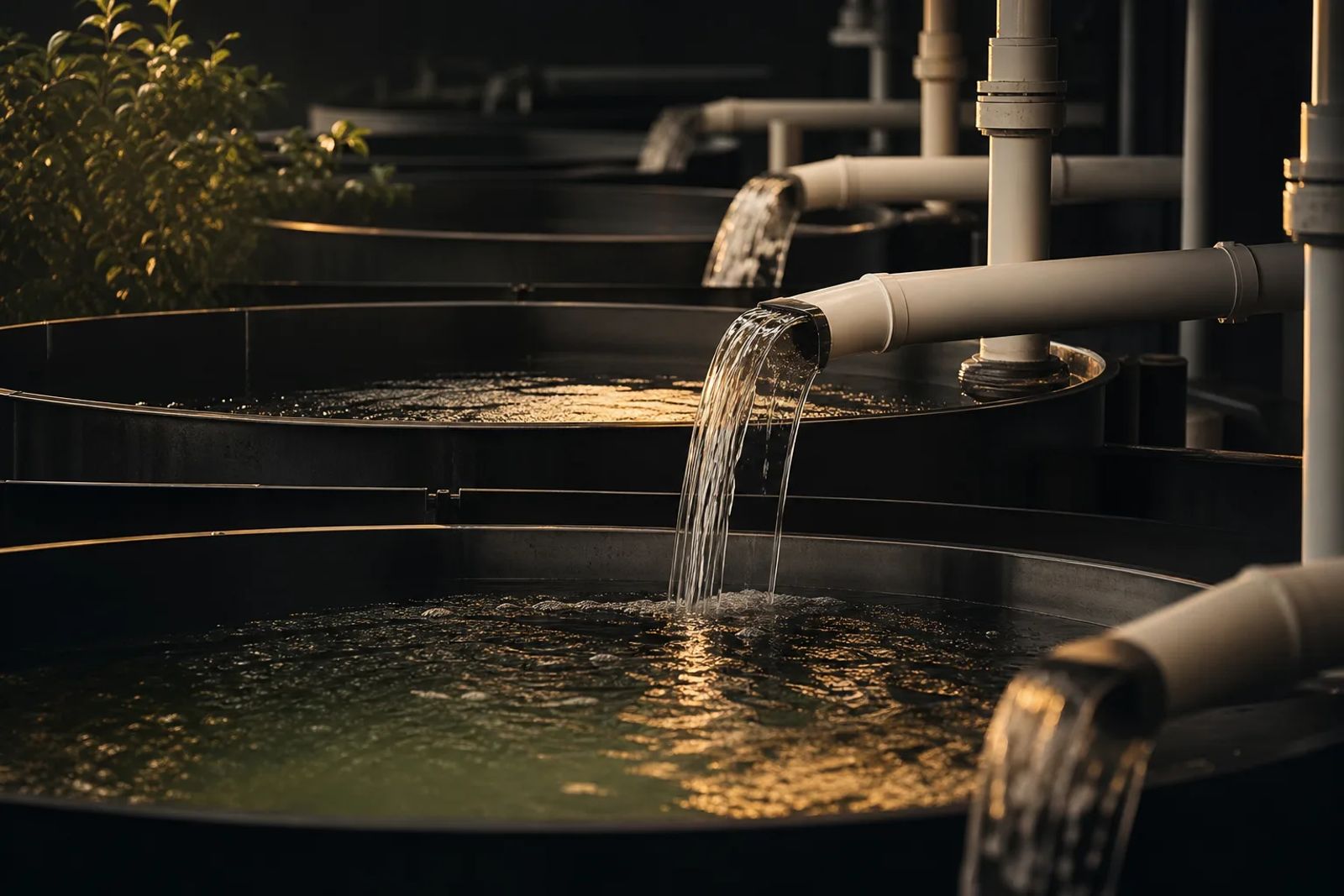
Royal Belgian Caviar is the caviar brand operated by Joosen-Luyckx Aqua Bio NV, a Belgian aquaculture and fish-feed business based in Turnhout. Its documented production chain links a Turnhout hatchery and caviar processing operation with sturgeon farming near Mouscron. The company says all the fish used for its caviar come from its own farm.
House fact box
| Start and launch | Operating company start date: 22 June 1990; brand launch: 2002. 1,4,5 |
| Operating entity and owner | Joosen-Luyckx Aqua Bio NV, according to its terms. A project announcement identifies Joosen Invest NV as the parent company. 1,8 |
| Headquarters | Oude Kaai 26, 2300 Turnhout, Belgium. 1 |
| Locations | Turnhout: hatchery, holding and caviar preparation; Mouscron: grow out at Belgian Quality Fish. 6,7 |
| Role | Farmer, processor and distributor; also develops and produces fish feed. 3,6,7 |
| Roe sourcing | The company says it uses fish from its own farm. 4 |
| Species and origin | Belgian production; the company names Siberian and Russian sturgeons, their hybrid, albino sterlet and beluga, as mapped below. 4,6,9 |
| CITES registration | The indexed register lists Aqua Bio at Oude Kaai 26, Turnhout, under code BE-VE3098, with exporter and processing or repackaging fields marked yes. |
The distinction between the brand, the operating company and the wider group matters. A retailer may know only the name on the lid, while business records and wildlife-trade registrations use legal entities and plant names. For comparisons with other businesses, start with caviar houses and producers.
Who owns Royal Belgian Caviar?
The company’s terms identify Joosen-Luyckx Aqua Bio NV as the business responsible for developing, producing and distributing its caviar. Belgium’s Crossroads Bank for Enterprises confirms the legal name Joosen-Luyckx Aqua Bio, its active status and its Turnhout registered office. Its recorded start date is 22 June 1990.
Joosen Invest NV is identified as the parent company in Agropolis’s July 2026 announcement about AquaBio’s planned Kinrooi development. The enterprise register also lists Joosen Invest as a director and delegated director of Aqua Bio. These records identify the operator and attribute group parentage to Joosen Invest NV.
The company dates Royal Belgian Caviar’s market launch to 2002. A contemporary business notice published on 7 December 2002 independently records the launch, making this firmer than a retrospective origin story alone. The earlier 1990 date belongs to Aqua Bio, not to the caviar brand.
Where the fish are farmed
The European Commission’s aquaculture account describes young fish moving from the hatchery to the main farm near Mouscron, also called Moeskroen in Dutch. There they grow in a recirculating aquaculture system, or RAS: water is treated and reused rather than simply passing through once. The engineering is explained separately in recirculating aquaculture systems.
An interview with Aqua Bio’s Willy Verdonck in AQUAcultuur describes a mixed operation, including ponds and RAS installations, rather than one uniform tank system. It locates hatchery and juvenile production in Turnhout and identifies Belgian Quality Fish in Mouscron as the grow-out operation. Mature females return to Turnhout for purging, meaning a holding period intended to reduce unwanted flavours before harvest.
The same interview describes removal of the ovaries after slaughter, followed by cleaning, salting and packing the roe. Royal Belgian Caviar’s own account specifies non-ovulated eggs, meaning eggs still held in the ovaries, and says ultrasound is used to assess readiness.
Kinrooi should be treated separately from those established sites. According to Agropolis, a permitted new RAS project in Kinrooi was announced on 13 July 2026. Agropolis gives future production targets.
Which species its names refer to
The following table maps the company's product names to the fish it identifies.
| House name | Declared fish |
|---|---|
| Gold Label | Siberian sturgeon, Acipenser baerii, or a Russian and Siberian sturgeon hybrid. |
| Platinum | Russian and Siberian sturgeon hybrid: Acipenser gueldenstaedtii and Acipenser baerii. |
| Osietra | Russian sturgeon, Acipenser gueldenstaedtii. |
| White Pearl | Albino sterlet, Acipenser ruthenus. |
| Beluga | Huso huso. |
According to the company descriptions, both hybrid parent species are named without identifying their sexes. The company names the two species without assigning their sexes. Under the CITES labelling system, a hybrid code places the male parent first and the female parent second.
Gold Label therefore does not promise one species. Nor does Platinum establish a universal biological category: here it is a house name for a declared cross. White Pearl’s albino sterlet is not a separate species. None of these names alone establishes the contents of an individual tin.
What Royal Belgian Caviar is known for
Its documented distinction is the connection between fish-feed production, sturgeon breeding and caviar preparation within one Belgian group. The company says it controls the cycle from fertilisation to harvest and produces its own feed. That supports describing it as a producer, not merely a Belgian label applied to imported roe.
Royal is part of the brand name, not evidence of an official quality grade.
The company also says it keeps eggs from individual fish separate during preparation and selects fish for egg characteristics. Its pale White Pearl product is specifically linked to albino sterlet; the company’s farming website describes those eggs as white.
Royal is part of the brand name, not evidence of an official quality grade. The brand name alone does not establish royal appointment. See trade names and grades for the broader distinction between marketing language and documented specifications.
Water, feed and sustainability claims
The brand describes its caviar as entirely sustainable and says closed-cycle breeding avoids taking production fish from the wild. That is its claim, not a whole-system environmental assessment. The Commission’s account does document support for water-saving purification technology and research into temperature and water-quality stresses.
The Kinrooi announcement describes extensive water reuse, treatment and permit conditions, but those project statements should not be substituted for measured performance at every existing site. Similarly, making feed in-house establishes control over formulation, not independently verified environmental performance of every ingredient. For the wider national context, read Belgian caviar.
What the registration and label can tell you
The public CITES register lists Aqua Bio at Oude Kaai 26 under code BE-VE3098. Both the exporter field and the combined processing/repackaging field read “Yes”. That entry identifies a registered operation at Turnhout; it is not a register of every farm or a separate confirmation of every company in the group.
For a tin represented as Belgian-farmed caviar, look for BE in the country-of-origin position of the CITES code, rather than relying on the brand’s Belgian address. The label also identifies the species, source, relevant year, plant and lot. If caviar is repacked abroad, the original roe origin and the repacker’s identity remain distinct.
A CITES label provides traceability information, not scientific proof that the declared species is inside. Match the plant identity against the public register, and read the ordinary food information alongside it. The dedicated guide explains checking a producer on the CITES register.
| Jurisdiction | Labelling distinction | Source | Date checked |
|---|---|---|---|
| Belgium and EU | Primary containers require non-reusable CITES identification, including repacked caviar. | Belgian CITES authority; Regulation (EC) No 865/2006, Article 66(6). | November 2026 |
| Great Britain | According to GOV.UK, food information must be accurate, clear and not misleading. | GOV.UK, food labelling guidance. | November 2026 |
| Northern Ireland | According to GOV.UK, Northern Ireland follows EU food information rules under the Windsor Framework. | GOV.UK, food labelling guidance. | November 2026 |
| United States | International caviar trade has specific CITES labelling requirements; FDA food-naming guidance is separate. | 50 CFR 23.71; FDA CPG 540.150. | November 2026 |
The FDA’s nonbinding guidance applies unqualified caviar to salted sturgeon roe. For other fish roe, FDA guidance calls for naming the fish with substantially equal type size and prominence, and prominently declaring any artificial colour. Switzerland, UAE, China, Japan, Russia and Australia apply separate rules.
Sources
-
Belgian Federal Public Service Economy. Crossroads Bank for Enterprises: Joosen-Luyckx Aqua Bio, enterprise 0440.948.241. Public enterprise record. Company record.
-
Belgian Federal Public Service Economy. Crossroads Bank for Enterprises: Joosen Invest, enterprise 0437.534.039. Public enterprise record. Company record.
-
Royal Belgian Caviar. Terms & Conditions. Undated company terms. Legal identity and commercial role.
-
Royal Belgian Caviar. Our story. Undated company account. History, sourcing and preparation statements.
-
DVO, Luc Willemijns. JOOSEN-LUYCKX N.V. Contemporary business report, 7 December 2002. Launch report.
-
European Commission, EU Aquaculture campaign. The success of caviar from Belgium. Undated Commission account. Hatchery, grow-out and research projects.
-
AQUAcultuur, Roel H. Bosma. Zelfs aquacultuur met RAS voor niche-markten heeft het zwaar. Volume 40, issue 2, June 2025, pp. 6 to 12; interview with Willy Verdonck. Hosted by Wageningen University & Research. Published interview.
-
Agropolis. AquaBio investeert in een innovatieve steurkwekerij in Kinrooi en draagt zo bij aan duurzame voedselproductie. Project announcement, 13 July 2026. Parent-company identification and Kinrooi project.
-
Royal Belgian Caviar. Gold Label; Platinum; Osietra; White Pearl; Beluga. Undated company specifications. These are the company’s species declarations.
-
Joosen-Luyckx Aqua Bio. Steur & steurkwekerij. Undated company farming account. Broodstock and white sterlet eggs.
-
CITES Secretariat. Belgium: Register of caviar exporters. Public CITES register entry. Belgian operations.
-
Belgian Federal Public Service Health. Kaviaar. Undated Belgian CITES guidance. Belgian caviar trade guidance.
-
European Commission. EU Wildlife Trade Reference Guide, Annex XIV. Explanation of Article 66(6) of Regulation (EC) No 865/2006, as amended. Caviar labelling requirements.
-
UK Government. Food labelling and packaging: Overview; Food labelling: giving food information to consumers. Government food labelling guidance. Overview; Detailed guidance.
-
United States Fish and Wildlife Service. 50 CFR 23.71: How can I trade internationally in sturgeon caviar? Regulatory text governing international trade in sturgeon caviar. Text reproduced by Cornell Legal Information Institute.
-
United States Food and Drug Administration. CPG Sec. 540.150: Caviar, Use of Term, Labeling. Nonbinding guidance, October 1989. FDA guidance.
Last checked: November 2026