
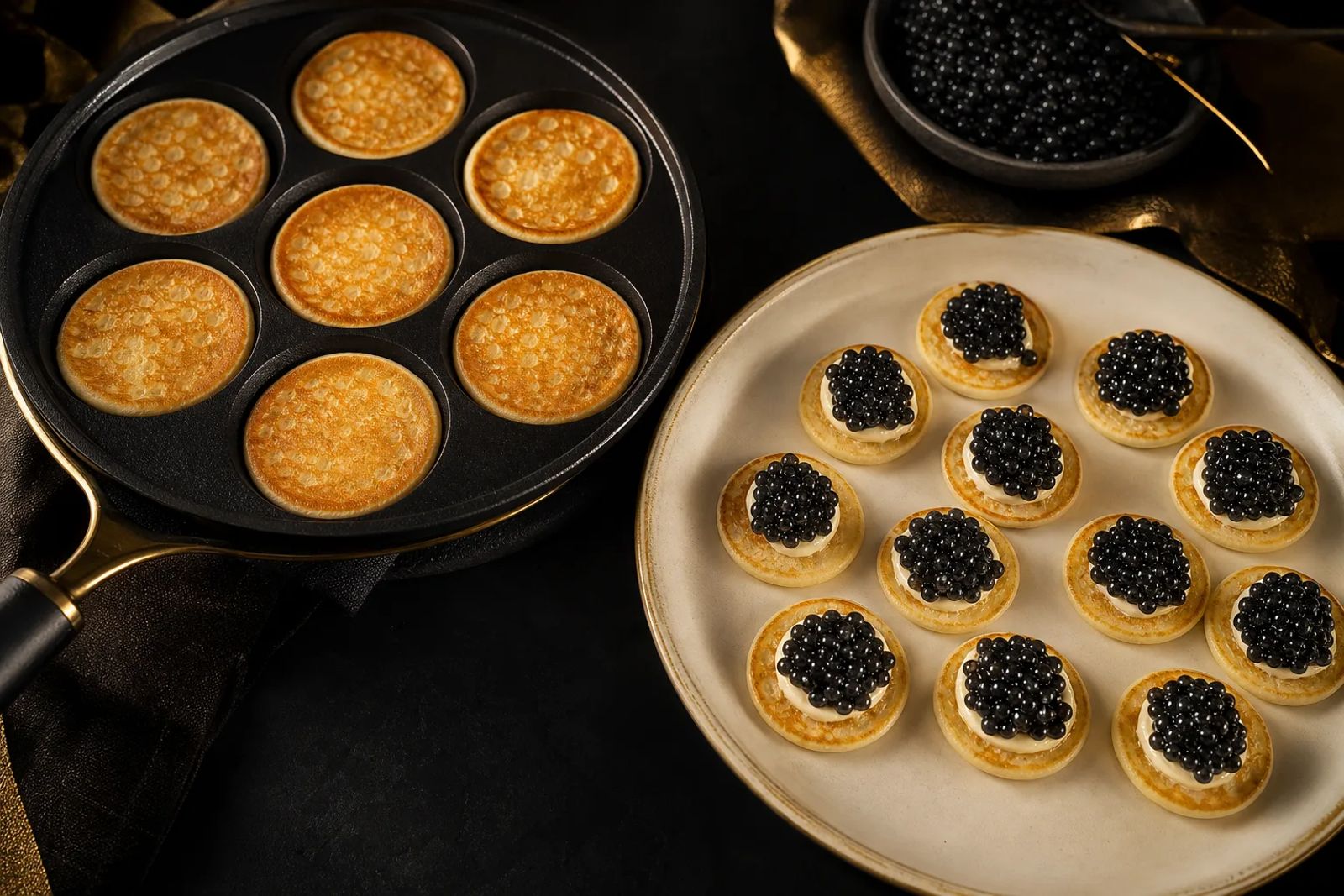
Seven neat circles can still be the wrong size for caviar. One seven-well pancake pan makes rounds about 7.6 cm across, noticeably larger than a suggested cocktail blini. The wells promise a tidy outline. Their diameter decides what lands on the plate.
A blini pan is a small frying pan, or a pan with several shallow circular wells, for cooking round pancakes. You do not need one: an ordinary frying pan or flat griddle works well. A dedicated pan mainly gives you control over shape and size.
What blini pans do
Choose a single pan for one larger pancake, or a multi-well pan for a batch of matching smaller ones. That is the useful distinction.
A single blini pan looks like a miniature frying pan, with one cooking surface and a handle. A multi-well pan holds several separate rounds of batter at once, each well setting the outline. For flat blinis, choose shallow pancake wells rather than deep moulds.
For an occasional caviar service, try your existing pan first. The wider accessories guide can help you decide which specialist tools deserve cupboard space.
Choosing a useful size
Check the diameter of each well, not just the overall pan. For cocktail blinis, aim for rounds about 4 to 5 cm across. That is a serving choice, not a formal standard.
A neat circle is little help if you cannot get underneath it.
Small single blini pans are available at 12 cm overall diameter, with a smaller cooking base. This format suits a larger individual pancake better than a batch of cocktail blinis. For broader, thin pancakes, check the usable surface of a larger frying or crêpe pan instead.
Before choosing, check hob compatibility and the manufacturer's minimum base requirements, especially on induction. Make sure your turner fits inside the wells, too. A neat circle is little help if you cannot get underneath it.
Choosing the material
Cast iron
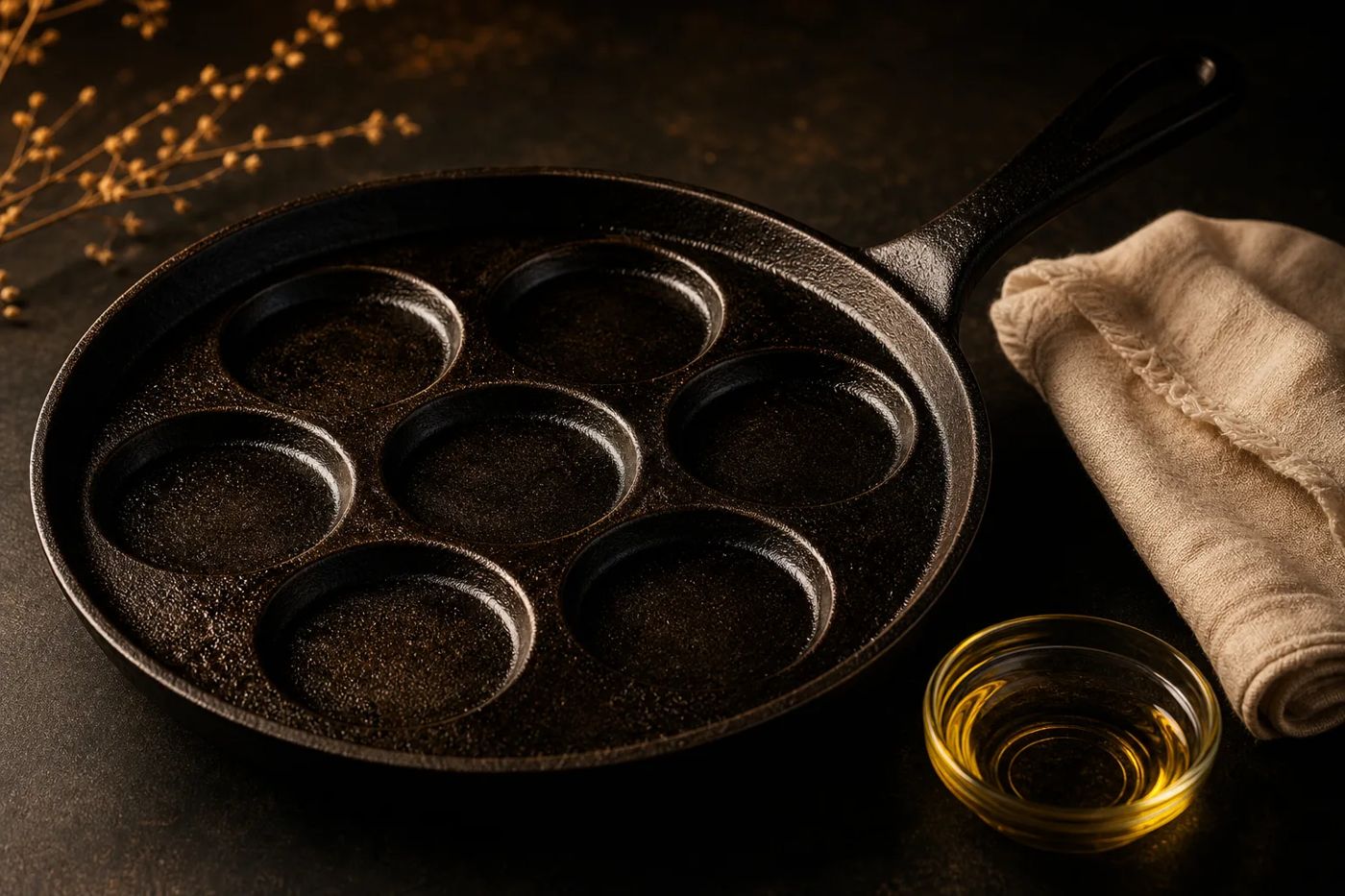
Uncoated cast iron asks for a little maintenance in return for its seasoned cooking surface. It needs seasoning: a layer of oil baked onto the surface to help food release.
Some pans arrive pre-seasoned. Follow the maker's instructions before first use, rather than assuming every black surface has the same finish. Choose uncoated cast iron if you are happy to maintain that surface between uses.
Seasoning does not replace greasing when a recipe calls for it. Nor is it a layer of old batter to leave behind: food residue still needs removing.
Carbon steel
Carbon steel also offers a seasoned cooking surface, including in small single blini pans. Before first use, check whether the pan needs seasoning and whether a temporary protective coating must come off.
A manufacturer's beeswax finish, for example, is not the finished cooking patina. Follow the preparation instructions before adding batter.
Non-stick coatings
A coated pan gives easy release without the work of building an oil-seasoned surface. Check the coating description and care instructions: non-stick finishes are not all alike. PTFE, short for polytetrafluoroethylene, is one coating material, not a name for every non-stick surface.
Moderate, controlled heat is the practical choice for blinis, within the pan maker's limits. A smoking-hot surface is not the aim. Health Canada advises against preheating empty non-stick cookware and against using high heat, giving above 260°C (500°F) as an example.
Germany's Federal Institute for Risk Assessment, BfR, warns that PTFE can decompose around 360°C (680°F), releasing hazardous gases. That is a hazard threshold, not a cooking target. BfR does not expect adverse health effects from properly used PTFE cookware, and the US Food and Drug Administration describes migration from authorised polymerised PTFE coatings as negligible.
Alongside these use precautions sit food-contact requirements: Regulation (EC) No 1935/2004 in the EU and Northern Ireland, its assimilated counterpart in Great Britain, and applicable FDA authorisations in the US, including 21 CFR 177.1550 for specified perfluorocarbon resins.
Heating, greasing and turning
Use the heat setting in your blini recipe and follow your pan's instructions. Warm an uncoated pan gradually, but do not preheat a non-stick pan empty.
Brush the cooking surface or each well lightly with the recipe's fat, then portion the batter consistently: the well controls the outline, but you control how much goes in.
For pancake-style blinis, watch for setting edges and bubbles before turning, following the recipe's cues for that particular batter. Slide a small turner underneath and flip gently. On coated pans, use a non-scratching utensil, such as a suitable silicone spatula, rather than a metal edge.
Cleaning and care
Clean away the batter, keep the seasoning, and dry seasoned pans promptly. With seasoned cast iron, wash by hand, remove food residue, dry promptly and rub on a very light film of oil. A small amount of washing-up liquid is permitted in documented cast-iron care guidance. Soaking is not: it encourages rust.
Carbon steel needs its own cleaning routine. Follow the maker's instructions, hand-wash rather than use the dishwasher, and protect the seasoned surface as directed. Dry thoroughly before storage, and follow the guidance on oiling or renewing the seasoning.
Let coated pans cool before hand-washing with warm soapy water and a soft sponge, following their care instructions. Avoid abrasive cleaners and metal scourers. Protect the surface from scratches in storage rather than piling other cookware directly against the coating.
Using a frying pan or griddle instead
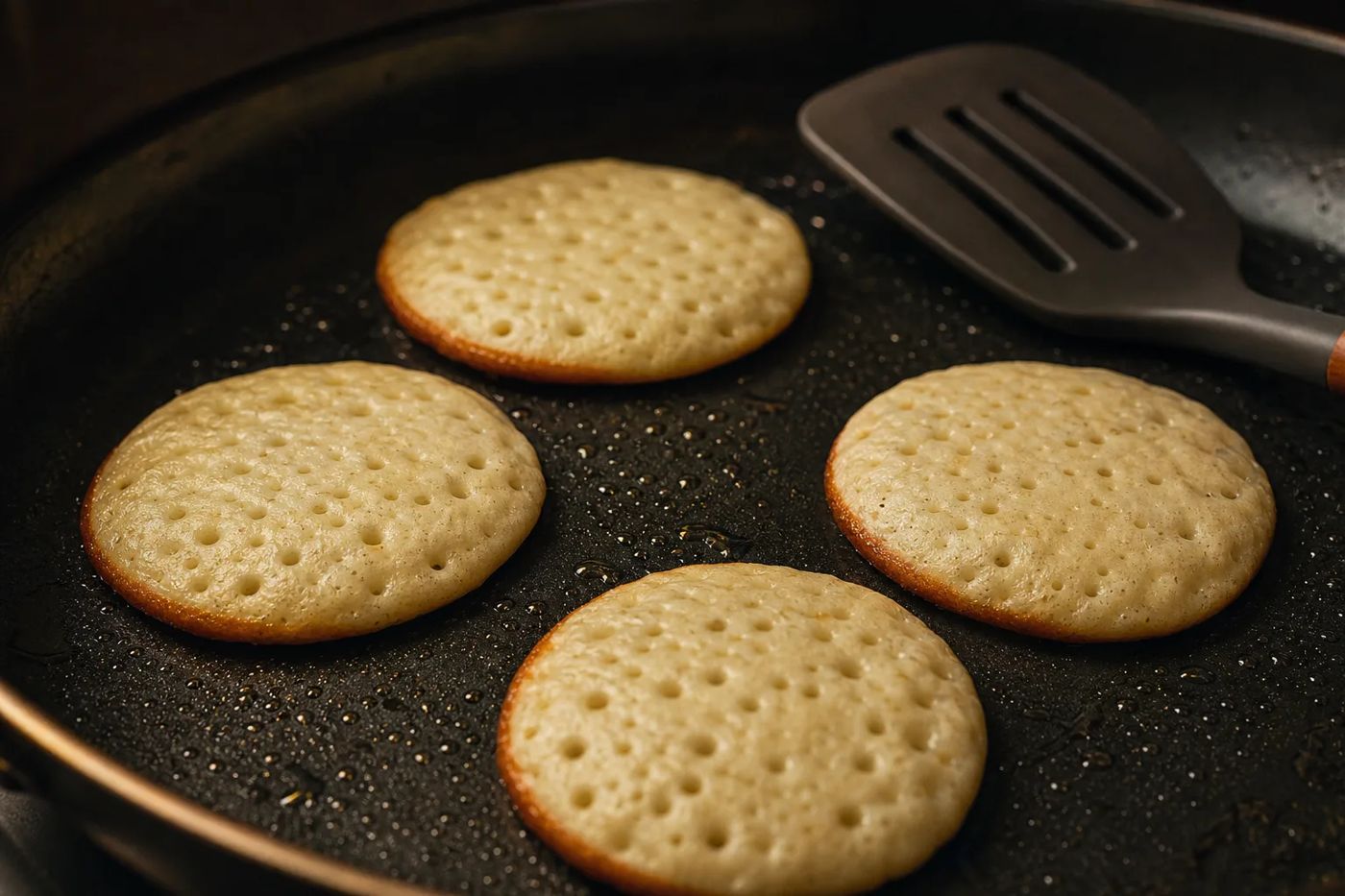
A heavy frying pan or flat griddle works well, with no special recipe required. Spoon separate portions onto the greased surface and leave room to turn them. Without wells, consistent portions matter more than perfectly circular edges.
Add a dedicated pan when its shape solves a recurring problem: producing matching canapé rounds or cooking one larger pancake at a time. Otherwise, the pan already in the cupboard may do everything you need.
For toppings and assembly beyond the pancake itself, see caviar canapé recipes and the guide to crème fraîche, smetana and butter.
Sources
-
King Arthur Baking Company. Blini. Undated online recipe, retrieved November 2026.
Recipe and cooking instructions -
de Buyer. 2026 catalogue, English edition, 2026, page 18, steel blini and pancake pans.
Catalogue PDF -
de Buyer. Steel blinis pan MINERAL B Ø12cm. Undated manufacturer specification, retrieved November 2026.
Material and protective finish -
Nordic Ware. The Original Silver Dollar Pancake Pan. Manufacturer specification and use instructions, checked November 2026.
-
Lodge Cast Iron. Seasoned Cast Iron Cleaning & Care. Undated manufacturer guidance, retrieved November 2026.
Seasoning and routine care -
Lodge Cast Iron, Canadian distributor Counseltron. Lodge Seasoned Cast Iron Use and Care. Undated care guidance, retrieved November 2026.
Washing and avoiding soaking -
Health Canada. The safe use of cookware and bakeware. Current online guidance retrieved November 2026.
Non-stick cookware precautions -
German Federal Institute for Risk Assessment, BfR. No adverse health effects to be expected from cookware with PTFE non-stick coating. FAQ revision, 2 July 2025.
PTFE use and overheating guidance -
US Food and Drug Administration. Authorized Uses of PFAS in Food Contact Applications. Current online edition retrieved November 2026.
Cookware coatings and migration -
European Parliament and Council. Regulation (EC) No 1935/2004 on materials and articles intended to come into contact with food. Original instrument, 2004, particularly Article 3.
EUR-Lex document record -
UK Government. Multi-Annual National Control Plan for Great Britain 2026 to 2030. 2026 edition, food-contact materials section.
Great Britain regulatory framework -
UK Parliament. Written question 127536: food-contact materials, tabled 15 April 2026, published ministerial response.
Northern Ireland application of EU rules -
US Food and Drug Administration, Electronic Code of Federal Regulations. 21 CFR 177.1550: Perfluorocarbon resins. Electronic text current to 3 November 2026.
Resin specifications and conditions -
Nordic Ware. Breakfast pans. Undated manufacturer guidance, retrieved November 2026, cleaning and care section.
Coated-pan cleaning and storage -
de Buyer. FAQ. Undated manufacturer guidance, retrieved November 2026, hob compatibility, dishwasher use and seasoning questions.
Cookware use and care -
Singapore Food Agency. Safe Practices for Non-Stick Pans. Undated authority guidance, retrieved November 2026, utensil and cleaning precautions.
Protecting non-stick surfaces
This piece was researched using a baking school's cooking instructions, manufacturer specifications and care guidance, and official food-contact and cookware-safety sources; no cookware was tested.
Last checked: November 2026