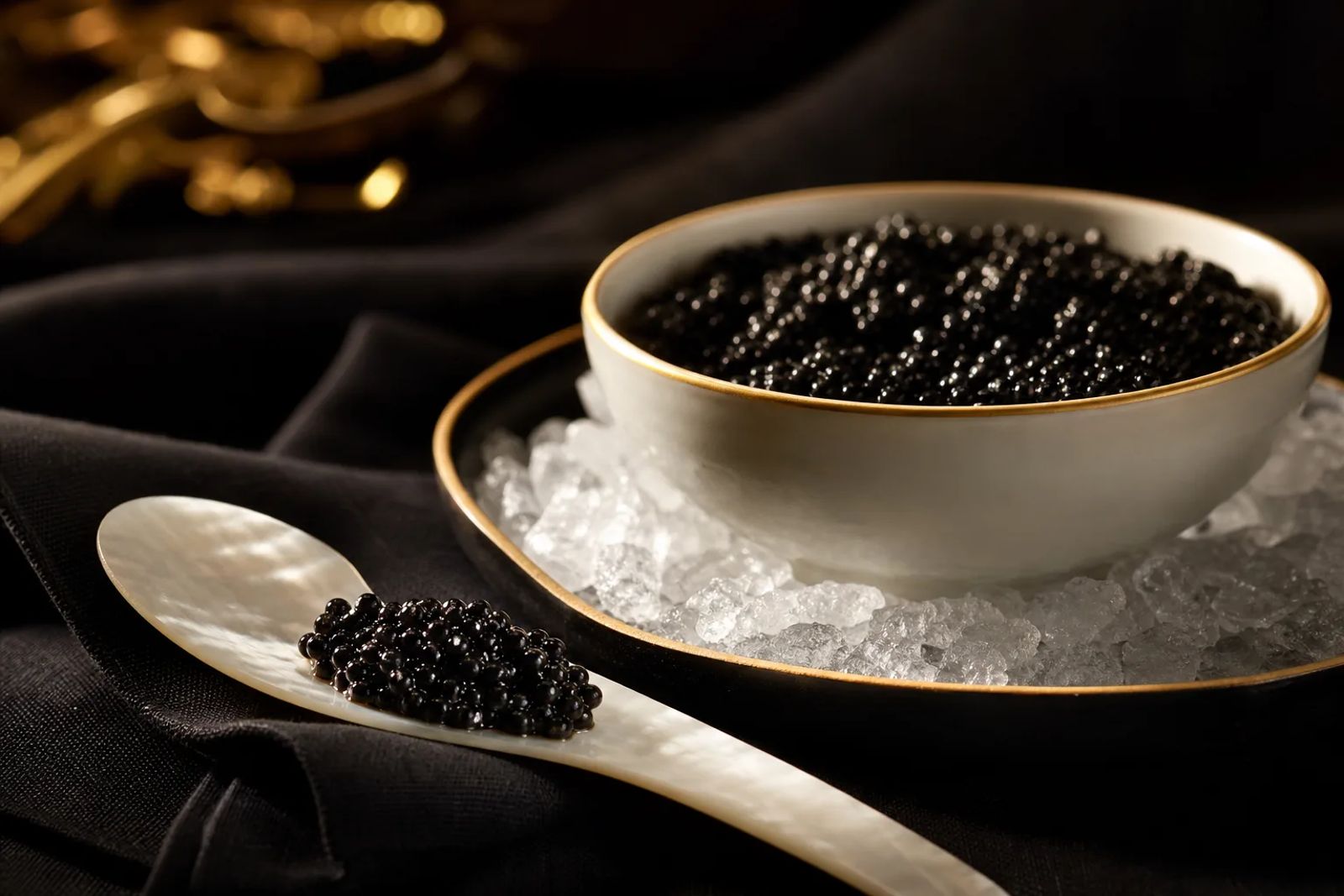
Copper and zinc brought out stronger metallic and bitter flavours than gold and stainless steel. That was the finding of a 2012 study in which 30 adults tasted five differently flavoured creams from spoons coated with those metals. The food was cream, not caviar, but the lesson matters at the caviar table: metals deserve to be distinguished, not dismissed together.
Mother-of-pearl remains the traditional choice. Food-grade stainless steel is a sound practical alternative. Whichever material you choose, look for a smooth, comfortable bowl, confirmed suitability for food contact and cleaning instructions you can follow.
Why non-reactive caviar spoons became the custom
The aim is simple: taste the caviar, not the spoon. Traditional service favours mother-of-pearl, horn and other materials chosen to contribute no flavour of their own. The precise origin of this convention is not reliably established; why not use a silver spoon explores the metal question.
The 2012 study helps explain why the distinction between metals matters. It does not establish which spoon makes caviar taste best, and the evidence does not justify treating every metal as a source of taint.
The materials compared
Choose for handling, care and provenance rather than an assumed flavour ranking. Washing instructions belong to the finished product: permission to machine-wash one spoon does not extend to every spoon made from that material.
| Material | Source | Care needs | Durability | Notes |
|---|---|---|---|---|
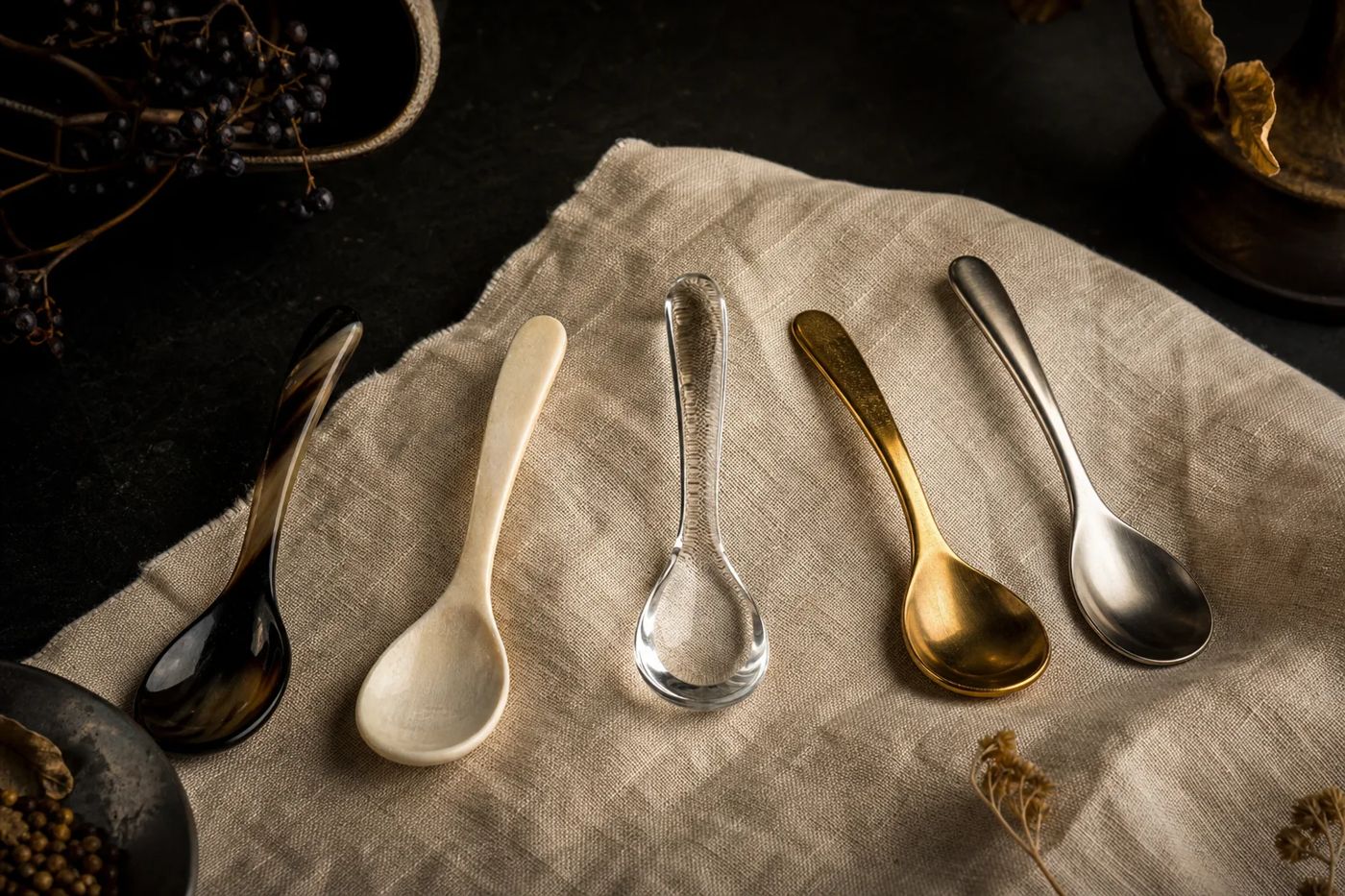
| Mother-of-pearl | Mollusc shell | Hand-wash; avoid soaking and dishwashers | Edges can chip | Ask for shell species and origin |
| Horn | Animal horn | Avoid hot water, soaking and dishwashers | Heat and moisture can damage it | Follow supplied cleaning instructions |
| Bone | Animal bone | Avoid soaking; clean as instructed | Can crack or stain | Not ivory; identify the animal source |
| Glass | Manufactured glass | Follow maker's washing instructions | Can chip or break | Identify borosilicate or other glass |
| Gold or gold-plated | Gold alloy or coated substrate | Follow finish-specific instructions | Protect coatings from wear | Identify base metal and surface |
| Stainless steel | Metal alloy | Wash promptly; follow maker's instructions | Avoid prolonged food-residue contact | Confirm food-contact suitability |
Mother-of-pearl: shell, not pearl
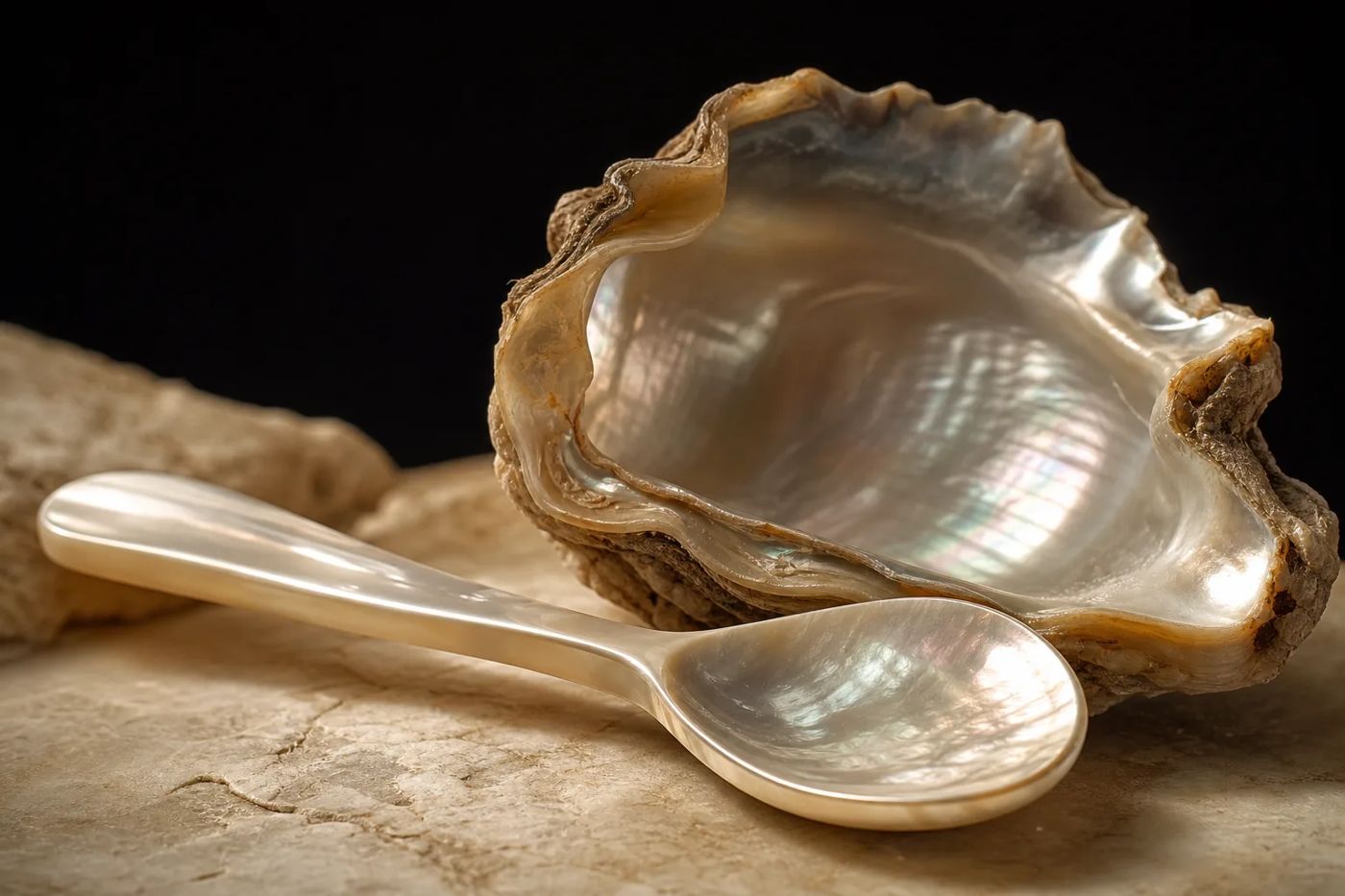
The lustre comes from nacre, the inner layer of certain mollusc shells. A mother-of-pearl spoon is not carved from a pearl. Documented materials include oyster and abalone shell, and a shellware manufacturer describes its spoons as hand-cut and polished. Look closely at the specification: a shell handle does not mean the bowl is shell too.
For everyday care, follow the supplied hand-washing instructions, then dry the spoon before putting it away. Published shellware guidance warns against dishwashers and heat. Avoid prolonged soaking unless the maker specifically permits it. Household glue and decorative varnish are not ways to restore a damaged eating surface.
Ask which mollusc supplied the shell and where it was harvested. “Mother-of-pearl” tells you the material, not the species or whether it was responsibly sourced. CITES lists giant clams (Tridacnidae) and chambered nautiluses (Nautilidae) in Appendix II. Shell articles can therefore fall within wildlife-trade controls.
Horn and bone: different animal materials
Horn is predominantly keratin, the protein found in hair and nails. Bone is mineralised tissue. They are distinct materials, not interchangeable versions of the same “natural” spoon.
An antique bone spoon may survive intact without being suitable for eating.
Makers shape and polish animal horn into spoons. One documented historical bone spoon has a feature suggesting cattle bone. In either case, ask for the actual animal source rather than settling for “natural”.
Check the care requirements before choosing. One horn manufacturer specifies lukewarm running water without soap, immediate drying, no dishwasher and no soaking. Follow that instruction for its product rather than applying it to every horn spoon. If the permitted cleaning method does not suit your household, choose another material.
Conservation guidance identifies bone and horn as porous and susceptible to staining. Museum cleaning advice, however, serves a different purpose from washing an eating utensil. Choose a spoon made for food use, with instructions for that purpose. An antique bone spoon may survive intact without being suitable for eating.
Glass and gold: check the specification
Glass offers an animal-free choice when the spoon has no animal-derived decoration or fittings. Glassware may be soda-lime or borosilicate; borosilicate is used where resistance to temperature changes matters. Neither makes a thin spoon unbreakable. Inspect the edges before use and retire any spoon that is chipped or cracked.
A comfortably rounded rim and a bowl you can lift cleanly matter more for caviar than heat resistance. Check washing instructions for the whole spoon, decoration included. Some glassware makers permit machine-washing; others recommend hand-washing even for borosilicate pieces.
Solid gold means gold or gold alloy throughout, not necessarily pure gold. Gold-plated means a surface layer over another material, with documented cutlery examples including gold over stainless steel. Ask what is underneath, whether there are intermediate layers and which parts touch the food. “Gold-coloured” tells you neither the gold content nor whether the spoon is suitable for food contact.
Protect the finish by following its own care instructions. Published cutlery guidance permits hand-washing or machine-washing for particular gold finishes, so there is no single dishwasher rule. If plating peels or becomes damaged, stop using the spoon until the supplier confirms whether it remains suitable for food.
Other materials, sizes and shapes
A small, shallow bowl is a practical choice for tasting; a larger spoon suits transferring caviar to plates. Compare bowl width, depth and handle length in millimetres, not just photographs. Look for a smooth, rounded edge rather than a sharp lip, and avoid elaborate crevices that make cleaning awkward.
Wood, glazed ceramic and food-contact plastic offer further options. Assess the finished surface and its documented use rather than trusting the material name alone. Decorative ceramicware can contain lead that migrates into food. For a tortoiseshell-pattern substitute, ask what the material actually is and confirm that it is intended for eating.
The bowl should fit the container without scraping awkwardly against the sides. Use scales when portions need to be exact: spoon capacity is not a reliable measure of caviar weight. For the wider setting, see caviar accessories and servers, bowls and presenters. Tasting caviar properly covers what happens once the caviar reaches the spoon.
Food contact and restricted antiques
Food-contact suitability applies to the whole utensil, including shell, coating, glaze, adhesive and base metal where present. Ask the supplier to confirm suitability for the intended use and provide relevant compliance information. These are market requirements, rather than a special certification for caviar spoons.
- EU: Regulation (EC) No 1935/2004, Article 3, requires food-contact articles not to transfer substances in quantities that endanger health or unacceptably alter food composition, taste or smell.
- UK: Great Britain applies its assimilated version of Regulation (EC) No 1935/2004, as amended; Northern Ireland generally follows EU food-contact rules under the Windsor Framework.
- US: Under federal law, a food-contact substance that is a food additive must be authorised for its intended use. “FDA approved” is not a blanket description for every finished spoon.
Antique tortoiseshell and ivory bring separate wildlife-law obligations. Hawksbill turtles are covered by CITES Appendix I, and an object's age alone does not authorise international trade. Keep identification, age and provenance documents. Before arranging a transaction, obtain advice from the relevant wildlife authority.
- CITES: International movement of listed animal materials can require wildlife-trade documents, including for old worked objects. Domestic sale is a separate legal question.
- EU: Commercial use of worked tortoiseshell acquired before 3 March 1947 may qualify for the antiques derogation. Elephant ivory faces tighter rules: some transactions require certificates, while others are prohibited or subject to different conditions.
- UK: Most dealings in ivory from species covered by the Ivory Act 2018 are prohibited unless the item qualifies for an exemption and is registered or has an exemption certificate. Dealings with qualifying museums are treated separately. Wildlife trade controls also apply to protected materials including tortoiseshell.
- US: Elephant ivory sales depend on species, transaction and narrow exceptions. Sea turtle shell generally cannot be sold interstate or internationally, and state restrictions can impose further limits.
Domestic dealing and crossing a border are distinct legal questions. These summaries do not authorise an antique purchase or shipment. Legal checks were made in November 2026.
Which should you choose?
Choose mother-of-pearl for traditional service if careful hand-washing fits your routine. Choose food-grade stainless steel for more straightforward everyday care. Glass suits those avoiding animal materials, provided the risk of breakage is manageable. Horn, bone and gold offer different materials and handling qualities, rather than demonstrated improvements in caviar flavour.
Before choosing, ask three questions: what exactly is it made from, is it intended for food contact, and can you clean it as instructed? Clear answers matter more than a promise of perfectly neutral flavour. The best choice is a spoon that feels comfortable, suits the way you serve and can be cared for properly.
Sources
- Piqueras-Fiszman, B., Laughlin, Z., Miodownik, M. and Spence, C. Tasting spoons: Assessing how the material of a spoon affects the taste of the food. Food Quality and Preference, volume 24, issue 1, 2012, pages 24 to 29. Publisher's article and abstract.
- Art Nacre Inc. Mother-of-Pearl Spoons. Manufacturer's materials and manufacturing description, undated online edition. Source.
- Tonkin Handicraft. How to care for mother of pearl. Maker's online care guidance, undated edition. Source.
- Caviar House & Prunier. Datasheet: Mother-of-pearl spoon flatware. Created 15 November 2022. Technical sheet.
- Canadian Conservation Institute. Care of Ivory, Bone, Horn and Antler. CCI Notes 6/1, online edition. Source.
- Hornvarefabrikken. Instructions. Manufacturer's online care instructions, undated edition. Source.
- MacGregor, A., Mainman, A. J. and Rogers, N. S. H. Bone, Antler, Ivory and Horn from Anglo-Scandinavian and Medieval York. The Archaeology of York, volume 17/12, York Archaeological Trust, 1999. Report.
- Lepelclub. Frequently Asked Questions. Manufacturer's materials and care descriptions, undated online edition. Source.
- New Tendency. How to Care for Glass Products. Manufacturer's guidance, 12 June 2023. Source.
- Lenox Corporation. Lenox Brands Product Use & Care. Sections on gold-plated stainless steel and cutlery, undated online edition. Source.
- Herdmar. Care Instructions and Warranty. Revision January 2021, section “Gold 24 carat”. Source.
- European Parliament and Council. Regulation (EC) No 1935/2004 on materials and articles intended to come into contact with food. 2004, particularly Articles 1, 3 and 15. EUR-Lex text.
- Northern Ireland business information service. Food contact materials and packaging. Official online guidance, edition retrieved November 2026. Source.
- US Food and Drug Administration. Food Packaging & Other Substances that Come in Contact with Food: Information for Consumers. Online edition retrieved November 2026. Source.
- US Food and Drug Administration. Questions and Answers on Lead-Glazed Traditional Pottery. Online edition retrieved November 2026. Source.
- CITES Secretariat. Appendices I, II and III. Current official listing, search-index text retrieved November 2026; relevant entries for Cheloniidae, Tridacnidae and Nautilidae. Appendices.
- Department for Environment, Food & Rural Affairs and Animal and Plant Health Agency. Deal in items made of or containing ivory. Current online guidance, retrieved November 2026. Source.
- European Commission. EU Wildlife Trade Reference Guide: Are specimens exempted by acquisition date? Current online edition, retrieved November 2026. Source.
- European Commission. Revised guidance document: EU regime governing trade in ivory. Commission Notice 2021/C 528/03, 2021. EUR-Lex text.
- US Fish & Wildlife Service. Elephant Ivory FAQs. Current online guidance, retrieved November 2026. Source.
- US Fish & Wildlife Service. Can I sell it? A Guide to Wildlife and Plant Protection Laws. Agency factsheet, undated retrieved edition. Source.
The piece was researched using a controlled sensory study, archaeological and conservation references, manufacturers' published specifications and care instructions, and official food-contact and wildlife-trade guidance.
Last checked: November 2026