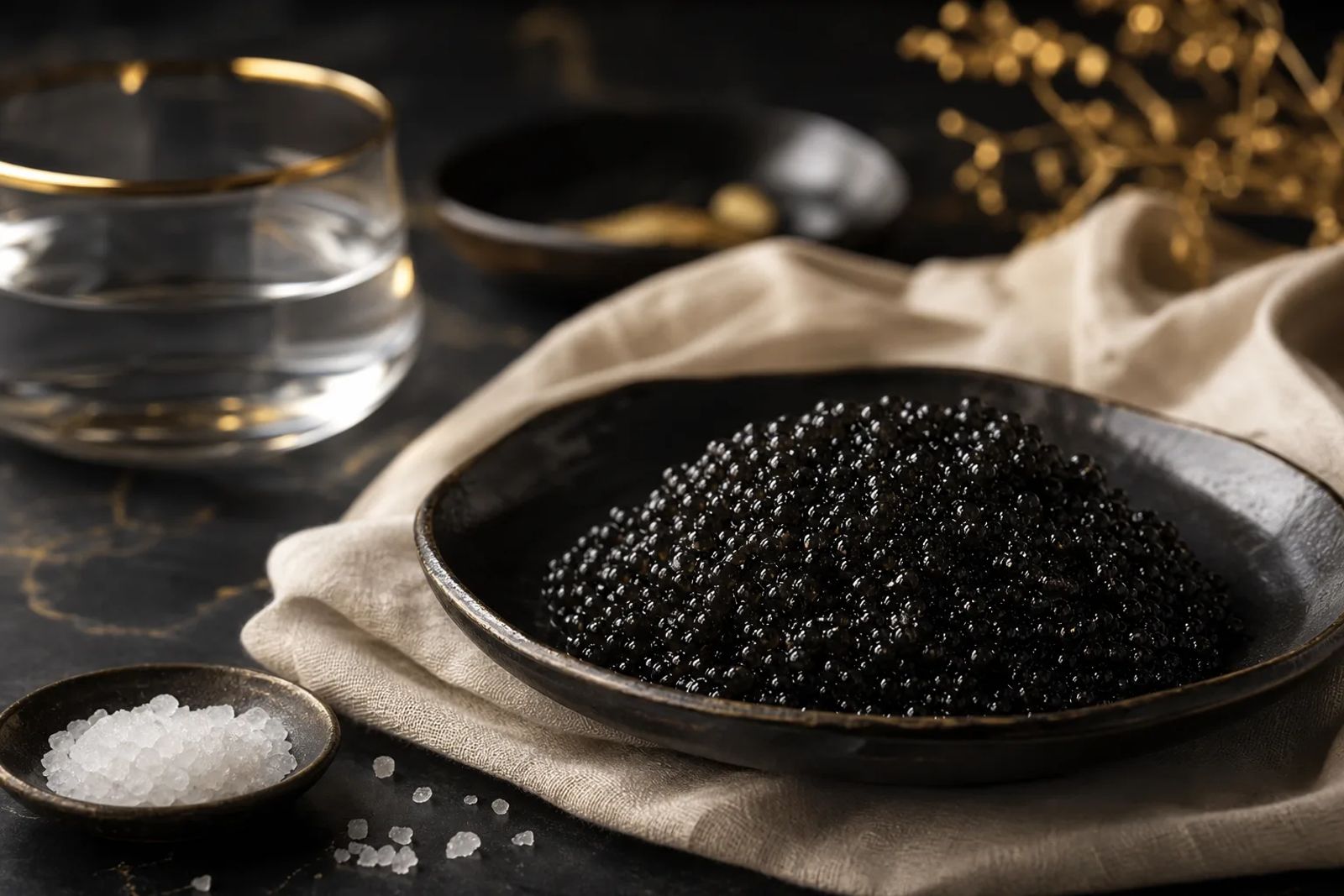
Devon water and Cornish sea salt: these are the ingredients of place that Exmoor puts at the heart of its caviar story. The fish at its beginning, the business says, were Siberian sturgeon. Alongside a documented farming project in Yorkshire, that original Devon stock gives British caviar a history rooted in British farms.
The important distinction is where the roe was harvested. A British business address can belong to a farmer, an importer or a repacker. And the old description of sturgeon as “royal fish” concerns Crown rights, not a national caviar grade or permission to catch wild fish.
United Kingdom at a glance
| Species farmed | Exmoor reports original stocks of Siberian sturgeon in Devon. |
| Documented farming areas | Devon and Yorkshire, in producer accounts. 9,10 |
| CITES operations | Kings Fine Foods is listed as exporter GB 0001, with processing and repackaging activity. 14 |
| Import and export regime | CITES; assimilated Regulations 338/97 and 865/2006 in Great Britain; EU wildlife trade rules in Northern Ireland; COTES Regulations 2018. |
| PGI or PDO | No British sturgeon caviar name appears in the GB register. |
| Wild stocks | The 2023 UK conservation strategy addresses European and Atlantic sturgeon recovery after their historical occurrence in British waters. |
| Country’s role | Farming origin, importing market and repacking location, including a London site audited in 2024. |
Where British caviar has been produced
Devon and Yorkshire anchor Britain’s documented sturgeon farming history: Exmoor Caviar in the south west, KC Caviar near Leeds. Their histories deserve separate attention. For a current tin, however, check the harvest origin rather than relying on a surviving brand or active company registration, especially where a business also imports caviar or changes its operating arrangements.
Exmoor Caviar dates its establishment to 2010 and says it obtained royal permission in 2013. Companies House records Exmoor Caviar Farming Ltd, company 08279519, as incorporated on 2 November 2012, with freshwater aquaculture as its business classification. Each date marks a different milestone; none can simply stand in for the first British harvest. The Exmoor National Park directory places the farm in Devon, at the foothills of the national park.
KC Caviar’s Yorkshire venture appears in a company announcement dated 22 January 2017, describing the arrival of sturgeon for a farm near Leeds. That announcement documents the project’s development but does not independently confirm its projected production. The brand’s current website identifies its operator as Kenkona Limited and describes its Yorkshire base; Companies House separately confirms the legal entity.
Exmoor identifies its original Devon stock as Siberian sturgeon. That gives a clear historical starting point, rather than a complete inventory of species currently farmed in Britain. Species sold by British businesses may have been raised overseas. The Exmoor caviar profile covers the fuller company history and facility checks.
Sturgeon in British waters
Sturgeon were more than occasional visitors to British waters. European sturgeon, Acipenser sturio, and Atlantic sturgeon, Acipenser oxyrinchus, both belong in this history, although older catch accounts do not always distinguish them securely. The UK Sturgeon Conservation Strategy and Action Plan, published in 2023, treats their recovery as a conservation task, separate from farming non-native sturgeon for food.
Females carrying roe, small juveniles and the timing of river catches all feature in a 2026 study by Samuel Turvey and colleagues, “Did sturgeon ever breed in Britain? Evaluating historical evidence and conservation implications”. Reassessing historical catch records and museum material, the authors report strong evidence of breeding in many British rivers into the twentieth century. Their findings concern historical breeding, not breeding today.
A modern sighting therefore deserves careful identification, rather than an automatic label of “stray”. The European sturgeon and Atlantic sturgeon profiles explore the species histories. Historical catches and isolated recent records do not establish a source of British wild caviar.
Sturgeon as a "royal fish"
Sturgeon’s royal status survives in chapter XIII of Prerogativa Regis, catalogued on legislation.gov.uk as “Of the King’s Prerogative (temp. incert.) (1324)”. The provision gives the King rights to whales and great sturgeons taken at sea or elsewhere within the realm, subject to places privileged by the Crown. Its date is less settled than the title suggests: “temp. incert.” indicates uncertainty, and 1324 is the traditional dating rather than a securely established enactment date.
The official statute marks this surviving chapter as extending to England and Wales. Modern HM Coastguard guidance separately describes the royal fish prerogative in England, Wales and Northern Ireland, including sturgeon. It also makes clear that administration differs between Scotland and those three jurisdictions.
Scotland’s current administrative definition is different. The Scottish Government’s royal fish guidance concerns stranded whales more than 7.6 metres (25 feet) long, not sturgeon. Sturgeon are therefore outside that Scottish definition, making the claim that every wild sturgeon anywhere in the UK belongs to the monarch too sweeping.
The provision gives the King rights to whales and great sturgeons taken at sea or elsewhere within the realm, subject to places privileged by the Crown.
For a deceased sturgeon found on the coast, HM Coastguard says to contact the local Maritime Rescue Coordination Centre on its non emergency number. HM Coastguard publishes a “Report royal fish” service. If a stranded sturgeon is alive, do not touch it: notify the Coastguard promptly.
A farming origin and a trading country
Caviar can be packed in London far from the water where the fish lived. A 2024 SALSA audit certificate for Exmoor Caviar Farming’s London site describes purchasing, storing, repacking, labelling and distributing chilled caviar. It records those activities at a particular site and period; it does not establish current certification or British origin for every product handled there.
This trading role is an important part of the UK industry alongside farming. CITES lists Kings Fine Foods as UK exporter GB 0001, with processing and repackaging activity. That entry identifies a registered trading operation, rather than a sturgeon farm.
Post-Brexit rules in brief
Great Britain and Northern Ireland follow different wildlife trade frameworks. In Great Britain, assimilated Regulations (EC) No 338/97 and No 865/2006 operate alongside the Control of Trade in Endangered Species Regulations 2018, as amended. APHA issues CITES permits, with guidance covering movements between Great Britain and both the EU and Northern Ireland.
Northern Ireland follows a separate framework. It continues to apply EU wildlife trade regulations under the Windsor Framework.
For additives, start with the jurisdiction. Great Britain’s FSA register lists boric acid (E284) and sodium tetraborate, or borax (E285), as authorised additives. The register covers Great Britain, not Northern Ireland.
Then check the limit. Their use in caviar is governed by assimilated Regulation (EC) No 1333/2008. Annex II permits each only in sturgeon eggs, at 4,000 mg/kg expressed as boric acid. These are legal conditions, not choices left to a producer.
For an EU consignment, check food import eligibility and establishment approval as well as wildlife permits. As of 4 November 2026, Annex IX lists GB for aquaculture finfish and finfish products.
Other destinations have their own rules. Separate requirements apply in the US, Switzerland, the UAE, China, Japan, Russia and Australia. APHA advises confirming the applicable requirements with the destination authorities.
Detailed permit, ingredient and consumer information requirements are covered in UK caviar rules. Two distinctions matter throughout: customs commodity codes do not replace retail food labelling rules, and CITES documentation does not remove the obligation to meet food law.
How British origin appears on a label
Look for GB in the country-of-origin field of the CITES caviar label. There it identifies UK origin. Attached to a repacker’s registration, GB identifies a different stage of the chain.
A London address or British brand name cannot answer the same question. The guide to country of origin versus country of repacking explains how to read the distinction. The label supplies traceability, rather than independent verification of the tin’s contents.
What British caviar is known for
Exmoor’s emphasis on its water and salt gives its caviar a producer’s account of place. Those stated points of difference do not establish national flavour characteristics or define the texture, colour or taste of every British caviar.
Farming origin belongs here. Restaurant traditions and the wider British appetite for caviar have their own story, covered in caviar in the UK. For the regional picture, see Europe.
For the individual tin, ask: where was this roe harvested, and what does the producer document about this batch?
Sources
-
The National Archives. Prerogativa Regis. Of the King’s Prerogative (temp. incert.) (1324), chapter XIII, revised online text, undated. Official text.
-
HM Coastguard. Our services, “Report royal fish”, current online guidance, undated. Guidance.
-
Scottish Government. Marine mammals, “Royal fish”, current online guidance, undated. Guidance.
-
Scottish Government. Guidance for dealing with stranded ‘royal fish’, published 19 November 2019. Publication.
-
Turvey, S. T., and colleagues. Did sturgeon ever breed in Britain? Evaluating historical evidence and conservation implications, Royal Society Open Science 13(7): 260521, July 2026, doi 10.1098/rsos.260521. University repository record and manuscript.
-
Zoological Society of London and conservation partners. UK Sturgeon Conservation Strategy and Action Plan, 2023. Report.
-
Exmoor Caviar. About us, company account, undated. Company history.
-
Companies House. Exmoor Caviar Farming Ltd, company 08279519, company overview. Company record.
-
Exmoor National Park Authority. Exmoor Caviar, business directory entry, undated. Directory entry.
-
KC Caviar Ltd. KC Caviar Ltd newsroom, including Caviar produced in Yorkshire, 22 January 2017. Company press announcement.
-
KC Caviar. Our story, current company account, undated. Company account.
-
Companies House. Kenkona Limited, company 16525840, company overview. Company record.
-
SALSA. Audit certificate: Exmoor Caviar Farming, certificate 19948, issued 3 May 2024, expired 4 May 2025. Certificate.
-
CITES Secretariat. Register of caviar exporters: GB 0001, Kings Fine Foods, current individual register entry, undated. Register entry.
-
APHA and Defra. Check if you need a CITES permit to import or export endangered species, current online guidance. Guidance.
-
The National Archives. The Control of Trade in Endangered Species Regulations 2018, SI 2018/703, revised online contents. Legislation.
-
CITES Secretariat. United Kingdom of Great Britain and Northern Ireland: country profile, including Windsor Framework implementation statement. Country profile.
-
Food Standards Agency. Authorised Regulated Food and Feed Products for Great Britain: Boric acid; and Food additives authorisations, entries E284 and E285, updated 1 April 2025. Boric acid entry; authorisations data.
-
European Union, reproduced by The National Archives. Regulation (EC) No 1333/2008 on food additives, consolidated text dated 25 March 2020, Annex II, category 09.3.
-
European Commission. EU Wildlife Trade Reference Guide, Annex XIX, current online edition. Reference guide.
-
European Union. Commission Implementing Regulation (EU) 2021/405, consolidation dated 4 November 2026, Annex IX, listing GB for aquaculture finfish and finfish products. Consolidation.
-
CITES. Resolution Conf. 12.7 (Rev. CoP17): Conservation of and trade in sturgeons and paddlefish, copy lodged in a US federal regulatory docket. Resolution copy.
-
Defra. Protected geographical food and drink names, GB registers. Register.
Last checked: November 2026