“Caviare on ice” opened a Garrick menu recorded in Linley Sambourne's diary in 1905. Pea soup, salmon and devilled whitebait followed on the page. Caviar had the first place, explicitly chilled and listed as a course of its own.
That opening captures one British story: imported caviar in clubs, hotel dining rooms and at celebration tables. Alongside it runs a broader appetite for fish roe, spread on toast or whipped into a dip. British sturgeon farming has added another chapter, though a British name on a tin does not necessarily mean eggs from British waters.
Royal fish and a literary afterlife
Wild sturgeon can still fall under a Crown prerogative in England, Wales and Northern Ireland. In Scotland, it covers only whales over 25 feet. Caviar also has a memorable place in Shakespeare. “Caviary to the general” in Hamlet describes something appreciated by a few rather than the public at large. It captures the food's cultural associations, rather than the contents of Elizabethan household meals. Explore the phrase in caviar in literature.
Victorian and Edwardian tables
A menu brings the history into focus. In her diary for 1897, Marion Sambourne recorded a dinner beginning with caviare, followed by clear soup, turbot and several further dishes. Here is caviar at a particular London household's formal dinner, with its place in the meal clearly set out.
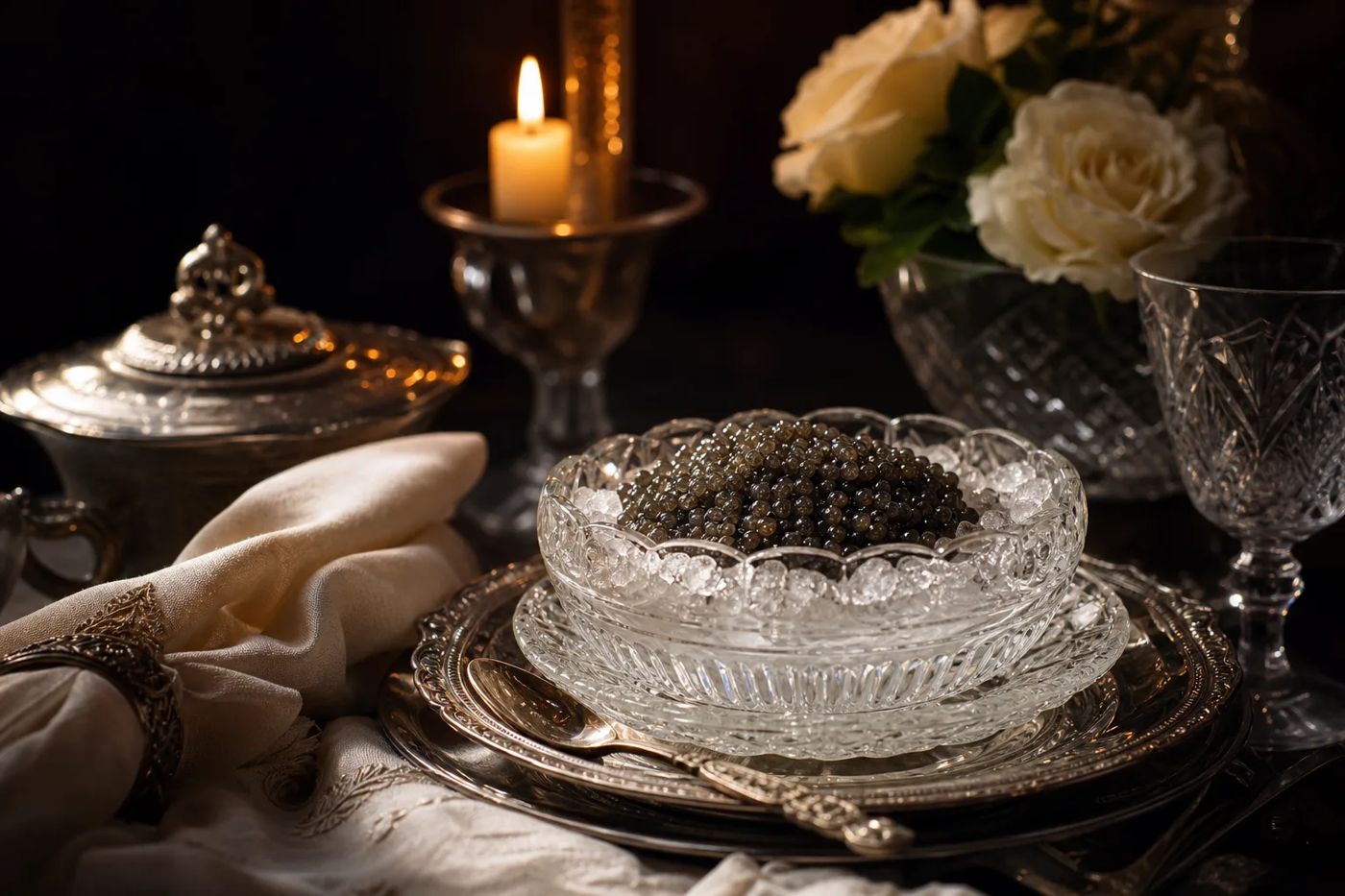
The Garrick menu in Linley Sambourne's 1905 diary gives an even sharper detail: the ice. It lists caviar as a distinct, explicitly chilled opening item, rather than an ingredient in a sauce. Several courses follow. The menu also moved easily between English and French culinary language.
The Savoy's banquet menu opened with beluga caviar and blinis. Nathaniel Newnham-Davis reproduced the menu, supplied by the hotel's management, in The Gourmet's Guide to London. Soups, sole and poultry followed. Caviar began an extended sequence; it was not the whole point of the meal.
The same connection between caviar and grand hospitality reached out to sea. La Cité de la Mer records Titanic survivor Mahala Douglas's recollection of caviar at the ship's à la carte restaurant on 14 April 1912. The record is her testimony, rather than a surviving menu naming the dish. These details reveal both the food and the performance around it. Ice at the Garrick and blinis at the Savoy describe presentation; the procession of dishes describes the shape of dinner. The settings matter, too. A London household, a club, a hotel banquet and a ship's restaurant offer specific glimpses of formal dining, each with its own audience, rather than a single picture of Victorian and Edwardian taste.
Caviar in the UK today
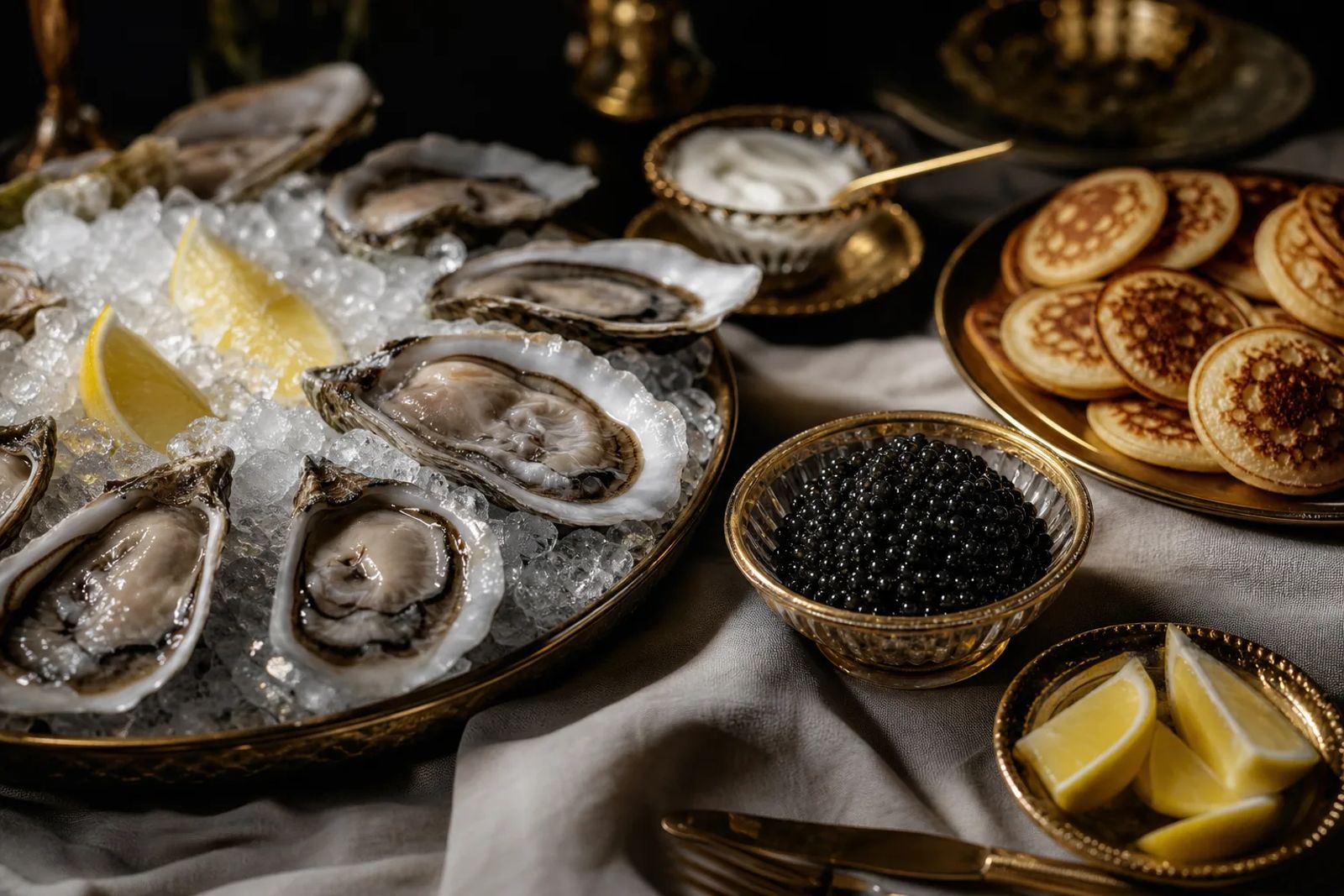
Caviar need not begin a long procession of courses. The Savoy's published events menu of 2022 included an oyster and caviar station with blinis, sour cream and lemon: service organised around a gathering.
Fortnum & Mason's account moves from the station to the sandwich. It dates its earliest reference to selling caviar to 1849 and describes caviar sandwiches among its cocktail party suggestions in the nineteen twenties. The same food could take a very different form.
Across these records, the strongest continuity is the sense of occasion, rather than one fixed British serving style. A small opening dish can make a meal feel like an event. The setting shifts from dining room to reception to home gathering, but that role remains recognisable. For individual venues, turn to caviar bars in London.
Christmas and celebration
Caviar has a documented place on a British festive menu, though it is not a universal Christmas custom. Fortnum's Christmas wine bar menu for 2021 listed it alongside seasonal dishes, including Christmas pudding. Here, caviar appeared within a recognisably British festive selection, rather than in a dining tradition of its own.
There is no need to recreate a hotel banquet at home. Give caviar a clear moment: a separate opening course, a few spoonfuls shared at the table, or a topping assembled just before guests sit down. These are ways to fit it into a celebration, not steps in a national Christmas custom. The guide to caviar for Christmas and New Year covers planning and serving.
Britain's other roe traditions
Not everything called roe is fish eggs. Britain's roe traditions range from smoked cod's roe to whipped dips and soft herring roe, each with a different preparation and place at the table. They deserve attention in their own right, rather than as interchangeable versions of sturgeon caviar.
Smoked cod's roe needs little ceremony. Somerset smokehouse Brown and Forrest suggests spreading its smoked roe on crisp toast or using it for taramasalata. The producer's suggestion gives a straightforward picture of roe eating in Britain: a preserved ingredient, bread, and something ready to eat without the structure of a formal meal.
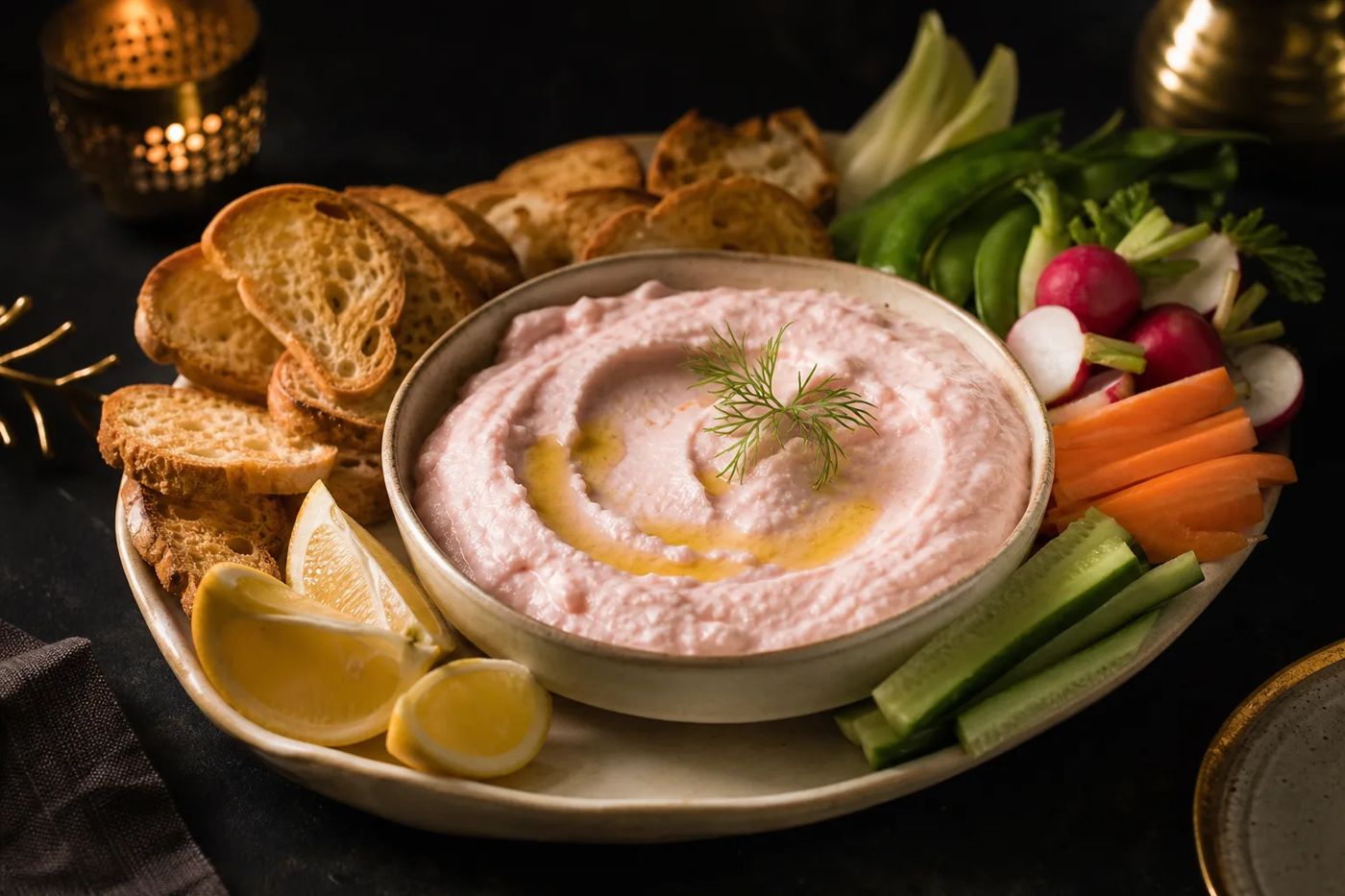
Taramasalata belongs in this British eating story, without recasting it as a British invention. Jamie Oliver's published version combines smoked cod's roe with bread, oil and lemon. Chef Merlin Labron-Johnson has shared a cod's roe version served with seasonal raw vegetables. In both preparations, the roe is blended into a dip rather than served as separate, intact beads.
Soft herring roe is something else again. It is the male fish's testes, which produce milt, the fluid containing sperm. Valentine Warner includes herring milts on toast in The Good Table, recalling his mother making the dish.
Sturgeon farming in Britain
Britain has farmed sturgeon for caviar as well as importing and serving it. Exmoor Caviar describes its beginnings at a Devon farm and now also describes working with partner farms abroad. KC Caviar's published history records a Yorkshire farming venture, a later suspension of trading and a re-established business involving caviar and fish imports.
Those changing histories make the distinction between brand and origin essential. The story of British farming is one thing; the origin of the eggs in a particular tin is another. A British brand name alone cannot establish where they were produced.
Bringing caviar home after Brexit
Check the route and the rules before bringing caviar home. Since 1 January 2021, movements between the EU and Great Britain have been subject to new wildlife trade arrangements.
APHA's personal effects guidance permits up to 125 g (about 4.4 oz) of Appendix II sturgeon caviar per person without CITES permits. It must be carried in personal luggage for personal use, in individually marked containers bearing the required CITES labels. CITES is the Convention on International Trade in Endangered Species. Its label supports traceability, but cannot establish what a container actually holds.
The exemption does not cover Appendix I species, postal imports or commercial imports. Nor does it override national bans or separate food import requirements, so travellers arriving from the EU should check those rules too.
Northern Ireland remains under EU wildlife trade rules. Direct movements with the EU are therefore treated differently from movements with Great Britain. See UK caviar rules for the route and documents involved.
A short timeline
| Date | Documented milestone |
|---|---|
| 1849 | Fortnum & Mason dates its earliest caviar sales reference to this year. |
| 1897 | Marion Sambourne records caviare opening a formal dinner. |
| 1905 | Linley Sambourne records caviare on ice on a Garrick menu. |
| 2012 | Exmoor Caviar Farming Ltd is incorporated, according to Companies House. |
| 2021 | Post-transition wildlife trade arrangements take effect between Great Britain and the EU. |
The 2012 entry marks legal incorporation, not a first harvest. Each record answers a different historical question: Fortnum & Mason offers a retailer's retrospective account, the diaries preserve contemporary dining records, and Companies House supplies an official company record. Together they trace several strands of the story, without giving each kind of evidence identical weight.
Where to go next
- Caviar Around the World: compare Britain's traditions with those of other countries.
Sources
-
The National Archives. Prerogativa Regis. Of the King's Prerogative (temp. incert.), catalogued as 1324, chapter 13, current online text.
https://www.legislation.gov.uk/aep/Edw2cc1317/17/13 -
House of Commons Library. The royal prerogative and ministerial advice, research briefing CBP-9877, online edition retrieved November 2026.
https://researchbriefings.files.parliament.uk/documents/CBP-9877/CBP-9877.pdf -
Folger Shakespeare Library. William Shakespeare, Hamlet, Act 2, scene 2, current Folger digital edition, retrieved 2026.
https://www.folger.edu/explore/shakespeares-works/hamlet/read/ -
Royal Borough of Kensington and Chelsea. Marion Sambourne's diary 1897, archival transcription, undated online edition.
https://www.rbkc.gov.uk/pdf/MAS%201897.pdf -
Royal Borough of Kensington and Chelsea. Linley Sambourne's diary 1905, archival transcription, online version LSH1905v2.
https://www.rbkc.gov.uk/pdf/LSH1905v2.pdf -
Nathaniel Newnham-Davis. The Gourmet's Guide to London, historical text, Project Gutenberg ebook 53304, digital edition 2016.
https://www.gutenberg.org/ebooks/53304 -
La Cité de la Mer. La gastronomie à bord du Titanic, undated online museum article, retrieved 2026.
https://www.mediathequedelamer.com/gastronomie-titanic -
The Savoy. Savoy events menu, edition dated 25 April 2022, “Oysters & caviar” section.
https://dq5r178u4t83b.cloudfront.net/wp-content/uploads/sites/86/2021/08/14152422/25.04.22_Savoy-Events-Menu-condensed.pdf -
Fortnum & Mason. The Fortnum's guide to caviar, undated company historical account, retrieved 2026.
https://www.fortnumandmason.com/stories/fortnums-guide-to-caviar -
Fortnum & Mason. Wine bar Christmas menu, 2021 edition.
https://www.fortnumandmason.com/media/fortnums/blogpost/pdf/Winebar_Christmas__2021.pdf -
Brown and Forrest. Smoked cod's roe, undated producer description, retrieved 2026.
https://www.brownandforrest.co.uk/product/smoked-cods-roe/ -
Jamie Oliver. Taramasalata, online recipe credited to Jamie Oliver's Christmas Cookbook, current online edition retrieved 2026.
https://www.jamieoliver.com/recipes/fish/taramasalata/ -
Merlin Labron-Johnson, via Fine Dining Lovers. Cod's roe and seasonal crudités, chef-supplied recipe, 15 July 2022.
https://www.finedininglovers.com/explore/recipes/cods-roe-and-seasonal-crudites-merlin-labron-johnson -
Valentine Warner. Herring milts (soft roes) on toast, The Good Table, edition identified by ckbk as 2013, online introduction.
https://app.ckbk.com/recipe/good38916c06s001r003/herring-milts-soft-roes-on-toast -
Exmoor Caviar. Home, current company account of its farming origins and international partnerships, retrieved 2026.
https://www.exmoorcaviar.com/ -
KC Caviar. Our journey, current company historical account, retrieved 2026.
https://www.kccaviar.com/kc-journey/ -
Companies House. Exmoor Caviar Farming Ltd, company number 08279519, current register entry, retrieved 2026.
https://find-and-update.company-information.service.gov.uk/company/08279519 -
APHA and Defra. Check if you need a CITES permit to import or export endangered species, current guidance, retrieved 2026.
https://www.gov.uk/guidance/cites-imports-and-exports -
UK Government. Bringing food into Great Britain: overview, current guidance, retrieved 2026.
https://www.gov.uk/bringing-food-into-great-britain/overview -
European Commission. EU wildlife trade reference guide, Annex XIX, rules following UK withdrawal, current online edition retrieved 2026.
https://environmental-data.ec.europa.eu/cites/reference-guide/chapters/annexes_xix.html -
Defra, hosted by the Police Service of Northern Ireland. Businesses and individuals moving CITES items, post-transition guidance leaflet, undated online edition.
https://www.psni.police.uk/sites/default/files/2022-09/Businesses%20and%20individuals%20moving%20CITES%20items.pdf
This piece was researched using contemporary dining records, historical testimony, official legal and travel guidance, published cookery writing and explicitly attributed company accounts.
Last checked: November 2026