
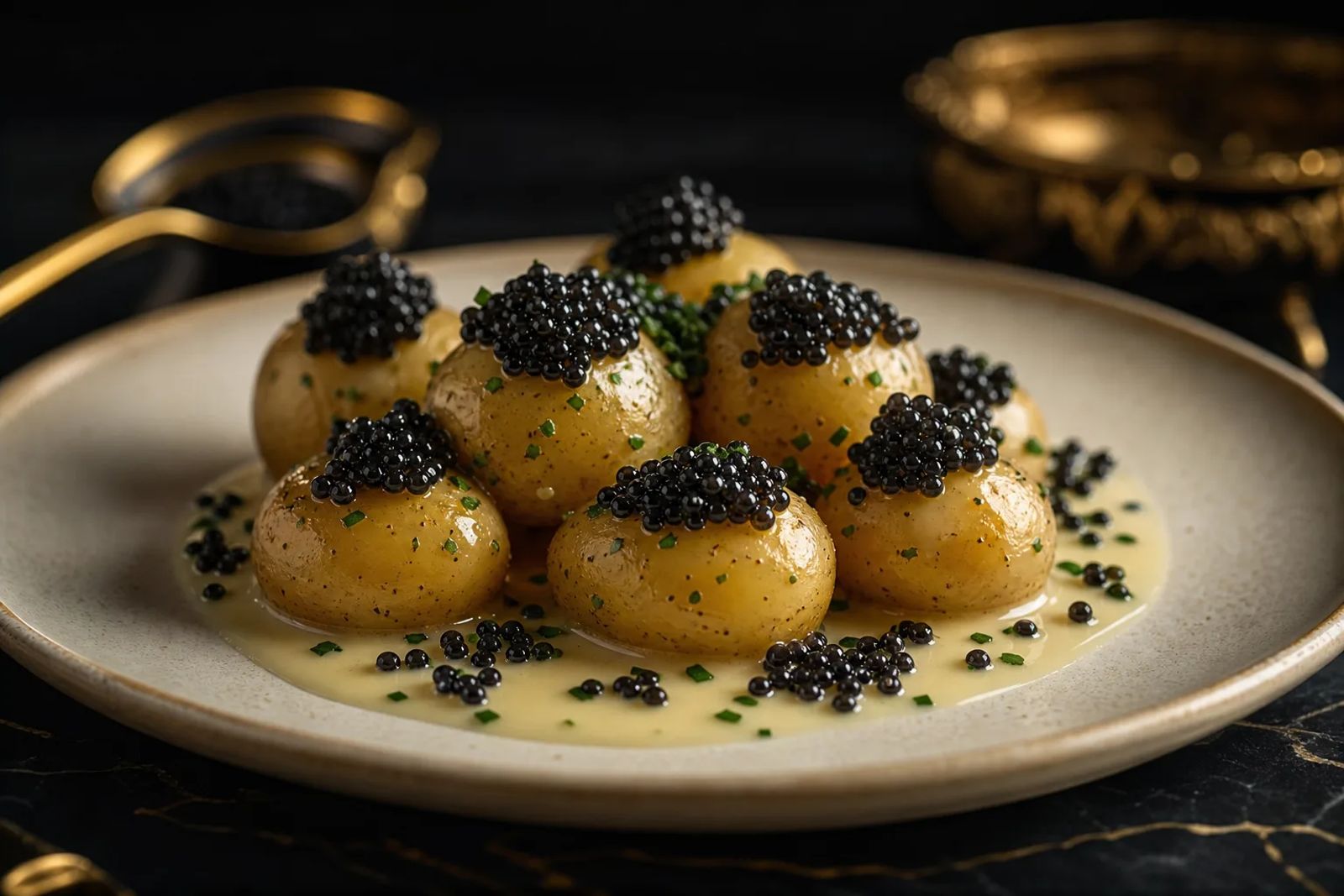
Glossy butter sauce beneath a final spoonful of caviar: in Will Holland's Jersey Royal dish, the roe goes on after plating. That last touch is the key to caviar beurre blanc, a warm French butter sauce finished with caviar just before serving.
First reduce wine, vinegar and shallot. Then whisk in cold butter over very low heat or off the hob. Spoon the caviar over the plated sauce, keeping its contact with the warmth brief.
What makes beurre blanc different
Beurre blanc means “white butter”. The glossy sauce is an emulsion: butterfat dispersed through the liquid rather than floating on top. Unlike the hollandaise used in eggs Benedict and eggs Royale, it contains no egg yolk.
The sauce is usually credited to Clémence Lefeuvre, a cook from Saint-Julien-de-Concelles, near Nantes. The familiar tale has her accidentally leaving the eggs out of a béarnaise. It is an appealing origin legend, but Nantes Métropole's heritage account records competing versions rather than a securely documented accident, placing the sauce's emergence around the turn of the twentieth century.
Why choose the cream-stabilised version?
Cream gives the emulsion extra stability, useful when fish or vegetables also need attention before plating. Le Cordon Bleu's Complete Cooking Techniques uses crème fraîche for this purpose; chef Will Holland uses double cream in his potato and caviar recipe. The sauce below follows Holland's quantities.
That extra tolerance makes this a practical version for a busy hob. Add the butter gradually all the same, and never boil the finished sauce. Cream helps the emulsion hold together; it does not remove the need for gentle heat.
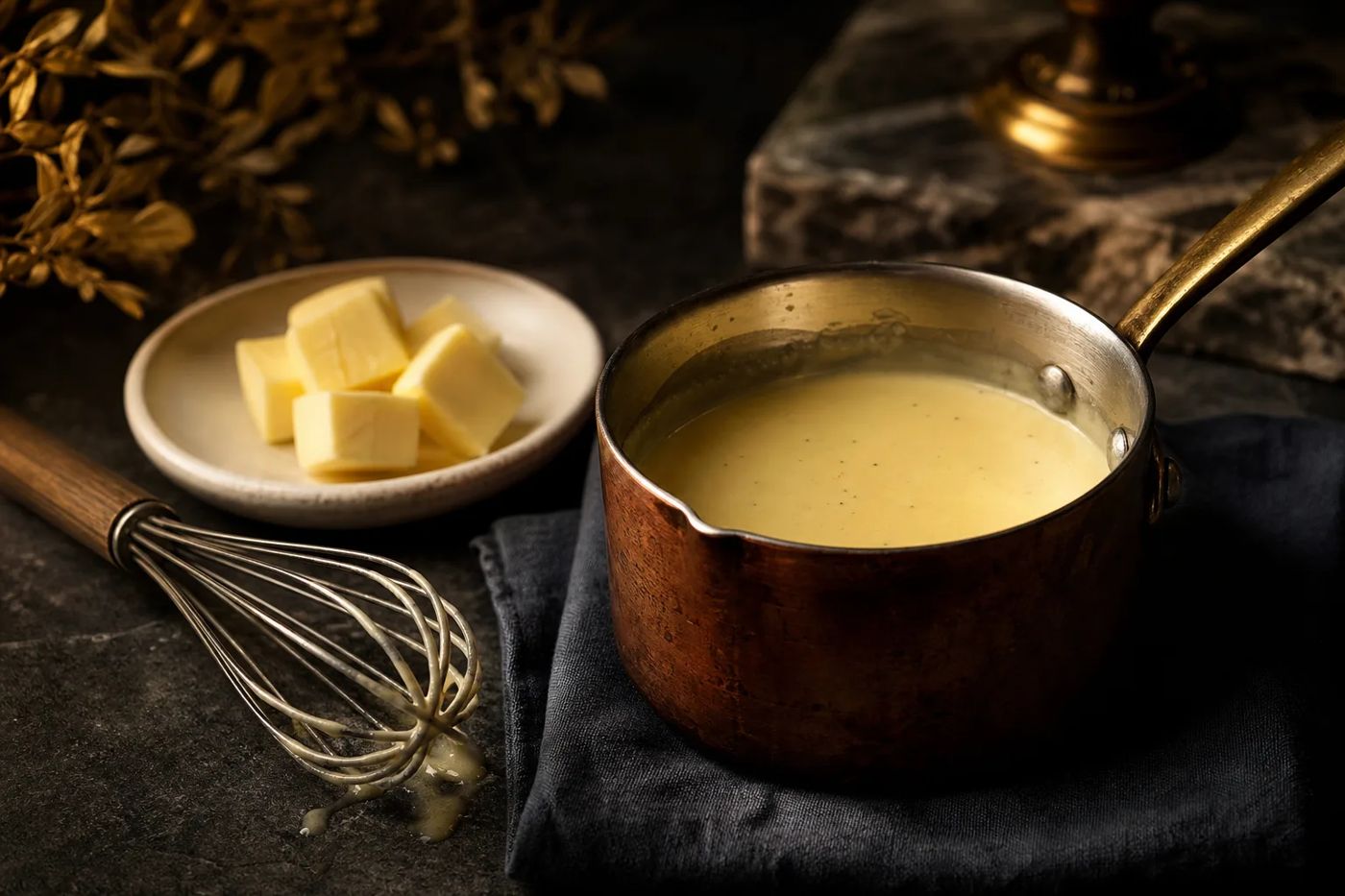
Caviar beurre blanc recipe
Adapted from Will Holland's Jersey Royal recipe, published by Jersey Royal, with the potatoes, lardo and garnishes omitted. The slower, low-heat butter method draws on Great British Chefs; spooning caviar on after plating follows Holland's dish.
- Serves: 4.
- Caviar per person: 7.5 g, the source's 30 g divided by four.
- Time: the source allows 10 minutes' preparation and 25 minutes' cooking for the complete potato dish; it gives no separate sauce-only time.
- Equipment: small heavy-based saucepan, whisk, scales, measuring jug, thermometer and serving spoon.
- Allergens: fish and milk; check wine and vinegar for sulphites.
Ingredients
- 50 g shallot, finely chopped
- 100 ml dry white wine
- 100 ml white wine vinegar
- 50 ml double cream
- 150 g unsalted butter, diced and kept cold
- 30 g (about 1 oz) malossol, or lightly salted, Siberian sturgeon caviar, Acipenser baerii
- Salt, to taste
Siberian sturgeon is the editorial choice here; Holland names a producer, not a species. Keep the roe refrigerated according to the producer's instructions as you make the sauce. Have the accompanying food ready before the final butter additions: once the sauce is finished, plating should follow promptly.
Method
- Reduce the liquids. Put the shallot, wine and vinegar in the saucepan. Bring to the boil and reduce the liquid by half, following Holland's method.
- Add the cream. Pour in the double cream and bring back to the boil. Turn the heat right down before any butter goes in.
- Whisk in the butter. Add the cold cubes a little at a time, whisking continuously. If the butter melts too quickly, move the pan off the hob. Return it briefly to very low heat only when needed to keep the butter melting.
- Finish off the heat. Remove the pan while the last pieces of butter are still visible. Whisk until smooth and glossy, then taste before adding salt.
- Plate and add caviar. Spoon the sauce beside or beneath the cooked food. Divide the caviar between the four plates, placing it on the sauce at the last moment. Serve immediately.
Holding the sauce warm
For a brief pause before plating, French vocational cookery teacher Fabien Marécaut's CAP manual specifies a warm place at 45 to 50°C (113 to 122°F), and explicitly advises against a bain-marie. This is a sauce-quality range, not a guarantee of preserved caviar texture or a food-safety hot-holding instruction.
Keep the caviar out and stir the sauce occasionally. James Beard's recipe warns that excessive heat separates beurre blanc: aim to finish and serve, rather than leave the saucepan waiting through a long meal.
Fold it in or spoon it over?
Spoon it over the plated sauce. Most beads then stay outside the warm liquid until the dish reaches the table, though the warmth can still alter their texture even off the hob.
Folding caviar through gives a different finish, with the beads surrounded by sauce. Chef Mackenson Horebe's published beurre blanc folds the caviar in off the heat, then returns the sauce to low heat. The plated finish used here limits that exposure.
If the sauce splits
Put down the caviar and rescue the sauce first. If it looks oily, caviar seller Beleaev's published beurre blanc advice is to take the pan off the heat and whisk in a teaspoon, about 5 ml, of cool water. This may bring the emulsion back together.
Watch for a uniform sauce, with no clear fat gathering around a watery layer. Finish all the whisking before adding the roe: repairing an emulsion takes much rougher handling than a final caviar garnish should receive.
What to serve it with
Start with white fish. Great British Chefs points readers towards Galton Blackiston's cod with lemon beurre blanc and Matthew Tomkinson's halibut with asparagus. Cook the fish separately, then add sauce and caviar at plating. Keep the finished sauce out of the fish's hot cooking pan.
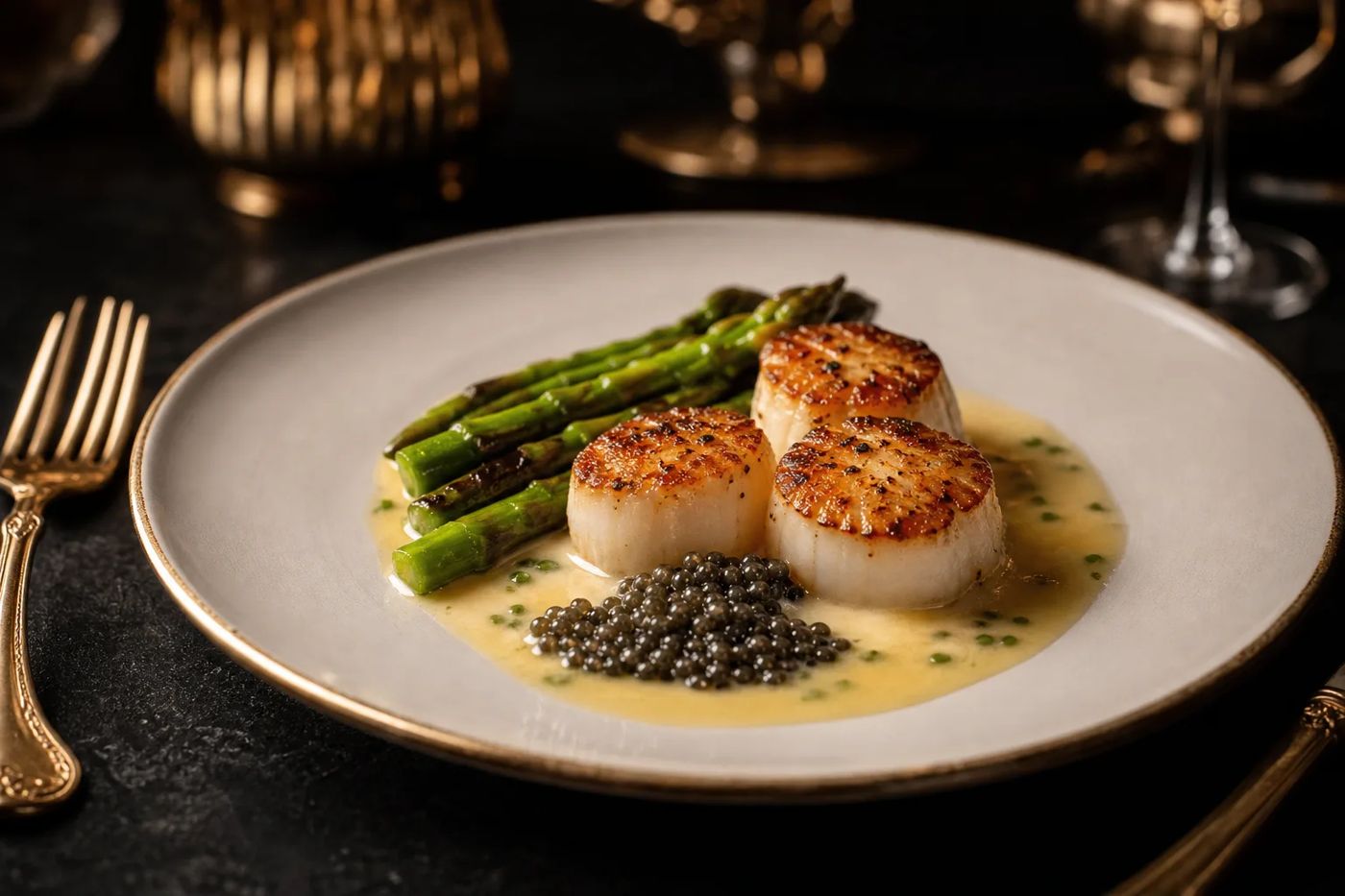
Or turn to scallops and asparagus, which Ross Deutsch serves with beurre blanc and a final caviar topping.For more dishes that leave the caviar to the final spoonful rather than prolonged cooking, browse caviar recipes.
Sources
- Jersey Royal, Will Holland. Jersey Royal Pearls with Chive Beurre Blanc, Lardo, and Caviar by Will Holland. Online recipe, publication year not stated. Source recipe.
- Great British Chefs. How to Make a Beurre Blanc. Online edition, 14 February 2025. Technique and serving suggestions.
- Le Cordon Bleu, Jeni Wright and Eric Treuille. Le Cordon Bleu Complete Cooking Techniques, “Beurre Blanc”. First published 1996; extract reproduced by ckbk. Cream-stabilised technique.
- Lycée professionnel Marc Godrie, Fabien Marécaut; hosted by Académie de Versailles. Les techniques de base de CAP, version 2.0, “Beurre blanc”, page 58. Publication year not stated. Training manual.
- James Beard Foundation. Beurre Blanc. Online recipe, publication year not stated. Butter incorporation and warm holding.
- Nantes Métropole, Patrimonia, Florent Quellier. Beurre blanc. Extract from the Dictionnaire de Nantes, online edition dated 2018. Historical account.
- Loire-Atlantique Tourisme. Le beurre blanc, la mâche et le rhum : les stars de vos repas de fêtes. Online edition, publication year not stated. Attribution to Clémence Lefeuvre and Saint-Julien-de-Concelles.
- StarChefs, chef Mackenson Horebe. Chilean Sea Bass: Creamed Farro, Caviar Beurre Blanc, Shaved Fennel. Adapted by StarChefs, March 2026. Folded-in caviar method.
- Beleaev Caviar & Gourmet. Sea Bass Fillet with Caviar Beurre Blanc. Online recipe, publication year not stated. Commercial seller's advice.
- Ross Deutsch, This Guy Cooks. Seared Scallop w/ Beurre Blanc & Caviar. Online recipe, 3 November 2025. Scallops, asparagus and plated caviar.
This piece was researched from published chef recipes, cookery-school techniques and official regional heritage accounts; the adaptation has not been tested by caviar.uk.
Last checked: November 2026